

The way most chiefs handle attending-resident conflict is backward. They either avoid it until it explodes, or they jump in emotionally and make it worse. You are supposed to be the pressure valve, not more pressure.
You want a chief-level approach? That means you stop reacting like a peer and start operating like leadership. Calm. Structured. Predictable.
Here is the playbook I wish every new chief had on day one.
1. Diagnose the Conflict Before You Touch It
You cannot fix what you have not defined. “They’re just difficult” is not a diagnosis. It is lazy.
There are only a handful of patterns you see over and over. Your first move is to figure out which one you’re dealing with.
| Conflict Type | Core Issue |
|---|---|
| Performance | Competence / safety |
| Professionalism | Behavior / respect |
| Expectation mismatch | Standards / norms |
| Communication style | Tone / feedback |
| System problem | Workload / coverage |
Quick triage questions (ask yourself first)
Before you meet anyone:
- Is patient safety involved? (med errors, unsafe autonomy, refusal to follow orders)
- Is there a clear professionalism breach? (yelling, insults, undermining in front of patients)
- Is this an isolated incident or part of a pattern?
- Is this about one person, or about the system (chronic understaffing, impossible workload, broken workflow)?
- Is there any risk of retaliation or evaluation bias?
If the answer to the first two is “yes,” this is not a casual hallway chat. You treat it like a serious event with documentation and leadership involvement.
What you do first – the 10-minute fact pass
Before you “mediate,” you need basic facts. Not gossip.
- Pull the schedule, patient list, and relevant notes/orders for the time of the conflict.
- Ask the charge nurse or senior nurse on the unit:
“I heard there was tension between Dr X and Dr Y yesterday on rounds. I am trying to understand what happened from a workflow perspective. What did you see or hear?”
Nurses often give you the cleanest, least ego-filtered version. - Check any incident reports or safety event logs if relevant.
You are not building a legal case. You are making sure you do not walk into a conversation blind and get spun by the more charismatic storyteller.
2. Separate Conversations: How to Talk to Each Side
You never start by putting both people in a room. That is lazy facilitation and it often backfires. You meet each person separately first.
Script for the resident meeting
Your tone: calm, direct, no drama.
Your goal: facts, impact, and their internal narrative.
Open cleanly:
“Yesterday there was clear tension between you and Dr Smith on rounds. I want to understand exactly what happened from your perspective so we can address it professionally and protect your learning environment.”
Then:
- “Walk me through what happened from the moment you arrived on the floor.”
- “What did you say? What did they say back? Be specific with words.”
- “What do you think triggered the escalation?”
- “How has this affected your ability to learn or feel safe on the team?”
- “Is this new or part of an ongoing pattern with this attending?”
You will hear emotion. Let it sit for 30 seconds. Then steer back to specifics.
You must also quietly assess:
- Is the resident’s performance actually poor?
- Are they overly sensitive to routine feedback?
- Are they being targeted?
Script for the attending meeting
Your tone: professional peer. Not subordinate. Not aggressive.
Goal: facts, expectations, and their level of insight.
Open cleanly:
“I heard there was significant tension between you and Dr Patel on rounds yesterday. I am talking to both of you to understand what happened and make sure our residents are getting clear expectations and professional feedback while supporting your standards.”
Then:
- “From your perspective, what happened?”
- “What about the resident’s behavior or performance concerned you most?”
- “What is your baseline expectation for a PGY-2 on this service in that situation?”
- “Have you had similar concerns with this resident before?”
- “Have you had similar conflicts with other residents?”
Watch for red flags:
- Global character attacks (“These new residents are all soft.”)
- Minimizing their own behavior (“I just raised my voice a bit; they are too sensitive.”)
- Power flexing (“They need to learn the hierarchy.”)
You are not confronting yet. You are collecting.
3. Classify and Choose the Right Intervention Level
Think like triage. Not every conflict needs a full ethics consult. Some need a quiet five-minute reset. Some need formal reporting.
Here is a simple decision frame.
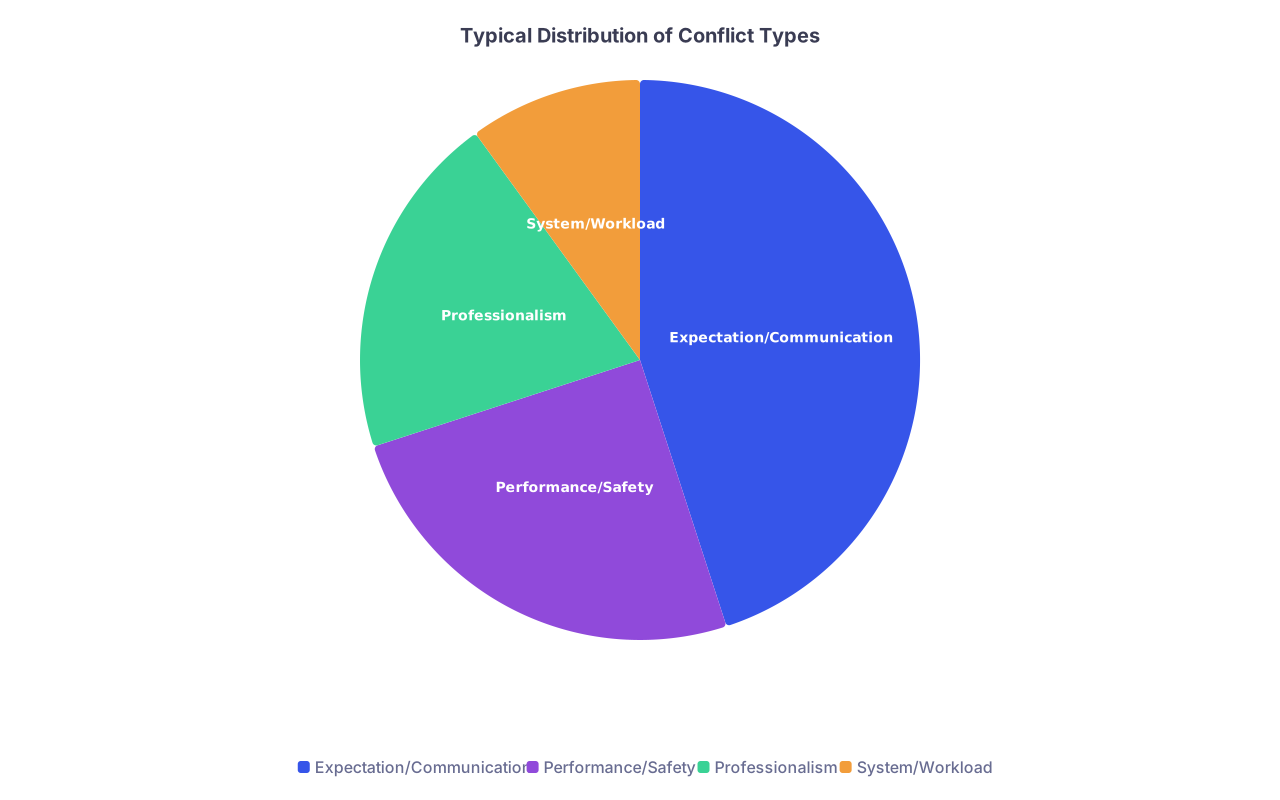
| Category | Value |
|---|---|
| Expectation/Communication | 45 |
| Performance/Safety | 25 |
| Professionalism | 20 |
| System/Workload | 10 |
Level 1 – Miscommunication / Expectation mismatch
Signs:
- Attending: “I expected them to know X.”
- Resident: “No one told me that was the standard here.”
- Frustration but no clear disrespect, no safety issue.
Intervention:
- Clarify expectations on both sides.
- Maybe a brief joint conversation.
- No formal documentation needed beyond your own notes.
Level 2 – Performance or borderline professionalism
Signs:
- Attending: “They ignored critical labs.” or “They rolled their eyes during feedback.”
- Resident: “They embarrassed me in front of everyone.”
- No outright abuse, but emotional impact is real.
Intervention:
- You likely need:
- Specific feedback to the resident (performance).
- Specific feedback to the attending (delivery and professionalism).
- Short documented email to PD or APD summarizing facts and actions.
Level 3 – Serious professionalism / safety
Signs:
- Yelling, insults, threats.
- Sabotaging evaluations.
- Unsafe orders, refusal to supervise, or retaliation.
- Resident appears fearful, not just annoyed.
Intervention:
- Immediate escalation to program leadership / DIO / HR / GME office.
- Written documentation. You are not handling this solo.
- You may need to remove the resident from that rotation.
4. The Chief-Level Mediation Structure (When Appropriate)
Once you have facts and classification, decide if a joint meeting is useful. If yes, you run it like a structured case conference, not a group vent session.
Before the joint meeting
You tell both sides what the meeting is and is not.
To both, separately:
- “Goal: align on expectations and restore a professional working relationship for the rest of the rotation.”
- “This is not a blame session. It is about what happens from today forward.”
- “I will keep the time, keep us on track, and redirect if it gets personal.”
Set a time limit. Usually 30 minutes. No more than 45.
During the meeting – the 4-step structure
You can literally outline it out loud at the start.
Ground rules (2 minutes)
“We will:- Speak about behaviors, not character.
- Avoid interruptions.
- Focus on what happens from here forward.
- If voices rise or it becomes personal, I will pause the meeting.”
Each side summarizes (10–15 minutes total)
You control the order. I usually start with the attending, then resident.Prompts:
- “Briefly describe what happened.”
- “What were you expecting in that moment?”
- “What would you have wanted to see or hear instead?”
Your job: keep them on this incident, not six months of history.
Clarify expectations (10–15 minutes)
You translate.Examples:
- To attending: “So for a PGY-1 on this ICU, your baseline expectation is that they call you for any lactate over 4 rather than just placing orders. Correct?”
- To resident: “You are saying you did not know that was the norm here and were acting on what your prior ICU taught you. Right?”
Then create joint clarity:
- “For the remainder of this month, let us make the standard explicit…”
Concrete next steps and check-in plan (5 minutes)
You close with specifics:- “Starting today, Dr Patel will call for all new pressor starts and lactate >4 before placing orders.”
- “Dr Smith, when you see an issue, you will provide feedback after rounds in a private space.”
- “We will have a 10-minute check-in in 1 week to see how things are going. I will email both of you the summary.”
You are not trying to make them like each other. You are trying to restore a functional working relationship with clear behavioral agreements.
5. Scripts For The Hard Parts
You are going to run into a few predictable problems. Here is how to respond.
When the attending dismisses the resident’s feelings
Attending: “They are too sensitive. This is medicine, not kindergarten.”
You:
“High standards and tough days are part of medicine. Personal attacks and public humiliation are not. We can hold residents accountable and still follow our professionalism standards. I expect both.”
If they push back:
“I am not challenging your clinical expectations. I am being clear about the behavioral standards we hold for supervisors in this program. Those are not optional.”
When the resident wants you to “take their side”
Resident: “You believe me though, right? They are just abusive.”
You:
“I hear that this felt abusive to you. My job is not to pick a side in an argument. My job is to protect your learning environment and ensure you and your attendings follow the same professionalism standards. That means I have to address both behavior and expectations, not just validate one narrative.”
If they feel unheard:
“I believe that your experience was painful and unacceptable to you. That is not in question. What I can do right now is work on the behavior and structure that led here and make sure it does not repeat.”
When either party starts re-litigating every old conflict
Them: “And another thing, three months ago…”
You:
“I want to keep us focused on what we can change right now. If there are recurring patterns that need a deeper review, we can schedule a separate meeting with program leadership. For this conversation, we are addressing this incident and a clear plan going forward.”
6. Documentation Without Burning Bridges
You are not an attorney, but you are foolish if you do not document.
Think of documentation as a neutral clinical note: date, participants, presenting complaint, objective facts, assessment, plan. No drama.
Simple template you can reuse
Subject line: “Summary – Attending-Resident Meeting on [Service, Date]”
Body:
- Date/time:
- Participants:
- Triggering incident (1–2 sentences, factual):
- Resident concerns (bulleted, behavior-focused):
- Attending concerns (bulleted, behavior/performance-focused):
- Shared expectations clarified:
- Resident will…
- Attending will…
- Follow-up plan:
- Check-in date:
- Escalation threshold:
Send to: yourself, PD/APD as appropriate. You do not need to CC half the department unless this is a Level 3 serious issue.
7. When The System Is The Real Problem
Sometimes both people are right and the real enemy is the schedule.
- The attending: “I have 20 patients, 6 consults, and 3 OR cases. I cannot spoon-feed.”
- The resident: “We are cross-covering 40 patients and writing 20 notes a day. I cannot be three places at once.”
They are both drowning. And they are fighting each other instead of looking at the water.
This is where you must zoom out.

| Step | Description |
|---|---|
| Step 1 | Conflict Reported |
| Step 2 | Immediate escalate to PD/DIO |
| Step 3 | Chief fact finding |
| Step 4 | Discuss with PD and service lead |
| Step 5 | Chief mediation |
| Step 6 | Follow up and document |
| Step 7 | Safety or abuse? |
| Step 8 | System issue present? |
Practical levers you actually control as chief
You are not the hospital CEO. But you are not powerless.
You can:
- Swap call nights or redistribute admissions for a struggling team.
- Ask PD to cap admissions when patient safety is clearly threatened.
- Adjust which PGY level is placed on a particularly brutal service next block.
- Standardize a few key expectations service-by-service and send them out before each block (e.g., ICU calls, consult communication, note deadlines).
That “expectations” email before each new rotation is underrated. It prevents a lot of nonsense.
Example, sent 2–3 days before the block:
- “On the VA wards service:
- Rounds start at 7:30 sharp, preround notes due by 7:15.
- All new admissions discussed with attending prior to 10 pm.
- Attending expects all PGY-1s to call for:
- Lactate >4
- New pressor starts
- Transfer to ICU”
This eliminates a huge category of “I assumed they knew.”
8. Protecting The Resident Without Infantilizing Them
You are the chief, not their parent. Your job is to protect their ability to learn and work safely, not to bubble-wrap them from all discomfort.
Where you draw the line
You protect them from:
- Abuse: yelling, insults, harassment, discriminatory comments.
- Retaliation: unfair evaluations after they raised concerns.
- Unsafe supervision: being left alone beyond competence.
You do not protect them from:
- Direct, specific feedback when they missed something important.
- Reasonable workload that feels tiring.
- A demanding attending who is strict but professional.
How to coach the resident through hard but fair feedback
Resident: “Dr X humiliated me. They told me my note was terrible.”
You:
- “What exactly did they say?”
- If it was: “This note is disorganized and leaves out key data. You have to do better.”
You respond:
“That is tough to hear. It is also valid feedback if the note was missing key data. Let’s review your note together and see what they are talking about. Then we can talk about how to ask for feedback in a way that feels more constructive.”
If it was: “Are you stupid? This note is useless.”
You:
- “That crosses a line. We can address the note quality and still keep basic respect. I will speak with Dr X about the language and how that affects your learning.”
This distinction matters. It keeps you credible with both residents and faculty.
9. Building a Culture That Makes Conflict Less Likely
You can spend your entire chief year putting out fires, or you can also reduce the fuel.
A few high-yield habits:
Front-load expectations each block
As I mentioned earlier: short, written expectations for each major service. Not 4 pages. One screen.Regular chief check-ins on high-risk rotations
There are always one or two notorious services. Round on them weekly. Ask:- “How are you and your attending working together?”
- “Any friction I should be aware of?”
Normalize upward feedback
Once a quarter, run a short, anonymous pulse survey:- “Have you experienced unprofessional behavior from faculty in the last month?”
- “Was it addressed?”
Present patterns (not names) at the Clinical Competency Committee or faculty meeting. Patterns get attention.
Close the loop
When you actually fix something, tell people.
“Several residents reported confusion about ICU calling thresholds. We worked with Dr X and Y to create the new guidelines attached here.”
People complain less when they see problems actually being addressed.
10. Advanced Moves For Messy Situations
Some conflicts are sticky. Here are three that show up often and what to do.
Scenario 1: The “legacy” attending everyone fears
Old-school, high-volume, famous surgeon or intensivist. Residents are terrified. PD is cautious.
You will not change their personality. You can:
- Push for small behavioral guardrails:
- Private feedback instead of public humiliation.
- No yelling in front of patients.
- Collect specific examples over time and feed them upward to PD and department chair.
- Protect particularly vulnerable residents by limiting exposure (e.g., new interns, residents who have already had conflicts there).
You frame it as risk management and recruitment:
“If we keep losing residents from burnout on this service, it will impact our recruitment and outcomes. We have to modernize how we supervise, even if we keep our high standards.”
Scenario 2: Resident with repeated conflicts with different attendings
Pattern: different attendings, same complaints.
You do not blame them automatically, but you stop ignoring the pattern.
You:
- Lay out the pattern directly:
“You have had serious tensions now with Dr A, Dr B, and Dr C. That tells me there may be some recurring behaviors on your side we need to work on, even if the attendings were not perfect either.” - Get specific:
- Chronic lateness?
- Defensiveness with feedback?
- Poor communication on call?
- Involve PD early. This may require a formal improvement plan, not just “be nicer.”
Scenario 3: Evaluations used as weapons
Attending blows up at resident. End-of-rotation eval is brutal and out of sync with others.
You:
- Compare evaluations across rotations. Pattern or outlier?
- If it is an extreme outlier and there was conflict:
- Tell PD: “This eval seems contaminated by the conflict. The narrative does not match prior or subsequent performance. Recommend we weigh it cautiously.”
- Long-term:
- Push for more frequent, mid-rotation feedback requirements to reduce “surprise” bad evals.
FAQ (Exactly 3 Questions)
1. When should I bypass mediation and go straight to the program director or GME?
Skip mediation if there is:
- Any allegation of harassment, discrimination, or physical intimidation.
- Clear patient safety risk from inadequate supervision.
- Evidence of retaliation (threats about evaluations, schedule, or career).
Your first duty is safety and institutional policy, not conflict “resolution.”
2. What if the attending refuses to meet with me or dismisses my role as chief?
Do not chase endlessly. Document the refusal and escalate.
“Dr X declined to meet to discuss the resident conflict on [date]. Given the impact on the resident learning environment, I recommend PD or department leadership address this directly.”
If your program tolerates faculty who refuse even basic professional conversations, that is not your failure as chief. That is a leadership problem.
3. How do I support the resident emotionally without becoming their therapist?
Be clear about your lane. You can:
- Listen, validate their experience, and say, “What happened to you was not okay.”
- Help them understand which parts are system or interpersonal and which are performance-related.
- Connect them with formal resources: wellness, counseling, ombudsperson, GME office.
You do not process every trauma in detail. You give them a safe first stop, then help them get to the right level of support.
Open your email drafts right now and create a rotation “expectations template” you can reuse. Send it to yourself and your co-chiefs. That one simple system will prevent half the attending-resident conflicts you are currently firefighting.


