

The fantasy of the endlessly energetic resident leader is a lie. You’re leading while burned out because the system runs on people exactly in your situation.
You’re not broken. You’re in a bad setup. So the question is not “How do I become superhuman?” The question is: How do I lead well enough, safely enough, while my tank is half empty?
Let’s treat this like a call night problem: limited resources, high stakes, no perfect options. You do what works.
1. First Rule: Stabilize Yourself Like You’d Stabilize a Patient
You already know this clinically: unstable patient first, everything else second. Same idea here, but applied ruthlessly to you.
You are burned out if things feel like this:
- You’re snapping at interns over tiny mistakes you used to just fix quietly.
- You stare at the sign-out email and feel physically nauseated.
- You’re forgetting orders you placed 5 minutes ago.
- You go home and lie in bed scrolling, too wired to sleep and too tired to do anything else.
That’s not “just tired.” That’s a system under strain.
The goal is not “fix burnout this month.” Unrealistic. The goal is stabilization: get yourself from “dangerously depleted” to “barely functional but safe and predictable.” From there, you can still lead.
Here’s exactly what to do:
Set a non-negotiable sleep floor.
Decide a hard minimum: maybe 5 or 5.5 hours on average during bad weeks. Not ideal, but real. Then back-calculate.- If you pre-round at 5:30, you need to be asleep by 11:30.
- That means in bed by 11:00.
- That means stop charting in bed. No “I’ll just finish this one note.”
Is this always possible? No. Is it more possible than what you’re currently doing? Yes.
Cut one big energy leak immediately.
Not someday. This week. Examples I’ve watched residents actually do:- Dropping the extra committee they said yes to because “it looks good for fellowship.”
- Stopping the overly detailed “perfect” sign-out formatting and switching to core bullet points.
- Turning off message notifications after 10 pm for anything that is not literally your on-call job.
If you are burned out, your leadership responsibility includes preserving yourself enough to not be unsafe. That outranks impressing anyone.
Use micro-recovery, not fantasy vacations.
You’re not getting a 3-week reset in Bali. You’ll get 3 minutes between admissions.During those 3–5 minute gaps:
- Close the computer.
- Sit, feet flat, slow your breathing for 60–90 seconds.
- No phone. No chart. Just let your brain stop for a moment.
Sounds trivial. It isn’t. When people actually do this 3–4 times per shift, their irritability and cognitive slips drop. I’ve seen it.
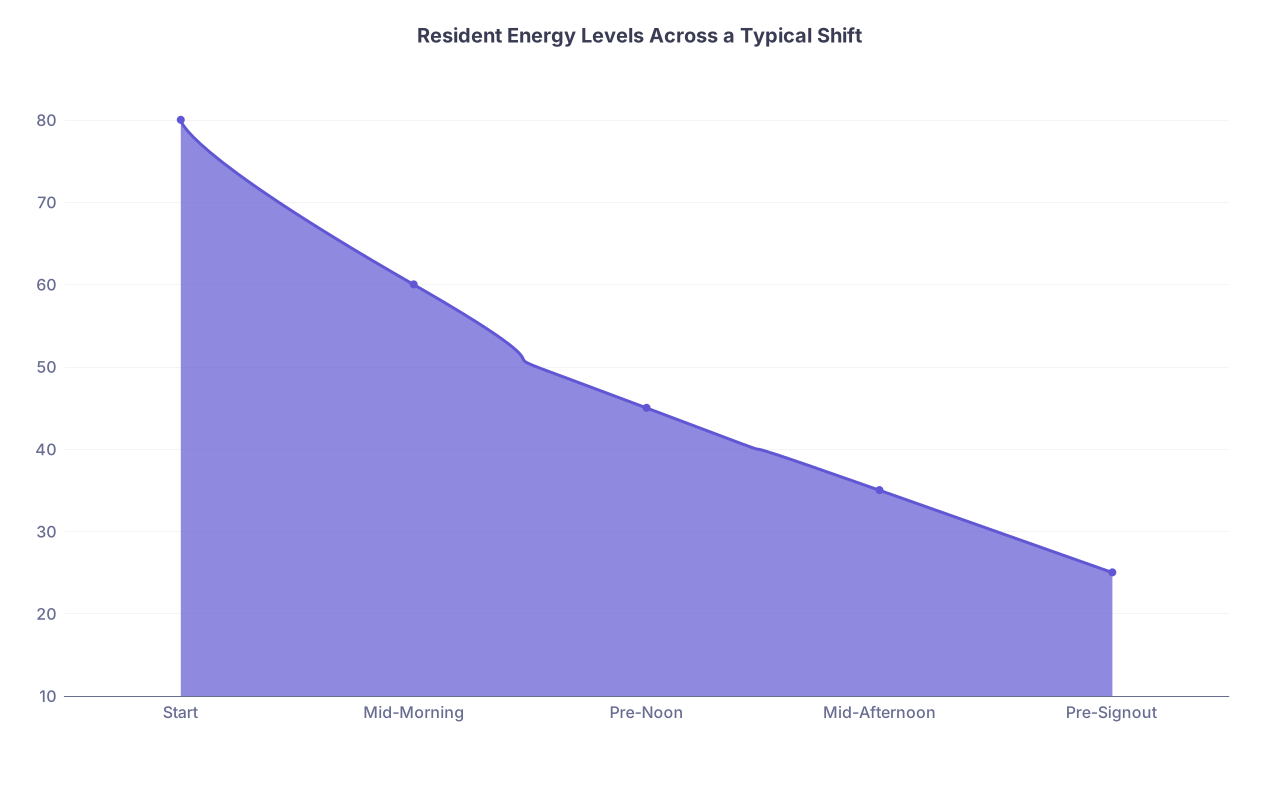
| Category | Value |
|---|---|
| Start | 80 |
| Mid-Morning | 60 |
| Pre-Noon | 45 |
| Mid-Afternoon | 35 |
| Pre-Signout | 25 |
2. Be Honest With Your Team—But Not Messy
Here’s where a lot of burned-out residents screw up: they either fake it (“Everything’s great!”) or they emotionally dump on interns and students.
Both are bad leadership.
You need something in the middle: transparent, contained honesty.
Use language like this:
- “I’m going to be honest: I’m pretty fried this week. So I’m going to lean on you all for attention to detail and communication. If I miss something, flag it. That’s not insubordination; that’s good medicine.”
- “If I sound short today, it’s not about you. I’m tired and behind. If anything I say feels off, check with me.”
- “We are all stretched. Let’s focus on safe, solid care, not perfection.”
This does a few things:
- Lowers the pressure for everyone to pretend.
- Gives them explicit permission to help you lead.
- Prevents your burnout from being misread as anger or disdain.
What you do not do:
- You don’t say, “I hate this program, I hate medicine, I’m dead inside.” That’s venting upward (trusted co-resident, therapist, partner), not downward.
- You don’t make your team responsible for your emotions. They are not your therapists. They’re your colleagues and learners.
If someone asks directly, “Are you okay?“ you can answer like an adult:
“I’m tired and a bit burned out, yeah. But I’m functioning and I care about the team. I’m working on it. If anything I do makes your job harder, tell me.”
Controlled honesty builds trust. Chaotic honesty erodes it.
3. Shrink Your Leadership Job to What Actually Matters
When you’re burned out, your brain wants to do everything badly or nothing at all. Neither works.
Goal: Do less, but do the right things extremely consistently.
Here’s what you must own as a resident leader on fumes:
| Category | Core (Non-Negotiable) | Nice-to-Have (Delay/Drop) |
|---|---|---|
| Patient Care | Safety checks, key orders, plans | Perfect notes, fancy templates |
| Team Management | Clear roles, check-ins, sign-out | Elaborate teaching scripts |
| Communication | Pages, consults, families as needed | Extra family updates you could batch |
| Admin/Education | Required evaluations, key emails | Optional projects, committees |
Your leadership priorities, when burned out, are:
Safety over speed.
- Double-check high-risk meds.
- Read back critical verbal orders.
- Ask, “What could kill this patient today?” and make sure it’s addressed.
Clarity over being liked.
Short, clear instructions beat warm, vague suggestions.- Bad: “Maybe someone can start working on the discharges.”
- Better: “Alex, can you own the TCU discharge? Priya, you take the floor discharge. Touch base with me in 30 minutes.”
Predictability over perfection.
Your team can function around you if you’re predictable. Weirdly, they can’t if you’re a brilliant but chaotic mess.Create small, stable routines:
- Same rounding order whenever possible.
- Same pre-round expectations.
- Same timing for quick check-ins (e.g., “We’ll regroup at 2 pm every day, no matter what.”)
When you are exhausted, you will not suddenly become a charismatic visionary. But you can be clear, consistent, and safe. That’s enough to be a solid leader.
4. Use Your Team as a Force Multiplier (Without Abusing Them)
Burned-out you can’t do everything. So stop trying.
Good leadership in this state looks like delegation with structure, not dumping chaos on your intern and disappearing.
Here’s a practical structure:
Explicitly assign lanes.
On day 1 of a rotation:- “You own all discharge summaries and follow-up appointments. If you’re drowning, say so early.”
- “You own cross-cover issues after 5 pm and call me for anything unstable or you’re unsure about.”
- “You own pre-rounding on these 4 patients. I’ll see them after you and we’ll finalize the plan together.”
Turn your students into value-adds.
Most burned-out residents underuse students, then resent how much work they have.Examples of smart delegation:
- Ask a student to prep a short one-page summary of a guideline relevant to a common case on your list.
- Have them call pharmacies for med histories.
- Let them do focused family updates, then debrief with you.
They learn more by doing. You save brain cycles.
Use your team as cognitive backup.
Say this out loud:- “I’m more forgetful when I’m tired. If I say I’ll do something and you see I haven’t done it in an hour, remind me. That is helping the team, not nagging.”
You are not “using” people. You’re scaling the work across the team in a way that acknowledges your limits and protects patients. That’s real leadership.

| Step | Description |
|---|---|
| Step 1 | Resident Leader Burned Out |
| Step 2 | Define Core Tasks |
| Step 3 | Assign Clear Roles |
| Step 4 | Intern Owns Orders and Discharges |
| Step 5 | Student Helps with Histories and Notes |
| Step 6 | Focus on Safety and Communication |
| Step 7 | Team Huddles and Check Ins |
| Step 8 | Safer Care Despite Low Energy |
5. Protect Your Team From Your Burnout Behaviors
Burnout makes smart people act worse than they are. Short-tempered. Passive-aggressive. Checked out. Sarcastic in ways that land badly.
Your job as a leader is not to “never feel that way.” It’s to not let those feelings consistently hit your team in the face.
Common patterns I see:
- The resident who corrects everything in front of patients, in a clipped, sharp tone, then says, “It’s just efficient.”
- The resident who goes silent and unapproachable after a bad page, so no one wants to bring them problems.
- The resident who makes constant dark jokes about hating life, then wonders why their intern is anxious and demoralized.
Practical fixes:
Pre-commit to your tone.
Before rounds, silently decide: “No matter how tired I feel, I will not raise my voice or roll my eyes at anyone.”
Then if you mess up, you own it quickly:- “Hey, that came out sharper than I meant. You did not deserve that. Let’s reset.”
Have a reset phrase with your co-resident or intern.
Something like: “You seem pretty flooded right now—want 2 minutes?”
Give each other permission to say this. I’ve watched this save multiple exploding relationships.Stop using “humor” as a cover for contempt.
Saying, “This consult is trash” in front of a student teaches them it’s okay to disrespect colleagues.
Saying, “This consult doesn’t answer our question; we need to call them back and clarify” teaches them professional frustration management.
Your burnout is partly not your fault. Your behavior still is.
6. Communicate Upward Before You Fully Crack
By the time a resident tells leadership, “I’m not okay,” they’re usually months past the point where small changes could have helped.
You don’t need a complete plan. You need a clear signal and a specific ask.
How to do it:
Pick one person above you you vaguely trust.
Chief, APD, PD, senior resident—whoever is least likely to dismiss you.Send an email or ask for 10 minutes in person.
Use language like:“I’m functioning, but I’m burned out enough that I’m worried about my effectiveness as a senior. I’m not asking to be pulled from service. I’m asking for help making this sustainable.”
Bring 1–2 concrete asks, not a general complaint.
For example:- “Is there any way to cap my admissions at X this month?”
- “Can I skip one clinic per week for the next month to see a therapist?”
- “Can we adjust my schedule next block so I’m not coming off nights directly into wards again?”
You are not weak for asking. You’re being clinically appropriate about your own functioning. If your PD can’t tell the difference between that and laziness, that’s a program problem, not a you problem.
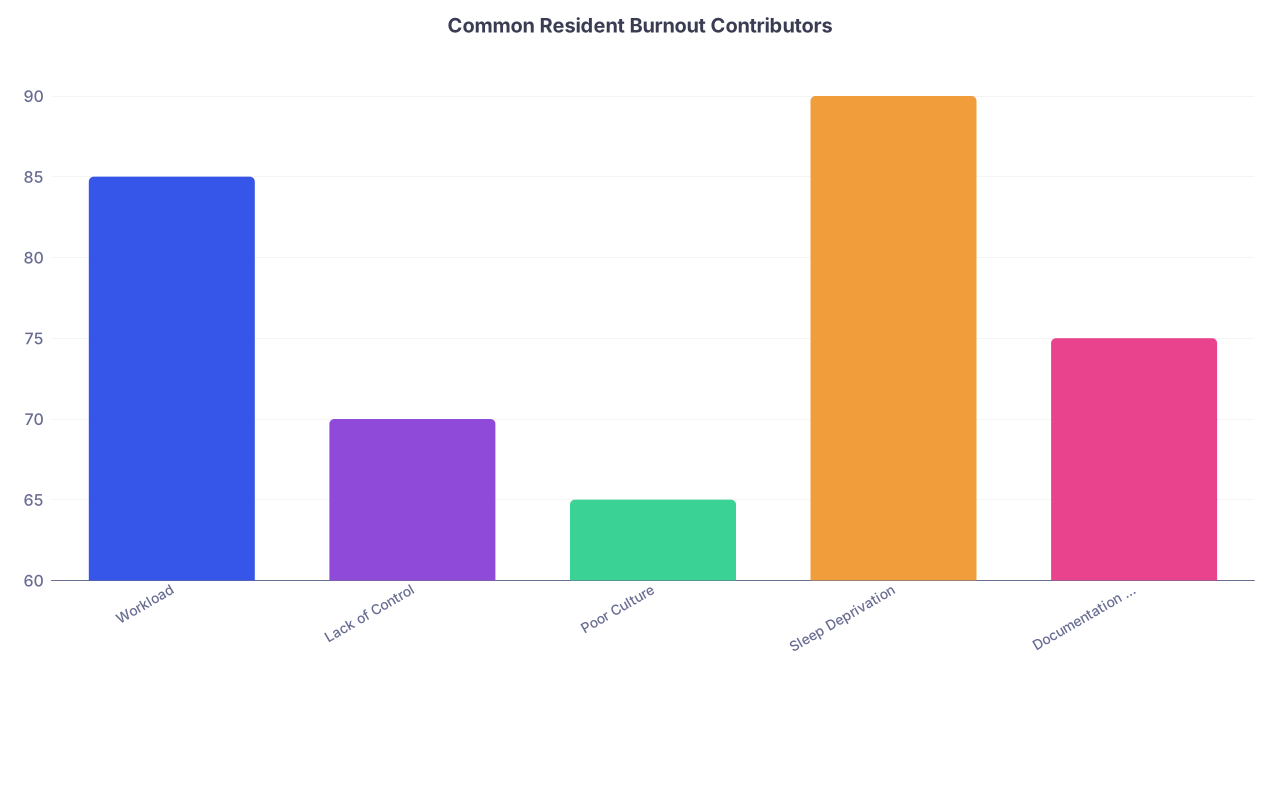
| Category | Value |
|---|---|
| Workload | 85 |
| Lack of Control | 70 |
| Poor Culture | 65 |
| Sleep Deprivation | 90 |
| Documentation Burden | 75 |
7. Teach While Burned Out Without Draining Yourself Dry
You’re told to be a “teacher and role model” even on days when you can barely string sentences together. Fine. So teach differently.
Low-energy teaching strategies that actually work:
Teach in 2-minute bursts.
On rounds, pick one patient and say:- “In 2 minutes, tell me: top 3 causes of X in a patient like this.”
Or - “Before we leave this room, what’s one thing you learned about managing Y?”
That’s it. Tiny. Repeat daily.
- “In 2 minutes, tell me: top 3 causes of X in a patient like this.”
Make them teach you.
You assign:- “Tomorrow, you teach us 3 key points about managing COPD exacerbations. No slides, just 3 takeaways.”
You listen, correct a point or two, move on. You didn’t prepare anything, but the team still learned.
- “Tomorrow, you teach us 3 key points about managing COPD exacerbations. No slides, just 3 takeaways.”
Turn real work into teaching.
- “You’re calling this consult. Draft what you’ll say, then I’ll edit it with you.”
- “You write the first draft of the discharge summary; I’ll show you how I tweak it.”
This costs you almost zero extra energy. You’re doing the work anyway.
Stop thinking of teaching as a 30-minute chalk talk. Think of it as letting them see how you think, in real time, with guardrails. Burned-out you can still do that.

8. Plan Micro-Exits for the Next 6–12 Months
I’m not going to lie and say, “Just hang in there, it gets better.” Sometimes it doesn’t, at least not in the current structure.
What you can do is create micro-exits: small, future-focused decisions that remind your brain this is not forever and you are not trapped.
Examples:
- If you’re a PGY-2 IM resident feeling done with hospital life, start mapping outpatient-heavy careers, or non-clinical options, or less intense subspecialties.
- If you’re a surgical resident buried in malignant culture, quietly explore programs with better reputations in case you need to transfer or pivot.
- Block one protected hour per week—yes, literally schedule it—to work on your CV, fellowship strategy, or non-clinical career exploration.
Burnout feels worst when it feels permanent and pointless. Leadership, even of yourself, means keeping a longer view alive:
“My job right now is to get through this year safely, grow where I can, and not let this system erase who I am for the next decade.”
That perspective alone can slightly reduce the heat.

9. Red Line: When You Should Pull the Emergency Brake
There is “burned out and functioning” and there is “unsafe.” You need to be brutally honest about the difference.
You are approaching or crossing the red line if:
- You are making repeated medication or order errors you never used to make.
- You are having intrusive thoughts about crashing your car, stepping off a ledge, or “disappearing,” even if you wouldn’t act on them.
- You are crying most days before or after work and feel completely numb on shift.
- You are using substances more heavily just to cope or sleep.
At that point, your job is not to “lead effectively while burned out.” Your job is to get yourself out of harm’s way. That might mean:
- Talking to GME or your PD about taking medical leave.
- Seeing a mental health professional urgently.
- Looping in someone you trust outside medicine (sibling, partner, friend) and saying the quiet part out loud: “I am not okay, and I need help making decisions.”
You would never tell a patient in acute decompensated heart failure to “just push through and show resilience.” Do not do it to yourself.

FAQ (Exactly 4 Questions)
1. How honest should I be with my interns and students about my burnout?
Be honest about your state, not your existential crisis. It’s fine to say, “I’m tired and a bit burned out right now, so I may be slower or forgetful—please help me by speaking up.” It’s not fair to unload, “I regret medicine, I hate this program, I’m barely hanging on.” That level goes upward (chiefs, PD, therapist) or sideways (trusted peers), not downward. Your team needs stability, clarity, and psychological safety, not your rawest distress.
2. I’m burned out and feel like a bad leader. Should I stop trying to lead and just focus on survival?
No. You do not get to abandon leadership just because you feel awful—patients and juniors still depend on you. But you absolutely should shrink the scope of what leadership means right now. Focus on: safe care, clear communication, consistent routines, and not taking your stress out on others. Drop the rest. You’re allowed to lead in “minimum viable” mode while depleted.
3. What if my program culture makes burnout worse and nobody seems to care?
Then part of your leadership is strategic: protect yourself and quietly plan your exit ramps. Document clear, dangerous issues; use whatever wellness or GME structures exist; and in parallel, explore future options—fellowship programs with better cultures, different specialties, or even non-clinical paths. You may not be able to fix the culture, but you can refuse to let it define your entire career.
4. How do I know if I need medical leave instead of just better coping strategies?
If your functioning is clearly compromised—frequent serious errors, inability to concentrate, daily uncontrollable crying, persistent thoughts of self-harm or wishing you wouldn’t wake up—you are past the point of “better strategies.” That’s medical territory. You should talk urgently with a mental health professional and someone in leadership you trust about medical leave or schedule modification. Protecting patient safety and your own life is not optional; it’s the top priority.
Key points:
- You can lead while burned out by stabilizing yourself, shrinking your responsibilities to what truly matters, and being transparent but contained with your team.
- Use your team as a multiplier, protect them from your worst burnout behaviors, and communicate upward before you fully break.
- Know your red line. When burnout becomes unsafe, your job shifts from “lead through it” to “get real help and step back if needed.”


