

The fantasy of the flawless chief is a lie.
You are going to screw something up as chief. Maybe in a small way, maybe in a big, obvious, horribly public way that makes your stomach drop and your ears burn. That part is almost guaranteed.
The real question isn’t: “Will I fail publicly?”
It’s: “When it happens, will it destroy me… or just suck for a while?”
Let me be honest: I’ve seen chiefs cry in stairwells, Google “Can I resign as chief?” at 2 a.m., and rehearse apology speeches in the bathroom mirror. I’ve watched people survive brutal, visible failures that felt career-ending in the moment—and later became the story they told on fellowship interviews as their “leadership growth moment.”
So let’s walk through the thing you’re afraid of in disgusting, specific detail and then figure out how you actually cope when everyone sees you fall on your face.
The nightmare scenarios (you’re not the only one imagining these)
Let’s just say the quiet part out loud. The thoughts you’re actually having.
- “What if I mess up the call schedule and someone misses their kid’s surgery?”
- “What if I lose my temper in front of the interns and become That Chief?”
- “What if I freeze when an attending is yelling at me?”
- “What if I back a policy everyone hates and the whole program turns on me?”
- “What if I miss a safety issue and it becomes a patient harm incident with my name on the email?”
You’re not crazy. Those things actually happen.
I’ve seen:
- A chief double-book someone on call for three nights in a row and only realize when the resident started sobbing in the workroom.
- A chief send a snarky text to a co-chief about an attending…and accidentally send it to the group chat with the attending in it.
- A chief forget to submit final rank list suggestions to the PD on time. The PD found out. It was… not pretty.
- A chief mishandle a harassment report and get pulled into GME-level fallout.
Public, visible failures. Gossip-level failures.
Here’s the ugly truth: chief isn’t “resident with a shiny badge.” It’s a role where your mistakes are amplified, replayed, and occasionally immortalized as “remember that year when…”
And you still will not be perfect.
What actually happens right after you fail publicly
The first 24–72 hours after a big visible mistake are usually the worst. Not career-wise. Emotion-wise.
It tends to follow a pattern:

| Step | Description |
|---|---|
| Step 1 | Trigger event |
| Step 2 | Shock and denial |
| Step 3 | Shame spiral |
| Step 4 | Catastrophic thinking |
| Step 5 | Avoidance or overcompensation |
| Step 6 | Conversation with mentor or PD |
| Step 7 | Repair plan |
| Step 8 | New baseline |
Let’s be more concrete.
Step 1: The hit
You:
- see the email from the PD calling your decision “unacceptable,”
- hear the attending say, “This is a chief-level failure,”
- or spot the group chat blowing up with “[Your Name], seriously???”
Physically, you feel it. Tight chest, hot face, hands a little shaky. Your brain jumps straight to, “I shouldn’t have been chief. They picked the wrong person. This proves it.”
Step 2: The internal trial
You go home and mentally prosecute yourself:
- Replay every moment: “If I had just triple-checked that schedule…”
- Rewrite history: “I knew this was a bad idea; why didn’t I listen to my gut?”
- Predict doom: “The PD will never write me a strong letter. I’ll be known as the worst chief of this program.”
This is where people do dumb things:
- Send defensive emails.
- Over-explain in group chats.
- Avoid the PD, co-chiefs, or “injured” residents.
- Over-promise insane fixes (“I’ll personally cover all your calls for the next month”).
Step 3: The “everyone is watching me” phase
You walk into morning report and you’re sure every whisper is about you. Any side-eye feels like judgment. Someone laughs in the corner and your brain goes, “They’re talking about me.”
Reality check: no, not everyone is thinking about you. But some people are. That’s what makes this awful—you’re not wrong that it’s visible.
Here’s where things start to split.
Chiefs who come out stronger:
- Confront it directly.
- Apologize clearly, once.
- Fix what they can.
- Accept that some people will still be pissed.
Chiefs who get stuck:
- Hide.
- Minimize or blame others.
- Pretend nothing happened.
- Or swing to martyr mode and self-destruct.
The part no one tells you: programs expect you to fail at scale
Here’s the twist: programs don’t pick chiefs because they think you’ll never screw up. They pick you because they think you can recover.
You know who doesn’t make a good chief?
- The person who has never been wrong in their life and can’t tolerate feedback.
- The person who disappears the second there’s conflict.
- The person who’s more interested in looking good than fixing things.
Public failure is almost baked into the chief job description. You’re:
- making decisions that affect 20–80 people,
- working with incomplete information,
- balancing resident wellness against service needs,
- and doing all of this while still being a resident yourself.
Of course you’re going to get some of it wrong. Sometimes loudly wrong.
The PDs and APDs have seen this before. They remember the chief who:
- pushed through a deeply unpopular night float change,
- mishandled their first resident–attending conflict,
- or forgot to escalate a safety event fast enough.
Programs don’t keep a secret blacklist labeled “Chiefs Who Screwed Up That One Time.” They pay attention to how you respond.
That doesn’t mean there are no stakes. If you repeatedly:
- ignore feedback,
- hide problems,
- or retaliate when challenged,
then yes, people remember that. But one big public mistake—handled well—rarely ruins anyone.
So what do you actually do when the mistake is out there?
Let’s say the worst has happened. The mistake is clear, other people are aware, your name is attached.
Here’s a practical sequence that doesn’t require you to be some heroic, emotionally regulated Jedi.
1. Triage your own freak-out
You cannot respond well if you’re in full shame spiral.
Bare minimum:
- Name it: “Okay, I screwed this up. It’s out there.”
- Physically reset: 5 minutes alone, slow breathing, drink water, step outside if you can.
- Do NOT immediately email or text a long explanation while your hands are shaking.
Sometimes you literally need to text a trusted friend/co-chief:
“Need 10 minutes. I’m not okay. Will respond after that.”
That delay often saves you from sending something defensive or panicked you’ll regret.
2. Ask the only question that matters at first
Not “How do I save face?”
Not “How do I make them like me again?”
The question is:
“What’s the most urgent harm here, and how do we limit or repair it?”
That might be:
- patient safety,
- resident coverage/fairness,
- trust in leadership,
- or confidentiality.
You don’t need to fix everything in one shot. Just start with the highest-impact damage.
3. Own your part in plain language
People can smell a non-apology a mile away. Don’t do the: “I’m sorry if anyone felt hurt by the schedule changes…”
Try something like:
- “I missed X, and that directly led to Y. That’s on me.”
- “I didn’t loop you in when I should have. That was my mistake.”
- “I prioritized the wrong thing here—coverage over your well-being—and I get why you’re upset.”
Short. Clear. Specific.
You are not groveling. You are taking responsibility.
4. State what you’re doing next (and then actually do it)
People care less about your emotional journey and more about: “So…now what?”
Examples:
- “For this month, I’ve fixed the call schedule by doing A, B, and C. Going forward, I’ll have a second person double-check before it goes out.”
- “I’ve spoken with the PD and GME about the incident. Here’s the process from here. I’ll update you by Friday with next steps.”
- “I’ll be running a brief debrief next week to hear concerns and suggestions. You’re not required to come, but if you want to weigh in, that’s the forum.”
This is where most chiefs underperform—they apologize emotionally but don’t build a system to prevent repeat failures.
The ugly truth about what people actually remember
You’re scared you’ll be “that chief who blew it.” Totally fair.
But when you look at actual program memory, it’s more nuanced.
| Chief Behavior | How People Remember It |
|---|---|
| Big visible mistake, handled well | Respected, “human, but solid” |
| Few mistakes, but distant/rigid | Competent but not well liked |
| Defensive after errors | Hard to trust, “blame shifter” |
| Invisible, avoids decisions | Forgettable, weak leadership |
| Admits fault and fixes patterns | Trusted, “one of the good ones” |
Residents care far more about:
- whether you were fair,
- whether you tried to protect them when it counted,
- whether you were honest when things went sideways,
than about whether you ever messed up a MUE deadline or asked someone to cover an extra Sunday by accident.
Your bar is not perfection. It’s repairability and honesty.
The scarier “public failures” that live in your head
There’s the obvious stuff (scheduling disasters, angry emails from attendings). But I know the quieter fears too:
- “What if I fail publicly at giving feedback—like I make someone cry or destroy their confidence?”
- “What if a junior resident goes to the PD saying I was unsupportive or unfair?”
- “What if I try to stand up for wellness and get labeled as ‘unprofessional’ by faculty?”
Those are real risks. Especially in medicine, where culture is… slow to change and often hypocritical.
Here’s a harsh line I’ll draw: you will not survive chief year with your integrity intact if your goal is, “No one is ever upset with me.”
Sometimes:
- Protecting a struggling intern means pissing off a fellowship-bound senior who thinks they’re carrying extra weight.
- Pushing back on toxic behavior means an attending decides you’re “difficult.”
- Being honest in CCC means a co-resident feels betrayed.
These also feel like “public failures” because the story being told about you isn’t the one you want.
The only way through is deciding what kind of failure you’d rather live with:
- Failing in the eyes of people who wanted you to stay silent.
- Or failing in your own eyes because you stayed safe and watched others get hurt.
That’s a brutal sentence, but it’s the actual job.
When the failure is ethical or clinical, not just logistical
Let’s go darker, because your brain already is.
What if:
- a patient is harmed after a systems issue you knew about but didn’t escalate aggressively enough?
- you sat on a report of discrimination because you “wanted more details,” and now GME is involved?
- your documentation or sign-out contributed to a serious event?
This is where your mind goes to: “I should lose my license. I shouldn’t be a doctor.”
Here’s what I’ve seen help people survive this level of failure:
Radical, specific honesty with a mentor
Not “I made a mistake.”
But: “I did X, didn’t do Y, and it led to Z. I’m scared this means I’m not safe to practice.”
Someone senior needs the full, unfiltered version, not the neat one.Participation in the actual review process
Root cause analysis, M&M, safety meetings.
Do not disappear. Do not hide behind carefully lawyered non-answers.
Show up, say what you did wrong, and actually listen to the system changes.Long-term behavioral change
I don’t mean generic “I’ll be more careful.”
I mean: new handoff structure, new fail-safe checks you personally use, new escalation habits.
You won’t feel “redeemed” right away. You might practice for months with a quiet background hum of “I’m dangerous.” Getting supervision, talking in therapy, and collecting evidence of changed behavior is how people dig out of that hole.
You are allowed to be a chief who learns in public
The myth you’re fighting is: “Once I’m chief, I should already know how to do all of this.”
No. Chief year is basically a forced, high-speed curriculum in:
- conflict,
- systems,
- power dynamics,
- moral distress,
- and visible imperfection.
You’re not learning in a classroom. You’re learning in the middle of a living, breathing hospital where actual people rely on you.
So yes, when you fail, they see you.
But they also see:
- whether you show up the next day,
- whether you quietly fix things without bragging or blaming,
- whether you keep advocating for them even when you’re embarrassed or tired.
Residents can smell when a chief is fundamentally on their side. One public failure doesn’t erase that. Ten defensive, ego-protecting responses might.
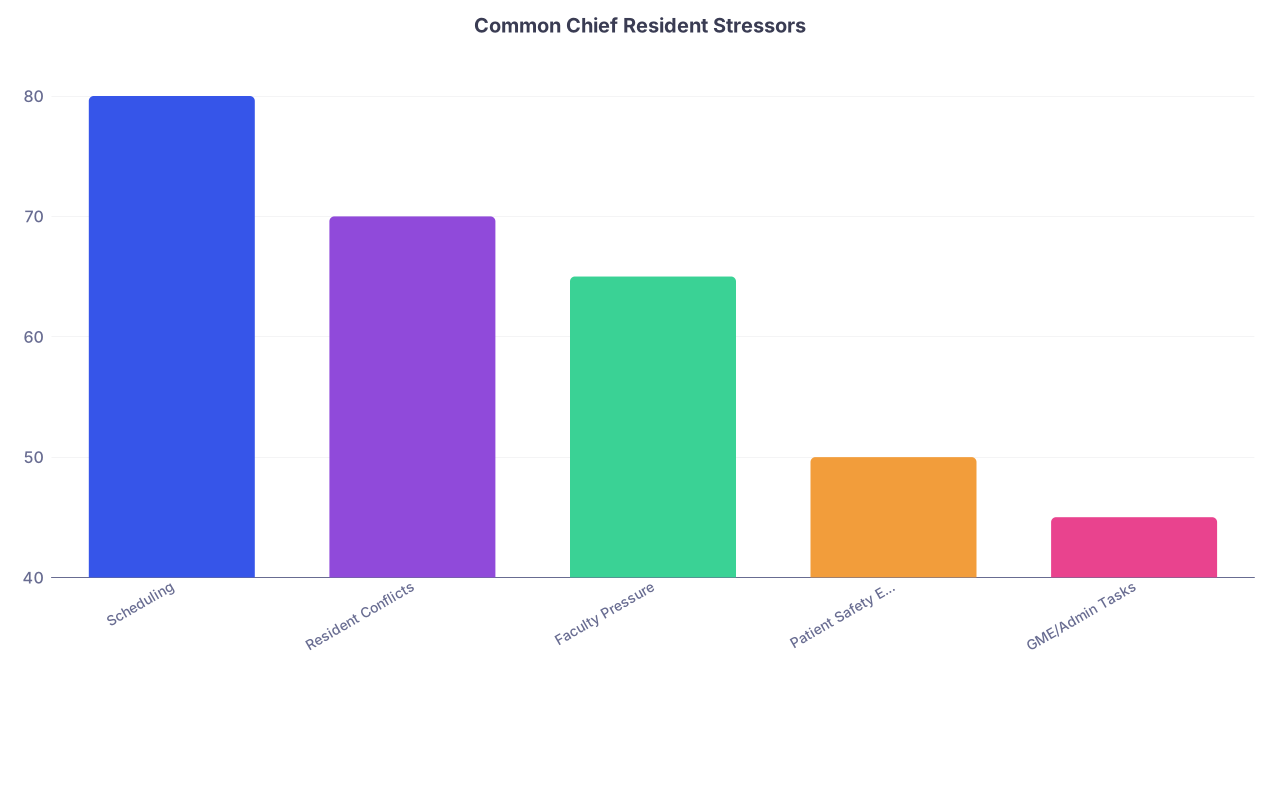
| Category | Value |
|---|---|
| Scheduling | 80 |
| Resident Conflicts | 70 |
| Faculty Pressure | 65 |
| Patient Safety Events | 50 |
| GME/Admin Tasks | 45 |
Practical mindset shifts so the fear doesn’t eat you alive
A few blunt reframes that help when you’re up at 1 a.m. catastrophizing:
“If I fail publicly, that means I shouldn’t have been chief.”
No. It means you’re doing work with consequences. The only people who never fail publicly are the ones who never step up.“Everyone will think I’m incompetent.”
People will think: “They’re human.” Then, based on your response, they’ll decide: “Can I trust them with hard things?”“This will define my career.”
Most of your future colleagues won’t even know you were chief, much less that you messed up that one schedule or that one policy. What does follow you is your pattern: honest, avoidant, vindictive, or resilient.“If I admit I was wrong, I’ll lose authority.”
In medicine, owning your mistakes clearly is actually rare. It often increases your credibility, because people relax. They know you won’t gaslight them when something goes wrong.

Very concrete “if this happens, do this” scenarios
Because abstract reassurance only goes so far.
Scenario: You botch the schedule and multiple people get unfair call
Do:
- Acknowledge the error in a short email/Slack:
“I missed X, which led to Y. That’s on me.” - Show the specific fix:
“I’ve adjusted A, B, C. If this still misses something, tell me by [time] and I’ll rework.” - Implement a new safeguard:
“Going forward, co-chief will double-check coverage before we release.”
Don’t:
- Argue that “it wasn’t that bad” or “well, last year’s chiefs did worse.”
- Guilt-trip: “You have no idea how hard this is for me.”
- Punish complainers by giving them worse shifts later.
Scenario: An attending calls out your decision in front of others
Do:
- Stay neutral in the moment: “I hear your concern. I’ll review this and circle back.”
- Follow up 1:1 later with the attending and your PD if needed.
- If you were wrong, circle back to the team: “After discussing with Dr. X, I realized my call was off here. Thanks for bearing with that.”
Don’t:
- Start defending yourself in real time in front of everyone with a shaky, over-explained speech.
- Throw residents under the bus: “Well they asked for this!”
Scenario: A resident publicly says you’re unfair or unsupportive
Do:
- Validate the emotion publicly, handle the details privately.
“I can see this feels unfair. Let’s talk after rounds so I can understand better.” - This shows you’re not silencing them, but also not litigating policy in front of everyone.
Don’t:
- Snap back: “You have no idea how much I do for you.”
- Try to get everyone else to side with you in the moment.
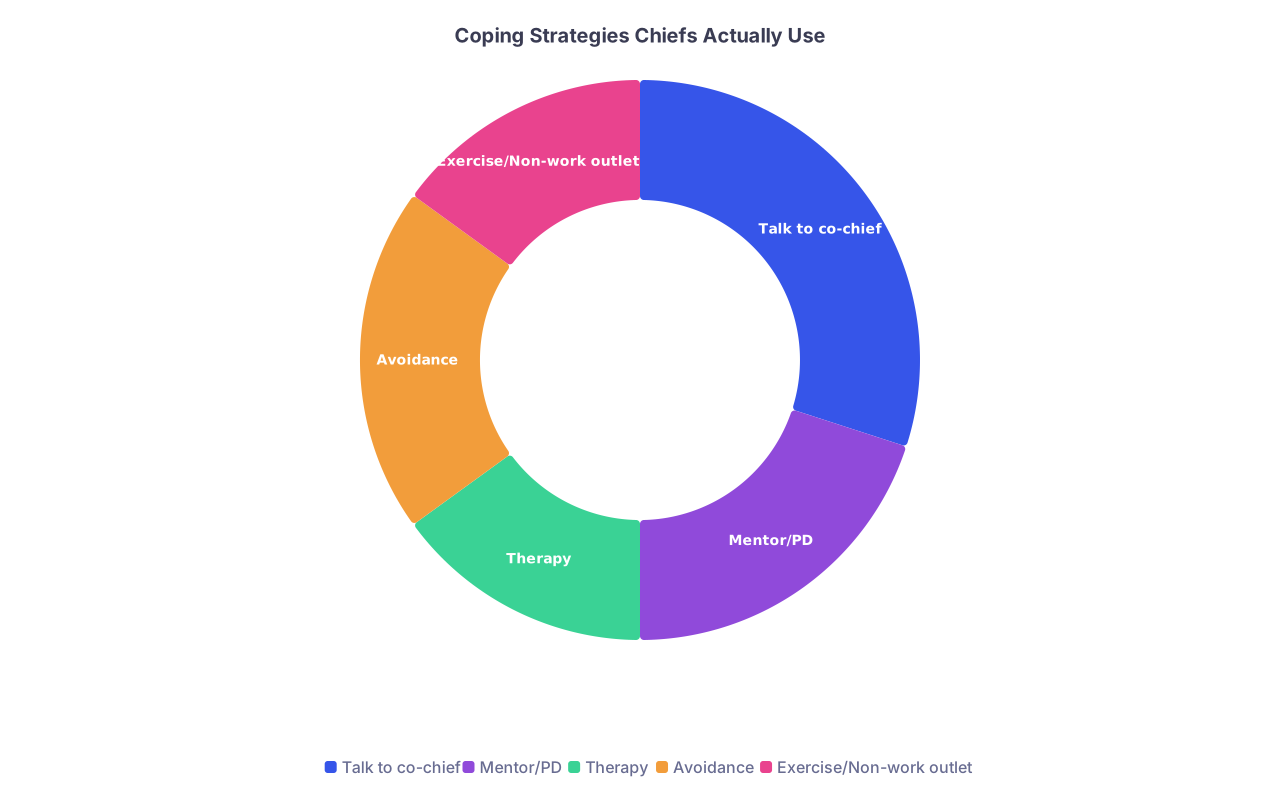
| Category | Value |
|---|---|
| Talk to co-chief | 30 |
| Mentor/PD | 20 |
| Therapy | 15 |
| Avoidance | 20 |
| Exercise/Non-work outlet | 15 |
FAQ: The questions you’re scared to ask out loud
1. Can one big public mistake actually tank my fellowship chances?
Very rarely. What hurts fellowship more is a PD who thinks:
- you’re dishonest,
- you blame others,
- or you crumble under pressure.
If your PD can say, “They had a tough chief year, made some visible mistakes, but handled them with maturity and integrity,” you’re fine. Programs know chief is messy. They often like applicants who have been through fire and are still standing.
2. Should I still rank chief high if I’m this afraid of public failure?
If this fear is paralyzing, but you also care deeply about culture, fairness, and your co-residents, you might actually be exactly the kind of person who should be chief. People who feel the weight of their decisions usually do less harm than people who assume they can’t screw up. The key is having support—co-chief, PD, mentor, maybe therapy—locked in from the start.
3. What if my co-residents genuinely don’t forgive me for something?
Sometimes they don’t. Some people hold grudges. Some are dealing with their own burnout and use you as the nearest punching bag. Your job is not to force forgiveness. Your job is to:
- be transparent,
- be consistent,
- and not let guilt push you into unfair decision-making later.
You’re allowed to accept, “Yeah, some people didn’t like my chief year. I still did my best with the information and resources I had.”
4. How do I know if I’m actually not cut out for chief and this isn’t just anxiety?
Anxiety says: “If I can’t do it perfectly, I’ll die.”
Reality says: “I will mess up, but I can repair, learn, and ask for help.”
You’re probably not cut out for chief right now if:
- you refuse all feedback,
- you shut down completely in conflict,
- or you’re more invested in being liked than being fair.
But if you’re just scared because you care a lot and you hate the idea of hurting people? That’s a decent starting point. Get honest with a mentor who knows you and your program culture, and ask them straight: “Do you think I’d grow in this role or get crushed by it?”
Three things to walk away with:
- You will fail publicly as chief. That’s not disqualifying; it’s part of the job description.
- What people remember isn’t the failure—it’s how you respond, repair, and show up afterward.
- You don’t have to be flawless to be a good chief. You just have to be honest, fix what you can, and keep choosing integrity even when it’s humiliating or hard.


