

The culture of “see something, say something” in medicine is a lie if no one protects the person who actually says something.
That’s what keeps looping in my brain when I think about speaking up about patient safety as the only one who seems worried. Because it’s not just about “doing the right thing.” It’s: will this ruin my reputation, my evals, my fellowship chances, my whole career?
You’re probably here because you’ve seen something that doesn’t sit right. Or you’re terrified you will see something and you’ll freeze. Or worse—you’ll say something and everyone will turn on you.
Let’s walk straight into that fear instead of pretending it’s not there.
The Nightmare Scenarios We Don’t Say Out Loud
Let me just name the stuff that plays on repeat at 2 a.m.:
- What if I speak up and the attending thinks I’m accusing them?
- What if the nurse gets mad and stops helping me?
- What if I’m wrong and I look stupid and dramatic?
- What if people label me “not a team player,” “difficult,” or “overly anxious”?
- What if this gets back to the PD and it quietly tanks my career?
You’re not crazy for thinking any of that. I’ve watched residents get:
- Rolled eyes and sighs when they question orders.
- “Feedback” like “needs to trust the team more” or “less anxious about minor issues.”
- Frozen out of informal teaching because they’re “too intense.”
And at the same time? You’re told in orientation: Speak up. We value safety. We have a just culture.
Cool. But when it’s 3:17 a.m., you’re PGY‑1, the ICU attending is known to be explosive, and you’re staring at an unsafe heparin order in the chart… “just culture” feels theoretical. Your name and your future do not.
You’re Not Actually the Only One Who Sees It (You’re Just the Only One Saying It)
This is the part that messes with your head: you feel isolated, but you’re usually not alone in noticing.
I’ve seen this exact dynamic too many times:
- The intern quietly worries.
- The nurse is clearly uncomfortable but doesn’t want to fight the attending.
- The pharmacist has “suggested” an alternative dose.
- The senior is uneasy but tired and wants to avoid conflict.
And then when something goes wrong, suddenly everyone says, “Yeah, I had a bad feeling about that.”
So if you feel like “the only one,” it’s often because:
- You’re the farthest down the hierarchy.
- You’re the easiest to ignore.
- You’re the one with the least political capital.
- You’re the one still naive enough to think “But… safety?” should be enough.
You’re not the only one who sees the problem. You’re the only one still holding onto the belief that it’s worth risking something to fix it.
That doesn’t make you naive. It makes you the kind of clinician we pretend we value.
The Real Risks: Career, Culture, and Being “That Resident”
I’m not going to sugarcoat this: speaking up is not risk‑free.
Let me lay out the practical risks, not the brochure version.
| Scenario | Short-Term Risk | Long-Term Risk |
|---|---|---|
| Speak up, you’re right | Awkward conflict | Possibly labeled “difficult” |
| Speak up, you’re wrong | Embarrassment, trust hit | Reputation as “anxious” |
| Stay silent, no harm | Emotional guilt, rumination | Reinforce unsafe culture |
| Stay silent, bad outcome | Moral injury, possible investigation | Lasting shame, burnout risk |
If you’ve ever watched an M&M where everyone politely avoids naming the power dynamics, you know: the emotional fallout of staying silent can be worse than the fallout of speaking up. But that doesn’t mean it feels that way in the moment.
There are three big fears that drive most of our paralysis:
Fear of retaliation.
Bad eval comments. Less support. Lost opportunities. The classic, “You’re not a good fit for our culture.”Fear of humiliation.
You misinterpreted something. You didn’t know some obscure detail. Everyone remembers that time you “overreacted.”Fear of standing out.
Medicine rewards people who blend into the hierarchy. Being the only one pushing back feels like painting a target on your back.
You’re not wrong to weigh those. You should weigh them. You just can’t let them completely override patient safety every time. That’s how you become numb and bitter by PGY‑3.
How to Speak Up Without Setting Yourself on Fire
You know all the slogans—SBAR, graded assertiveness, “CUS” (Concerned, Uncomfortable, Safety issue). They sound great in workshops with laminated cards and catered lunch.
But what do you actually say when you’re terrified and your heart is pounding?
Here’s what I’ve seen actually work on real wards with real humans who have egos and tempers.
Step 1: Start small, specific, and humble
Don’t go in with, “This is unsafe.” Go in with curiosity and specifics.
Try something like:
- “Can I run something by you? I’m worried I’m missing something.”
- “I’m probably overthinking this, but I’m a little concerned about X because of Y. Can you help me understand?”
You are:
- Inviting explanation.
- Showing you know you’re junior.
- Still putting the issue on the table.
It’s a way of saying, “Something feels off,” without throwing a grenade.
Step 2: Anchor it to the patient, not the person
People get defensive when they feel accused. They get less defensive when you keep it about the patient.
Instead of:
“You’re giving too much insulin.”
Try:
“I’m worried this insulin dose might drop his sugars too low, since he hasn’t eaten all day. Could we review it together?”
The subtle message: “I care about the patient,” not “You made a mistake.”
Step 3: Use escalation language only when needed
If you still feel uneasy and you’re not getting traction, then you level up.
That’s when you use the actual safety words:
- “I’m uncomfortable with this plan because I think it could harm the patient.”
- “I’m worried there’s a safety issue here.”
- “I need to clearly state I think this is unsafe.”
Say it calmly. Slowly. One time clearly. People remember tone more than words.

You’re Allowed to Not Do Unsafe Things
Here’s the part nobody writes down in the handbooks: You are not obligated to carry out something you believe is truly unsafe just because you are junior.
If you are at that sick-to-your-stomach point, you can say:
- “I’m not comfortable entering that order myself, but I understand if you’d like to enter it.”
- “I can’t personally perform that procedure without support because I don’t feel it’s safe for the patient.”
Yes, that’s scary. Yes, that may cause friction. But if you think about worst‑case scenarios, then be consistent: one worst‑case is a bad eval; another worst‑case is serious harm to a patient with your name in the chart.
I’ve seen attendings eventually respect this. I’ve also seen some roll their eyes. But I have never seen a program director say, “I wish our residents cared less about safety.”
They might wish you packaged it more politically, sure. Which is why wording matters.
When the Culture Is the Problem (and Not Just One Order)
Let’s be real: sometimes it’s not a one‑off bad call. It’s a whole culture that treats shortcuts and near‑misses as “part of the game.”
Things like:
- Nurses apologizing for “bothering” doctors about critical labs.
- Residents joking about “riding the line” of unsafe staffing.
- Attendings openly mocking “safety culture” or Epic alerts.
- Leadership only talking about safety after something blows up.
That’s when being “the only one” feels not just lonely, but pointless.
Here’s where you have to differentiate:
Acute safety risk: individual patient, right now
→ You act. You speak. You escalate if needed.Chronic safety culture problem: patterns, units, people
→ You document. You use systems. You recruit allies.
Hospitals love dashboards. That means numbers and patterns actually get attention in ways one complaint doesn’t.
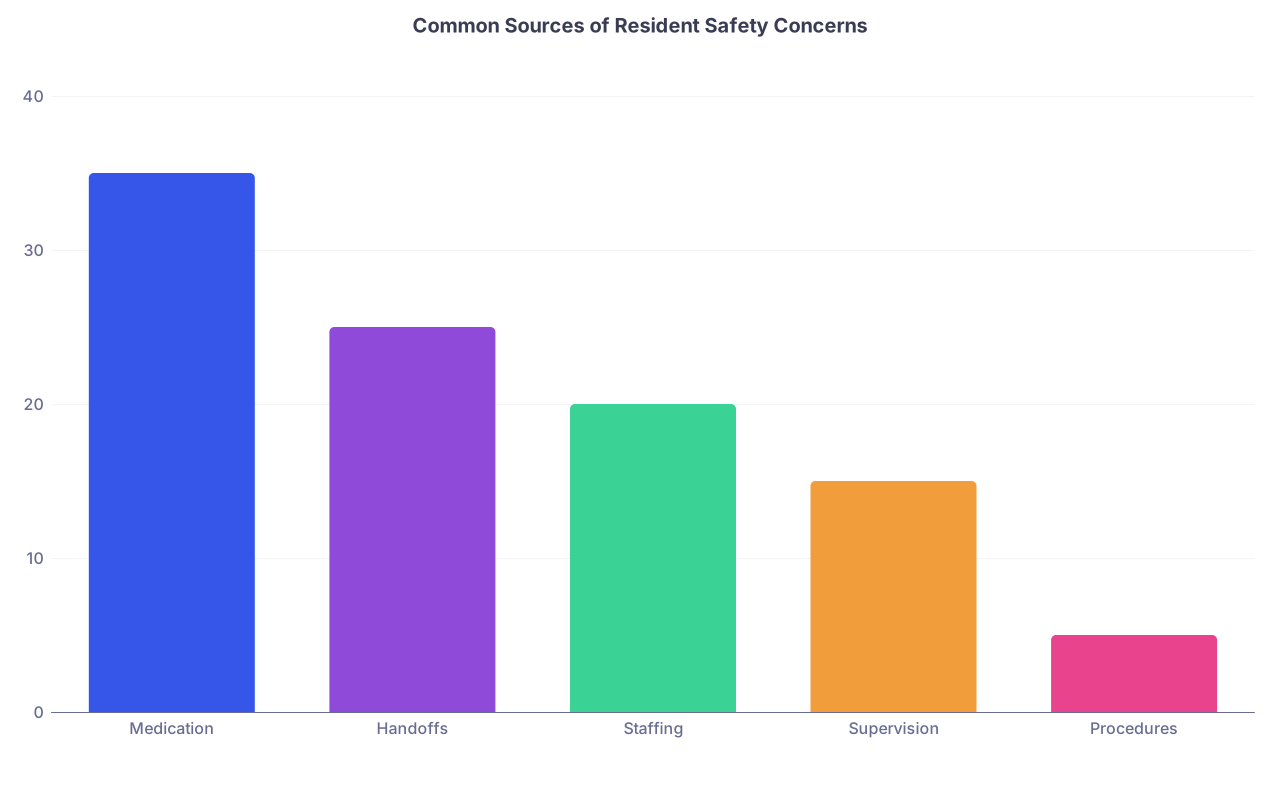
| Category | Value |
|---|---|
| Medication | 35 |
| Handoffs | 25 |
| Staffing | 20 |
| Supervision | 15 |
| Procedures | 5 |
So what does “using the system” look like when you’re scared?
- Use anonymous safety reporting tools (even if they feel clunky).
- Talk with your chief residents first—they often know which attendings or admins actually listen.
- Loop in program leadership when there’s a pattern, not just a bad day.
You’re not tattling. You’re backing up your safety instinct with a paper trail.
You’re Not Crazy to Worry About Being Labeled
That fear—that you’ll be “the dramatic one,” “the anxious one”—is real.
If you’re already a bit anxious (hi, same), you’ll overthink every word you say. You’ll replay conversations in your head, obsess over the attending’s facial expression, re‑read eval comments looking for code words.
Let me give you a hard truth with a soft landing:
- If you raise safety concerns constantly about truly trivial things, people will tune you out.
- If you carefully speak up about real, plausible risks, and it slightly annoys some people, you can live with that.
Your job is not to be perfectly chill all the time. Your job is to avoid becoming background noise.
That means:
Pick your hills.
Not every mild discomfort is a safety crisis. Save strong language for clear, non‑trivial risks.Gut‑check with someone lateral.
Ask another resident or nurse: “Am I overreacting or is this actually concerning to you too?”
If they say, “No, that’s bad,” that’s your sign.Follow up like a grown-up.
If there was tension, circle back later:
“Thanks for hearing me out earlier—I know I’m still learning. I really appreciate you walking through that case with me.”
You just turned “difficult” into “conscientious and teachable.”

| Step | Description |
|---|---|
| Step 1 | Notice safety concern |
| Step 2 | Clarify facts |
| Step 3 | Raise concern to immediate supervisor |
| Step 4 | Use clear safety language |
| Step 5 | Escalate to higher level |
| Step 6 | Document pattern |
| Step 7 | Discuss with peers or chiefs |
| Step 8 | File safety report or talk to leadership |
| Step 9 | Acute risk to patient? |
| Step 10 | Still concerned? |
| Step 11 | Resolved? |
What If You Speak Up and You’re Wrong?
This is the scenario that haunts a lot of us more than anything: you push back, you escalate, you make it a big deal… and you misunderstood.
I’ve seen that happen.
The resident:
- Misread the lab units.
- Didn’t know the attending had spoken with a consultant off‑record.
- Didn’t realize there was a protocol allowing what seemed odd.
Here’s what usually happens in reality:
- Some teasing or mild frustration.
- An awkward moment.
- Then everyone moves on.
What matters is what you do next:
“I’m glad we reviewed that; I clearly didn’t know about X. I’m still glad I brought it up, but I’ll make sure I understand the protocol better next time.”
You’ve:
- Owned the gap.
- Reaffirmed that speaking up is your default.
- Shown you’re willing to learn, not just protest.
People remember that. And honestly, I’d rather be “the one who cares too much” than “the one who never questions anything.”
Protecting Your Sanity When You’re the One Who Cares
There’s a cost to seeing risk everywhere. Hyper‑vigilance can burn you out just as badly as apathy.
You need ways to offload that mental load so you don’t spiral.
Some options that actually help:
Debrief with someone who gets it.
A co‑resident on another service. A nurse you trust. A therapist, if you have access. Keeping it all in your head will eat you alive.Separate what you control from what you don’t.
Did you:- Voice the concern clearly?
- Escalate appropriately?
- Document if needed?
If yes, then you did your job. The outcome is not fully in your hands.
Notice the wins.
The order that got changed. The nurse who thanked you later. The attending who softened over time. These are tiny pieces of evidence that you’re not shouting into a void.
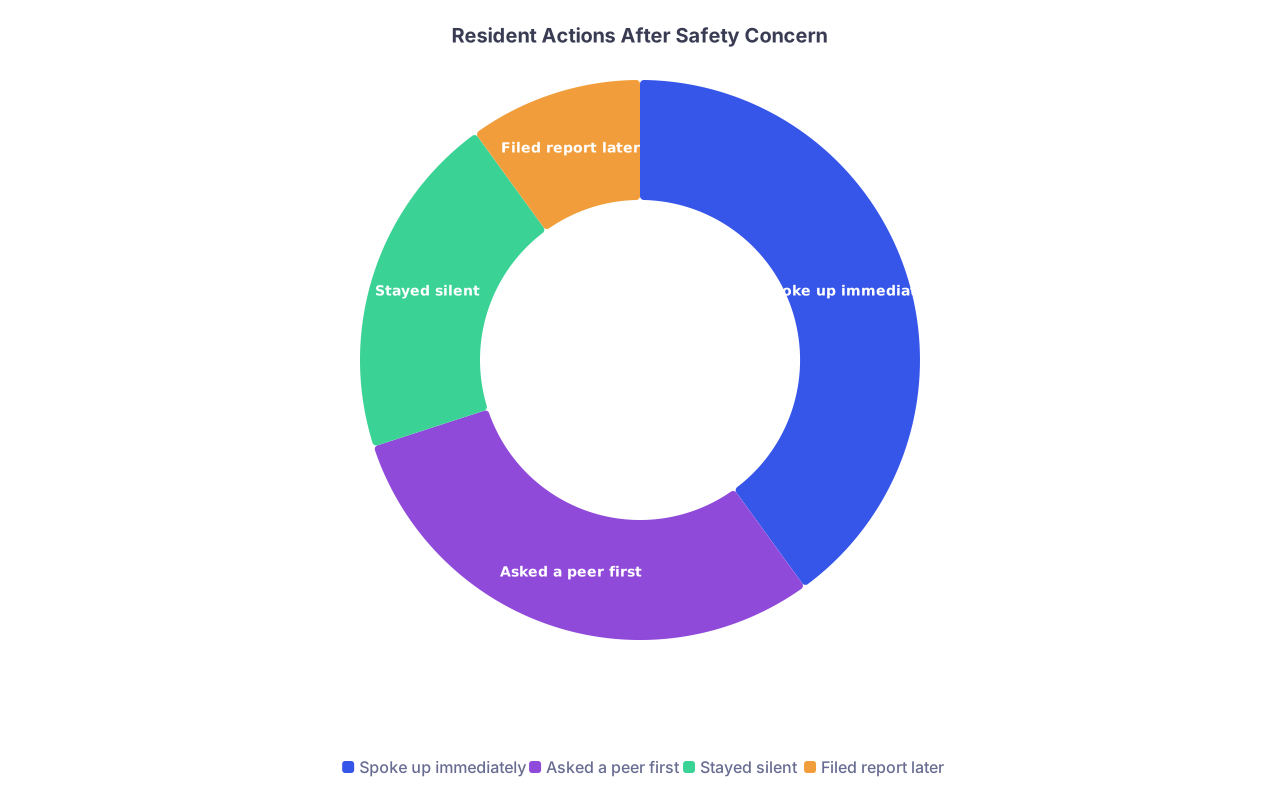
| Category | Value |
|---|---|
| Spoke up immediately | 40 |
| Asked a peer first | 30 |
| Stayed silent | 20 |
| Filed report later | 10 |
You don’t need to be fearless. You just need to be scared and still willing to act sometimes.
What If Your Program Really Doesn’t Support This?
There’s a darker version we don’t like to admit: some places genuinely punish people for speaking up. Not just awkwardness—actual retaliation.
If you’re seeing things like:
- Residents explicitly told “Don’t rock the boat if you want a good letter.”
- Chiefs discouraging formal reports because it “makes the program look bad.”
- Leadership dismissing clear safety issues as “complaining.”
Then the problem isn’t you. It’s the environment.
You still have options:
- Document incidents privately (dates, who was present, what was said).
- Talk to GME or an institutional ombudsperson if you have one.
- Use anonymous reporting channels.
- If you’re truly worried about systemic harm and retaliation, some people eventually go external (state boards, accrediting bodies). That’s not a first step, but it exists.
And yes, you can also decide: “I’ll survive this program, protect patients where I can, and then I’m out.”
It’s not defeat to admit a culture is toxic. It’s self‑preservation.
The Ugly Truth: You Won’t Always Get Closure
Sometimes you’ll:
- File a report and never hear what happened.
- Speak up, get brushed off, and then the patient is fine and everyone forgets.
- See a near‑miss that doesn’t turn into an actual harm—so nobody cares.
That lack of closure is its own kind of injury. It makes you question whether it was worth saying anything at all.
It was.
Because the point isn’t just “Did something bad happen?” It’s “Did I do what a responsible clinician should do with the information I had?”
That’s the standard you can live with years later, when you barely remember the details but you remember how you felt.
The One Next Step
Open the Notes app (or a physical notebook if you’re old‑school) and create one new note titled:
“Safety Concerns – Scripts and Wins”
In it, write:
Three phrases you’re willing to try the next time something feels off. Example:
- “I’m probably overthinking this, but I’m worried about…”
- “Can we walk through this one more time? I’m not fully comfortable.”
- “I need to say out loud that I think this could be unsafe.”
One time in the past when you did speak up, even about something small, and it helped—even if nobody celebrated it.
That note is your tiny armor. Next time your heart’s pounding and you feel like the only one, you won’t be starting from zero—you’ll have your own words ready.


