

The fear of being called “bossy” has quietly ruined more resident leaders than bad evaluations ever will.
You know exactly what I mean. You’re in the middle of rounds, the plan is chaos, no one’s paged consults, your intern forgot to check a potassium of 2.9, and you know you have to step in. But your brain starts screaming:
“If I say this too directly, they’ll think I’m bossy.” “If I correct him again, he’ll say I’m ‘difficult’.” “If I sound too firm, someone will call me ‘intense’ on my eval.”
So you soften. You hedge. You hint. You apologize… for doing your job.
And then you go home and obsess:
“Great, now I look weak and disorganized.”
Welcome to leadership in medicine, where you’re supposed to “take ownership” and “run the list” and “protect patient safety” — but also somehow never be “bossy,” “abrasive,” or “intimidating.”
I’m going to say the thing that no one says out loud:
Residency wants you to lead decisively… but will absolutely punish you if you don’t manage people’s feelings while you do it.
And yes, the double standard hits women, IMGs, quieter personalities, and underrepresented folks harder. I’ve seen it. I’ve felt it. It’s not in your head.
But you can lead strongly without constantly triggering backlash. Not perfectly. Not in every situation. But better than you’re doing right now while white‑knuckling every interaction.
Let’s untangle this.
The “Bossy” Trap You’re Terrified Of
Here’s the nightmare scenario running in your skull:
You’re on wards, team is behind, the attending wants disposition plans by noon. You say, “We’re behind. Let’s move faster and keep presentations focused.”
Later you imagine:
- The med student: “She was kind of bossy.”
- The intern: “He was really controlling.”
- The attending: “Good knowledge, but needs to work on interpersonal skills.”
And then your brain does what it always does:
“Cool, I’m going to get labeled as that resident forever.”
Here’s the ugly truth:
You will be misunderstood sometimes. You will be mis-labeled sometimes. Someone will call you bossy. Or harsh. Or scary. Even when you were right.
But the solution is not to lead less.
The solution is to lead in a way that:
- Makes your decisions extremely clear
- Makes your intent visible (patient-centered, team-supportive)
- Gives people less ammo to turn “strong” into “bossy”
That’s what we’re going to build.
The Real Difference Between “Leader” and “Bossy” (It’s Not What You Think)
You’re probably obsessed with tone:
“If I just sound gentle enough, no one will think I’m bossy.”
Tone matters, but it’s not the core issue. The real line people feel is this:
- Bossy = “You’re making this about your power over me.”
- Leader = “You’re making this about our shared responsibility and the patient.”
Watch how this plays out in almost identical phrases.
Resident says to intern:
- “You need to call cardiology now. You’re way behind.”
- “Cardiology needs to be called in the next 10 minutes so we can get this patient to the cath lab on time. Can you take that now, and I’ll finish the note?”
The second one is still direct. Still a command. But:
- There’s a why tied to the patient.
- There’s shared responsibility (“we”).
- There’s partnership (“I’ll finish the note”).
You’re still the leader. You’re just not power-flexing.
Let me be blunt:
You will never entirely control how people interpret you. Some folks are going to label any firm female resident as “bossy” no matter what. Some will call any IMG “rigid” for doing exactly what an American grad does.
Your job isn’t to magically erase bias.
Your job is to give normal, reasonable people obvious evidence that you are leading for the team and for the patient, not for ego.
That’s survivable. Bias is still there, but they have less to hook it on.
Concrete Phrases That Let You Lead Without Sounding Like a Tyrant
You don’t need a personality transplant. You need a small script upgrade.
Here are swaps you can actually use on a sleep-deprived post-call brain.
When you need to redirect someone who’s messing up
Default (what you want to say):
“Why didn’t you follow up that CT? I told you this morning.”
Backlash magnet. Here’s a better version:
“Hey, I didn’t see the CT result in your note — did it come back yet?”
(wait for answer)
“Got it. That one’s time-sensitive because of the bleed risk. Let’s pull it up now together, and going forward just flag CT heads as ‘STAT follow up’ on your list, yeah?”
Same message:
- There was a miss.
- It does matter.
- But you’ve framed it as “this is how we do safe care here,” not “you’re incompetent and I’m the sheriff.”
When the team is slow and you need to push the pace
Instead of:
“You guys, we’re so behind. You need to present faster.”
Try:
“We’re behind and I don’t want us staying here till 8 pm. Let’s try tight, problem-based presentations: overnight events, new labs/imaging, and today’s plan. I’ll jump in if I need more details.”
You’re still in charge. You just tied:
- The ask → to a shared goal (not dying on the unit all night)
- The structure → to clarity and efficiency, not your impatience
When you have to override someone’s plan
Instead of:
“No, we’re not doing that. That doesn’t make sense.”
Try:
“I see what you’re thinking with that, especially with his blood pressure. I’m worried about his kidneys though. Let’s go with low-dose ACE and hold the diuretic today, and we’ll reassess tomorrow once we see his BMP.”
You:
- Acknowledge their reasoning (so they don’t feel stupid)
- Explain your reasoning
- State a clear plan
Yes, this takes an extra 10 seconds. But this 10 seconds is literally the difference between “helpful senior” and “bossy jerk” in most people’s minds.
The Bias Elephant: It’s Not Your Imagination
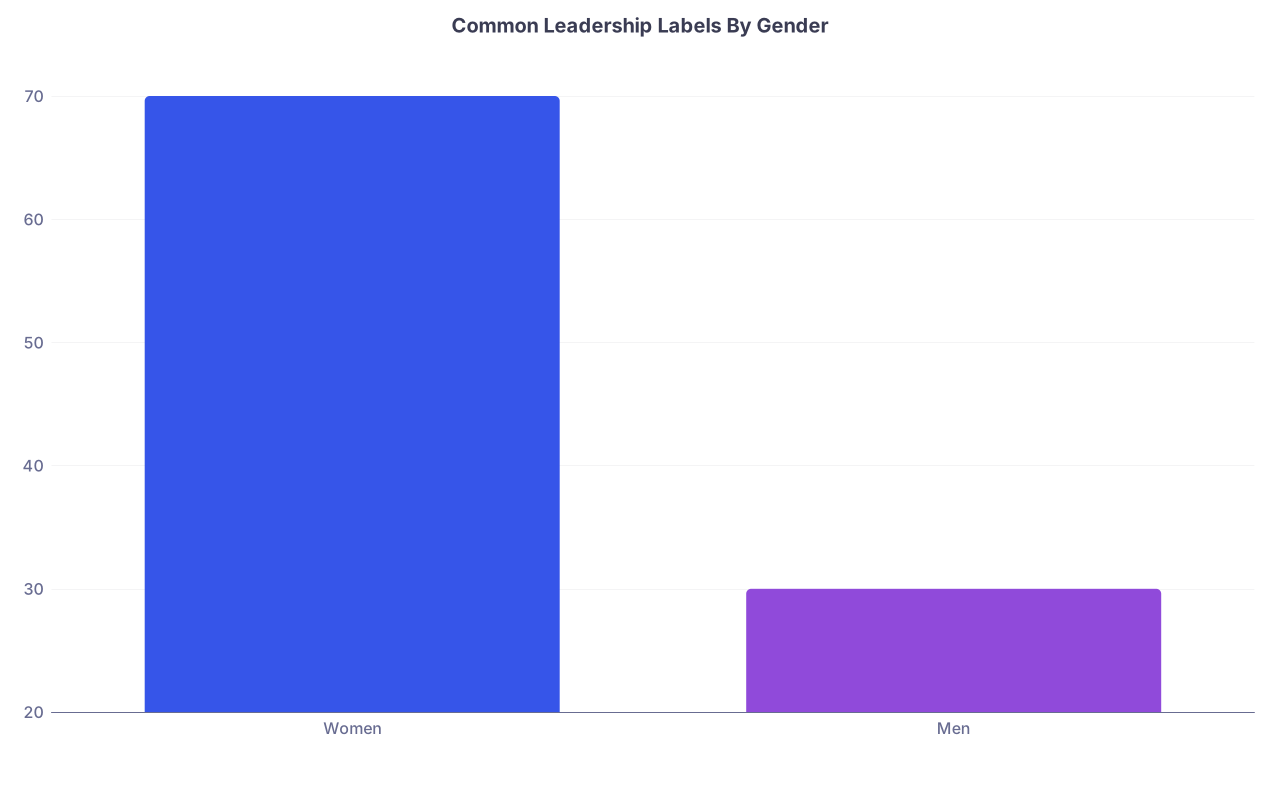
Let’s not gaslight ourselves. Certain groups get the “bossy” label faster.
- Women get “bossy,” “shrill,” “emotional”
- Men get “strong,” “assertive,” “confident”
- URM residents get “angry,” “intimidating”
- IMGs get “rigid,” “not a team player”
You’re probably over-correcting because you’ve seen this happen to people who look like you.
| Category | Value |
|---|---|
| Women | 70 |
| Men | 30 |
(Think of that as the percentage of times I’ve personally heard “bossy” used about residents; wildly unscientific, but you know it feels true.)
So what do you do? Because “just be yourself” is terrible advice when “yourself” gets punished.
Here’s the uncomfortable but practical approach I’ve seen work:
Choose your non-negotiables.
Patient safety, ethics, your core values. Non-negotiable. You will be firm here, even if someone thinks you’re bossy.Be more flexible on style, not on substance.
You can soften how you say it without backing off what you say.Document patterns privately.
If one attending keeps calling you “intense” whenever you speak up about safety, write it down with dates and details. You may never use it. But if evaluations start tilting that way, you’re not starting from zero.Find at least one faculty who “gets it.”
Someone who can say: “You are not bossy. You’re clear. This is good. Ignore Dr. X’s tone comment.” That validation literally keeps people in medicine.
This isn’t a fair game. But you’re not powerless.
A Simple Framework for Giving Orders Without Sounding Like a Monster
If your brain goes blank during chaos, use this mini-template: Task – Why – Support – Check
Example: sepsis admission, everyone’s scrambling.
Task: “Can you call the ICU and give them a quick signout now?”
Why: “He’s hypotensive on pressors and we’re worried he’ll need higher-level monitoring.”
Support: “Use the note I just wrote as your structure, and if they push back, page me and I’ll talk to them.”
Check: “Sound okay?”
It looks like this in real time:
“Hey, can you call ICU now and give them a quick signout? He’s hypotensive on levophed, and I’m worried we’re going to need higher-level monitoring. Use the note I just finished as your guide, and if they push back, page me and I’ll jump on. That work?”
You’re being:
- Direct about what needs to happen
- Explicit about why it matters
- Clear that you’re backing them up
- Respectful enough to briefly check in
That’s not bossy. That’s leadership.
You might still get labeled by someone who doesn’t like any authority. But at least you’ll know you weren’t actually acting like a tyrant.
When You Actually Cross the Line (Because It Will Happen)
Here’s another fear:
“What if I do come across as bossy or harsh and they’re right? Then I’m doomed.”
You’re not. Residents snap. People get short on day 27 of nights. You will say something too sharp at some point.
What matters is what you do after.
Example:
You: “Why is this consult note still not in? I told you two hours ago.”
You see your intern’s face fall. You know you blew it.
Later, in a quieter moment:
“Hey, about earlier — I was too sharp about that consult. That wasn’t fair. We’re both tired and behind and I took it out on you. You didn’t deserve that. Next time I’ll flag urgency earlier, and you tell me if my tone’s getting off, okay?”
Notice what you didn’t do:
- You didn’t say, “Sorry you felt that way.”
- You didn’t justify it with “I’m just stressed.”
- You owned it. Fully. Without melodrama.
One sincere, non-defensive apology goes a very long way in preventing the “bossy” narrative from sticking. People will think:
“Yeah, she’s intense, but she’s fair. And she owns it when she messes up.”
That’s not a bad reputation to have.
The Quiet Skill That Protects You: Making Your Thought Process Visible
A lot of “bossy” labels come from this dynamic:
- You: Make a fast, confident decision
- Them: Don’t understand your reasoning
- Brain: “Wow, power trip much?”
So start narrating your thinking just enough.
Not an attending-level blackboard talk. Just quick, concrete links.
Instead of:
“Stop fluids. Start pressors.”
Try:
“His pressures are still low despite 3L and now his lungs sound wet — that’s why I want to hold more fluids and start pressors.”
Three extra seconds. But now you’re not just barking orders. You’re teaching, including, justifying. That feels like leadership, not domination.
Especially for med students and interns, explaining why tells them:
“I’m not bossing you, I’m bringing you into how I think.”
That’s powerful. And protective.

| Step | Description |
|---|---|
| Step 1 | Need to lead |
| Step 2 | Prioritize clarity and safety |
| Step 3 | Leave more room for flexibility |
| Step 4 | Use direct language |
| Step 5 | Explain why |
| Step 6 | Offer support |
| Step 7 | Invite input |
| Step 8 | High stakes? |
You’re Allowed To Be Strong
This is the part I wish someone had told me bluntly my first year:
You are not in residency just to be liked.
You are in residency to become the person families trust at 3 am when everything is going wrong.
That person:
- Does not whisper their concerns.
- Does not apologize for actionable decisions.
- Does not freeze because someone might think they’re bossy.
You are allowed to be:
- Clear
- Decisive
- Unapologetically protective of your patients
You will not do this perfectly. People will still misunderstand you. Some comments on your evals will sting and feel unfair.
But you are not crazy for wanting to lead well and also not get destroyed by subjective labels. That’s a real tension. You’re walking a tightrope.
The good news? Tightropes get easier when you stop staring at every possible way to fall and start focusing on a few solid footholds.
Yours are:
- Be clear about tasks and why they matter
- Tie your leadership to patient care and team well-being
- Own it quickly when you slip
- Refuse to abandon your standards just to avoid a label
You will still be anxious sometimes. I am too.
But you don’t have to let the fear of “bossy” keep you from being the leader your patients actually need.
| Situation | Bossy Version | Effective Version |
|---|---|---|
| Team is slow | "You all need to hurry up." | "We’re behind; let’s keep presentations focused." |
| Error made | "Why did you do that?" | "Walk me through your thinking on that choice." |
| Urgent task assignment | "Call the consult now." | "Can you call consult now so we don’t delay care?" |
| Overriding a plan | "No, that’s wrong." | "I see the logic, but I’m worried about X, so let’s do Y." |
| Giving critical feedback | "You need to fix your attitude." | "When you do X, it comes across as Y; let’s try Z." |

FAQ: Anxious About Being Labeled ‘Bossy’
1. What if my attending actually does call me bossy or harsh on an evaluation?
First, read the exact wording. Is it “abrasive,” “difficult to work with,” “needs to work on communication”? Pull one trusted mentor or chief aside, show them the eval, and ask, “Is this a fair description of how I was on that rotation, or does this feel off?” If multiple people you trust say, “Yeah, your tone can be sharp when stressed,” then you have something specific to work on (phrasing, timing, checking facial expression). If they say, “This is not consistent with how you are,” you file it as one biased data point, not your identity, and keep proof of your other strong evals.
2. How do I lead older nurses or staff without sounding like a know-it-all resident?
Acknowledge their experience out loud. “You’ve taken care of way more of these than I have — does anything about this patient worry you?” But when it’s your call, don’t shrink. “Thanks, that helps. Given his vitals and labs, I still want to get him to CT now. I’ll put the order in and let’s move him as soon as transport’s ready.” Respect + clarity. You’re not equal in role, you’re equal in humanity. They usually respond better to firm respect than timid uncertainty.
3. I’m naturally quiet. Do I have to fake being extroverted to be seen as a leader?
No. You have to be audible and clear, not loud or performative. Quiet leaders can be incredibly powerful if they: speak up on key decisions, explicitly back their team (“I’ll take responsibility for that”), and give concise direction. You don’t need to be the loudest voice on rounds. You do need to stop disappearing when it’s time to decide.
4. What if a med student tells me I was intimidating or bossy — should I change how I lead?
Ask for specifics: “Can you tell me a moment where I felt that way to you?” If it’s, “When you corrected me in front of the team,” you can adjust how you correct (more neutral tone, explain why, invite questions), not stop correcting altogether. If it’s, “You expected a lot,” that’s not automatically a problem. You’re allowed to expect performance; you just can’t be demeaning about it.
5. How do I push back on an attending’s unsafe plan without being labeled difficult?
Use structure: “I’m worried about X because of Y. Could we consider Z instead?” If they shut it down, you’ve at least documented (in your brain and maybe in the note) that you raised the concern. If it’s egregious, you escalate quietly through the proper channel (program leadership, patient safety). But you do not stay silent just to seem agreeable. That’s how regret is born.
6. I’m scared that once people see me as bossy, I’ll never shake it. Is that true?
No. Reputations can soften faster than you think if your behavior consistently shows something different. If over 3–6 months you’re the resident who: backs their team publicly, apologizes when snappy, explains decisions, and advocates for patients reasonably, people’s mental file on you changes from “bossy” to “strong, but fair.” You don’t erase the old story overnight, but you outgrow it. Quietly. Repeatedly.
Key takeaways:
- You’re not crazy: bias and double standards around “bossy” are real in residency, but you’re not helpless against them.
- Lead clearly and explicitly tie your decisions to patient care and team support — that’s what separates genuine leadership from how “bossy” feels to people.
- You will mess up your tone sometimes; owning it quickly and adjusting your phrasing is enough. Don’t let the fear of a label stop you from becoming the doctor who actually keeps patients safe.


