

The way chiefs are evaluated behind closed doors on Zoom calls would make a lot of residents very uncomfortable if they heard it word-for-word.
You think it is about leadership, systems improvement, wellness initiatives, feedback. On paper, yes. In reality, when program leadership logs into that closed Zoom to “discuss the chiefs,” the conversation is sharper, more political, and much more personal than anyone admits. I have sat in those calls. I have watched careers get buoyed—or quietly kneecapped—in 30 minutes.
Let me walk you through how it really works.
The Setup: Who’s On That Zoom and What They Actually Care About
First myth to kill: there is no unified “they.” Different people on that Zoom want very different things from their chiefs, and that shapes how you’re judged.
Here’s the usual cast:
- Program Director (PD) – Runs the show. Their priority: stability, accreditation safety, “no fires.” Chiefs are extensions of their authority.
- Associate/Assistant PDs – Often closer to residents. They care about fairness, schedule sanity, and whether residents hate you.
- Department Chair or Vice Chair – Occasionally present. They care about reputation, subspecialty politics, and whether chiefs embarrass the department.
- Chief of Service / Site directors – Care about patient flow, staffing, and not having the attending group complain.
- Program coordinator / manager – The secret power broker. They know who actually gets things done and who creates chaos.
When the “Chief Evaluation” or “Chief Debrief” Zoom happens, it usually has one of three triggers:
- End-of-year debrief on the outgoing chiefs
- Mid-year check-in on current chiefs
- Pre-selection or early discussions of future chiefs, using current chiefs as reference points
Those aren’t “formal” ACGME-evaluable events. These are candid, sometimes brutal, back-channel conversations. This is where the real grading happens.
The Unwritten Rubric: What Chiefs Are Actually Evaluated On
Nobody pulls up a formal rubric on that call. They say they do. They don’t.
What they actually use is a mental scorecard. It’s more pattern recognition than performance review. Over time, you hear the same categories come up again and again.

Let me translate the real categories.
1. Crisis Handling and “Adult in the Room” Factor
Every chief class faces a few big crises: a tragic resident outcome, a massive COVID surge, a sentinel event, a resident calling out a toxic attending. On the Zoom, you’ll hear:
- “When X happened, did they keep their head?”
- “Did residents go to them or bypass them and come directly to me?”
- “Did they escalate appropriately or blow things up?”
What they really mean:
Can this chief be trusted to behave like an adult peer—not a panicked intern with a title? Chiefs get judged harshly for two extremes:
- Over-escalation: running to the PD for every conflict
- Non-escalation: burying major issues to “keep the peace”
The chiefs who get praised are the ones who:
- Gather facts from multiple people
- Present a distilled, balanced picture
- Offer 2–3 workable options instead of “What do you want to do, Dr. X?”
That “solutions-oriented” behavior gets remembered. Long after the specifics of the crisis are forgotten.
2. Schedule and Coverage Management: The Silent Killer
You think leadership projects and committees matter most. They don’t. The call schedule does.
I’ve heard this sentence almost verbatim:
“She’s wonderful, but residents are still angry about how she handled sick call. That’s what they’ll remember.”
On the Zoom, schedule performance gets boiled down to:
- Did people feel the schedule was reasonably fair?
- When things went bad—COVID outbreaks, maternity leaves, sudden resignations—did the chief scramble for the residents or on the residents?
- How many “escalation emails” about coverage landed in the PD’s inbox?
There is a quiet metric some programs track (even if informally):
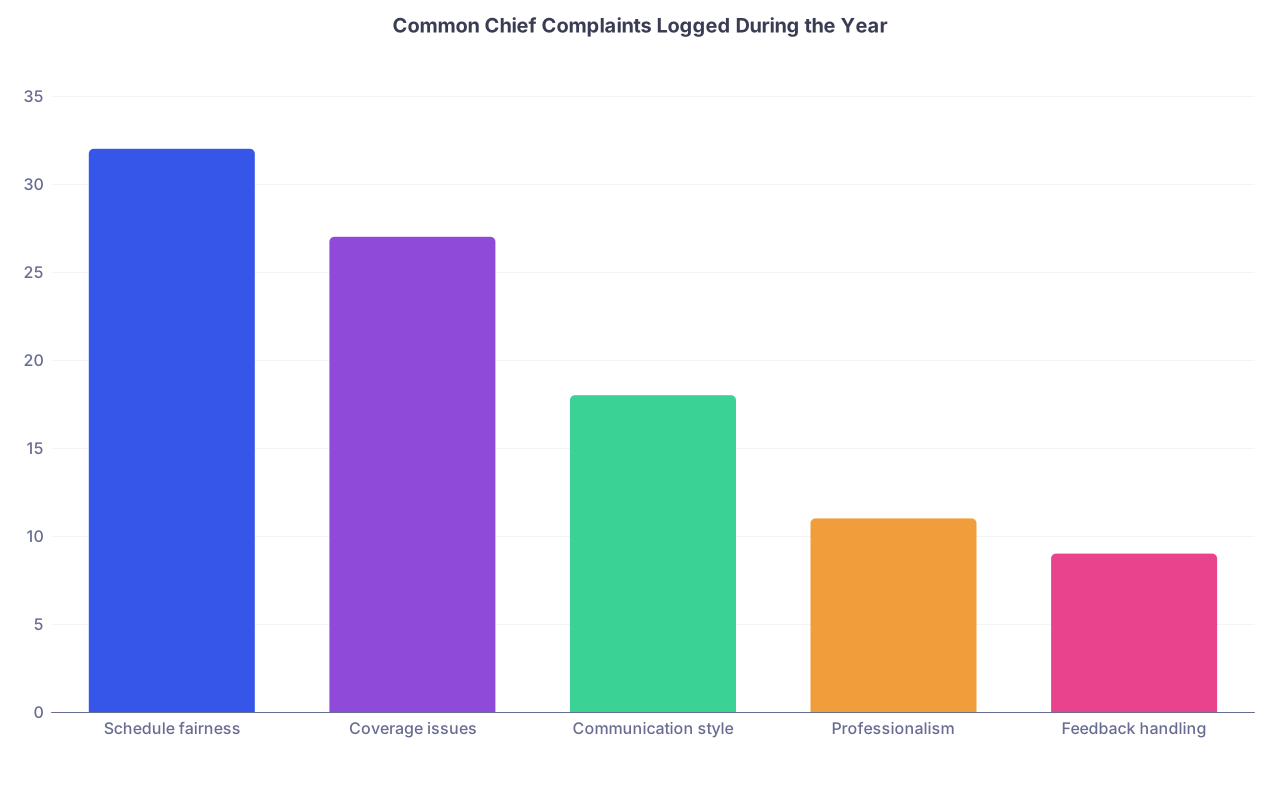
| Category | Value |
|---|---|
| Schedule fairness | 32 |
| Coverage issues | 27 |
| Communication style | 18 |
| Professionalism | 11 |
| Feedback handling | 9 |
If even a quarter of those schedule/coverage complaints have your name attached, you will be framed as “problematic” in that Zoom—no matter how strong your teaching or research is.
3. Resident Sentiment: Not What You Think
Program leadership does not believe all “chief gossip.” They’re not idiots. They discount the chronic complainers. But patterns matter.
Here’s how they really assess resident sentiment on that call:
- Did multiple residents, from different PGY levels, say the same thing about this chief?
- Did feedback show up through multiple channels—anonymous surveys, one-on-ones, offhand comments?
- Did complaints sound like “they’re tough but fair” or “they’re petty / retaliatory / absent”?
Chiefs get destroyed over one specific phrase:
“I don’t feel safe going to them.”
That line, or any variant (“I worry about retaliation,” “I don’t trust them to keep things confidential”), is lethal in a Zoom evaluation. People will forgive being strict. They will not forgive being unsafe.
4. Loyalty: To Whom?
This part you’re never told explicitly.
On that Zoom, they’re quietly evaluating: “Who is this chief loyal to?” Residents? PD? Department? Themselves?
The chiefs who rise are usually those who:
- Advocate hard for residents in private, then present unified decisions in public
- Do not undermine the PD or department in front of the resident body
- Refuse to weaponize resident complaints to advance their own agenda
The ones who get labeled “dangerous” are those who:
- Publicly throw program leadership under the bus (“I fought for you, but they said no”)
- Leak internal discussions to residents to score points
- Say different things to different people, then get exposed when stories are compared
On Zoom, the language is sanitized:
- “They sometimes struggled with boundaries in conflict situations.”
- “They could have protected the chain of communication better.”
Strip the politeness away: they see you as disloyal or untrustworthy.
The Politics of Those Zoom Calls: Who Defends You, Who Stays Silent
Here’s the most uncomfortable truth: your evaluation as chief is heavily influenced by who is willing to go to bat for you when the conversation turns.

| Step | Description |
|---|---|
| Step 1 | Chief Resident |
| Step 2 | Program Director |
| Step 3 | Associate PDs |
| Step 4 | Program Coordinator |
| Step 5 | Site Directors |
| Step 6 | Final Narrative |
During that Zoom, the conversation tends to follow a rhythm:
- PD opens with a broad impression: “Overall, I think this chief class has been strong/rocky/uneven.”
- Each leader adds a few anecdotes—good or bad.
- Someone brings up the resident perspective (formal survey or “the word on the street”).
- The outliers get dissected—either the superstar or the problem child.
- A “narrative” forms. That narrative will outlive the details.
If nobody defends you when your name comes up, you’re in trouble—even if the criticisms are fixable.
Watch for these roles:
- The PD: If they like you, they’ll reframe mild failures as growth areas. If they don’t, even small missteps become examples of “a pattern.”
- The coordinator: They will either say, “When something needed to get done, they always followed through,” or “I had to chase them down constantly.” That single sentence changes the room temperature.
- The associate PDs: If you have one ally here who says, “Residents really trust them,” you get oxygen.
I’ve watched a borderline chief pulled back from the edge because a site director quietly said, “Look, the residents out here love him. He has rough edges, but he shows up every time we need him.” That kind of statement recalibrates the entire evaluation.
Conversely, I’ve watched a seemingly “beloved” chief lose ground because:
- They came off as dismissive in faculty meetings
- They were consistently late to admin calls
- They publicly aired program dirty laundry on social media
You rarely hear about those Zoom comments afterward. You just feel the chill in your letters, or the lack of support when you apply for a fellowship or junior faculty position.
Zoom-Specific Dynamics: How Remote Changed the Game
You asked specifically about “behind closed doors on Zoom calls.” That matters. The move from in-person conference rooms to Zoom changed how candid—and how casual—these evaluations became.
On Zoom:
- People are more blunt. There’s less politeness theater when you’re staring at a grid of faces in little boxes.
- Chat backchannels exist. PDs and coordinators send each other side messages during the meeting: “Remind me what happened with that schedule blowup?” “Didn’t she have an issue with that ICU attending?”
- Attendance is higher. Site directors and off-site faculty who never came to in-person debriefs now log in for 20 minutes—and leave their opinions.

Zoom also makes it easy to:
- Pull up resident survey data instantly
- Share screen with incident logs, duty hour reports, evaluation comments
- Scroll through specific episodes: “Remember that weekend coverage debacle in October? Let me share my screen…”
So your evaluation is not just fuzzy memory and vibes. It’s anchored to on-screen receipts.
The Hidden Metrics No One Tells You About
Nobody hands you a chief “scorecard” when you start. They should. They won’t. But these are the quiet metrics that surface on that Zoom:
| Metric | How It Shows Up on Zoom Call |
|---|---|
| Email response time | “I can always reach them” vs “I never get a reply” |
| Reliability on deadlines | “They get it done” vs “Always needs reminders” |
| Escalation judgment | “Brings me solutions” vs “Drops problems in my lap” |
| Drama footprint | “Calms situations” vs “Seems to be at the center” |
| Reputation with staff | “Nurses love them” vs “Clinic staff complain often” |
Let me translate each into plain language.
Email / Message Responsiveness
Chiefs who respond within a reasonable window (not instantly, just reliably) get labeled as “dependable.” Those who frequently vanish—or answer incompletely—are described as “hard to work with.” Yes, that language is used.Reliability on Administrative Tasks
When the PD says, “We need the schedule by X,” they’re also watching how you deliver:- On time? Complete? Minimal errors?
Or: - Late, with multiple corrections and excuses?
- On time? Complete? Minimal errors?
Escalation Judgment
Good chiefs come to leadership with a situation already framed and pre-digested:- “Here’s what happened. Here’s what we’ve done. Here are options A and B. I’m leaning toward A, but want your input.” Bad chiefs show up with:
- “Everyone’s mad. What do you want me to do?”
Drama Footprint
If your name comes up every time there’s conflict—either as a cause, accelerant, or regular participant—people start to assume you are the variable.Reputation with Non-Physician Staff
Chiefs who are kind and respectful to nurses, coordinators, front desk staff, and social workers get quietly praised: “Everyone loves working with her.” Chiefs who are rude or condescending? That always reaches leadership. Sooner than you think.
How Chief Evaluations Shape Your Future (Even If Nobody Says So)
Here’s another thing chiefs underestimate: that Zoom narrative follows you.
When fellowship PDs call your PD, they don’t ask, “Were they good at Epic smartphrases?” They ask:
- “Would you hire them as faculty?”
- “Would you want them as your chief again?”
- “Any concerns working with others?”
The answers come directly from that mental file built on those closed-door Zooms.
If your chief year narrative is:
- “Strong leader, occasionally rigid, but grew a lot and always had residents’ backs,” you’re fine. If your narrative is:
- “Bright, but a source of multiple conflicts and complaints,” doors quietly close.
No one emails you, “By the way, the evaluation Zoom went badly; that’s why I didn’t support your faculty application.” You just feel weird friction where you expected an easy endorsement.
If You’re a Current or Future Chief: How to Play the Real Game
This is the part you actually care about: how to not get shredded when your name comes up on that Zoom.
I’ll be blunt.
Make your PD’s life easier, not harder.
Not as a sycophant, but as a functional leader. Come with solutions. Protect them from noise. Handle what you can at your level.Make the coordinator your ally.
Never disrespect them. Never leave them holding the bag. If they think, “I can count on this chief,” they’ll say so on that call. That one sentence can outweigh three resident complaints.Be consistent in public messaging.
Do not trash leadership to residents to look like the “cool chief.” It will come back around, and it will be framed as “unprofessional” and “divisive.”Document your decisions on the hard calls.
When you do something that will upset people (redistribute calls, deny a last-minute vacation, adjust rotations), write a brief, clean rationale and send it to leadership. Later, on Zoom, they’ll say, “They handled that correctly, I saw the emails.”Address conflicts early and directly.
The chiefs who look worst are the ones who let tension simmer for months, then it explodes and reaches leadership as “chief doesn’t care.” An awkward 10‑minute Zoom with an angry resident now is better than a scathing comment in the annual survey later.
Because yes—those survey comments sometimes get screenshared on the chief evaluation Zoom. I’ve watched it happen.
The Part Nobody Tells You Until It’s Over
Being chief is not a gold star. It’s a year-long interview in front of the people who control your near-term future in medicine.
By the time that evaluation Zoom happens, the story about you is mostly written. Not in your PowerPoints, not in your wellness initiatives, not in your “chief projects”—but in a series of decisions and reactions, especially when things went sideways and everyone was tired.
The irony? The chiefs who “look best” in those calls are rarely the loudest or most performative. They are:
- Predictable under stress
- Fair when stakes are high
- Loyal without being blind
- And—this matters more than you’d like—low drama
So if you’re in that role now, or aiming for it, do not obsess over how you look in public chief meetings. Worry about what they say in that quiet Zoom after you log off.
That’s where your real evaluation lives.
When you understand that, you stop playing for applause and start leading like someone who expects to be judged by people taking notes in another room. Because they are.
The next phase, once you have this piece down, is learning how to use your chief year strategically—to open doors for leadership positions, fellowships, and early faculty roles. That’s a different conversation. And we’ll get to it another day.


