

It’s 2:03 a.m. on night float. The ED just paged for yet another admission. The intern is drowning in notes, the cross-cover pager will not shut up, and the senior who’s technically “in charge” is buried in a septic shock admission in the ICU.
Yet somehow, the floor keeps moving. Orders get placed. Discharges are tidied up. Notes are finished enough that no one gets yelled at in the morning. If you slow the chaos down and watch it carefully, you’ll notice something.
One resident—usually not the loudest, often not the one with the title—quietly decides what happens next. Who goes where. Which fire matters now. Who needs to be protected because they’re about to fall apart.
That person is doing shadow leadership. And that’s usually who becomes chief resident.
Let me tell you how this actually works behind closed doors, when program directors and attendings sit down and decide who gets the “chief” letter.
What Programs Really Look At When Picking Chiefs
Here’s the thing almost no one tells you as a PGY-1 or early PGY-2: chiefs are not chosen just for “being nice,” “working hard,” or “being a team player.” Those are table stakes. If you don’t have those, you’re not even in the conversation.
When we’re in those selection meetings, we’re looking for residents who’ve already been functioning like chiefs for months—sometimes years—without any title. Residents who occupy informal, quiet positions of authority the way some people naturally stand at the center of a crowd.
We watch:
- Which resident everyone pages first when things explode.
- Whose name interns bring up when they say, “She really helped me survive my first month.”
- Who the nurses trust enough to walk past the assigned senior to ask, “Can you look at this patient with me?”
- Who consistently makes the day run smoother without announcing it.
We don’t pick the person who says they want to be a leader. We pick the one who already is one when it’s inconvenient, unpaid, and invisible.
That’s shadow leadership.
Let’s break down the specific informal roles that quietly build the case for you to become chief.
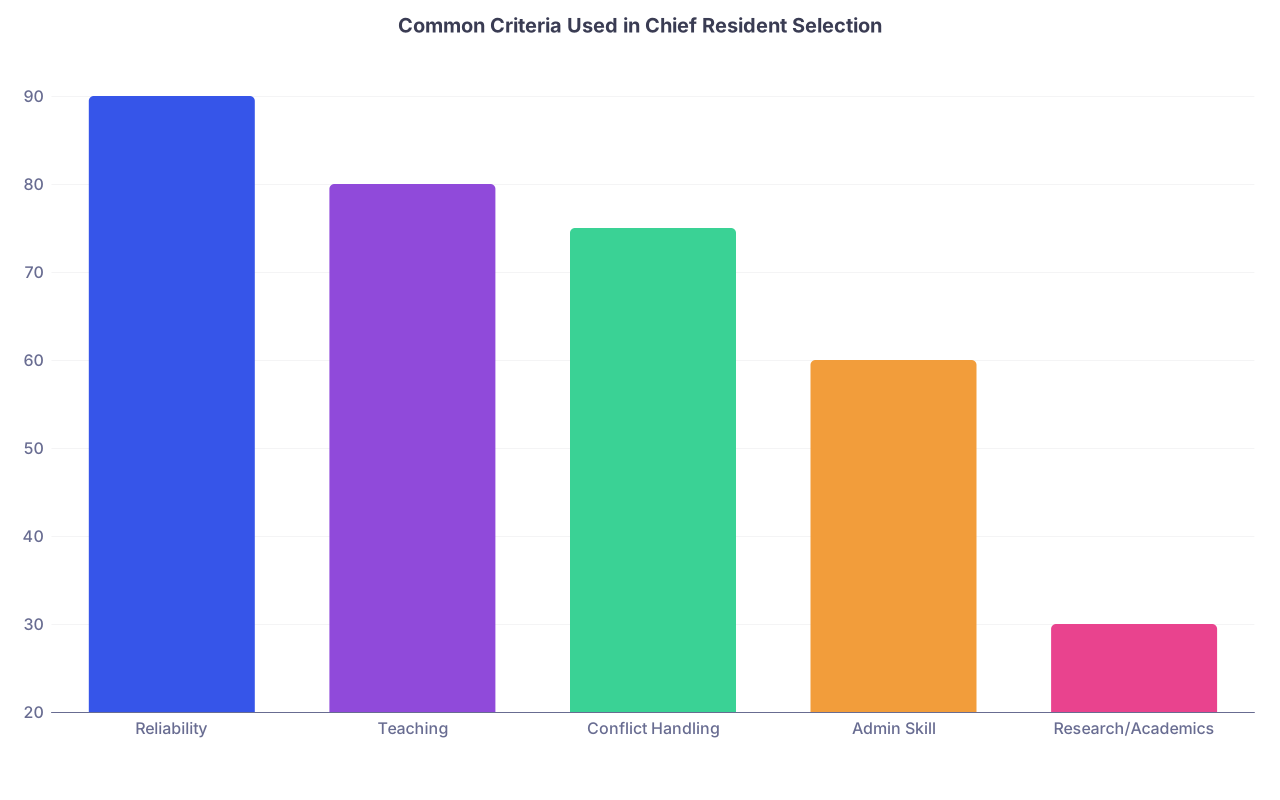
| Category | Value |
|---|---|
| Reliability | 90 |
| Teaching | 80 |
| Conflict Handling | 75 |
| Admin Skill | 60 |
| Research/Academics | 30 |
The Quiet Coordinator: Running the Day Without a Title
Every program has one resident who becomes the unofficial “unit air traffic controller.” No title. No extra pay. Yet the whole team subconsciously orbits them.
You know you’re in this role when:
- The charge nurse walks up and says, “Can we plan discharges? Who’s going first?” and looks at you, not the assigned senior.
- Interns text you the night before a rough admit call: “Hey, how bad is it tomorrow? Anything I should know?”
- The ED doc calls and says, “Hey, can I run a couple of borderline admits by you?” when you’re technically just another resident.
From the program side: we notice who runs board sign-out like they own it. Who plans the order of work rounds so that procedures get done on time, scans don’t get missed, and clinics aren’t constantly delayed.
The informal chief behavior here looks like this:
You show up to the workroom at 6:40, not 7:00, skim the list, and pre-plan the day. You say things like:
- “We’ll pre-round fast on 3, then get Mr. So-and-so to CT before 9.”
- “You take that discharge, I’ll grab the complicated admission.”
- “Let’s huddle at noon to see what’s stuck.”
You’re not bossing people around. You’re anchoring the chaos.
Faculty see that. We talk about it.
I’ve sat in meetings where someone says, “Look, when she’s on nights, the page volume is the same, but somehow the morning sign-out doesn’t feel like a disaster. That’s chief material.”
The Emotional Shock Absorber: Handling Conflict Before It Explodes
Programs live or die on how they handle conflict. Not the big formal complaints; those are easy. The small daily frictions that poison a culture if no one absorbs them.
The shadow leader becomes the emotional shock absorber.
Here’s what that looks like on the ground:
The intern is furious because the consult service refused to see a patient. The nurse is furious because the intern didn’t answer the page fast enough. The attending is annoyed that nothing seems to be moving. That’s a standard Tuesday.
The obvious response is to pick a side and complain with them.
The shadow leader does something else. They validate, then redirect, then quietly fix.
Example I’ve seen more than once:
- Nurse storms in: “Your intern never answers the pager.”
- Shadow leader: “I hear you. Today’s been brutal. Let me find them and see what’s going on. For now, page me directly for that patient while we sort it out.”
Then they go to the intern, not to scold, but to assess capacity.
- “I heard you’re getting buried in pages. Let’s look at your list and offload a few things. For the rest of the shift, keep your phone on you; I told charge to page me too. We’ll get through tonight, then talk about how to avoid this next time.”
That intern will trust you. The nurse will trust you. And the program will quietly flag: This person makes small fires go out instead of bigger.
Insider truth: in chief selection meetings, we ask, “Who do people go to when they’re upset?” If the answer keeps being your name, you’re already halfway to the role.
The Informal Teacher: Teaching When No One’s Giving You Credit
Programs do not need chiefs who only teach when they have a dedicated noon conference slot. That’s easy. Prepared talk, free lunch, everyone applauds.
We look for the resident who teaches when there’s absolutely no incentive. No audience. No eval form.
Shadow teaching looks like this:
- You watch an intern order a “routine” CT PE on a low-risk patient, and instead of silently fixing it, you say, “Pause. Walk me through your thought process. Let’s talk about PERC and Wells for 3 minutes.”
- You finish a central line at 2 a.m. and, while cleaning up, say, “Next time you’re doing this. Tomorrow I’ll send you a quick text with a couple YouTube vids that are actually good.”
- You’re post-call and exhausted but still take 5 minutes to walk the med student through how you framed a tricky family discussion.
Program directors track this far more than you think. Attendings will come to chief selection meetings and say, “I see him constantly pulling the intern aside, explaining his reasoning. That’s what I want our chiefs doing at scale.”
The mismatch residents make: they think big, polished presentations are what matter. The real currency is micro-teaching under pressure. That’s where we see who can integrate patient care, speed, and education.
If you want chief, you start doing this daily. Quietly. Without fanfare.
The Cultural Architect: Setting the Unwritten Rules
Every residency has a written handbook. Then it has the real handbook: how things actually work. The shadow leader rewrites that second one by how they behave.
Here’s the part programs don’t say out loud: your informal actions as a PGY-2 or early PGY-3 can shift the tone of an entire program for years.
There’s always a small handful of residents who become “how we do things here.” Not by preaching. By modeling.
Examples I’ve personally watched:
- A resident who always backs their intern publicly if an attending is unfair, then gives constructive feedback privately later. The message that spreads: “We don’t throw juniors under the bus here.”
- A senior who consistently takes the sickest patients themselves rather than dumping them on the weakest intern. Signal: “We protect the most vulnerable learner first.”
- Someone who starts checking in with team members before days off: “What can we close out today so you’re not logging on at home?” That becomes infectious.
Soon enough, you’ve got PGY-1s saying, “On this service we always…” and they’re describing behaviors you modeled, not policies you wrote.
That’s cultural leadership. And when we pick chiefs, we’re thinking: “If I give this person formal authority, will the program become more like them?” If the answer is yes, you’re in the top tier.

The Administrative Ghost: Doing Unsexy Work Without Credit
Nobody applies to residency saying, “I can’t wait to be in charge of scheduling and QI spreadsheets.” Yet that’s a good chunk of what chiefs ultimately do.
Programs look very carefully for residents who show a natural instinct for operations… before they’re asked.
This is the most underrated shadow role: the informal administrator.
What it looks like:
- You quietly build better sign-out templates and share them.
- You notice a recurring bottleneck—like delayed discharges because of imaging timing—and you start keeping a mini-tracker, nudging the team during the day.
- You volunteer to help with a small QI project on your own service and actually execute: data in, follow-up done, simple intervention tested.
I’ve seen selection meetings where a resident gets vaulted into the “strongly consider for chief” category because the PD says, “She already redesigned the handoff process on nights, and everyone likes it. Imagine what she’d do with the whole program.”
Here’s the harsh truth: most residents avoid unglamorous administrative work like the plague. If you consistently volunteer for the annoying stuff—and finish it—you stand out fast.
Not by bragging. We find out anyway. Attendings and coordinators talk.
| Shadow Role | What Faculty/PDs Actually Say |
|---|---|
| Quiet Coordinator | “When he’s on, the day just runs smoother.” |
| Emotional Shock Absorber | “People go to her when there’s drama.” |
| Informal Teacher | “He explains his thinking to interns constantly.” |
| Cultural Architect | “Residents copy the way she handles conflict.” |
| Administrative Ghost | “He fixes processes instead of just complaining.” |
The Back-Channel Communicator: Handling Upward and Downward Communication
Chiefs live in the no-man’s-land between residents and leadership. You’re translating in both directions. If you cannot do that informally as a resident, you’ll be miserable as a chief—and so will everyone else.
Shadow leaders practice this early.
Downward, with peers and juniors:
You’re honest without being catastrophic. You don’t sugarcoat bad rotations, but you frame them with strategy.
Instead of: “Cards nights is hell, good luck.”
You say: “Cards nights is busy, but if you batch your pages and frontload discharges, it’s survivable. Here’s how I’d play it.”
Upward, with leadership:
You bring patterns, not just grievances.
Instead of telling the PD: “Everyone’s burned out.”
You say: “Night float interns are consistently leaving 2 hours late post-call. Most of the delay is notes. Could we trial a protected note hour or a scribe template? I think we can cut that down.”
Insider detail: faculty absolutely remember who shows up with coherent, specific feedback versus who just vents.
During chief discussions, you’ll hear:
- “He’s honest with me, but not dramatic.”
- “She brings me problems and a rough solution. I don’t always take it, but she’s thinking like leadership.”
That’s gold. That’s what we want in the room when we’re redesigning rotations or handling a resident crisis.
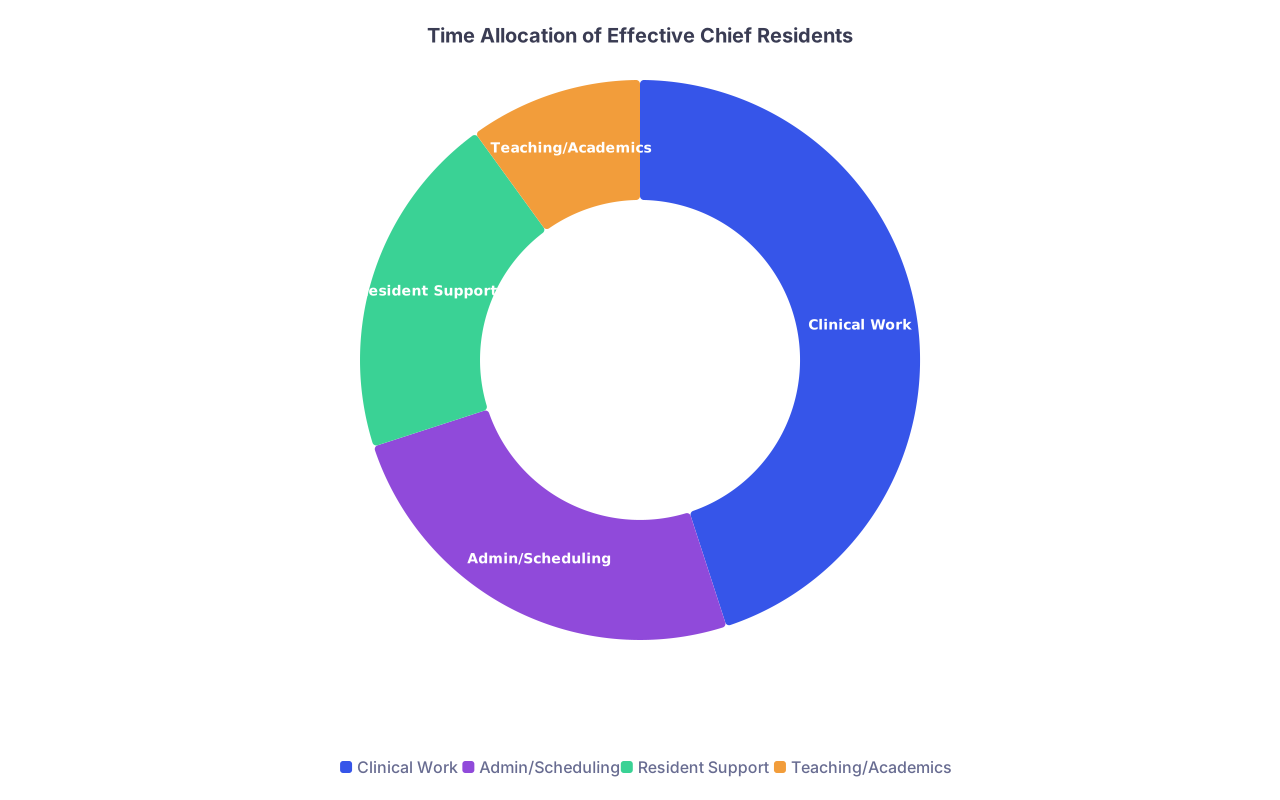
| Category | Value |
|---|---|
| Clinical Work | 45 |
| Admin/Scheduling | 25 |
| Resident Support | 20 |
| Teaching/Academics | 10 |
The Crisis Operator: Who People Look for When Things Go Sideways
All the warm, fuzzy leadership stuff is nice. But there’s one test that cuts through the fluff.
When something truly bad happens—rapid response, code, violent patient, family meltdown—who do people look for?
There’s usually one name that lives in everyone’s head as “the person I want on my side when everything goes wrong.”
That’s not always the flashiest proceduralist. More often, it’s the resident who:
- Walks into chaos, speaks two calm sentences, and people move.
- Assigns clear roles without barking.
- Remembers to protect the intern who’s about to freeze.
- After the event, circles back to check in on the nurse who’s shaken and the intern who feels like they failed.
We notice the residents who stay in the pocket during crisis. Not because they’re heroic. Because they’re reliable.
I’ve seen PDs say bluntly: “When the bad email or the bad phone call comes, who do I want as chief?” Then they list the names of people who’ve already handled smaller crises with poise.
If you want that role, you don’t need to be perfect. You need to be the one who takes a breath, looks around, and quietly says, “Okay. Here’s what we’re going to do…”
How to Start Building Shadow Leadership—Deliberately
If you’re reading this thinking, “I’m not that person… yet,” good. That means you’re not delusional. Shadow leadership isn’t some magical charisma trait. It’s a set of repeated behaviors.
Here’s the simple version of how to build it over the next 6–12 months.
1. Pick your lane for 2–3 months
You don’t need to do every role at once. That’s how people burn out.
Decide: for the next stretch, am I going to focus on:
- Being the quiet coordinator (smoother days), or
- Being the informal teacher (better juniors), or
- Being the administrative ghost (better systems)?
Pick one, do it consistently. Then layer another.
2. Use the “One Level Down” rule
Whatever PGY level you are, commit to making life meaningfully better for the tier just below you.
PGY-2? Protect interns. PGY-3? Support PGY-2s in running the show. Already a strong PGY-3? Start acting like the chief you’d want to work with.
The residents who rise as chiefs are the ones who make the people below them feel safer and more competent, not just more productive.
3. Volunteer once per block for unglamorous work
Once every rotation, stick your hand up for something annoying:
- Help the chief trial a new sign-out system.
- Sit on a small QI subcommittee.
- Offer to organize one teaching session for interns that actually addresses what they’re struggling with.
You’re training your brain for the admin side of being chief. Because if you get the title, that part doesn’t go away. It multiplies.
4. Collect honest, unfiltered feedback from people who don’t owe you anything
Ask one nurse, one intern, and one co-resident (who’s blunt by nature):
“How do I show up on busy days? What do people actually say about working with me?”
Don’t argue. Just take notes. That’s your baseline. Chief-level leadership starts with being brutally honest about how you’re already perceived.
You can’t fix what you pretend isn’t there.

What Happens Behind Closed Doors: The Chief Selection Meeting
Let me walk you into the room you never see.
It’s late winter. Program director, associate program directors, chief(s), maybe a couple of key faculty, sometimes the program coordinator. There’s a whiteboard or spreadsheet with every rising senior’s name.
Step one: we eliminate people. Harsh, but true.
- Chronic lateness.
- Persistent unprofessional notes from nursing.
- Repeated difficulty with feedback.
- The “brilliant but toxic” resident: always a hard no, even if they’re clinically incredible.
Then we sort into categories:
- Residents who want to be chief and are viable.
- Residents who don’t particularly want it but would be excellent.
- Residents who want it but no one trusts them.
- Residents no one is sure about.
Now the informal data start flowing.
Comments that actually get said:
- “Interns worship her. She’s basically been their chief all year.”
- “He’s good clinically, but when conflict happens, he disappears.”
- “The nurses page her first, even when she’s not the covering senior.”
- “He complains in the resident room, then nods along in leadership meetings. I don’t trust him to give me the real pulse.”
We weigh what we’ve seen in crises, in clinics, on nights, in the resident lounge.
You won’t hear us say, “She gave that great noon conference once.” That’s not what carries weight.
Here’s the line that usually clinches it for someone:
“Honestly, she’s already doing the job. We might as well give her the title.”
Your goal—if you want chief—is to make someone say that about you in that room.


