

The “hero resident” mindset is quietly destroying good doctors long before burnout ever gets coded in the chart.
You know the script. Always stay late. Never say no. Be “the rock” for your team. Answer every page yourself. Fix everyone’s mistakes. Do it all, perfectly, without complaining.
On paper, this looks like dedication. In reality, it’s a leadership failure dressed up as virtue.
Let me be blunt: the “hero resident” syndrome doesn’t just wreck your sleep and your mental health. It makes patient care worse, erodes team function, and teaches bad habits that will follow you into attending life. You do not want to be that person everyone quietly depends on and secretly resents.
Let’s break down exactly how this goes wrong, the red flags you’re probably ignoring, and what to do instead.
What “Hero Resident” Syndrome Really Looks Like
This is not just “working hard.” Everyone in residency works hard. Hero syndrome is something else:
You might be slipping into it if:
- You feel guilty going home on time, even when your work is done.
- You routinely say, “I’ll just do it myself, it’s faster.”
- You fix everyone else’s tasks instead of teaching them.
- You’re terrified someone will think you’re “not pulling your weight.”
- You brag (even quietly to yourself) about how late you stayed or how many patients you “saved.”
And on rounds, it looks like this:
- Interns and students stand there while you answer every question.
- Nurses call you first for everything, because “you always pick up.”
- You pre-chart for the whole team, “just to be safe.”
- You accept extra admissions without pushing back on unsafe volume.
- You never raise your hand to say, “This isn’t sustainable.”
Here’s the twist: early on, programs love you for this. Attendings call you “reliable,” “solid,” “the glue of the team.” The system eats up hero residents because you plug every gap.
But the system also spits them out. Usually around PGY-3. Sometimes earlier.
Why Hero Behavior Backfires (Even When Your Intentions Are Good)
The biggest mistake hero residents make is assuming more personal effort always equals better leadership. It doesn’t. Sometimes more effort just equals more damage.
1. You Become a Single Point of Failure
When you’re the one who “does everything,” you become the bottleneck. That works until you get sick, post-call, miss a detail, or simply reach cognitive overload.
Common pattern I’ve seen:
- You manage every sick patient because you “know them best.”
- You keep all key details in your head instead of shared lists.
- You run codes, handle families, manage discharges, all yourself.
- One night, you’re cross-covering, sleep-deprived, and miss a subtle change in a lab you usually catch.
Now the “hero” is the weakest link. Not because you’re lazy, but because you’re human.
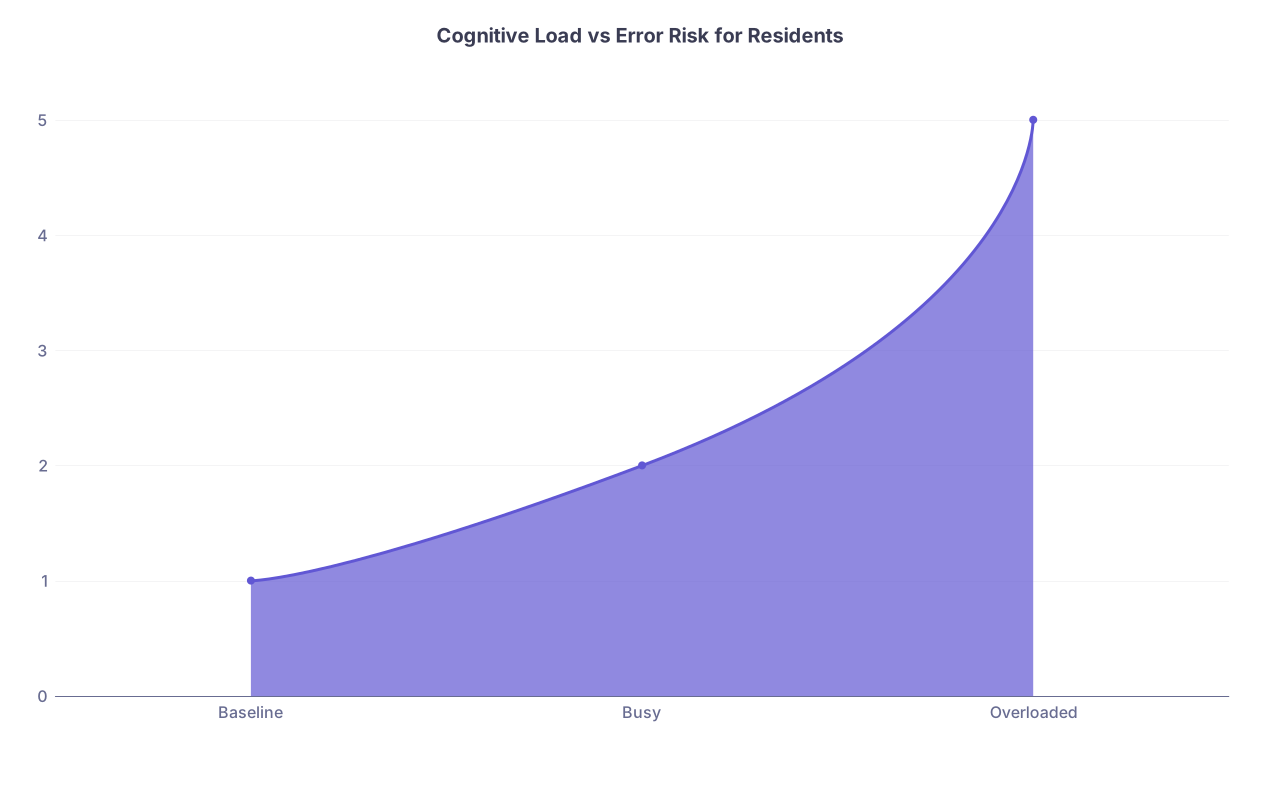
| Category | Value |
|---|---|
| Baseline | 1 |
| Busy | 2 |
| Overloaded | 5 |
As cognitive load spikes, error risk doesn’t rise gently. It jumps. The more you hoard tasks, the faster you hit the overload zone.
2. You Train Your Team To Be Passive
When you swoop in and “save the day” every time, you teach everyone else a simple lesson: don’t worry, the senior will handle it.
I’ve watched this play out on MICU rotations:
- Intern starts to think through a plan, you cut them off: “Just order cefepime and vanc, I’ll put in the rest.”
- Student tries to present, you jump in to “clean it up” for the attending.
- Nurse calls an intern with a concern, they shrug and say, “Let’s just see what the senior wants.”
You feel useful. Needed. Essential. But you’re actually disabling the people you’re supposed to be growing.
Good leaders build redundancy. Hero residents build dependence.
3. You Confuse Martyrdom with Professionalism
Staying late sometimes is part of the job. Staying late every day is not noble. It’s usually a sign of:
- Poor delegation
- Poor boundaries
- Poor system design
Yet hero residents tell themselves, “If I don’t stay, the patients will suffer.” That’s rarely accurate.
What actually happens:
- You stay late to finish non-urgent tasks that a cross-cover or night float could handle.
- You come in post-call to “help” and end up working a second shift.
- You do everyone’s notes, then complain about the workload.
Here’s the uncomfortable truth: after a certain point of fatigue, you are not helping. You are just protecting your self-image as the indispensable one.

The Hidden Costs: What Hero Syndrome Does to You Long-Term
This is where people underestimate the damage. Hero behavior doesn’t just make you tired. It reshapes how you practice.
1. You Erode Your Own Clinical Judgment
When your brain is constantly juggling too many tasks, your thinking shifts from deliberate to reactive. You start:
- Clicking through orders on autopilot.
- Accepting prior plans without re-interpreting data.
- Missing slow, subtle trends because you’re always in “fix-it-now” mode.
Residents stuck in hero mode slowly lose the habit of deep thinking. They live in perpetual triage. That shows up later when they’re attendings who don’t actually reassess cases, they just keep “doing more.”
2. You Set Yourself Up for Resentment and Cynicism
At first, you’re proud to be the go-to person.
By mid-year, you’re asking: “Why does nobody else step up?”
By late year, it often turns into:
- “My co-residents are lazy.”
- “Administration doesn’t care, they just know I’ll handle it.”
- “Nurses call me for everything; they don’t think.”
That bitterness is self-inflicted. You trained everyone around you to expect you to overfunction. Now you’re mad at them for believing you.
The system always takes what you offer. It rarely gives back boundaries.
3. You Normalize Unsafe Practice
This one is ugly, but it’s real. Hero residents quietly bend rules:
- Signing out late without documenting fatigue issues.
- Covering too many patients alone but not escalating.
- Doing procedures exhausted because “no one else is comfortable.”
You tell yourself, “This is what it takes.” You’re wrong. It’s what it takes when nobody is willing to say, “This is not safe.”
I’ve watched strong residents hit a breaking point after a near-miss they could have prevented if they’d just admitted they were overloaded.
| Situation | Hero Resident Response | Effective Leader Response |
|---|---|---|
| Extra admission at 6:45 pm | Accepts silently, stays late | Assesses load, negotiates or escalates |
| Intern struggling with notes | Finishes notes for them | Teaches template, sets deadline |
| Nurse calls with concern | Handles everything personally | Involves intern, supervises |
| Team running behind on rounds | Skips teaching, does all talking | Delegates, shortens nonessential tasks |
How Hero Syndrome Hurts Patients and Teams
If this were just about your happiness, we could call it a self-care issue. It’s not. It’s a patient safety issue and a culture issue.
1. Fewer Eyes, More Misses
When you take everything on yourself:
- Fewer people independently review data.
- Fewer team members feel ownership over patients.
- Fewer perspectives are voiced during planning.
You might think, “But I know these patients best.” Maybe. But you’re also the most tired, the most stretched, and the least likely to catch your own blind spots.
Distributed responsibility catches errors. Hero behavior centralizes risk.
2. You Accidentally Undermine Psychological Safety
Your team learns quickly:
- “If I speak up, the senior will just override me.”
- “If I try and mess up, the senior will be annoyed.”
- “It’s safer to let them lead everything.”
So they shut up. They follow. They don’t challenge. Then one day, you miss something, and no one says a word because they’ve learned not to interfere with the hero.
A good chief once said on rounds: “If I’m talking more than I’m asking, I’m failing you.” Hero residents do a lot of talking. Not much asking.
3. You Model Bad Leadership for Students and Interns
Remember, they are watching. All the time.
If the MS3 sees that:
- The “best residents” never say no
- Real leadership means suffering in silence
- Asking for help is weakness
Guess what they’ll copy later?
You are not just running a team. You’re teaching them what being a doctor is supposed to look like. If you perform martyrdom every day, they’ll think that’s the standard.

| Step | Description |
|---|---|
| Step 1 | PGY1 - Wants to prove self |
| Step 2 | Starts taking extra tasks |
| Step 3 | Gets praised for overworking |
| Step 4 | Team relies heavily on resident |
| Step 5 | Resident stops delegating |
| Step 6 | Fatigue and errors increase |
| Step 7 | Resentment and burnout risk |
Red Flags: How to Know You’re Already Trapped
You don’t need a wellness screening to know if you’re in trouble. Watch these specific warning signs:
- You rewrite your intern’s notes “to make them sound right” instead of sending feedback.
- You’re routinely doing tasks a nurse, intern, or student could do with minimal supervision.
- You answer texts/pages immediately at all hours because “it’s just easier.”
- You haven’t eaten a real lunch on service in days “because there’s too much to do.”
- When people say “You’re the only one I trust with this,” you feel a little proud.
If you see yourself there, you’re not just “hard-working.” You’re drifting into hero territory.
How to Lead Without Playing the Hero
The solution is not to swing to the other extreme and start refusing everything. Effective leadership is controlled, intentional effort — not constant self-sacrifice.
1. Start With One Simple Rule: “If I Can Teach It, I Shouldn’t Just Do It”
Before you reflexively say “I’ll handle it,” ask:
- Could my intern do this with supervision?
- Could my student at least start this?
- Is there a nurse/RT/social worker whose job this actually is?
If yes, your job is to structure, supervise, and follow up — not to hoard the task.
Example:
Instead of: “I’ll put in the admission orders, you’re too behind.”
Try: “You start the orders set for sepsis; I’ll stand here and we’ll go through each section together. Then you’ll do the next one on your own and I’ll review.”
Slower today. Much faster in a week. Infinitely safer in a month.
2. Build Default Delegation Habits
You need habits that fire automatically when your brain is tired. A few that work:
- Every new admission: intern writes H&P, student writes initial note or problem list.
- Every sick patient: intern drafts plan, you refine, not create from scratch.
- Every code/rapid: you assign roles out loud — not just jump into the middle of everything.
This isn’t lazy. It’s how you turn a group of bodies into an actual team.
3. Use Your Attendings – Don’t Shield Them from Reality
Hero residents love to “protect” their attendings from the chaos. Bad plan. Strong attendings want to know when the service is unsafe.
You should be saying:
- “We’re at 18 patients, two are unstable, and my intern is brand new. We need to cap or redistribute.”
- “I can stay a bit late today, but this volume is becoming the norm. We need a system change.”
- “I’m worried about missing things; can we prioritize high-risk patients together?”
If your attending dismisses genuine safety concerns, that’s their failure. Document your efforts. Don’t respond by just grinding harder.

Protecting Yourself Without Abandoning Your Team
Let’s talk about the objection I always hear: “But if I don’t step up, my patients and team will suffer.”
No. If you vanish, yes, they suffer. If you shift from hero to leader, they get stronger.
Concrete boundaries that don’t make you a bad doctor:
Define a real stop time most days.
If your posted sign-out is 6 pm, you aim for 6–6:30 on normal days. You only blow past that for:- True clinical instability
- Time-critical information transfer that cannot safely wait
Use the coverage structure as designed.
Night float, cross-cover, consults — they exist for a reason. Use them without apology when appropriate.Say the quiet part out loud.
To your team: “I’m not going to fix everything for you. I’ll support you and teach you, but you’re responsible for your patients.”
To yourself: “Working until 9 pm every day isn’t sustainable. That’s not commitment; that’s poor boundary-setting.”Document unsafe patterns.
Keep a simple record: dates, patient loads, late stays. Not to whine. To have data when leadership inevitably says, “We had no idea the load was that high.”
If You’re Already Burned Out from Being the Hero
If you’re reading this and thinking, “That’s me, and I’m already cooked,” you’re not stuck. But you can’t fix this by just “trying harder.”
Steps that actually help:
- Tell one co-resident the truth. Not the Instagram version. The “I’m starting to hate this job” version.
- At your next check-in with your program director or chief, talk about workload and patterns, not just “I’m tired.”
- Pick one rotation coming up where you will intentionally pilot different behavior: more delegation, clearer boundaries, specific stop times.
- Consider talking to a therapist familiar with healthcare. Not to “toughen up,” but to unlearn the part of you that only feels valuable when you’re suffering.
And stop glamorizing your exhaustion. You’re not in a competition to see who can sacrifice the most.
FAQ (Exactly 5 Questions)
1. Isn’t being a “hero resident” just what’s expected in a competitive program?
No. What’s expected is reliability, ownership, and growth. Hero behavior goes beyond that into unsupervised over-functioning, poor delegation, and hidden workload. Strong programs want sustainable performance, not quiet self-destruction. If your program explicitly rewards martyrdom and punishes boundary-setting, that’s a culture problem, not a professionalism standard.
2. How do I say no to extra work without looking lazy or uncommitted?
You do not say, “No, I’m tired.” You say, “We’re at 16 patients, I have 3 actively unstable, and my intern is swamped. If we add more admissions, I’m concerned we’ll miss something important. Can we cap or redistribute to maintain safety?” Frame it around risk and quality, not your personal comfort. That’s leadership language, not complaining.
3. What if my intern or student really is slow or unreliable — shouldn’t I just do it myself?
Temporarily, in true time-sensitive situations, yes. But if that becomes the default, you’re teaching them nothing and burning yourself out. Instead, tighten supervision and structure: set mini-deadlines, review work early in the day, give blunt feedback, and loop in your attending if performance doesn’t improve. “Doing it all yourself” is the worst long-term strategy for dealing with a weak team member.
4. Won’t delegating more put my name and license at greater risk if someone else messes up?
You’re responsible either way. The difference is: if you supervise and teach, you create a defensible pattern of reasonable oversight and shared responsibility. If you hoard everything and then miss something because you’re overloaded, that’s harder to justify. Good documentation, clear sign-outs, and appropriate escalation protect you more than heroic solo effort ever will.
5. How do I know if I’ve crossed from hardworking into unhealthy hero behavior?
Ask three questions:
- Am I routinely staying more than 60–90 minutes past sign-out on “normal” days?
- Do others assume I’ll fix things they could handle with minimal guidance?
- Do I feel resentful that no one “helps enough” but keep volunteering anyway?
If you’re hitting yes on two or more, you’ve drifted into hero territory. Time to adjust how you work, not just how much you work.
Open your current rotation schedule and pick one upcoming call or ward day. Write down, on a single sticky note, one specific task you will not do yourself (and will instead delegate and supervise). Put that note in your workroom. Tomorrow, honor it.


