

The fastest way to burn out as a resident is to “help out” your team by quietly taking on leadership you’re not actually empowered to hold.
That’s the boundary error almost nobody warns you about.
You think you’re being a team player. You think you’re protecting patients. Instead, you’re drifting into a gray zone where responsibility is high, authority is low, documentation is vague, and when something goes wrong, it will somehow be “your” fault.
Let’s dissect the specific leadership mistakes residents make when “helping out” crosses the line into unsafe, unprotected leadership—and how to stop doing that before it hurts you or your patients.
1. The Most Dangerous Role in the Hospital: Unofficial Leader
You’re a resident. Not the attending. Not the nurse manager. Not the program director. Yet every day you’re pressured into functioning like all three.
The most dangerous pattern I see is residents becoming unofficial leaders:
- You organize and run the team.
- Everyone comes to you for decisions.
- You “smooth things over” when attendings are absent, disengaged, or inconsistent.
- You feel responsible for everything, but you don’t actually have the authority to change the system.
Here’s the trap: leadership without clear authority and without explicit backing is not noble. It’s unsafe.
Common ways this shows up:
- You routinely act as de facto attending on nights, making independent decisions “because no one else is answering.”
- You’re coordinating multiple services (e.g., medicine, surgery, ICU, palliative) but nobody has explicitly designated you as point person.
- Nursing staff and consultants treat you as the final word when you’re actually supposed to be implementing someone else’s plan.
Whenever the expectation of leadership is high but the formal structure is vague, risk skyrockets.
Because when the chart is vague about who decided what, when orders are “from the team” instead of a named supervisor, and when your role is “sort of in charge,” you’ve created the perfect storm: maximum responsibility, minimum protection.
That’s not leadership. That’s a liability sinkhole.
2. Five Boundary Errors Residents Keep Repeating
Let me call out the five boundary errors I see over and over. If you recognize yourself in any of these, you need to course-correct—not next month, but this week.
2.1 Acting Like the Attending When You’re Not
You are supposed to grow in autonomy. You are not supposed to silently replace your attending.
Boundary error version:
- You sign verbal orders from consultants without confirming with your attending, because “they know what they’re doing.”
- You change the plan of care after a consultant discussion but never update your attending, because “it was obviously correct.”
- Overnight, you make high-risk decisions (pressors, end-of-life changes, major anticoagulation shifts) without documenting attending involvement or attempted contact.
The problem isn’t just competence. You might be right clinically. The problem is structure and accountability.
If the chart reads like you independently planned and executed high-risk changes as a PGY-1 or PGY-2, and there’s an adverse event, you’ll discover very quickly where the blame slides.
2.2 Saying “Yes” to Tasks That Are Actually System Problems
Almost every resident I talk to is doing work that belongs to:
- Case management
- Nursing leadership
- Clinic schedulers
- IT / admin
- The attending
But you “help out,” because otherwise things don’t get done and patients suffer. Here’s where it turns into a boundary error:
You stop asking, “Whose work is this?” and you start assuming it must be yours because you’re capable.
I’ve watched residents:
- Personally call every outpatient provider for discharge follow-up because the system is broken.
- Rebuild clinic schedules on weekends “to make things flow.”
- Create workarounds for EMR order sets instead of pushing for correct templates.
Occasional heroics? Fine. Making a broken system your personal responsibility? That’s how you end up angry, exhausted, and weirdly blamed for delays you never owned.
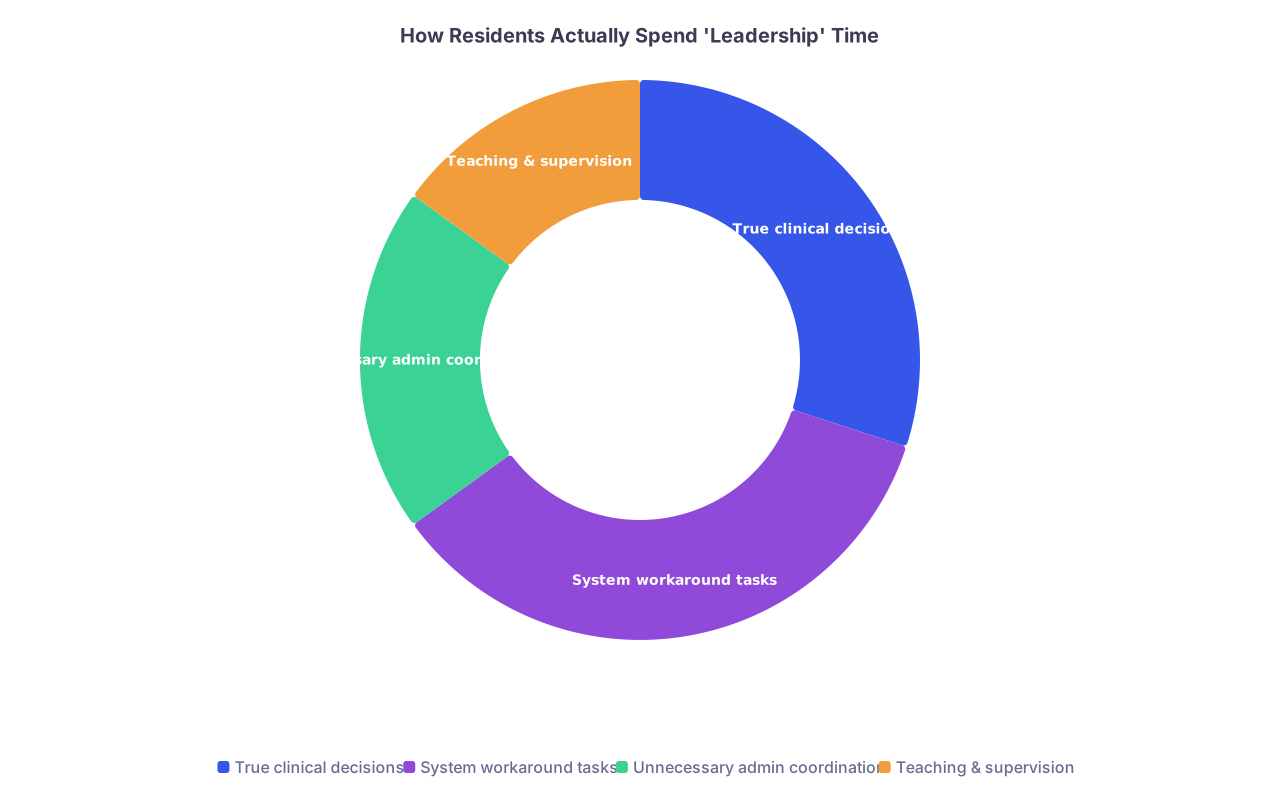
| Category | Value |
|---|---|
| True clinical decisions | 30 |
| System workaround tasks | 35 |
| Unnecessary admin coordination | 20 |
| Teaching & supervision | 15 |
If more of your “leadership” time is spent patching system failures than making clinical decisions, you’re doing someone else’s job—and doing it without their authority or pay.
2.3 Letting Emotion Blackmail You into Unsafe Responsibility
You’ll hear this line a lot: “You’re the doctor.” Usually when someone wants you to take on risk they don’t want to own.
Examples:
- A consultant won’t see the patient and says, “You’re the primary team, just manage it.”
- A nurse is appropriately worried and says, “I need you to do something right now.”
- A family is demanding: “You’re in charge here, right?”
The boundary error is when you accept non-existent authority because you feel guilty, scared, or ashamed to push back.
No, you are not always “in charge.” Sometimes you are just the only one willing to show up. Those are not the same thing.
Safe response patterns sound like:
- “I’m concerned too. I’m calling my attending now and documenting that they’ve been notified.”
- “This decision requires attending-level input. I can’t safely make it alone.”
- “I’m responsible for your care as part of a team supervised by Dr. X. I’m going to speak with them directly about this.”
If your identity as “the responsible one” is driving you to accept authority you do not actually have, you’re setting yourself up to be the convenient scapegoat.
2.4 Blurring Peer vs. Supervisor Lines with Juniors and Students
Another sneaky boundary error: acting as full supervisor for interns and students when your role is actually supposed to be near-peer teaching under attending oversight.
Red flags:
- You’re doing all the feedback and evaluations for a student while the attending barely knows their name.
- Interns say, “I don’t want to bother Dr. X; I’ll just check with you, you always know what to do.”
- You’re running full sign-out for the team, and the attending isn’t even present or available.
Teaching? Good. Coaching? Good. Being the de facto program for your juniors because your seniors or attendings aren’t engaged? Unsafe—for you and for them.
If an intern is floundering, your job is not to secretly carry them and protect your team’s image. Your job is to alert the attending and program so real remediation and support can happen.
2.5 Quietly Accepting Unsafe Coverage Models
“I was on for 28 beds, cross-covering the ICU, and also covering admissions because the night float called out sick.” I’ve heard versions of this more times than I can count.
Residents will silently accept absolutely absurd coverage models, then brag/complain about how they “handled it.”
Boundary error: you treat unsafe staffing as a personal challenge instead of an institutional failure.
You’re not proving anything except your willingness to:
- Risk patient safety.
- Risk your license down the line.
- Normalize dangerous expectations for whoever comes after you.
A safe leader says: “I am at or over safe capacity. I will prioritize based on acuity and document the limitation. And I will escalate the staffing issue in writing.”
Not: “I’ll just grind through this and hope nothing bad happens.”
3. How Boundary Errors Turn Into Real-World Disasters
Boundary mistakes don’t stay theoretical. They show up in incident reports, patient harm, and professional fallout.
Here’s how the progression usually looks.

| Step | Description |
|---|---|
| Step 1 | Resident helps out |
| Step 2 | Assumes unofficial leadership |
| Step 3 | Decisions without clear attending input |
| Step 4 | Ambiguous documentation of responsibility |
| Step 5 | Adverse event or complaint |
| Step 6 | Chart review and blame assignment |
| Step 7 | Resident seen as overstepping or negligent |
Scenario 1: The Overnight Upgrade
- You’re on nights.
- A borderline sick floor patient gets worse.
- You titrate oxygen, give fluids, adjust meds, delay calling ICU because “they’ll just say ride it out.”
- Hours later, the patient crashes and gets emergently transferred. ICU notes: “Delay in escalation of care.”
Chart review shows:
- Multiple nursing notes: “Resident notified, decision to continue monitoring.”
- No documentation that you attempted to call your attending or the ICU earlier.
- No clear timestamped note about your concern level.
Result? Suddenly your “independent judgment” is on trial, even though everyone knows the real issue was poor backup and system culture.
Scenario 2: “You’re the Primary, Right?”
- Two services: medicine and surgery.
- Everyone assumes your team (medicine) is “primary,” though it was never clearly documented.
- A critical lab goes unaddressed because each team assumes the other is following it.
After the harm:
- Admin asks: “Who was the attending of record? Who was actually leading this patient’s care?”
- Notes are vague: “Will discuss with team,” “Plan per surgery,” “Appreciate medicine recs.”
Guess what? The resident who looked most “in charge” on paper becomes the focus of questions—whether or not they ever had explicit responsibility or authority.
Scenario 3: The Overhelpful Senior
- You shield your intern from criticism by rewriting all their notes, fixing their orders, and quietly correcting their errors without escalating.
- Problems continue.
- Finally, a serious medication error happens.
Now the conversation becomes: “You saw a pattern of unsafe performance and didn’t bring it up. Why did you keep covering for them?”
Your good intentions—protecting a struggling intern—turn directly into accusations of poor supervision and failure to escalate.
4. Building Safe Leadership: Clear, Hard Boundaries
You can be a strong leader as a resident without being reckless with your license or your sanity. But you need to be deliberate.
4.1 Know Exactly What You Own—and What You Don’t
On any given rotation, you should be able to answer, in one sentence each:
- What decisions am I expected to make independently?
- What decisions must involve an attending?
- Whose job is it to coordinate X (discharges, consults, follow-up, placement)?
- Who is the attending of record for this patient and this issue?
If you can’t answer those, that’s not “uncertainty of training.” That’s a structural problem.
Your move: ask explicitly and document the answers. “Per discussion with Dr. X (attending of record), plan is…” is your friend.
4.2 Document Your Escalation, Not Just Your Decisions
If you remember nothing else from this: if you tried to escalate and were ignored, that needs to be in the chart or a contemporaneous email/page log.
Examples of safe documentation language:
- “Discussed with Dr. X (attending), who agrees with continued monitoring in step-down; will re-evaluate if hypotension recurs.”
- “Attempted to reach Dr. X at 22:15 and 22:30 regarding persistent hypotension; awaiting callback; initiated sepsis protocol per prior standing instruction.”
- “Regarding code status discussion: plan confirmed with Dr. X and family; DNR/DNI.”
This doesn’t just protect you; it forces the system to face its own behavior. Silence protects nobody.
4.3 Stop Owning System Failures That Aren’t Yours
When a discharge is delayed because case management is short-staffed, or follow-up can’t be arranged due to insurance or scheduling, you document:
- The clinical readiness.
- The limiting factor.
- Your attempts to escalate or solve it.
You do not turn yourself into unpaid case management.
| Situation | Healthy Leadership | Unhealthy Boundary Error |
|---|---|---|
| Overnight decompensation | Call attending early, document attempts | Manage solo, hope it stabilizes |
| Complex discharge barriers | Escalate to CM/attending, document limits | Personally fix every non-clinical barrier |
| Struggling intern | Coach, then formally escalate concerns | Quietly redo all their work |
| Confused service responsibilities | Clarify and document attending of record | Just assume you are primary |
| Unsafe census / coverage | Declare capacity, prioritize, escalate | Grind through and stay silent |
4.4 Use “I Can’t Safely Do That” as a Complete Sentence
Residents are taught to say “yes” until they break. Start practicing a different line:
“I can’t safely do that without attending input.”
Not “I don’t want to.” Not “I don’t feel comfortable,” which people dismiss as weakness. Safety language lands differently.
- With nursing: “I’m worried too. I can’t safely increase this dose further without attending input. I’m paging them now and documenting.”
- With consultants: “I can’t safely manage this complex issue as primary without attending involvement. Please discuss directly with Dr. X, attending of record.”
- With administrators: “That coverage request would exceed safe patient load. I can’t safely agree to that without backup and clear documentation of coverage changes.”
Say it once calmly. If they push, escalate.
5. Protecting Yourself Without Abandoning Your Patients
This all might sound like I’m telling you to withdraw, to care less. I’m not.
I’m telling you to stop absorbing institutional cowardice and calling it “being a team player.”
You can still be the resident who:
- Shows up when others disappear.
- Thinks three steps ahead.
- Cares deeply about patients and juniors.
But you do it inside clear, visible, documented boundaries, not as an invisible, unofficial, disposable leader.
Here’s what that looks like day-to-day.
5.1 Make Leadership Visible and Shared
You’re running rounds? Fine. But you say out loud:
“Let’s review the plan with Dr. X before we finalize this.”
You’re coordinating multiple teams on a complex case? Fine. You document:
“Interdisciplinary plan discussed with Dr. X (medicine attending of record) and Dr. Y (surgery attending); see their notes for specialty-specific recommendations.”
You’re covering extra patients due to a call-out? You email or message:
“Per tonight’s coverage change, I am covering X additional patients from Service Y from 19:00–07:00. I will prioritize based on acuity; please be aware of increased census and potential delays.”
You’re not hiding the leadership. Or the risk.
5.2 Teach Your Juniors Boundaries Too
Nothing corrupts a team faster than modeling martyrdom.
Instead of saying, “Yeah, we just handle it,” you say to your interns:
- “Here’s when I expect you to call me.”
- “Here’s when I will call the attending.”
- “Here’s how we document when resources are limited.”
- “Here’s how we push back on unsafe expectations.”
You’re not just teaching medicine. You’re teaching professionally sustainable leadership.
5.3 Use Incident Reporting Wisely
I know, everyone hates incident reports. They feel like snitching. But refusing to document unsafe patterns traps you in Groundhog Day.
Report when:
- Coverage is repeatedly unsafe.
- Consultants systematically refuse appropriate care.
- Systems (labs, transport, EMR) repeatedly create risk.
You frame it neutrally: “This creates patient safety risk,” not “I’m mad.” That’s how you push institutions to own their part, instead of quietly dumping it on residents’ backs.

FAQ: Boundary Errors and Hidden Leadership in Residency
1. How do I know if I’m crossing from healthy responsibility into unsafe leadership?
Ask yourself three questions: Am I the one legally accountable for this decision? Do I have the authority and resources to do this safely? Is there clear documentation of who owns this plan? If the answers are no, no, and no—but you’re still the one everyone looks to—you’ve crossed into unsafe leadership territory.
2. Won’t I look weak or incompetent if I keep escalating to my attending?
You’ll look weak for about 10 seconds to people who don’t understand safety. Then, when something goes wrong and your notes show timely escalation and documented attending input, you’ll look like the only adult in the room. Competent doctors ask for backup when the structure demands it.
3. What if my attending is chronically unavailable or dismissive?
You document your attempts. You loop in the chief resident or program leadership if it’s a pattern. You use email or messaging systems that create a time-stamped trail. “Attempted to contact attending at X, Y times; no response; proceeding per previously discussed plan” is a survival sentence. And you file formal feedback—this is exactly what CCCs and program evaluations are for.
4. How do I push back on unsafe census or coverage without getting labeled ‘not a team player’?
You don’t whine. You state specific numbers and risk. “I currently have 18 floor patients and 6 step-down; accepting 10 more will mean I can’t respond promptly to acute issues. I can safely accept X more patients; beyond that, I’ll need another provider or clear documentation of reduced expectations.” Calm, specific, safety-focused. Then follow it with written confirmation.
5. What’s one concrete habit I can start this week to fix my boundary issues?
Start adding one line to any note involving a significant decision: “Discussed with Dr. X (attending); plan as above.” And if you made the decision solo within your permitted autonomy, explicitly state your role: “Plan made by resident within scope of service protocol.” Do that consistently for a week. You’ll instantly see where your boundaries are unclear—and where you’ve been silently acting like the attending.
Open your last 5 progress notes (or night shift cross-cover notes) and look for one thing: is it obvious, sentence by sentence, who decided what and with whose backup? If not, start fixing that today. That’s where real, safe leadership begins.


