

The fastest way to lose an attending’s trust is not incompetence. It is overstepping.
Not malicious errors. Not lack of knowledge. The thing that quietly kills your reputation is acting beyond your role, beyond your skills, or beyond the shared plan without looping in the right people. And residents do this all the time—often thinking they are being “proactive” or “taking ownership.”
Let me be blunt: overstepping as a resident is not seen as leadership. It is seen as unsafe.
You want attendings to trust you? Good. You should. But you will not earn that trust by trying to act like an attending before you have the judgment, context, or authority. I have watched very capable residents permanently damage how they are perceived because of one “I thought it would be fine” decision.
This is about how not to become that story.
The Core Mistake: Confusing Initiative with Independence
Most residents who overstep are not reckless. They are ambitious and trying to help. The problem is they misread what attendings actually want.
Attendings want:
- Reliable data
- Clear communication
- Sound judgment about when to act alone and when to escalate
They do not want:
- Surprises
- Unapproved changes in high‑risk plans
- “Creative” workarounds that bypass systems or other teams
Overstepping usually comes from a simple misconception:
“I am PGY-2/3 now, I should be more independent. I do not want to seem needy.”
That logic sounds mature. It is exactly how you talk yourself into trouble.
Here is the line you must not cross: when your “independence” changes risk for the patient or risk for the team without your attending explicitly knowing and accepting that risk. Once you do that, everything you built with them can evaporate in a single shift.
Common Overstepping Scenarios That Destroy Trust
Let me walk you through the patterns I see over and over. If you recognize yourself in any of these, fix it now.
1. Making High‑Risk Orders Without Backup
The classic error.
You are on nights. The patient is hypotensive. You have seen this before. You push ahead.
- You start a vasopressor without informing your attending.
- You cancel a planned CT PE because you “do not think it is PE.”
- You reverse anticoagulation on your own because the patient “looks unstable.”
Are these things you will eventually need to be able to do independently? Yes. But the timing and context matter.
What goes wrong:
- The attending finds out from the nurse, not you.
- The day team inherits a mess and discovers undocumented decisions.
- The outcome is bad—or even just borderline—and now there is scrutiny: “Who decided this and why were they alone?”
Once an attending has to answer to the ICU team, the consultant, or risk management about a decision you made without looping them in, your trust account takes a hit. Sometimes a permanent one.
How to avoid this mistake
Use a simple internal rule:
If your intervention:
- Changes location of care (ward vs stepdown vs ICU)
- Changes code status or goals of care
- Has major bleeding/airway/hemodynamic implications
- Goes against a previously documented plan
…you do not do it solo. You call, you text, you page. If you cannot reach your attending, you document your attempts and keep your actions conservative until you do.
2. Over‑promising to Patients and Families
Another silent killer of trust: you try to be “reassuring” and step directly into the attending’s lane.
Examples I have actually heard on the wards:
- “We should be able to get you discharged tomorrow.”
- “Surgery will probably take you this afternoon.”
- “We will definitely get that MRI done today.”
- “We will lower your pain meds once you are on the floor.”
You say it because you are trying to show control and kindness. Then the consultant disagrees. The bed is not ready. Imaging is backed up. The attending had a different plan entirely.
The family now thinks the attending is backtracking. Or incompetent. Or disorganized. And they quote you by name: “The doctor this morning said…”
You have just undermined your own team. That is how attendings experience it.
How to avoid this mistake
Use conditional, team‑focused language:
- “Our plan right now is…”
- “If everything goes as expected, we may be able to…”
- “I will discuss this with my attending and we will update you this afternoon.”
You protect yourself by making it clear you are part of a team decision, not the final authority.
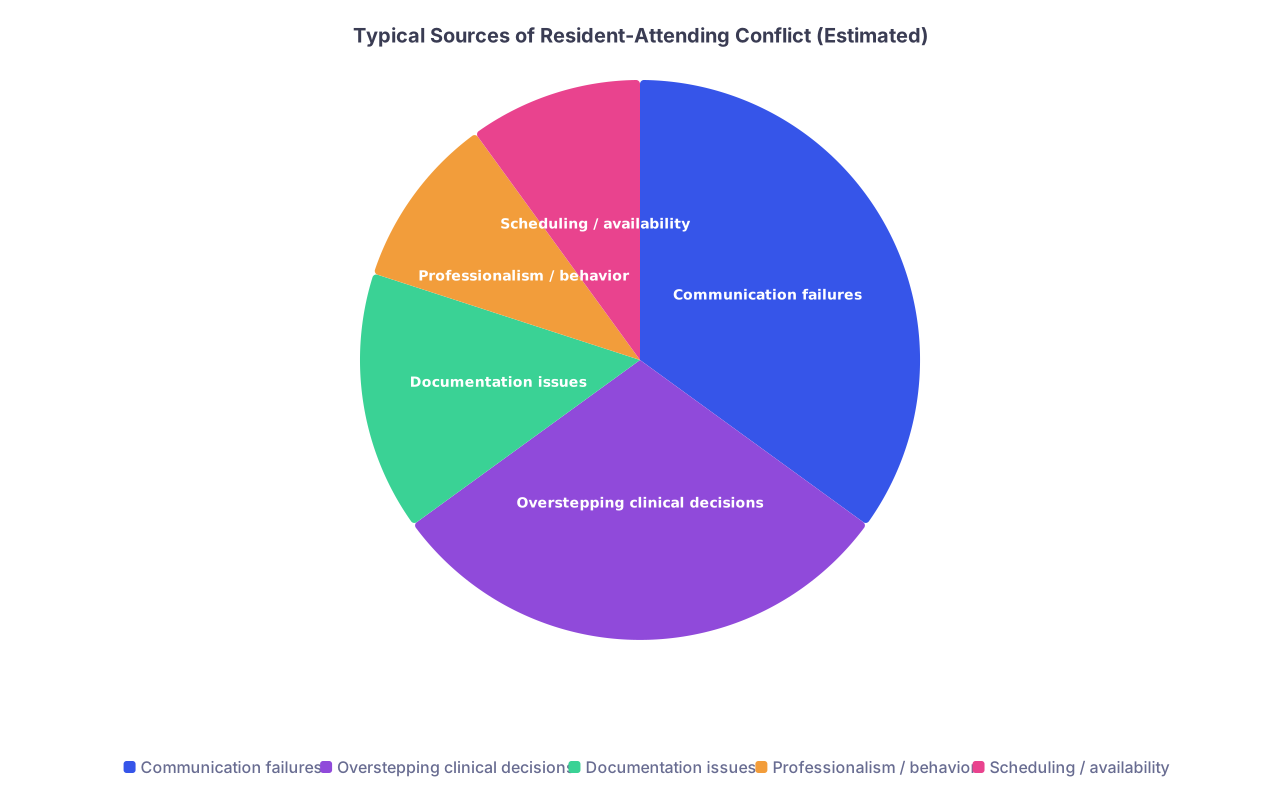
| Category | Value |
|---|---|
| Communication failures | 35 |
| Overstepping clinical decisions | 30 |
| Documentation issues | 15 |
| Professionalism / behavior | 10 |
| Scheduling / availability | 10 |
The Subtle Ways Overstepping Shows Up (That You Think Are Harmless)
Some forms of overstepping are obvious. Others are more insidious. These do not always cause immediate harm, but they erode how attendings see you.
3. Rewriting the Plan Without Saying So
Morning rounds: your attending explicitly states the plan.
- “We are not starting steroids unless they worsen.”
- “We are not transfusing unless Hgb drops below 7.”
- “No more imaging unless neuro changes.”
Afternoon: you are pressured by:
- A consultant who says, “I would just start steroids.”
- A nurse worried about the hemoglobin of 7.4.
- A family demanding “one more MRI.”
You cave. You change the plan “just this once.” You do not notify your attending because you do not want to bother them. And you tell yourself the change is “minor.”
Then on chart review, they see it. Or they show up next morning and the plan is unrecognizable. Now they are asking themselves:
- “Do they even listen when I talk?”
- “Can I trust them to carry out my management?”
That is the quiet loss of trust. They will still be polite. They will still teach you. But they will not rely on you the same way.
Avoidance strategy
If you are going to deviate from an explicit plan, you do one of three things:
- Get approval first.
- If you truly cannot reach them in a time‑sensitive situation, clearly document: “Deviation from discussed plan due to X, attempted to reach attending at times Y and Z.” Then update them as soon as humanly possible.
- Or you hold the line and say to others, “Our attending prefers we not do that; I will discuss it with them and get back to you.”
Anything else looks like you are freelancing.
4. Bypassing Other Services or Hierarchy
You know what irritates attendings very fast? When a resident decides the usual process is optional.
Typical maneuvers:
- Calling CT directly to “squeeze in” your scan without orders fully placed.
- Going straight to an attending surgeon instead of the resident on call “to speed it up.”
- Asking a consultant for an informal curbside that contradicts your own attending’s approach, then quietly following the curbside.
You might think you are being efficient. Attendings see it as:
- Unprofessional
- Disrespectful of systems and colleagues
- Dangerous, because half‑documented requests are how big errors happen
You are teaching people that you go around processes when it suits you. That is not leadership. That is short‑sighted.
Avoidance strategy
Three questions before jumping levels or systems:
- Does this change responsibility or accountability?
- Will someone be surprised or blindsided by what I am about to do?
- Could this reasonably wait for me to clarify the plan with my attending?
If “yes” to any of these, you probably should not be doing it solo.

Overconfidence in Procedures: The Fastest Route to a Quiet Ban
There is a particular kind of overstepping that shuts doors for you: procedural bravado.
I have seen this more than once:
- A PGY-2 does an LP without supervision after only one assisted attempt previously. The result: traumatic tap, wrong level, nearly a cord injury.
- A resident decides to intubate a borderline patient alone “because anesthesia was taking too long,” does not call their attending, fails twice, and now anesthesia walks in to a disaster.
- A surgery resident starts a central line at the bedside without ultrasound and without backup because “it is faster this way,” causing a pneumothorax in a patient who already struggles to breathe.
Technically, in some settings you may “be allowed” to do these. That is not the point. Trust is not about what is technically allowed. It is about what your attending believes you will handle wisely.
Once your name is attached to a preventable complication that happened because you did not ask for supervision, you gain a reputation nobody wants: unsafe.
You may notice, very quietly:
- You get fewer opportunities for procedures.
- Attendings insist on “direct supervision” for you when others get more autonomy.
- You are not the one entrusted with complex airways or critical lines, even when you feel ready.
That is what overstepping does. It narrows your future.
Avoidance strategy
Use a brutally honest checklist before any procedure:
- Have I done this independently before on a similar patient, without issues?
- If this goes bad, can I rescue it alone?
- Would I be fully comfortable explaining my decision to proceed solo on M&M in front of the department?
If the answer to that last question is “no” or even “I am not sure,” you get supervision. No ego. No shame. That is how senior people think.
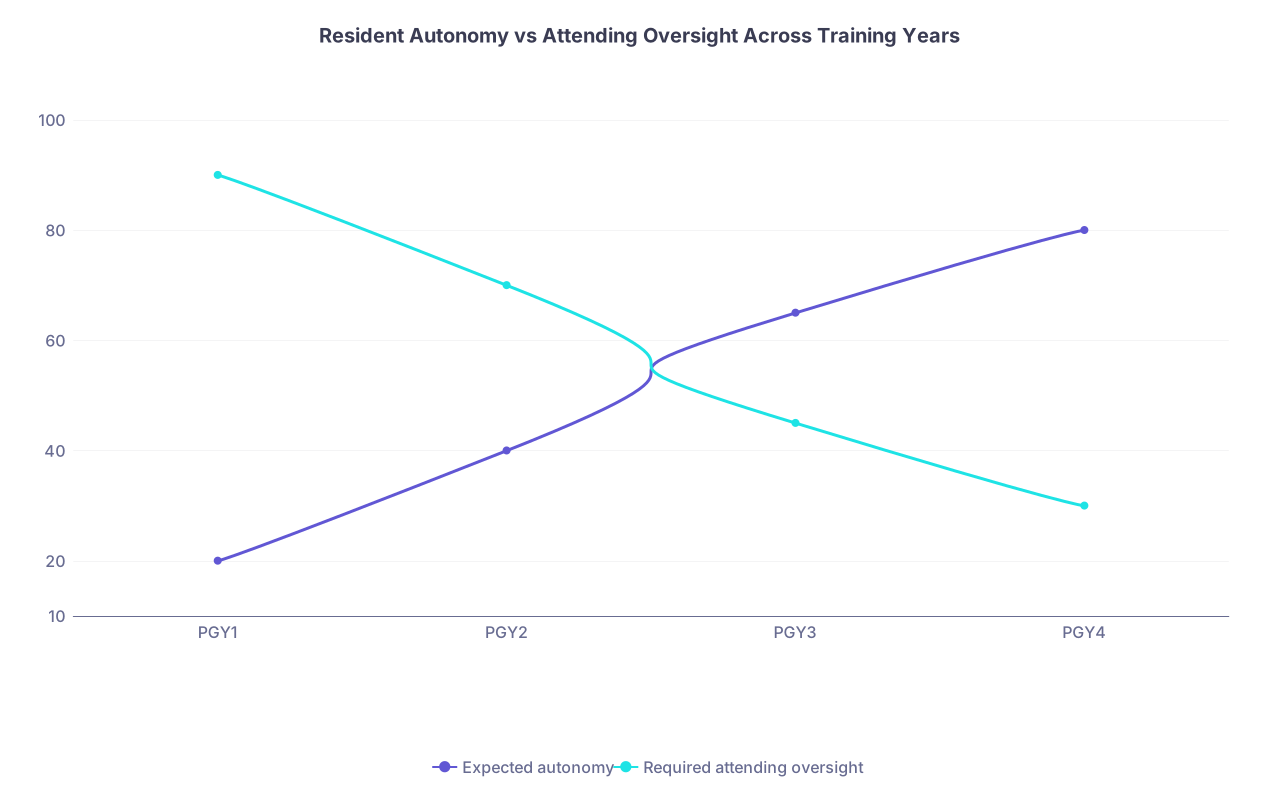
| Category | Expected autonomy | Required attending oversight |
|---|---|---|
| PGY1 | 20 | 90 |
| PGY2 | 40 | 70 |
| PGY3 | 65 | 45 |
| PGY4 | 80 | 30 |
The Documentation Trap: Overstepping on Paper
You can overstep without touching a patient. You can do it in the chart.
A few ways residents sabotage themselves:
Documenting decisions as if they were attending‑level calls.
Writing “We decided to transition to comfort measures only” when in reality you just relayed what the attending said. It sounds minor. It is not. If there is ever legal review, it looks like you made the call.Editing attending notes or orders without telling them.
Adding things to the attending’s assessment that they did not say. Modifying their orders in a way that changes the plan. You might think you are “cleaning up.” They see it as tampering.Using language that implies promises.
“Patient will be discharged tomorrow.” “MRI scheduled for this afternoon.” Now those statements are in stone, and when they do not happen, the family is rightfully upset.
Avoidance strategy
- Always make clear whose decision something is: “Discussed with attending Dr. X; plan is…”
- Do not rewrite an attending’s assessment. Add an addendum if you must, and tell them.
- Favor “Plan: likely discharge tomorrow if stable” rather than firm guarantees.
Good attendings read charts. You will be judged on what you write.

The Psychological Fallout: Once Trust Is Gone, Everything Gets Harder
Let us talk about what actually happens after you overstep and it backfires.
Because it is not just “they were mad for a day.”
Here is what I have seen repeatedly after one or two big missteps:
- Micromanagement: Suddenly your attending wants to know every lab you ordered, every call you made, every med you started. You feel suffocated. They feel forced into it.
- Lost opportunities: That ICU attending who used to let you run the code now runs it themselves. The surgeon who used to let you close the wound now hands it off to someone else.
- Poisoned handoffs: Attendings talk to each other. Not with malice, just self‑protection. “Watch out, they tend to do things without calling.” Once that sentence exists in the ecosystem, you are playing uphill everywhere.
The worst part is you may not get explicit feedback. You just feel the shift:
- Fewer questions directed at you.
- Less trust in your overnight decisions.
- Vague comments about “judgment” on your evaluations.
And trying to “prove” yourself by doing more on your own will only deepen the problem. That is the trap.
How to Show Leadership Without Overstepping
Fine. You know what not to do. What should you do instead if you actually want to be seen as a leader?
1. Over‑communicate Upward on High‑Risk Issues
Strong residents know when to pull the alarm. They are not scared of “bothering” their attending for:
- Acute changes in vitals
- New neuro deficits
- Conflicts with consultants
- Goals of care discussions
- Any decision that feels like a turning point in the hospitalization
You do not page for everything. But you never let your attending be surprised about the big things. That is how trust is built: “If something is important, they will tell me.”
2. Own the Details, Not the Final Calls
Leadership at your level is about execution quality.
- You know the latest labs, not your attending.
- You know family dynamics, not your attending.
- You know which nurse has real concerns and which consultant is dragging their feet.
Use your detailed knowledge to support better decisions, not to make unilateral ones.
Phrase things like:
- “Here are the changes since rounds; what I would consider is X or Y.”
- “Family is asking for Z; I think we need a joint conversation with you involved.”
You are not powerless. You are steering—but with someone else’s hands still partly on the wheel.
| Resident Action | Healthy Initiative? | Dangerous Overstepping? |
|---|---|---|
| Updating routine labs and meds per existing plan | Yes | No |
| Starting pressors on a crashing patient without call | No | Yes |
| Clarifying family questions, deferring big promises | Yes | No |
| Changing code status without attending input | No | Yes |
| Calling consultant per attending plan | Yes | No |
| Overriding explicit attending plan without notice | No | Yes |
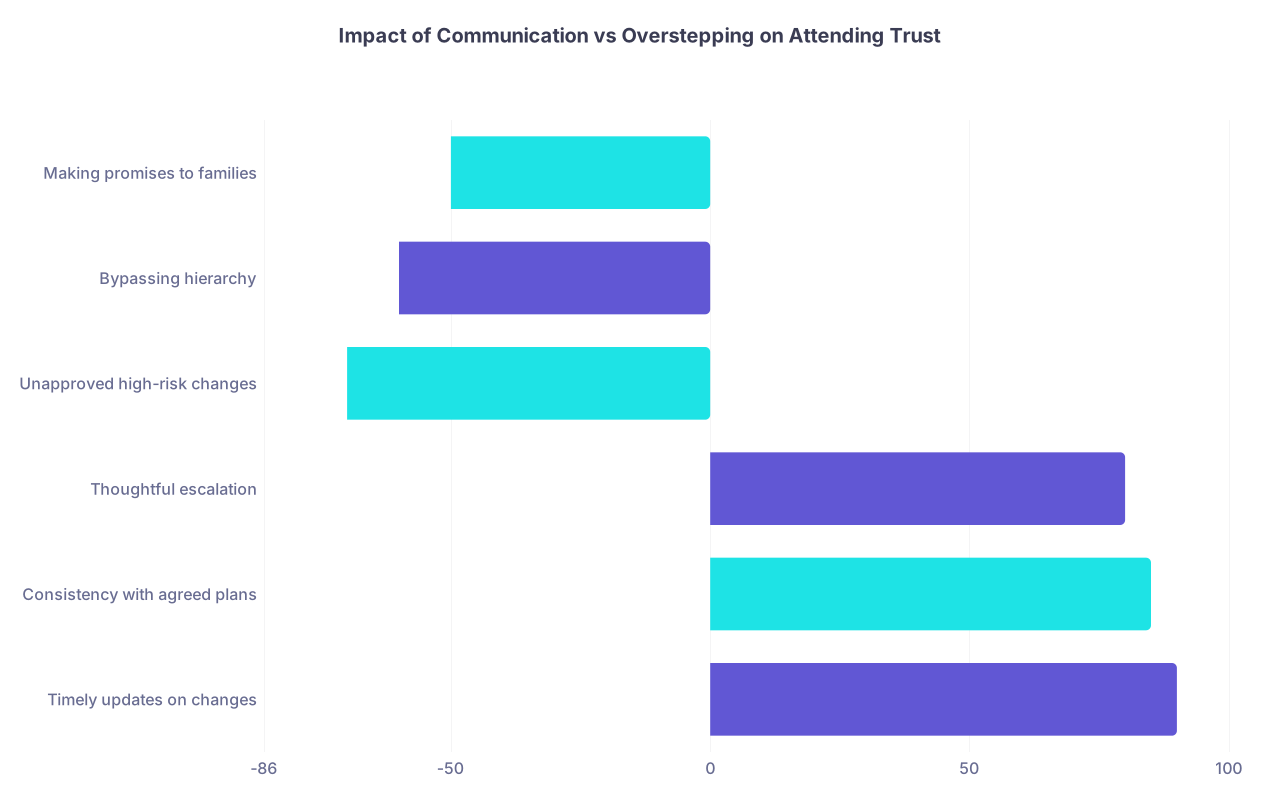
| Category | Value |
|---|---|
| Timely updates on changes | 90 |
| Consistency with agreed plans | 85 |
| Thoughtful escalation | 80 |
| Unapproved high-risk changes | -70 |
| Bypassing hierarchy | -60 |
| Making promises to families | -50 |
3. Ask for the Right Kind of Feedback
Most residents never ask, “Do you feel I am overstepping or under‑communicating anywhere?” They wait for trouble. That is a mistake.
A better move during a calm moment:
“On nights, I sometimes hesitate about when to call you versus manage things myself. Can you tell me where your threshold is and how I am doing with that so far?”
This does three things:
- Signals that you care about appropriate boundaries.
- Gives your attending explicit permission to correct you early.
- Shows insight—one of the main things attendings look for in senior residents.
If they do give you a correction—“Next time, call me before starting a pressor”—you treat that as policy, not a suggestion. One repeat offense in the same domain smells like arrogance, even if you do not feel arrogant.

The Quiet Discipline That Keeps You Out of Trouble
Let me put this as plainly as possible: the residents who end up as trusted leaders are not the ones who “act like attendings early.” They are the ones who:
- Know their limits without being defensive.
- Communicate clearly, especially when things go sideways.
- Respect the chain of responsibility, even when it slows them down.
You are not just protecting yourself. You are protecting patients, colleagues, and your future opportunities.
If you remember nothing else:
- Independence is earned through judgment, not bravado.
- Overstepping feels like “initiative” to you but looks like “risk” to attendings.
- When in doubt on a high‑risk decision, you call. You inform. You document. You do not freelance.
That is how you keep trust intact—and keep doors open.


