

You just finished a 14‑hour call. Your pager finally went quiet. Instead of heading home, you are still in the workroom, sitting next to your intern as they place every single order you dictated. You are watching them click “sign” like a hawk. You are correcting their phrasing in every note. You are re‑writing their plans on rounds while the team stands there, silent.
You tell yourself you are “protecting patients” and “teaching high standards.”
What you are actually doing is micromanaging. And if you keep it up, you will burn out every intern you touch—and yourself along with them.
Let me walk through the specific leadership mistakes that drive interns into the ground, and how to avoid becoming that attending or senior that everyone dreads being assigned to.
1. The Hidden Cost of Micromanaging Interns
Micromanagement in residency is rarely intentional. It hides behind good motives: safety, efficiency, impressing the attending, “setting the tone.” That is why so many smart, well‑meaning seniors slide into it without noticing.
Here is what it looks like in practice:
- You insist on approving every single order, no matter how basic. Even Tylenol.
- You re‑write all your interns’ notes instead of giving feedback on theirs.
- You correct them in front of patients and nurses for small issues.
- You “pre‑chart” everything, then expect them to follow your script.
- You text them off‑hours to check if tasks are done that you already delegated.
On your side of the equation, it feels like control. Safety. Getting things “right.”
On their side, it feels like this: “They do not trust me. I am failing. I am a liability.”
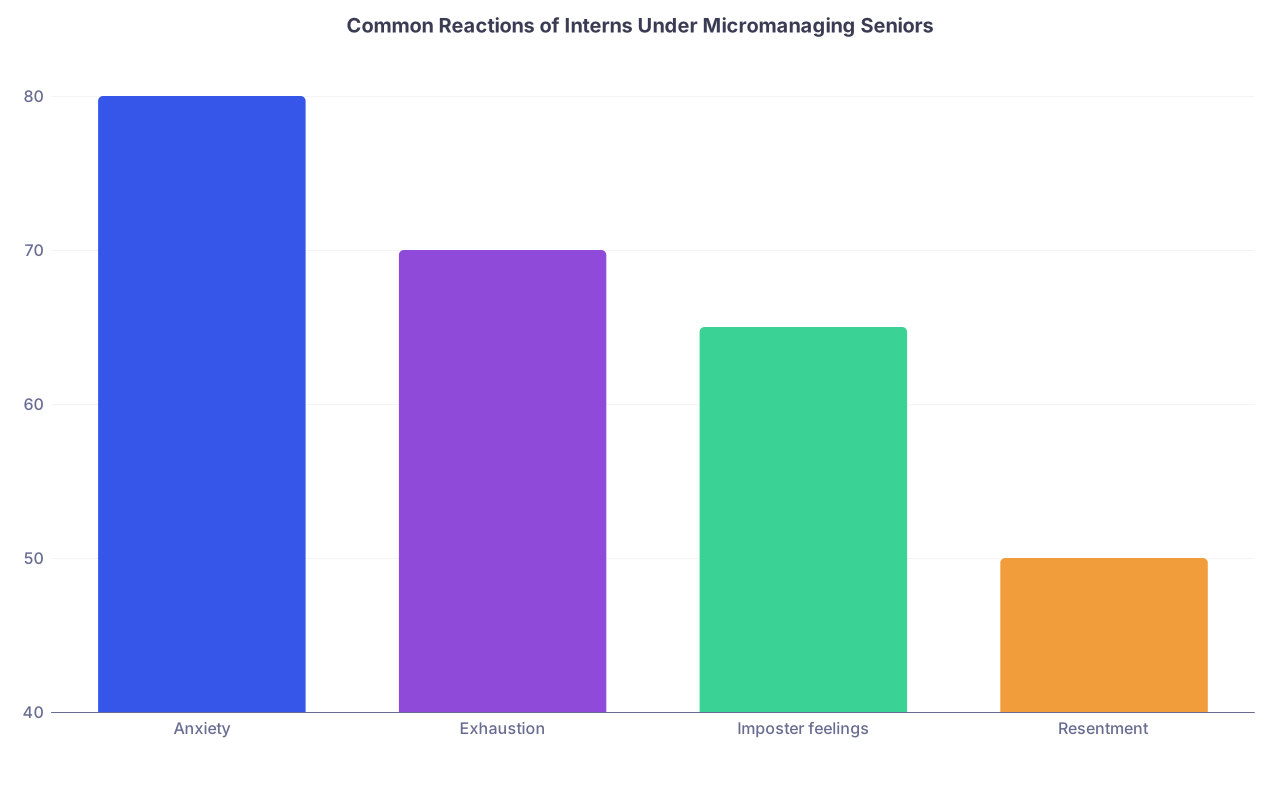
| Category | Value |
|---|---|
| Anxiety | 80 |
| Exhaustion | 70 |
| Imposter feelings | 65 |
| Resentment | 50 |
Those numbers are not made up. On almost every service I have seen, the “highly involved” senior’s teams report:
- Higher anxiety
- More late‑night work finishing notes “to their standard”
- Less independent decision making by the end of the rotation
Translation: you are not actually teaching them to be safe and strong; you are training them to be afraid and dependent.
The worst part: patients do not benefit from a team walking on eggshells. People make more mistakes when they are exhausted, anxious, and terrified of being second‑guessed.
2. Micromanagement Patterns That Burn Out Interns Fast
You do not burn people out with one harsh comment. You burn them out with patterns. Daily, predictable, grinding behaviors.
Here are the big ones you need to recognize—and stop.
A. “Let me just do it” Medicine
You ask the intern to write orders. They start. You sigh, take the mouse, and say, “Here, let me just do it, it’s faster.”
You just taught them three things:
- You do not believe they can learn quickly enough.
- Your time is more valuable than their learning.
- Their role is to watch, not practice.
Repeat this for two weeks, and they are not “slow learners.” They are undertrained because you hijacked every opportunity.
The fix: tolerate inefficiency. Early in the rotation, say explicitly, “It is going to be slower while you do this yourself. That is intentional. I am here if you get stuck.” Then keep your hands off the mouse unless safety is at risk.
B. Real‑Time Note Policing
The classic ICU horror story: senior stands over intern’s shoulder at 6:30 a.m., correcting every sentence in their progress note line by line, muttering, “No, do not say ‘improved,’ say ‘somewhat improved’… change this… reword that…”
Nothing kills confidence faster than having your thinking edited into oblivion before you even get to present.
You need to recognize the line between “feedback” and “control.”
- Feedback: “Your assessment is missing X. Next time, structure it like this.”
- Control: “Delete this sentence. Add this phrase. Move this line here. Use my template or else.”
The fix: let them write the damn note. Read it later. Pick 2–3 specific improvements. Deliver them once a day, not in a nonstop commentary stream. You are training judgment, not copy editors.
C. Over‑checking Basic Tasks
It is 11 p.m. You text: “Did you sign the discharge? Did you send the Rx? Did you call the PCP? Did you schedule the follow‑up?”
You might think you are “supporting” them. What they hear is: “I assume you forgot. I do not trust you. I will monitor you until you prove otherwise (which you never will).”
Once your intern has demonstrated competence on basic tasks, constant checking is not about them. It is about your anxiety.
The fix: set clear expectations early. “For the first 2 days, I will double‑check your discharges. Once I see you are solid, I will step back. If I do not ask, assume I trust your process.” Then actually step back.
D. Hijacking Rounds
You ask your intern, “What is the plan?” They get two words out. You interrupt and deliver a 5‑minute monologue about the disease, management, and follow‑up.
You call it “teaching.” It is not. It is broadcasting.
Teaching involves letting them think out loud. Make a decision. Be a little wrong. Then you refine. You do not bulldoze.
Interns under chronic plan‑hijackers stop preparing. Why bother crafting a thoughtful plan if it will be overwritten in public anyway?
The fix: institute a rule for yourself. Intern always presents:
- Problem
- Brief assessment
- Concrete plan (even if imperfect)
You listen. You ask, “Why?” You correct one or two major points. You do not re‑state the entire thing just to hear your own voice.
3. Why You Micromanage (And How To Stop Lying To Yourself About It)
Most micromanaging seniors will swear they are doing it for “patient safety” and “education.”
Sometimes, that is true. But not usually.
Here are the more honest drivers I have seen:
- You are terrified of looking incompetent in front of the attending.
- You had a brutal, critical senior, and you are copying what you know.
- You equate control with safety because you do not trust systems or other people.
- You get anxious when others move slower or think differently than you.
If you do not confront that, you will rationalize abuse as “high standards.”
Ask yourself, bluntly:
- Do I feel physically uncomfortable when someone else is “running the show”?
- Do I frequently redo other people’s work rather than give feedback?
- Do I feel angry when interns do things a different (but still safe) way?
- Have I heard multiple interns say they feel “watched” or “on edge” around me?
If yes, this is not about your team’s competence. It is about your need for control. And that is dangerous in a leadership role.
4. Safe Medicine vs. Micromanagement: Know the Difference
Let me draw a sharp line. Patient safety is non‑negotiable. Stepping in aggressively is sometimes absolutely correct.
Examples where stepping in hard is appropriate:
- Intern tries to prescribe a clearly wrong dose of a high‑risk medication.
- They repeatedly miss critical labs or vitals despite prior feedback.
- They demonstrate poor insight into their own limitations.
That is supervision. Good. Required.
Where people get into trouble is using “safety” to justify policing everything:
- Renal dose of a med that is slightly conservative but safe? Let it go; discuss later.
- Note formatting that is ugly but accurate? Teach, do not rewrite.
- Slightly different diuresis strategy that is reasonable? Explore their reasoning.
Here is a quick comparison to keep your own behavior honest:
| Behavior Type | Supervision Example | Micromanagement Example |
|---|---|---|
| Orders | Block unsafe insulin dose | Re‑enter all daily electrolyte orders |
| Notes | Flag missing assessment of sepsis | Re‑write entire note in your template |
| Communication | Coach before a hard family meeting | Speak for them in every patient encounter |
| Autonomy over time | Gradually increase with competence | Keep same control level all rotation |
| Feedback style | Focus on patterns and judgment | Fix every small wording and formatting choice |
If you are routinely living in the right column, you are not “careful.” You are suffocating your team.
5. How To Lead Interns Without Crushing Them
You want to protect patients and produce strong residents. Good. You can do both without micromanaging. But you need to be deliberate.
A. Start with Explicit Expectations
Most anxiety comes from guesswork. Interns try to read your mind. They are usually wrong.
Day 1, tell them clearly:
- What you care about most (e.g., “safety and communication beat perfect notes”).
- How and when you like updates (e.g., “text for these three things, otherwise list for rounds”).
- Where you will be more hands‑on at first (e.g., high‑risk meds, discharges).
Then say out loud: “My goal is for you to be running this service independently by the end. I will start close, then back off as you show me you are solid.”
Now they know that oversight is temporary and purposeful, not a commentary on their worth.
B. Use Structured, Not Constant, Feedback
Rotation‑long micromanagers give an endless stream of tiny corrections. It feels like getting pecked to death.
Instead, build a rhythm:
- On rounds: two or three verbal tweaks about plans.
- After rounds or end of day: 5–10 minutes of focused feedback on decision making, not formatting.
- Weekly: bigger picture—“Here is where you are stronger, here is where I want to see growth next week.”
Interns do not need fifty micro‑notes about synonyms. They need to understand:
- Did I miss anything dangerous?
- Was my thinking sound?
- How do I prioritize better next time?
If you cannot answer those because you are too busy fiddling with commas, that is a you problem.
C. Deliberately Hand Over Control
Do not wait for the last day to say, “Okay, you run the list.”
Map out a progression:
Week 1:
You lead rounds, intern presents and suggests plans. You approve all high‑risk orders.
Week 2:
Intern runs parts of rounds (e.g., stable patients or their own admissions). You watch and step in only when necessary.
Week 3+:
Intern runs the entire list. You are the safety net and consultant, not the puppeteer.
Spell this out. “On Monday, you are taking over running the list. I am there, but you are the quarterback.”

| Step | Description |
|---|---|
| Step 1 | Week 1 - Observe and Guide |
| Step 2 | Week 2 - Shared Control |
| Step 3 | Week 3 - Intern Leads |
| Step 4 | End of Rotation - Independent Intern |
Do not move the goalposts. If they are safe and improving, let it be a little messy. Medicine is messy.
D. Protect Their Cognitive Bandwidth
Micromanagement eats mental energy. When interns are spending 30% of their brain power anticipating your next criticism, they have less left for… actual medicine.
Things that look “small” but drain them:
- Forcing three different note templates in two weeks.
- Changing your preferred presentation style daily.
- Publicly correcting minutiae (word choice, tiny lab deltas) in front of the team.
Be boringly consistent. Pick one structure. Stick to it. Make changes only if there is a clear reason, and explain why.
Your job is to simplify the frame so they can think.
E. Do Silent Oversight, Not Performative Oversight
You are absolutely allowed to keep a closer informal eye on a shaky intern. But you do not need to make that visible every minute.
Example:
- Quietly skim their orders at lunch. If something is off, discuss privately.
- Read two notes per day in detail rather than hovering for all ten.
- Ask them to “talk through their plan” with you briefly before implementing on the first few sick patients.
When you can correct issues without public theater, do that. You maintain safety, and they maintain dignity.
6. Red Flags That You’re Already Burning Out Your Team
If any of these sound familiar, you have work to do.
- Interns on your team stop volunteering ideas. You talk, they nod.
- They ask permission for every tiny decision, even after weeks together.
- You hear they are staying late re‑writing notes “to your standard.”
- Nurses bypass interns and go straight to you by default.
- Attending comments on you answering every question instead of letting trainees respond.
One of the clearest signs: your interns perform worse with you than with others. Less confidence. Sloppier presentations by the end of the rotation, not sharper. That is not them suddenly becoming incompetent. That is the damage of constant second‑guessing.
If you are brave, ask directly at mid‑rotation: “Do you feel like I trust you? Are there places I am too in your space?” And then listen. Without defending. Without explaining “why.” Just hear it.
7. Protecting Yourself From Becoming That Senior
You are not immune. Especially as you move from intern to senior.
Common trap: you get promoted, you do not trust your own leadership yet, so you cling to control of everything.
Guess what you become? The same suffocating senior you swore you would never emulate.
A few guardrails for yourself:
- Pick two domains where you will be strict (e.g., safety checks, communication) and relax on others (note style, exact phrasing).
- Give yourself a rule: for every thing you “fix,” you must explain why. Out loud. That friction will cut down on compulsive tinkering.
- Have a peer who can call you out. “You are re‑writing all their notes again. Stop.”
And remember this: your job as a senior is not to show the attending how smart you are. It is to make your intern competent and confident enough that the system is safe when you are not there.
If you leave a rotation with perfect notes and terrified interns, you failed.
FAQ (Exactly 4 Questions)
1. How do I know when it is safe to give an intern more autonomy?
Look at patterns, not one‑off mistakes. If they consistently recognize sick vs stable, call for help appropriately, and handle routine tasks (orders, discharges, notes) without major omissions, they have earned more space. Start by letting them manage stable patients and admissions independently with you reviewing afterwards. If their decisions are reasonable and safe—even if not identical to yours—back off more.
2. What if my attending expects perfection and I feel forced to micromanage?
Name the tension to the attending early: “I want to keep high standards without crushing intern autonomy. Are you okay if notes are imperfect while they learn?” Most decent attendings will agree. If not, protect your intern where you can: do silent oversight, give private feedback, and avoid public nitpicking. You can still shield them somewhat, even under an overly controlling attending.
3. How do I give feedback without it feeling like micromanagement?
Make it time‑limited and focused. Do not correct everything in real time. Instead, say, “Let us talk about your last two admissions,” and highlight 2–3 key themes: prioritization, recognition of red flags, clarity of assessment. Avoid obsessing over documentation cosmetics unless they affect patient care or communication. Teach them how to think, not how to copy your personal style.
4. What if an intern is truly unsafe—am I still micromanaging if I stay on top of everything?
A clearly unsafe intern requires close supervision. That is not micromanagement; that is your duty. The difference is intent and transparency. Tell them directly: “Given these safety concerns, I will be much more involved in your orders and plans until we see consistent improvement.” Set concrete goals and timelines. Document, involve program leadership if needed, and aim to remediate—not quietly smother them with control for the entire year.
Key points to carry with you: micromanagement is not safety, it is control. Autonomy is not a luxury; it is how interns become real physicians. If you want to protect your patients and your team, supervise firmly where it matters—and get out of the way everywhere else.


