

If you are reacting all night, you are already behind.
Chaotic call nights do not destroy you because they are busy. They destroy you because you have no system. The residents who drown on call are not weaker; they are improvising. The ones who look strangely calm at 3:00 a.m. are running a repeatable playbook.
This is that playbook.
1. Before the Chaos: How You Start Determines How You Finish
If you “see what happens” on call, you have lost by 7 p.m.
You need a pre-call routine that is almost boring in its repetition. Five key objectives:
- Know your patients.
- Know your resources.
- Set expectations with the team.
- Build your “war board.”
- Decide how you will triage.
A. The 30–45 Minute Pre-Call Handoff You Actually Need
Stop accepting garbage sign-outs. You are the doctor overnight. If something goes wrong, “the note said stable” will not save you.
During sign-out, get:
The real sick list:
- Who is on vasopressors?
- Who was in rapid response / code today?
- Who has a chest tube, external ventricular drain, LVAD, ECMO, BiPAP?
- Who is “one bad decision from ICU”?
The “likely to blow up” list:
- New GI bleed, borderline vitals, not fully worked up
- DKA just arriving to the floor
- Unstable arrhythmias in last 24 hours
- Fresh postop day 0–1 with borderline labs or big comorbidities
- New sepsis on broad antibiotics but no clear source
The “do not miss overnight” tasks:
- “Needs midnight BMP” (why? what are we looking for?)
- “Check H/H at 2 a.m.” (what are our transfusion thresholds?)
- “Repeat troponin at 11 p.m.” (what is the plan if it is up?)
- “Re-eval pain and advance diet if OK” (what exactly is ‘OK’?)
If they say “they’re fine,” translate that into: “I have not thought this through.” Ask:
- “If something goes wrong with this patient tonight, what is it most likely to be?”
- “What would you do first if you were here at 2 a.m.?”
You are not being annoying. You are preventing 3 a.m. disasters.
B. Build the War Board
You cannot keep a 30–40 patient service in your head. Stop trying.
Use a single glanceable system. Could be:
- A whiteboard in the workroom
- A paper list with sections
- A digital board with clear tags
Core elements:
- Column 1 – Sick/Watch Closely
- Mark with a star, highlight, or “SICK” in caps
- Include room, one-liner, primary issue, and main risk
- Column 2 – Time-Sensitive Tasks
- Labs to check at specific times
- Imaging results you must follow up
- Reassessments promised to families or consultants
- Column 3 – New Admissions
- Slots ready to fill as they arrive
- Quick labels: “likely floor,” “may need ICU,” “rule-out vs confirmed sick”
This is your command center. Refer to it every 30–60 minutes. Update it ruthlessly.
C. Decide Your Triage Rules Before Things Get Ugly
The worst time to invent priorities is when you are already overwhelmed.
Make explicit decisions:
- “If 2 new admits + 2 pages come at once, what gets done first?”
- “When do I call the attending without debate?”
- “What is my threshold for ICU upgrade tonight?”
Write your non-negotiables on a sticky note or in your brain:
- Any acute mental status change → evaluate in person quickly.
- Any MAP < 60, SBP < 90, new O2 requirement, or new tachy to 140+ → see now.
- New chest pain with concerning features → immediate evaluation, EKG, labs.
- “Nurse is worried” + abnormal vitals → treat as real until proven otherwise.
If you walk into the night with these rules prepared, your decisions under pressure will be much faster and much cleaner.
2. Running the First 2 Hours: Set the Tone or Get Buried
The first 1–2 hours of call decide whether the night feels barely controlled or completely out of control.
Your goals from 7–9 p.m.:
- Clear the known tasks.
- See the sickest patients yourself.
- Build goodwill with nurses.
- Establish communication patterns that will save you at 3 a.m.
A. Do a Quick Sickness Round
After sign-out:
- Pick your top 3–5 highest-risk patients.
- See them in person.
- Do a very focused mini-round:
- Look at them. Not just the monitor.
- Recheck vitals and IV access.
- Ask the nurse: “Any worries about this patient tonight?”
You will catch:
- The patient already getting worse, but “has not triggered a call yet.”
- The subtle change the nurse has not had time to mention.
- The missing order that would have caused problems at 1 a.m. (like no sliding scale insulin on a T1 diabetic NPO).
You are not doing full H&Ps. You are sanity-checking the people who can ruin your call if things go wrong.
B. Knock Out Predictable Time Bombs Early
Look at your task list:
- Timed labs that can be drawn by 10 p.m. instead of 2 a.m.? Move them.
- One-time doses that can be given earlier without harm? Adjust.
- Awkward things like “2 a.m. dressing change” that could reasonably be done at 10 p.m.? If safe, negotiate with the nurse and update orders.
Objective: remove unnecessary 1–4 a.m. interruptions.
C. Align With the Charge Nurse
Five-minute conversation. Non-optional if you want to survive.
Ask:
- “Who are you most worried about tonight?”
- “Any difficult families I should know about?”
- “Where do you think the first rapid response will happen if it happens?”
- “How many nurses are on? Any new staff who may need more support?”
Then say clearly:
- “If something seems off, even if vitals look okay, please call me early. I would rather get a ‘false alarm’ at 10 p.m. than a train wreck at 3 a.m.”
You just bought early warning and goodwill.
3. Triage in Real Time: The 4-Bucket System
When everything hits at once—pages, admits, rapid response—you need a default mental model. I use a simple 4-bucket system:
- Immediate (Now)
- Urgent (0–30 minutes)
- Routine (This hour)
- Deferrable (Later or Sign-out)
You apply this to every new demand: page, consult, order, admission.

| Step | Description |
|---|---|
| Step 1 | New Page or Task |
| Step 2 | Go now |
| Step 3 | Do within 30 min |
| Step 4 | Do this hour |
| Step 5 | Defer or sign out |
| Step 6 | Life threat? |
| Step 7 | Could worsen soon? |
| Step 8 | Needs done tonight? |
Bucket 1 – Immediate (Drop Everything)
Examples:
- “Patient is unresponsive.”
- “SpO2 dropped to 80% on 4 L.”
- “BP 70/40 and they look bad.”
- “Active seizure now.”
- “Massive bleed: vomiting bright red blood, large melena with hypotension.”
Actions:
- Tell whoever is with you: “I am going to room X now.”
- On the way, call:
- Rapid response / code if indicated.
- Charge nurse to mobilize resources.
- Attending concurrently if this is big (massive GI bleed, likely intubation, etc.).
You do not finish notes. You do not review other pages. You move.
Bucket 2 – Urgent (0–30 Minutes)
Examples:
- New-onset chest pain with stable vitals.
- Fever 39.5°C in neutropenic patient, hemodynamically stable.
- Post-op with rising HR to 130, BP okay, more pain.
- New mental status changes but vitals stable.
Rule: Place them in the front of your queue, but you can finish truly immediate tasks (like hanging pressors in another room) first.
Key move: Text or call the nurse back and say:
- “I will be there within 15–20 minutes. In the meantime, please do X (EKG, repeat vitals, send lactate, etc.). Call me back sooner if BP drops below Y or HR above Z.”
You just:
- Acknowledged the concern.
- Gave interim steps.
- Defined escalation criteria.
Bucket 3 – Routine (This Hour)
Examples:
- Pain is not well controlled; asking for adjustment.
- Glucose 320 in stable patient.
- Mild worsening leg edema.
- Request to clarify diet or bowel regimen.
You aim to:
- Batch these tasks.
- Handle several when you are already at the computer or near that part of the floor.
- Use them as “breathers” between high-intensity events.
Bucket 4 – Deferrable (Later or Sign-Out)
Examples:
- Family wants an extended update “whenever you have a chance.”
- Non-urgent med reconciliation on an already stable patient.
- Clarification on a discharge plan that is for tomorrow.
- Case management questions that cannot be solved at 1 a.m.
Two rules here:
Do not be rude, but do be honest:
- “Tonight is very busy with acutely sick patients. I may not get to this in detail, but I will flag it for the day team and document your concern.”
Document the ping in your sign-out or message system.
You cannot treat every task as urgent and still function. You are making choices either way. Better to make them consciously.
4. Commanding the Team: You Are the Calm in the Storm
Chaotic nights fall apart because everyone starts working in parallel with no coordination. Your job as senior resident is to prevent that.
You need to:
- Assign roles fast.
- Communicate clearly.
- Make decisions, even if imperfect.
A. Rapid Role Assignment: Who Does What
When multiple things hit at once:
- A new admit from ED
- A rapid response on the floor
- Two nurses with urgent questions
You say explicitly:
- “Intern A: Go to the rapid response in 5W, call me with a 60-second update in 3 minutes.”
- “Intern B: Start the H&P on the ED patient, get vitals, start basic orders. I will join after I check 5W.”
- “Med student: Pull the last 24 hours of labs/imaging on the sickest patient on our list and have it ready when I get back.”
People want to help. They just do not know where to start. You tell them.
B. Use Closed-Loop Communication
Lazy communication kills time and occasionally patients.
Do not say:
“Okay, someone call respiratory.”
Say:
“Alex, please call respiratory for stat BiPAP in room 412. Then come back and tell me when they are on their way.”
And when someone gives you information:
- Them: “Potassium back at 2.8.”
- You: “I heard 2.8, hypokalemia. I will place an order for IV KCl now, then recheck BMP in 4 hours.”
This reduces “I thought you meant…” disasters.
5. Decision Algorithms That Save You at 3 a.m.
You do not need perfect medicine at 3 a.m. You need safe, systematic medicine. Here are a few core decision frameworks you should run in your head.
A. The “Is This Patient Crashing?” Checklist
For any “patient is not doing well” page:
- Airway – Can they speak in full sentences? Gurgling? Stridor?
- Breathing – SpO2? Work of breathing? New wheeze/crackles?
- Circulation – HR, BP, temp, capillary refill, mental status.
- Mentation – Alert? Confused? Agitated? Lethargic?
- Glucose – Check fingerstick in any altered patient.
If any of these are genuinely off and deteriorating, escalate immediately:
- Rapid response.
- Call attending.
- Consider early ICU input.
B. The “Should I Upgrade to ICU?” Framework
Ask yourself:
- Does this patient need:
- Continuous titratable vasopressors?
- Invasive monitoring (arterial line, central line with active titration)?
- Non-invasive ventilation that is not stable (escalating BiPAP, not tolerating mask)?
- Hourly neuro checks with real risk of deterioration?
- Frequent interventions you cannot safely do on the floor?
If yes, stop trying to be a hero on the floor. Call the ICU fellow/attending. Phrase it like this:
- “I am worried this patient is beyond what we can safely manage on the floor because of X, Y. I am calling early rather than late.”
You will almost never regret upgrading too early. You will absolutely regret upgrading too late.
6. Time Management Under Fire: Protect Your Bandwidth
On a chaotic night, your real job is not to write perfect notes. It is to protect your brain from fragmentation.
A. Batch Tasks Aggressively
Stop opening a new chart with every page.
Instead:
- Keep a running list (paper, phone, or EMR sticky):
- Patient – Task – Urgency bucket.
- Every 20–30 minutes, do a “batching block” for 10–15 minutes:
- Answer non-urgent pages in one session.
- Place a set of related orders together.
- Update 3–4 notes in one go rather than one note every 40 minutes.
You will cut your mental switching costs by half.
B. Protect 10–15 Minutes for Documentation Twice per Night
You think you will “catch up on notes later.” You will not. Then you get crushed on post-call rounds.
Set two deliberate documentation blocks:
- 11 p.m.–12 a.m.: Get at least skeleton H&Ps and key event notes in.
- 3–4 a.m.: Update with key overnight events, ensure critical sign-out items documented.
During those blocks:
- Tell the team: “For the next 20 minutes I am at the computer finishing admissions. If something is urgent, page STAT or call my phone directly. Otherwise I will get to messages after this block.”
You are not ignoring people. You are declaring how to contact you for true emergencies.
7. Communication With Attendings: Call Earlier Than You Think
Residents under-call because they fear looking incompetent. That is backwards. Good attendings would rather be called for near-misses than be blindsided at M&M.
Use a simple internal threshold:
- “If I had to justify not calling this to the PD or at M&M tomorrow, would I feel solid?”
Situations where “just call” is the right move:
- Possible need for ICU transfer.
- Unexpected serious deterioration (new stroke, massive PE, sepsis with borderline BP).
- Any case where you are about to do something big:
- Thrombolytics.
- Emergent OR for a borderline patient.
- Stopping essential home meds in a complicated patient (e.g., transplant immunosuppression).
How to call efficiently:
- Lead with a one-liner:
- “This is Dr. X, senior on night float. Calling about Mr. Y, 68-year-old with sepsis who is now hypotensive despite 3 L fluids.”
- State your concern:
- “I am worried he is failing floor-level care.”
- Present key data in 30–45 seconds:
- Vitals trends, O2 needs, labs, lactate, urine output, mental status.
- Propose a plan:
- “I am starting norepinephrine and think we should transfer to ICU. Do you agree, and anything you would add?”
Attendings respect concise, structured communication. They do not expect you to know everything, but they expect you to recognize when to ask.
8. Using Data and Patterns to Improve Your Call Nights
Chaotic nights feel unpredictable, but they are not completely random. Patterns exist:
- Admissions peak around certain hours.
- Certain services generate more nighttime work.
- Some pages are low-yield noise, others predict real deterioration.
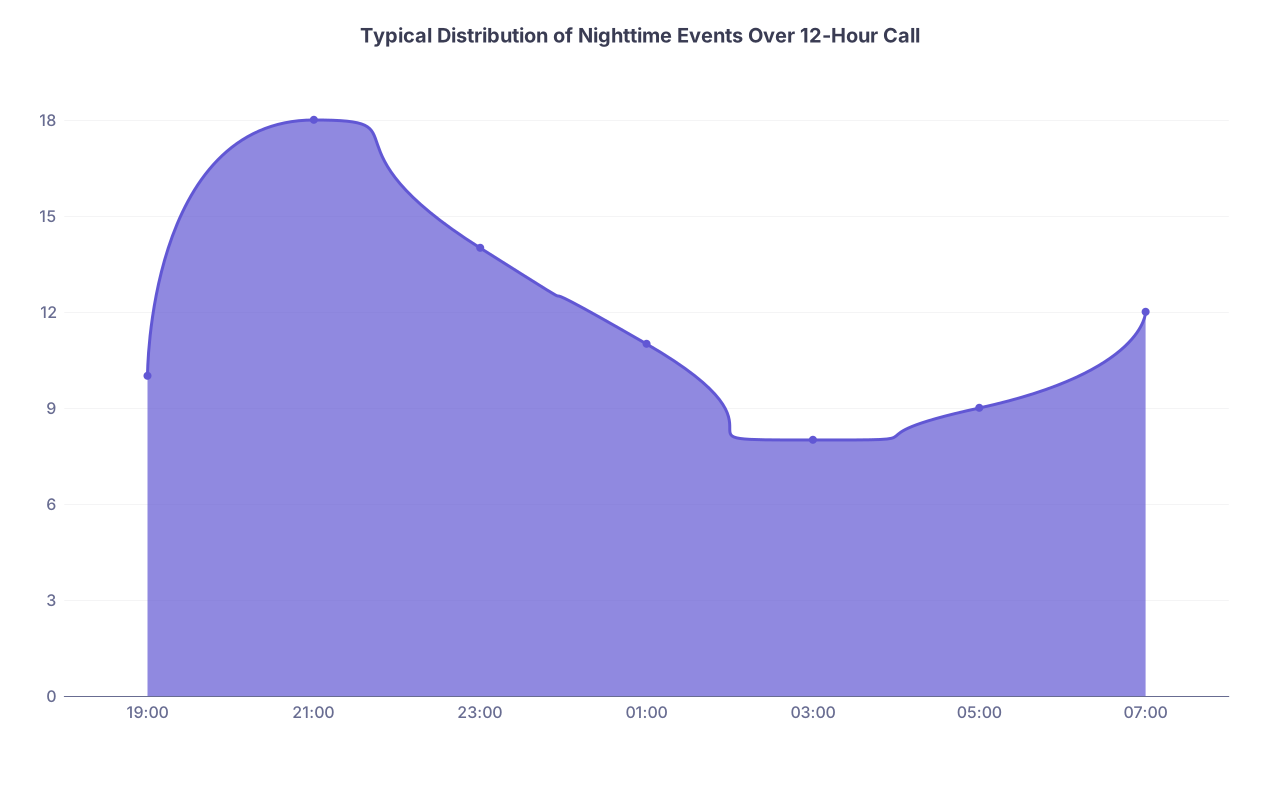
| Category | Value |
|---|---|
| 19:00 | 10 |
| 21:00 | 18 |
| 23:00 | 14 |
| 01:00 | 11 |
| 03:00 | 8 |
| 05:00 | 9 |
| 07:00 | 12 |
Where this helps you:
- Expect more admissions early in the night → stay aggressive about admin and batching 7–11 p.m.
- Realize that 1–4 a.m. are often quieter but fatigue is higher → schedule your quick self-checks (snack, water, 5-minute reset) here.
- Identify chronic offenders:
- A specific service with constant non-urgent pages.
- A recurring documentation gap that generates calls.
Log 3–4 chaotic nights briefly (even just on your phone):
- What kinds of pages?
- What times?
- What felt most overwhelming?
Then go to your chief or a trusted senior and say:
“Here are the patterns I am seeing. How would you handle or prevent these?”
You will get service-specific hacks that no textbook mentions.
9. Protecting Yourself and Your Team: Micro-Recovery and Debrief
You are not a robot. On a wild call night, you must manage your own physiology or your decision-making will degrade.
A. Micro-Recovery During the Night
Simple, non-negotiable moves:
- Hydrate early:
- Drink water before you feel thirsty, especially in first 3 hours.
- Eat something with actual calories, not just coffee:
- One real snack/meal before midnight, one light snack after if possible.
- 3-minute reset:
- After a code or high-stress event, step into a quiet area.
- Three slow breaths in and out.
- Quick mental check: “What is next? What is my top priority now?”
This is not wellness fluff. This is brain maintenance so you do not miss something obvious at 5:30 a.m.
B. End-of-Night Debrief (5–10 Minutes)
Before morning sign-out, ask yourself:
- What went well that prevented worse chaos?
- Where did we get bogged down?
- Which pages or events could have been prevented by earlier action?
If you have an intern or student, pull them aside:
- “Here is what worked last night. Here is where we struggled. Next time, here is what I want us to do differently.”
You are building their playbook while refining your own.
10. A Quick Reference Playbook You Can Actually Use Tomorrow
This is the condensed version you can screenshot and keep.
| Step | Action |
|---|---|
| 1. Pre-call | Strong sign-out, identify sick/watch list, build war board |
| 2. 7–9 p.m. | See top 3–5 sickest, clear timed tasks, talk to charge nurse |
| 3. Triage | Use 4 buckets: Immediate, Urgent, Routine, Deferrable |
| 4. Team | Assign roles explicitly, use closed-loop communication |
| 5. Decisions | Use A-B-C-D-Mentals-Glucose and ICU need checklist |
| 6. Time | Batch tasks, 2 documentation blocks, protect bandwidth |

11. A Worked Example: One Chaotic Hour, Step by Step
To make this concrete, walk through a real scenario. You are the senior on a busy internal medicine service at 11:30 p.m.
Events in 5 minutes:
- Page 1: “Chest pain in room 612, stable vitals.”
- Page 2: “Temp 39.2 for neutropenic patient, ANC 300 in 5N.”
- Page 3: “Family in room 502 insists on speaking with doctor about plan.”
- Pager beeps with new admission from ED with hypotension and suspected sepsis.
Here is how you run it.
Rapid triage—bucket everything
- Chest pain – Urgent (0–30 min).
- Neutropenic fever – Urgent (0–30 min).
- Family meeting – Deferrable.
- New septic admission – Likely Immediate or high Urgent, depending on vitals.
Get quick data before moving
- Call ED: “Quick update on sepsis admit – current vitals, lactate, pressors?”
- They say: BP 88/52 despite 2 L fluids, HR 120, febrile, on 2 L NC.
- This becomes Immediate.
- Call 5N nurse: “How does neutropenic patient look? Vitals? Any localizing signs?”
- Call 612 nurse: “Describe the chest pain – exertional vs pleuritic, any EKG yet?”
- Call ED: “Quick update on sepsis admit – current vitals, lactate, pressors?”
Assign roles
- You: Go straight to ED septic patient; potential ICU-level issue.
- Intern A: Go to chest pain in 612, get focused H&P, STAT EKG, troponin, call you with update in 10–15 minutes.
- Intern B: See neutropenic fever in 5N, pull up last cultures, start febrile neutropenia protocol you agreed on during pre-call (broad-spectrum antibiotics, blood cultures).
- Med student: Print or pull up relevant notes/imaging for septic patient and meet you in ED.
Communicate expectations
- To both interns: “Call me if either looks unstable or if EKG is concerning. Otherwise, I will call you back after I stabilize ED patient.”
- To nurse for family in 502: “Please let them know I am tied up with a couple of acutely ill patients. If I cannot come tonight, I will relay details to the day team and document all concerns.”
Execute, then re-synchronize
- You stabilize/semi-stabilize the ED patient.
- 30–40 minutes later, you regroup with interns:
- Chest pain: Probably non-ACS, ECG and trops reassuring.
- Neutropenic fever: Antibiotics started, vitals okay.
By 12:30–1:00 a.m.:
- Immediate life threat addressed first.
- Two urgent issues delegated with clear plans.
- Non-urgent family conversation honestly deferred but not ignored.
- No one felt abandoned, and nothing critical was missed.
This is leadership. Not magic. System.
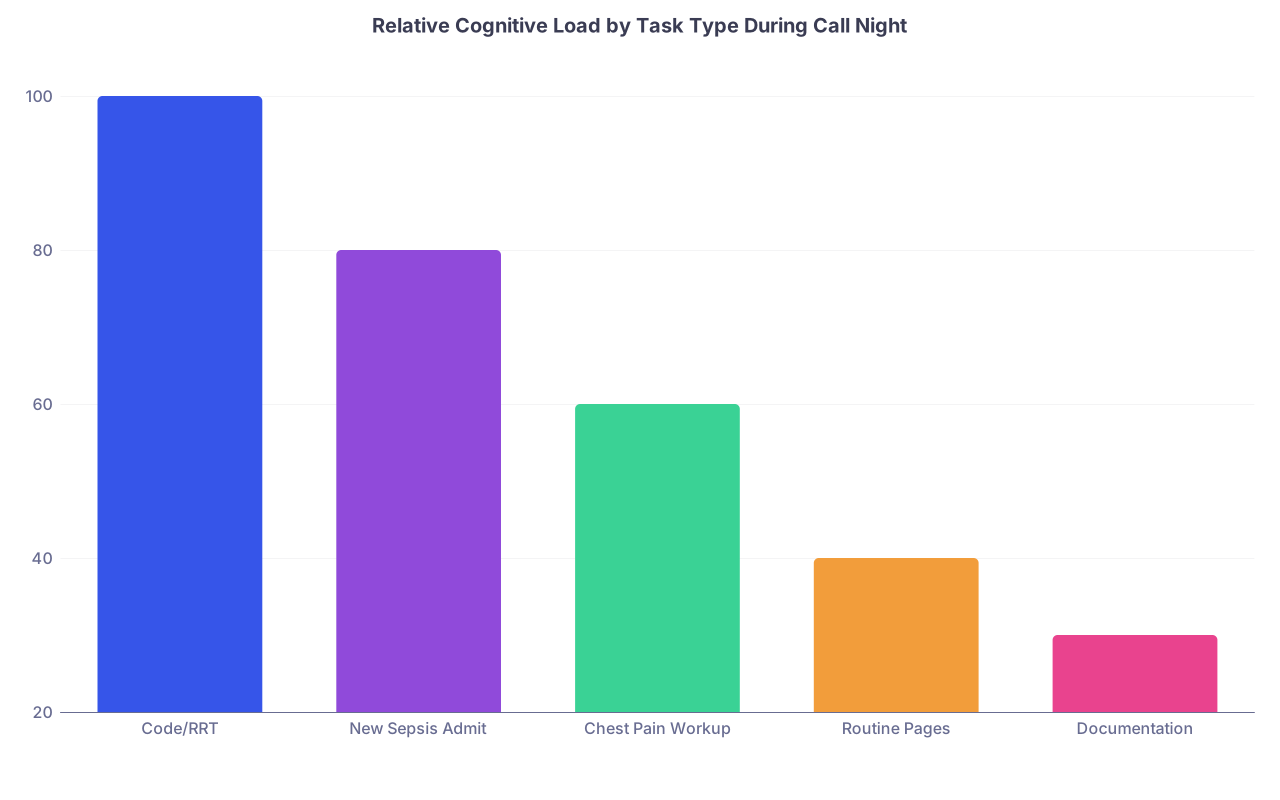
| Category | Value |
|---|---|
| Code/RRT | 100 |
| New Sepsis Admit | 80 |
| Chest Pain Workup | 60 |
| Routine Pages | 40 |
| Documentation | 30 |

The Bottom Line
Three points you need to walk away with:
Chaos demands a system, not heroics. If you build a repeatable structure—pre-call prep, clear triage buckets, and role assignment—you will outperform residents who “wing it,” no matter how smart they are.
Your primary job on a brutal night is prioritization and communication. You are the one who decides what happens now vs later, who does which task, and when to pull in help. The medicine matters, but your leadership multiplies or destroys that medicine.
Improve a little every call. After each bad night, grab one failure point and fix it in your playbook. Over a few months, you will go from drowning to being the person others quietly watch and think: “How are they so calm?”


