

The residents everyone likes rarely become chiefs. The residents who avoid the traps in this list do.
If you want chief potential, you cannot just be “nice,” “hard‑working,” or “a team player.” Chiefs are chosen for who they are when no one is watching at 3 a.m., not for how they look on graduation day. The problem is that most future non‑chiefs sabotage themselves quietly with behaviors they think are harmless or even smart.
Let me walk you through the 10 behaviors that quietly kill chief potential in residency. I have watched them sink people who should have been slam‑dunk choices.
1. Acting Like a Union Rep Instead of a Bridge
There is a difference between advocating and antagonizing. Many residents never learn it.
The trap: You frame yourself as “the voice of the residents” by:
- Sending scorched‑earth emails about schedules, call, or workload
- Publicly cornering PDs or APDs during conferences
- Turning any minor issue into an us‑vs‑them battle with leadership
You think this proves you care about your co‑residents. Leadership sees something else: someone who will be impossible to work with when they hold actual authority.
I have seen residents who:
- Organized a “mass refusal” to do a bad rotation change without even trying a quiet conversation first
- Called out attendings by name in group emails
- Told interns, “Administration does not care about us; we have to push back hard”
None of them became chief. Not because they raised concerns. Because they made everything combative.
Chiefs are bridges:
- They validate resident concerns without trashing leadership
- They push hard in private, de‑escalate in public
- They know when to fight and when to negotiate
If your go‑to move is to embarrass leadership or rally people against them, you are not going to be invited into their most trusted role.
Avoid this trap:
- Take serious concerns up first, 1:1, not in a group email or group chat screenshot
- Drop the hostile tone: no all caps, no sarcasm, no threats
- Ask, “What is actually changeable here?” before you light anything on fire
Your job is not to be a martyr. It is to be effective. Chiefs are chosen for effectiveness, not theatrical outrage.
2. Being a Black Box: Unpredictable, Hard to Read, or Inconsistent
Programs do not choose chiefs they cannot predict.
The trap: You think “I just keep my head down and do my work; they know I am solid.” They do not. They know:
- Some days you are fantastic
- Some days you look checked‑out
- Some days your notes are pristine; other days they are late and sloppy
Unpredictability makes leaders nervous. They cannot afford a chief who is amazing…when they feel like it.
Common black‑box behaviors:
- Mood swings that affect how you treat nurses, students, or juniors
- Occasionally blowing up when stressed, then going back to “normal”
- Being vague about your availability or frequently switching shifts at the last minute
Here is what chiefs look like to PDs:
- Steady, boringly reliable
- Same person at 9 a.m. and 3 a.m.
- Can be trusted not to shock anyone with some unexpected meltdown or rumor
Avoid this trap:
- Cut the “I’m just having a bad day, everyone should understand” mindset
- If you are struggling, proactively tell someone you trust, not after three weeks of passive chaos
- Review yourself: are you different on “good” versus “bad” rotations? Leadership notices that pattern too
If people have to guess which version of you is showing up, you have already lost chief ground.
3. Quietly Undermining Colleagues (Especially Other Strong Residents)
This is the chief‑killer I see the most. Nobody admits to doing it. Almost everyone does it once.
The trap:
- Complaining sideways about co‑residents: “Off the record, I would not put them with sick patients”
- Highlighting others’ mistakes to attendings under the banner of “patient safety”
- Casually seeding doubt: “Yeah, she is smart, but she is kind of disorganized, you know?”
You think you are being honest. You are actually branding yourself as unsafe to trust.
Program leadership compares notes. Nurses talk. Fellows talk. Once a pattern of “they always seem to have something negative to say about someone else” surfaces, your chief chances evaporate.
Avoid this trap:
- If someone is unsafe, report it once, through the correct channel, not via gossip
- If someone is just annoying, slow, or different than you, keep it out of your evaluation comments unless it directly affects patient care
- Never, ever critique a peer’s competence in front of medical students, nurses, or other services
I have seen PDs explicitly say: “She is very strong clinically, but she causes too much drama around other residents. Not chief material.” That sentence is your nightmare.
4. Treating Non‑Physicians as Background Characters
If you think leadership promotions are based on how you impress attendings alone, you are already in trouble.
The trap:
- Being polite, but dismissive, with nurses, techs, clerks, RT, PT/OT
- Rolling your eyes when a nurse pages “unnecessarily”
- Ignoring advice from experienced staff because “I am the doctor here”
Here is the part residents forget: chiefs are chosen by people who have been watching how you treat everyone for three years, not just the PD. Program coordinators. Nurse managers. Case managers. Even the night charge nurse who sees you every fourth call.
Those people absolutely send signals:
- “If that person became chief, I would not feel comfortable”
- “He never answers pages without sounding annoyed”
- “She blames nurses every time something is missed”
You do not hear those conversations. Leadership does.
Avoid this trap:
- Learn and use names: clerks, transport, housekeeping
- Thank people in a way that sounds real, not robotic
- When there is a conflict, solve it privately, not by shaming someone in front of a whole team
If nurses and staff quietly hope you do not become chief, that is a massive red flag for leadership.
5. Living Only in the Weeds: No Big‑Picture Thinking
Excellent worker bees do not automatically make good chiefs.
The trap:
- You crush the daily grind: notes done, orders correct, thorough follow‑up
- You never think beyond your list: clinic flow, rotation structure, on‑boarding, handoff systems
Chiefs are not just super‑residents. They are junior administrators. If leadership has never once heard you say anything thoughtful about systems, education design, or long‑term improvements, they are not handing you the keys.
Signals you are stuck in the weeds:
- You complain about call frequency but never suggest a workable schedule model
- You hate conference, but you have never articulated what would make it better
- You have never volunteered to pilot a new process or sit on a committee
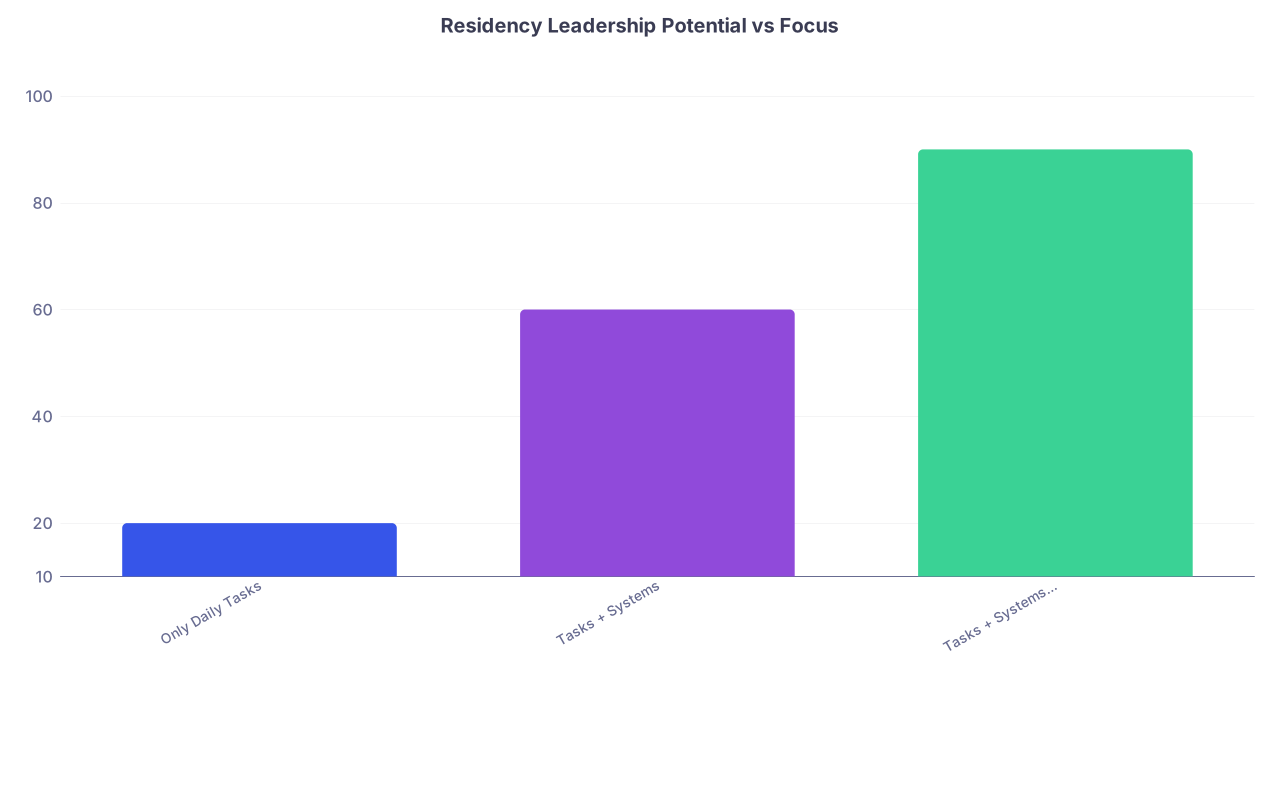
| Category | Value |
|---|---|
| Only Daily Tasks | 20 |
| Tasks + Systems | 60 |
| Tasks + Systems + People | 90 |
The people who rise tend to:
- Notice patterns: repeated consult delays, recurrent discharge failures, constant paging chaos
- Propose concrete, realistic fixes, not just “they should do something about this”
- Volunteer to test those fixes, even when it means extra work
Avoid this trap:
- Once a month, ask yourself: “What on this rotation is consistently broken? What is one change that would help?”
- Write it down. Share it with someone in leadership with a short, coherent explanation
- Stop assuming “someone else” is responsible for long‑term problems
If you never show any systems‑level curiosity, you look like a good resident. Not a chief.
6. Over‑Identifying with “Burnout Culture”
I am not talking about real burnout. That is serious and needs help. I am talking about performative burnout—where being constantly cynical becomes part of your identity.
The trap:
- Constantly posting on social media about how miserable residency is
- Joining every “this place is toxic” conversation and adding fuel
- Eye‑rolling through wellness sessions and loudly mocking any institutional effort
Here is the unpleasant truth: PDs are not going to put the most openly bitter, chronically negative resident in the one role that requires optimism and resilience for 12 straight months.
Common signs you have over‑identified with burnout culture:
- Your default tone about residency is mocking or dark
- Interns know you as “the one who tells it like it is” in the most pessimistic way possible
- When someone expresses hope or excitement, you reflexively bring them back down
Leadership reads this as: “If we make them chief, they will poison an entire class.”
Avoid this trap:
- Vent in small, trusted circles, not publicly, not every day, not in front of juniors
- If you are genuinely burned out, seek real help: schedule changes, therapy, leave—do not just marinate in sarcasm
- Decide whether you want to be the person who makes things better or the person who confirms they are awful
You do not need to be fake cheerful. You do need to avoid making negativity your brand.
7. Being “Too Cool” for Professionalism
Some residents truly believe they can stay casual, irreverent, and slightly sloppy and still be seen as leaders. They are wrong.
The trap:
- Chronic lateness framed as “running from another thing”
- Half‑finished notes, missed deadlines, or constant “oh I forgot to do that form”
- Unprofessional social media presence that everyone in the program has seen
You may get away with this as a PGY‑1 or even PGY‑2 if you are clinically strong. But when the chief conversation happens, someone will say: “He is great, but the professionalism stuff worries me.”
And that is usually the end of it.
Common professionalism killers:
- Not responding to emails from leadership for days
- Ghosting on teaching commitments or conferences you agreed to run
- Being the person who always needs “just one more reminder” to turn something in
| Behavior | Impact on Chief Potential |
|---|---|
| Response time to emails | Signals reliability |
| Timeliness to conferences | Shows respect for others |
| Completion of admin tasks | Predicts chief workload |
| Social media professionalism | Reflects judgment |
Avoid this trap:
- Treat every email from PD/APD/coordinator as something you must at least acknowledge within 24 hours
- Be early to things others treat as optional: didactics, recruitment dinners, town halls
- Clean up your public‑facing social media; leadership absolutely sees it
Being brilliant but sloppy is a great way to be admired as a clinician and quietly excluded as a chief.
8. Vanishing When Work Is Done (No Visible Investment in the Program)
Residents who only ever do precisely what is on their schedule rarely become chiefs.
The trap:
- You show up, do your job, go home. Always. No exceptions.
- You never show up to optional events: recruitment, journal clubs, social events, retreats
- You assume “they know I’m busy” explains your zero extra involvement
Here is the thing: chiefs work a lot of invisible hours. Curriculum planning. Schedule troubleshooting. Resident crises at midnight. PDs are not going to gamble on someone who has never shown interest in contributing outside their assigned duties.
Signals of vanishing:
- Never volunteering to cover a hole unless forced
- Never mentoring medical students or juniors unless they are assigned to you
- Skipping every non‑mandatory thing and joking, “I am on a need‑to‑be‑there basis only”
Avoid this trap:
- Pick 1–2 things per year to invest in: residency recruitment, QI project, wellness committee, teaching series
- Say “yes” occasionally to unglamorous work: being a mock interviewer, orientation small‑group leader, tour guide
- Show up to at least some program social events; people remember who bothered to be there
You do not need to be everywhere. You do need to show, clearly, that you care about the program as something larger than your own training.
9. Being Conflict‑Avoidant to the Point of Uselessness
Residents often confuse being “easygoing” with being leadership material. They are not the same.
The trap:
- You never say no, never push back, never deliver hard feedback
- You let interns flounder because you do not want to “be mean”
- You never bring resident concerns to leadership because you fear drama
Chiefs must:
- Have difficult conversations with co‑residents
- Call out repeated unprofessionalism
- Represent resident frustrations to leadership without sugar‑coating
If you have built a reputation as “too nice” to confront anyone, PDs worry you will disappear the moment conflict appears. And chief is basically 12 straight months of conflict management.
Signs you are too conflict‑avoidant:
- You complain sideways to friends but never address the actual person
- You frequently leave problems to “sort themselves out”
- You delegate all hard conversations to someone else
Avoid this trap:
- Practice one small, direct conversation per month: “Hey, I noticed X; can we talk about it?”
- When interns or juniors are unsafe, say it plainly and document if needed
- When residents ask you to convey feedback anonymously, be honest about what you can and cannot do
Chiefs are not chosen because they never rock the boat. They are chosen because they rock it deliberately, with control.
10. Forgetting That People Are Watching When You Think No One Is
Your “real” chief interview is not in a conference room. It is every single shift.
The trap:
- Letting your worst moments be in front of the most invisible people: night float, ED staff, weekend nurses, cross‑cover attendings
- Assuming the overnight meltdown, the rude response, or the corner‑cutting will stay in that moment
- Believing that as long as your formal evals look fine, you are safe
You are not. Informal reputations sink chief candidates every year.
Things people remember for years:
- The time you refused to see a late ED consult and told the ED attending, “We are capped, figure it out”
- The time you snapped at a night nurse for waking you twice
- The time you disappeared for two hours on a busy call and others had to cover
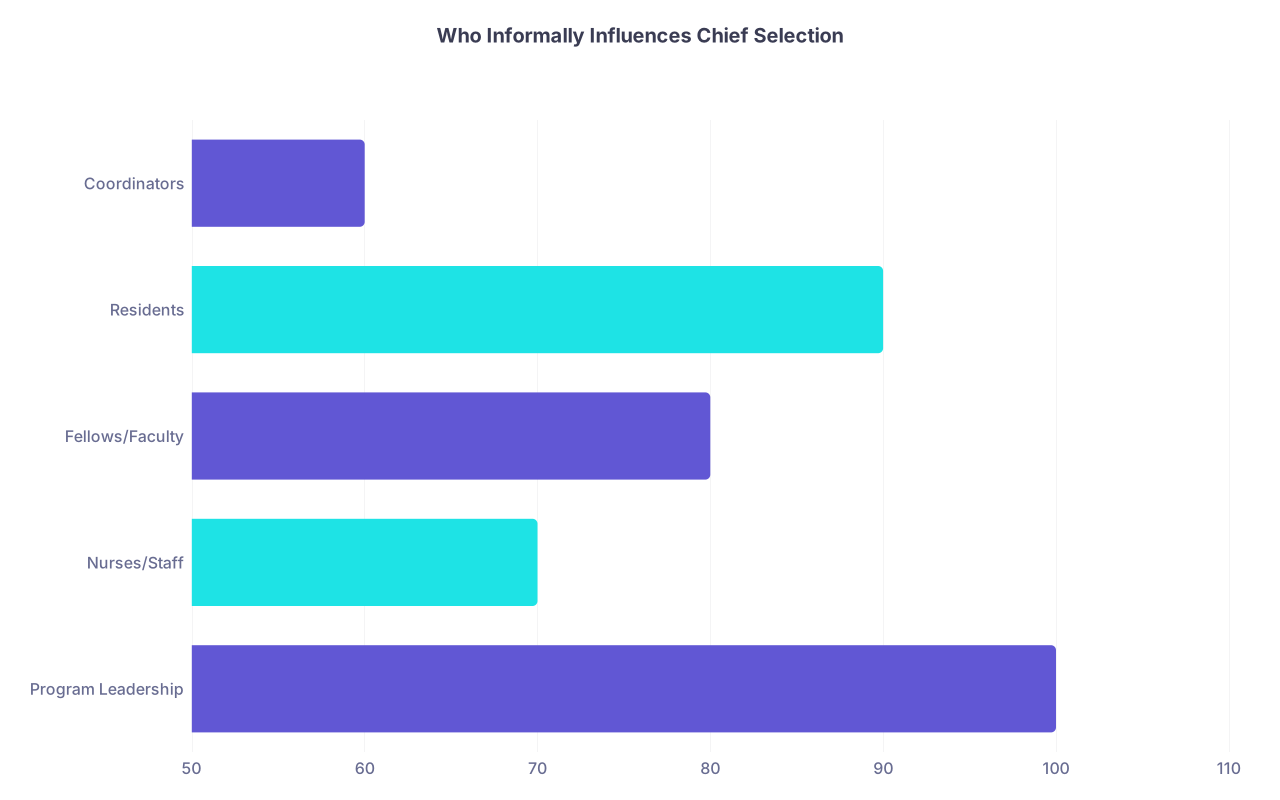
| Category | Value |
|---|---|
| Program Leadership | 100 |
| Nurses/Staff | 70 |
| Fellows/Faculty | 80 |
| Residents | 90 |
| Coordinators | 60 |
You may not hear about it. Leadership does. Usually like this:
- “I know he is strong, but the night staff hate working with him”
- “She is excellent when people are watching. Different story overnight.”
Avoid this trap:
- Assume every interaction can and will be remembered by someone who has the PD’s ear
- After a bad night, if you know you snapped, go back and apologize; word of that travels too, in a good way
- Ask explicitly for feedback from people outside your usual circle: night nurses, ED staff, OR teams
Your off‑shift behavior is often the single biggest blind spot for residents. Fix it, and you immediately separate yourself from a lot of the pack.
How to Stop Killing Your Chief Potential
If you recognize yourself in some of these, that does not mean you are done. It means you have time to stop bleeding credibility.
Three moves that change the trajectory fast:

| Step | Description |
|---|---|
| Step 1 | Identify Top 2 Traps |
| Step 2 | Seek Honest Feedback |
| Step 3 | Make Visible Changes |
| Step 4 | Ask for Stretch Responsibilities |
Pick your top two traps. Do not try to overhaul everything at once. Maybe you are conflict‑avoidant and professionally sloppy. Or maybe you undermine colleagues and bathe in burnout culture. Name them. Clearly.
Tell one trusted faculty member or chief. As in: “I realize I have been too X. I want to change that. If you notice me slipping, can you call it out?”
Leadership loves people who self‑correct before it becomes a formal problem.Take on one visible responsibility and do it flawlessly. Something leadership notices:
- Running an intern teaching series
- Joining a recruitment committee and reliably showing up
- Leading a QI project that actually reaches completion
Then do it without drama, without excuses, and without disappearing halfway through.
The Bottom Line
Three things you must remember if you care about chief potential:
- You are being evaluated on patterns, not isolated moments. A single bad night will not kill you. A recognizable pattern of undermining, vanishing, or unprofessionalism will.
- Leadership roles go to residents who reduce friction, not add it. If people breathe easier when you are on service, that is chief energy. If they brace themselves, it is not.
- You can course‑correct, but you have to do it loudly enough that your new pattern is impossible to miss. Quiet improvement is good for your conscience. Visible, sustained change is what shifts how people rank you when the chief conversation happens.
Avoid these traps, and you stop quietly disqualifying yourself. Which, in residency, is half the battle.


