

What do you think your program director says about you when you are not in the room—“leader in the making” or “loose cannon I cannot trust with patients”?
You are told nonstop to “take initiative,” “own your patients,” “step up as a leader.” Then someone a year ahead of you gets quietly sidelined or non-renewed for “professionalism concerns.” Same advice. Very different outcomes.
The problem is not initiative. The problem is initiative with blind spots. Program directors are not scared of residents who take charge. They are scared of residents who take charge in dangerous, self-centered, or tone-deaf ways.
Let me walk you through the patterns that get residents labeled as a risk. Not “needs coaching.” A risk.
The Core Mistake: Confusing Initiative With Autonomy
There is a specific resident archetype that makes PDs nervous: the person who thinks initiative means acting without oversight and then “updating” people later.
You know the moves:
- Changing major plans on patients, then telling the attending at the end of rounds.
- Giving families prognostic information without looping in the team.
- Calling consults as if you are the attending.
- Adjusting critical meds without discussing with the senior.
On the surface, it looks like leadership: “I am proactive; I do not wait to be told.” Underneath, attendings are asking themselves one question: “If I do not check every detail, will this resident hurt someone?”
Once that question appears in their mind, you are on thin ice.
Here is the key distinction residents regularly miss:
- Healthy initiative: “I saw X, I did Y within my scope, and I immediately informed the right person.”
- Red-flag initiative: “I saw X, I made a big change, and I assumed everyone would be fine with it.”
If the team routinely finds out about significant decisions after you make them, you are doing it wrong.
Red Flag #1: Acting Outside Your Lane “For the Patient”
The most dangerous justification you will ever use is: “But I was just doing what was best for the patient.”
Program directors have seen this go bad too many times.
Classic examples
- Intern independently discontinues anticoagulation for a postoperative patient because “the hemoglobin was trending down and I was worried about bleeding” without discussing with the surgery team. Patient later clots.
- Night float resident “does not want to bother” the attending, so they start vasopressors on a crashing patient without supervision, using a dosing regimen they half-remember from Step 1.
- Junior in the ICU changes vent settings because “the CO2 looked high” without notifying the fellow or RT. Next gas is a train wreck.
In each case, the story the resident tells themselves is “I am stepping up.” The story the PD hears in the incident report is “This resident does not understand their limits and is unsafe.”
How to avoid this mistake
- Ask yourself: “Would a reasonable attending expect to be notified before or immediately after this change?” If the answer is yes, and you do not call, you are walking into a red flag.
- Use “I am concerned about X; I am considering Y; can I run that by you?” as your default script.
- If you truly must act first (code, airway, acute decompensation), your next step is not documentation. It is: “Call the senior / fellow / attending. Now.”
Initiative that ignores hierarchy in acute care does not look brave. It looks reckless.
Red Flag #2: Performing Leadership Theater
Some residents love the appearance of leadership more than the responsibility.
You have seen them:
- Talking over interns during rounds to “demonstrate ownership.”
- Volunteering loudly for every teaching opportunity, then leaving scut and follow-up work to others.
- Giving big speeches about “team culture” but never showing up early or staying late when it counts.
On paper, this looks like initiative: “Leads rounds,” “takes charge,” “teaches actively.” In real life, the team quietly avoids working with them.
Program directors get emails like:
- “Resident X often interrupts others and dismisses nursing concerns.”
- “Resident X is very vocal but does not follow through on tasks.”
- “Resident X likes to dictate workflows without listening to anyone.”
That is leadership theater. PDs hate it.
Signs you are doing leadership theater
- You talk more than you listen on rounds.
- You give instructions before asking what work has already been done.
- You “delegate” tasks you have never done yourself or do not intend to help with.
- Nurses roll their eyes when you say, “Here’s what we’re going to do.”
What real initiative looks like instead
Real initiative is usually quiet:
- You notice discharge summaries are always delayed and quietly build a checklist or template, share it, and use it yourself.
- You realize night float sign-out is chaotic and propose a new standardized format, then trial it and adjust with feedback.
- You consistently close loops: labs checked, orders placed, families updated, documentation complete.
If your “leadership” makes you look busy and important but does not measurably reduce errors, delays, or confusion, you are just acting.
Red Flag #3: “Owning” Patients by Excluding the Team
“Own your patients” gets repeated so often that residents twist it into something toxic.
I have seen interns who:
- Refuse to let medical students present “their” patient because “I do not want anything missed.”
- Withhold new developments from nurses until they “figure out the plan.”
- React defensively when consultants suggest changes: “Well, we already considered that.”
PDs pick up the pattern: Resident believes ownership = control. Control = not sharing.
That is a red flag, especially on services where coordination is everything (ICU, ED, oncology, OB).

Why this worries PDs
When you act like the gatekeeper instead of the coordinator, a few predictable things happen:
- Nurses stop telling you early about subtle changes because you previously dismissed them.
- Consultants stop going out of their way for your team because interactions with you feel adversarial.
- Students learn to stay quiet because you correct them harshly “to keep the note accurate.”
Then something is missed. And suddenly your “ownership” does not look like dedication. It looks like a single point of failure.
Safer version of ownership
Own your patients by:
- Making it easier for others to care for them safely.
- Broadcasting key updates clearly to nurses, students, and consults.
- Inviting disagreement: “Am I missing anything? Would you do this differently?”
The resident who owns the patient is the one everyone trusts to have the full picture and to share it.
Red Flag #4: “Fixing Systems” in a Way That Makes You the Problem
Another classic pitfall: early-residency “systems improvers” who try to change everything loudly and all at once.
Yes, QI and leadership are important. PDs want people who will improve workflows and patient safety. They do not want:
- Rants on group email about “toxic culture” without specific solutions.
- Residents refusing to follow existing protocols because “they make no sense.”
- Public conflicts with nursing leadership or administration on day 20 of intern year.
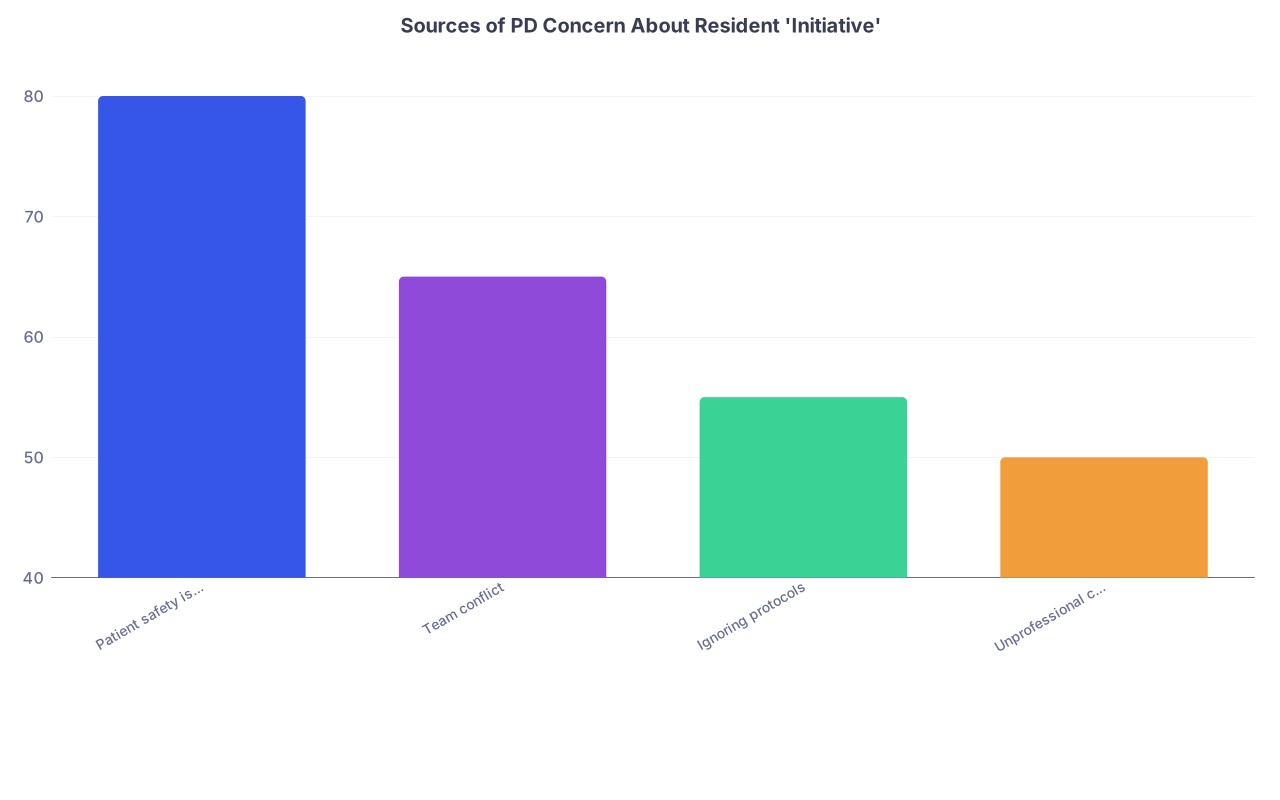
| Category | Value |
|---|---|
| Patient safety issues | 80 |
| Team conflict | 65 |
| Ignoring protocols | 55 |
| Unprofessional communication | 50 |
I have seen an intern email the CMO about “unsafe staffing ratios” before speaking with their chief, PD, or unit director. They were not wrong to be worried. They were absolutely wrong in execution. The fallout labeled them as “difficult” for years.
How to avoid becoming “that resident”
- Start small and local. Fix one rotation-level problem at a time. For instance: improve handoff checklists on nights before tackling hospital-wide throughput.
- Get allies. Run your idea by a senior or chief first: “Is this a real problem? Who actually owns this?”
- Respect chain of command. You are not the first person to notice that ED boarding is bad or that nursing is short-staffed. Act like someone entering a system, not overthrowing one.
Initiative that makes life harder for chiefs, PDs, or nursing leadership—without a plan, data, or allies—gets remembered. And not in the way you want.
Red Flag #5: Initiative Without Documentation or Handoff
This one is subtle, but program directors are very sensitive to it: residents who act—but leave no clear trace.
Examples:
- You call a rapid response, order labs, give fluids, then forget to document the event and your reasoning.
- You adjust warfarin dosing “to be helpful,” but do not sign your orders or update the sign-out.
- You give family a major prognostic update, but no one else documents any similar conversation, and there is no note tying it together.
From a PD perspective, this resident looks both active and invisible. Which is the worst combination. They are affecting patient care, but no one can reliably track what they did or why.
In any investigation, lack of documentation shifts blame toward you, fairly or unfairly.
Safe pattern to adopt
Every time you take initiative in a meaningful way, you must do three things:
- Tell the appropriate person (senior / fellow / attending).
- Tell the team members who need to act on it (nurse, night team, covering service).
- Create a short, clear documentation trail.
If you cannot point to where your action lives in the chart or handoff, you have left a loose end. PDs hate loose ends.
Red Flag #6: Treating Initiative Like a Competition
Some residents are so focused on impressing attendings that they start competing with their own co-residents.
You see them:
- Rushing to answer every question on rounds before juniors can think.
- Volunteering to take the “sickest” patients but then not helping with the rest of the list.
- Undermining others subtly: “Oh, I already thought of that, but I just did not say it yet.”
PDs hear about this from multiple angles—co-residents, nurses, students, sometimes even attendings who are uncomfortable with the dynamic.
Initiative, when warped into competition, looks like:
- “I want credit,” not “I want the team to function better.”
- “I want the toughest cases,” not “I want patients covered equitably.”
| Behavior Type | Healthy Initiative Example | Problematic Initiative Example |
|---|---|---|
| Patient care decisions | Suggests plan, confirms with senior, then implements | Implements major change without discussing |
| Team dynamics | Supports intern presentations, fills gaps | Talks over others, claims ideas as their own |
| Systems improvement | Pilots small change on one service with feedback | Emails leadership blasting policies on day one |
| Communication | Documents clearly, updates team immediately | Acts first, documents late or not at all |
| Relationship with peers | Shares credit, distributes tough cases fairly | Competes for sickest patients, hoards complex cases |
If the rest of your cohort dreads working with you, your “initiative” is not leadership. It is a liability. PDs know that one resident can poison a class.
Red Flag #7: Initiative Without Self-Awareness or Feedback
The biggest, long-term red flag: you keep “taking initiative,” but your feedback is full of the same warnings year after year.
Common comments:
- “Tends to act independently beyond their level.”
- “Could improve in accepting feedback.”
- “Needs to better recognize limitations.”
- “Sometimes oversteps in conversations with families or staff.”
If you brush this off as “they do not like strong personalities,” you are making a serious mistake. PDs are very used to strong personalities. They are not used to residents who cannot adjust when told clearly where the line is.

| Step | Description |
|---|---|
| Step 1 | Overconfident Initiative |
| Step 2 | Minor Incident |
| Step 3 | Feedback Given |
| Step 4 | Trust Rebuilt |
| Step 5 | Repeated Incidents |
| Step 6 | Formal Documentation |
| Step 7 | Remediation or Nonrenewal |
| Step 8 | Resident Adjusts? |
What moves you off the PD worry list is not perfection. It is the ability to hear: “You are overstepping here,” and respond with: “Understood. Here is what I will do differently.”
If you get defensive every time, the message they receive is: “This resident will not course-correct.” That is the type they eventually remove.
How To Show Initiative Without Triggering Red Flags
Let us be very concrete. Initiative that reassures PDs tends to look like this:
You anticipate needs but do not hide actions.
You pre-chart, tee up orders as “pending,” and then say on rounds, “For this CHF patient, I prepped diuretics and an echo order; can we review and sign if you agree?”You loop the right people in, early.
Before a big family meeting: “I am happy to lead the medical part, but I want you there, Dr. Smith, given the complexity.”You solve small problems, not structural ones, as an intern.
Missed lab trends? You build a sign-out section for “must-follow labs” and push the team to use it.You ask for scope checks.
“As a PGY-2, is it appropriate if I handle these phone consents alone, or would you prefer to be looped in?”You transparently own missteps.
“I changed the insulin without checking with you first; that was above my comfort level in retrospect. Here is what happened, and here is what I’ll do differently.”
That last one is critical. A resident who self-identifies and corrects overreach becomes a trusted junior leader. A resident who denies or minimizes it becomes a file of incident reports.
FAQ (Exactly 5 Questions)
1. How do I know when I am “overstepping” versus just being proactive?
Ask two questions:
a) Would a reasonable attending expect to be involved in or immediately aware of this decision?
b) If this went badly, would I be comfortable defending my choice and communication in front of my PD?
If the honest answer to either is no, you are likely overstepping. In doubt, call your senior and say, “Here is what I am thinking; is this within my lane?”
2. What is an example of safe initiative for an intern on a busy ward?
Safe initiative for an intern looks like: pre-rounding thoroughly, having problem-based plans ready, ensuring all necessary orders are placed immediately after rounds, proactively paging consultants with a clear clinical question, updating families once plans are confirmed, and tightening handoffs. None of that requires solo high-risk decisions, but it dramatically improves team function and patient care.
3. Can I ever independently change serious meds like pressors, anticoagulants, or chemo?
As a general rule: no, not without explicit prior parameters or real-time supervision. If an attending or fellow has given you a clear algorithm (“If MAP < 65 after 1L fluids, titrate norepinephrine up by X…”), that is within scope. Freestyling on critical medications because “it seemed right” is exactly what lands people in morbidity and mortality conferences and PD offices.
4. What if my program culture is very hands-off and seniors seem annoyed when I call?
Do not let their annoyance push you into unsafe practice. You can say, calmly: “I want to make sure I am staying within my scope, so I am calling to confirm you are comfortable with me doing X.” If they still push back, document your discussions appropriately and, if patterns continue, speak with a chief or PD. Residents who quietly “stop calling” to avoid eye rolls are the ones who end up isolated when something goes wrong.
5. How do I repair my reputation if I have already overstepped?
You need two things: explicit acknowledgment and a visible change in behavior. Tell your chief or PD: “I understand I acted beyond my level when I did X; I see why that was concerning. Here are the guardrails I am putting in place so it does not happen again.” Then actually live by those guardrails—more frequent check-ins, clearer documentation, and early communication around tough decisions. Over time, consistent, boringly safe behavior is what rebuilds trust.
Key points:
- Initiative that ignores scope, hierarchy, or communication is not leadership; it is a liability that makes PDs nervous.
- The safest, most respected form of initiative is visible, well-communicated, and tightly documented—everyone knows what you did, why, and when.
- If your “leadership” repeatedly generates feedback about overstepping, defensiveness, or team conflict, the problem is not that you are too strong; it is that you are not adjusting.


