

What do people on your team actually say about you after you walk out of the room where you “invited feedback”?
If you think your reputation as a chief, senior resident, or attending depends mostly on how smart or clinically strong you are, you’re missing the trap that takes down more leaders in medicine than incompetence: how you react when someone gives you feedback you do not like.
This is where reputations quietly die.
Not on your CV. Not on rounds. In those 30–60 seconds after someone takes the risk to tell you the truth.
Let me walk you through the most common feedback reactions that destroy leadership credibility in residency and early attending life—and how not to be that story people tell for the next five years.
1. The Instant Defense: “That’s Not What Happened”
The fastest way to teach your team never to be honest with you again?
Argue with their experience.
You know this move. Someone says, “It felt like you shut me down during rounds,” and your mouth automatically goes:
- “That’s not what I said.”
- “You’re misinterpreting.”
- “I was just in a rush.”
- “Everyone else understood what I meant.”
You think you’re “clarifying.” You’re not. You’re broadcasting: “My intent matters more than your experience.” That’s leadership poison.
Here’s the core mistake: treating feedback as a factual accusation to be disproven instead of a window into how your behavior lands on others.
In medicine we’re trained to correct inaccuracies immediately. Wrong dose? Correct it. Wrong diagnosis? Refute it. That habit bleeds into feedback conversations and wrecks trust.
Residents and students watch this pattern very closely. I’ve watched interns in a workroom say, “Don’t bother talking to her about that, she’ll just explain why you’re wrong.” That’s your reputation. And it travels.
The smarter move is brutally simple but not easy:
- First instinct: listen, not defend.
- Default response: “Got it. Thank you for telling me that. Let me sit with it.”
- If you need to clarify, do it later, and gently: “Can I ask a couple questions so I really understand what it felt like from your side?”
If you feel the urge to prove they’re wrong, that’s your red flag. You’re making the conversation about your ego rather than their experience.
2. The Emotional Meltdown: Making It About Your Hurt Feelings
Here’s another common leadership self‑sabotage: you ask for feedback, someone finally gives it honestly, and you… emotionally fall apart.
Examples I’ve seen verbatim:
- “Wow. I didn’t know you thought I was that terrible.”
- “I’m doing my best, you know. This really hurts.”
- “Everyone thinks I’m a bad chief now.”
You think you’re being “vulnerable.” You’re not. You’re making your team manage your emotions.
And once they have to take care of you, they will not bring you hard feedback again. Ever.
The internal medicine chief who burst into tears when interns told her they felt intimidated? No one told her anything real for the rest of the year. Instead, they told each other, “Just say she’s doing great. She can’t handle criticism.” That’s the sentence that should terrify you as a leader.
There’s nothing wrong with feeling hurt. You’re human. But unloading that hurt onto the person who just did the hard thing is unfair and frankly unprofessional.
Better pattern:
- Feel punched in the gut? Fine. Breathe. Do not react verbally for a few seconds.
- Say something simple: “Thank you. I know that probably was not easy to say.”
- If you’re too flooded: “I really appreciate you sharing that. I want to think about it and circle back when I can respond thoughtfully.”
Then go fall apart privately. With a peer. A friend. A therapist. Not the intern who just showed more courage than most attendings.
3. The Scorekeeper: Retaliating Later (Yes, People Notice)
You might think you’re subtle. You’re not.
If someone gives you feedback and then—strange coincidence—their schedule gets worse, their evaluations drop, or they get fewer opportunities, everyone connects the dots. They might not say it to your face, but in that group chat or call room? It’s obvious.
This is how you torpedo psychological safety on a team:
- You don’t invite that resident to present at grand rounds after they criticized your teaching style.
- You suddenly “remember” a bunch of minor mistakes they made when writing their evaluation.
- You become cooler, more distant, less supportive after a hard feedback conversation.
People clock patterns like this. Your “open‑door policy” loses all credibility the first time someone speaks up and then mysteriously pays a price.
In medical culture, where hierarchy already makes people anxious, even a hint of retaliation creates a chilling effect. One story of “I gave feedback and then my life got harder” will wipe out ten of your “I’m always open to feedback” speeches.
If you cannot separate feedback from your decisions about opportunities and evaluations, you shouldn’t be asking for feedback from people you supervise. Full stop.
A safe rule: If you’ve recently had critical feedback from a trainee, bend over backwards to be fair—and if anything, a bit generous—when evaluating or supporting them. You’re not buying them off. You’re signaling: “You can be honest with me without paying a price.”
4. The Fake Listener: “Thanks” With Zero Follow‑Through
Another reputation killer: performative listening.
You nod. You say “Thanks, that’s really helpful.” You might even repeat back what they said like you took a comms workshop. And then… nothing changes. Ever.
At first, people are hopeful: “Maybe they’re thinking about it.” By the third round of this, the story becomes: “She always ‘thanks’ you and then ignores it. Don’t waste your time.”
Let me be blunt: asking people for feedback and then consistently doing nothing with it is worse than never asking at all.
Because you’re not just ignoring them. You’re teaching them that their voice doesn’t matter. And that’s exactly the opposite of what effective clinical leadership requires.
You don’t have to implement every piece of feedback. Sometimes you can’t. Sometimes it’s unrealistic or conflicts with other priorities. That’s fine. The mistake is silence.
Do this instead:
- Close the loop explicitly: “You mentioned last week that my feedback on rounds felt rushed and unclear. I’ve been trying to slow down and ask if my comments made sense. Have you noticed any difference?”
- Explain when you can’t change something: “You’re right that call is brutal. I don’t control the master schedule, but I did share the concern with the PD and suggested X and Y as changes.”
- Choose one thing to act on quickly. People need to see at least one concrete change to believe you mean it.
If no one can point to a single way you’ve changed in response to feedback over a year, don’t kid yourself. They’ve already labeled you: “Doesn’t really listen.”
5. The Over‑Explainer: Intent vs. Impact
Here’s a subtle one that feels benign but is toxic over time: the chronic “let me explain myself” leader.
Scenario: A student says, “When you corrected me in front of the patient, I felt embarrassed and anxious to talk in front of them again.”
You respond with:
- “I was just trying to teach the correct approach.”
- “I didn’t mean to embarrass you.”
- “That’s just my style, I’m direct.”
All intent. Zero ownership of impact.
You’re essentially saying: “If my intent was good, your experience doesn’t count.” And you probably don’t mean that. But that’s what lands.
This is rampant in medicine because we cling to “good intentions” as moral armor. We’re here to help patients, so we assume that shields us from interpersonal harm. It does not.
People don’t need a courtroom defense of your motive. They need you to:
- Acknowledge how your action landed.
- Own that impact even if it wasn’t what you meant.
- Adjust going forward.
Try: “I see how that was embarrassing. I was focused on getting the right info out and not thinking about how it felt in the moment. Next time I’ll either talk to you first or debrief privately afterwards.”
Notice: No self‑flagellation. No debate. Just ownership and a concrete shift.
Keep clinging to “I didn’t mean it that way,” and you’ll earn the label “uncoachable.” Which is ironic, because you’re the one supposed to be coaching everyone else.
6. The “Above Feedback” Attending: Hiding Behind Hierarchy
Nothing damages a senior leader’s reputation faster than clearly believing they’re beyond critique.
The phrases give it away:
- “When you’ve done this as long as I have…”
- “Back in my day we just dealt with it.”
- “This generation is very sensitive.”
Translation: “My experience is the gold standard. Your concerns are noise.”
I’ve watched residents stop bringing legitimate safety concerns to attendings who used that tone, because they assumed any pushback would be dismissed as “weakness.” That’s not just a leadership failure. That’s dangerous.
If you’re an attending or senior fellow and think residents can’t see your blind spots, you’re deluding yourself. They see everything. Your temper. Your shortcuts. Your biases. The question is whether they feel safe telling you.
Hierarchy is already built in. You don’t need to reinforce it to maintain authority. The more senior you are, the more you have to overcorrect toward humility to keep lines of communication open.
If your default stance is “I have nothing left to learn about how I show up,” your reputation will calcify as old‑school, hard to work with, and eventually “avoid that rotation if you can.”
And that will hurt your influence more than you realize.
7. The Public Shutdown: Humiliating People Who Speak Up
This one should be obvious and yet I still see it constantly.
Team meeting. Someone gives you honest feedback or asks a hard question. You reply with:
- Sarcasm: “Well, I’m sorry I can’t make 28‑hour call pleasant for you.”
- Mocking: “We’re doctors, not spa employees.”
- Dismissal: “We don’t have time to talk about feelings right now.”
You’ve just taught the entire room: “Do not challenge this person. Do not raise concerns that aren’t strictly about patient care. You will be punished.”
And make no mistake, public embarrassment is punishment. In medicine, where shame is already weaponized, you’ve just piled on.
The collateral damage is bigger than you think:
- People stop naming burnout and near misses.
- Students keep quiet about boundary violations.
- Residents don’t surface workflow problems that are actually harming patients.
If you feel disrespected by how feedback is brought up in a group, you can address process without crushing content.
Try: “I appreciate you bringing that up. This might be better to explore in more detail after sign‑out so we don’t shortchange patient care, but I do want to talk about it.”
What you must not do is use your positional power to humiliate someone for speaking up. That’s how toxic cultures are born.
8. The Silence: Ignoring Feedback Entirely
One of the most corrosive reactions to feedback isn’t aggressive at all. It’s nothing.
You get an email from a resident with thoughtful suggestions about night float handoffs. You read it. You never reply.
You receive 360‑degree feedback that multiple learners find you unapproachable. You skim it, feel annoyed, and move on. You mention none of it to the team.
They notice. They always notice.
Silence communicates: “Your input is irrelevant.” Over time, this kind of non‑response rots any culture of honesty. People think, “Why risk awkwardness if nothing changes anyway?”
This is especially common with anonymous survey feedback. Leaders dismiss it as “a few bitter people” and never address themes openly. Then they act surprised when morale tanks.
If you’re in any kind of leadership role in residency—chief, QI lead, rotation director—build a basic habit:
- Acknowledge. “Several of you brought up concerns about X in the last survey.”
- Name one thing you’re doing. “We’ve changed Y. We’re still working on Z.”
- Keep it short. This isn’t theater. It’s accountability.
Ignoring feedback is lazy leadership. And your reputation eventually matches: disengaged, out of touch, doesn’t care.
9. How To React Instead: A Simple, Boring, Reputation‑Saving Script
You do not need a degree in organizational psychology to not screw this up. You just need a default response pattern you can lean on when your ego is screaming.
Here’s a basic feedback‑response script that will protect you 90% of the time:
- Pause before speaking. Two seconds is enough to interrupt your reflex defense.
- Acknowledge the risk they took.
“Thanks for telling me that. I know that’s not easy to say to someone senior.” - Reflect back what you heard.
“So it felt like I was dismissive on rounds when you presented those labs?” - Own at least part of it.
“I can see how that came across. That wasn’t my intention, but the impact matters.” - Ask one clarifying question (if needed).
“What would have felt better in that moment?” - Commit to a small concrete change.
“Next time I’ll slow down and ask you what you were thinking before jumping in.” - Circle back later.
“You gave me that feedback last week about being abrupt. Have you noticed any change, or am I still doing the same thing?”
Notice what’s missing: defending your character, explaining your life story, turning it into a debate. You’re not on trial. You’re learning how you land.
Use this script until it becomes muscle memory. It will save you from yourself.
10. Why This Matters More in Residency Than You Think
You might be thinking, “I’m just a PGY‑2. Does any of this really matter? I’m not a program director.”
Yes, it matters. Because reputations in medicine form early and stick.
Chiefs, attendings, fellowship directors hear about the residents who are “great to work with” versus “brilliant but impossible.” The “impossible” label almost always includes some version of: “Can’t take feedback,” “Gets defensive,” or “Retaliates when challenged.”
And once you’re tagged that way, opportunities quietly disappear. You aren’t asked to be chief. You’re passed over for certain projects. Faculty hesitate to write the strongest letters.
Meanwhile, the resident who reacts well to feedback—even when they’re frustrated—gets trusted with more responsibility. Not because they’re perfect. Because people know they’re coachable and won’t blow up or shut down when things get hard.
In a field built on lifelong learning, looking unteachable is career damage.
Your choice is simple: become the leader people feel safe telling the truth to, or the one they politely avoid and complain about privately.
You don’t control what feedback you get. You do control whether your reaction builds or burns your credibility.
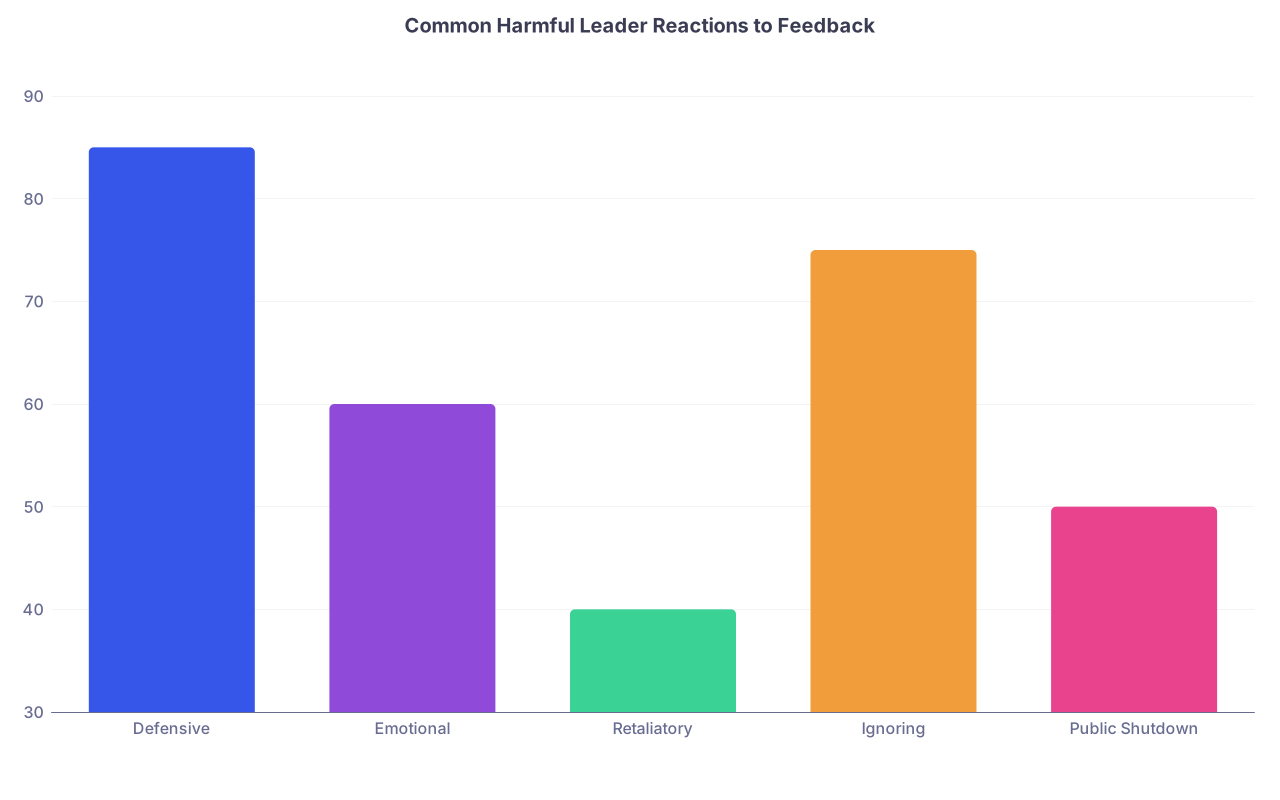
| Category | Value |
|---|---|
| Defensive | 85 |
| Emotional | 60 |
| Retaliatory | 40 |
| Ignoring | 75 |
| Public Shutdown | 50 |

| Bad Reaction Pattern | Better Replacement |
|---|---|
| “That’s not what happened” | “I hear that’s how it felt. Tell me more.” |
| Emotional collapse on the spot | “Thank you for saying that. I want to think about it and come back to this.” |
| Subtle retaliation later | Explicitly protect and support that person in following weeks |
| Polite nod with no change | Make and state one concrete behavior change to try |
| Public sarcasm/dismissal | Validate the concern and redirect to a better time/place if needed |
FAQs
1. What if the feedback I’m getting is clearly unfair or inaccurate?
Do not argue in the moment. Treat it as data about perception, not a courtroom fact pattern. You can say, “That’s not how I saw it, but I appreciate knowing it landed that way.” Later, check with a trusted peer: “You were there—did I come across how they’re describing?” If multiple people see it, it’s a pattern you need to own. If it’s truly off‑base and isolated, your calm response still protects your reputation as balanced and mature.
2. How do I handle feedback from someone who is consistently negative?
You still model good listening, but you don’t have to internalize everything. A simple framework: listen, summarize, pick any useful kernel, and set limits if needed. “I hear you’re frustrated about X, Y, and Z. I can work on doing A differently. Some of the rest is outside my control, but I appreciate you flagging it.” If it becomes abusive or personal, you shut that down: “I’m open to feedback on my behavior, but personal attacks are not okay.”
3. What if I honestly disagree and think the person is being too sensitive?
You’re not the judge of how sensitive someone is. You’re responsible for your side of the interaction. You can disagree internally and still take the impact seriously. Ask yourself a tougher question: “If three other people saw this video with no sound, what would they think my tone was?” Then adjust based on that. Respecting their experience doesn’t mean you’re confessing to being a monster. It means you care about how you come across.
4. How can I practice better feedback reactions if I already have a bad reputation?
You start now and you over‑communicate the shift. Tell a couple trusted colleagues: “I’ve realized I get defensive when I get feedback. I’m trying to change that. If you see me doing it, call me out.” Then use the simple script: pause, thank, reflect, own, adjust. Over time, people will notice. Reputations are slow to change, but they do change when behavior is consistent. You can’t rewrite last year, but you can make it very clear that “old you” is not how you intend to lead going forward.
Key points:
- Your leadership reputation in medicine is built less on brilliance and more on how you react when challenged.
- Defensiveness, emotional dumping, retaliation, and silence after feedback all teach people to stop being honest with you—and that quietly limits your influence and opportunities.


