

It’s 6:45 a.m. You’re in the cramped workroom, staring at your bloated task list in Epic and your equally bloated “leadership goals” section on your semi-annual evaluation. Your PD has written, “Look for opportunities to lead small initiatives on the ward.”
You have no idea what that actually means.
You’ve seen the resident who calls themselves “Chief of Wellness Committee” without a single concrete outcome. You’ve also seen the quiet PGY‑2 who changed one tiny workflow on nights and suddenly everyone, including the PD, knows their name.
Here’s the part nobody says out loud: program directors are absolutely judging your “leadership,” but not by the titles you think. They’re looking for very specific, unsexy, behind-the-scenes projects that make their lives easier, make the program look good, and don’t create more paperwork.
Let me walk you through the leadership projects that quietly move you from “solid resident” to “someone I’d hire as faculty.”
What PDs Actually Mean By “Leadership”
First thing: directors don’t care about the word “leadership.” They care about three things, usually not phrased this bluntly:
- Do you make the clinical system work better with minimal drama?
- Are you someone they can trust with other people’s time, money, and reputation?
- Will you make the program look good on ACGME surveys, during site visits, and in the grapevine between attendings?
They use “leadership” as shorthand for those traits.
When we’re in the closed-door Clinical Competency Committee meeting, here’s how it really sounds:
- “She took that mess of a night float handoff and actually fixed it. Nurses love her.”
- “He organized M&M so it runs on time and people actually show up now.”
- “She started that micro-QI thing on discharge med rec; metrics are better, pharmacy is happy.”
Notice what’s missing. Nobody is impressed by “Co-chair of Social Committee” unless you turned a potluck into a system that tracks burnout and feeds data straight to the PD before survey season.
The leadership projects that land are small enough to be realistic, concrete enough to see change, and tied to one of three buckets:
- Patient care and safety
- Education
- Operations (the boring-but-essential glue of residency)
Let’s get specific.
The Quietly Powerful Projects That Stand Out
1. The “Fix-One-Step” Clinical Workflow Project
This is the gold standard. Not a grand redesign of the entire EMR. One step in one broken process.
Examples I’ve seen get real attention:
A PGY‑2 on nights noticed cross-coverage pages for the same three issues: pain control, bowel regimens, and sleep meds. She built a simple “night orders bundle” template and wrote a one-page guide for the day teams. Cross-cover pages dropped. Nurses were happier. She measured before-and-after pages over two months, put it into a 5-slide deck, and presented at morning report. The PD brought it up in every faculty meeting for a year.
A surgery resident was sick of chaotic pre-op consent situation. He made a checklist on a laminated card for juniors and med students, plus a shared folder with “consent cheat sheets” by procedure. Fewer last-minute consents delayed cases. OR leadership noticed. That’s the kind of thing that lives in a PD’s memory when picking chiefs.
What PDs see:
- You observed a real problem.
- You implemented a change with zero new committees.
- You generated a small but measurable outcome.
- You didn’t create extra work for anyone but yourself.
That’s leadership.
2. The Lean, High-Impact Teaching Initiative
Not “start a curriculum.” That phrase gives PDs hives. They hear “curriculum” and see ten emails, ten meetings, and forty PowerPoints no one wants to sit through.
But a targeted, recurring, resident-owned educational piece? That hits.
Strong versions look like:
“X-minute pearls” series: A PGY‑3 in MICU started a 5-minute “vent pearl” at 8:05 a.m. every day, one slide, one concept. She rotated presenters. Nurses sometimes joined. No sign-in sheet, no CME, no bureaucracy. After a month, fellows reported interns were less terrified of the vent. The PD called it out in program-wide emails.
Rad-Path-Clin conference: An EM resident built a once-monthly 15-minute debrief with radiology and pathology on a few interesting cases (mass on CT, the final path, what we could have caught earlier). Tiny time cost, huge learning, easy to sustain. Department chair mentioned it to the PD. That’s free political capital for you.
Key pattern: minimal overhead, high educational value, clear cadence (weekly, monthly), and visible benefit to other learners.
If you want your PD’s respect, don’t ask for a half-day “boot camp.” Start something tiny that sticks.
3. The Data-Backed “Annoyance” Fix
Every resident complains. Few track. Almost none come with data.
Program directors are drowning in vague complaints: “Nights are brutal,” “Clinic is impossible,” “We never get enough teaching.” It all blurs.
What cuts through is a resident who treats a common annoyance like a micro-QI project. Not because QI is trendy, but because it gives PDs cover to actually push change.
Example:
- A PGY‑2 in IM was tired of discharge summaries being finished late, which ticked off attendings and harmed continuity. She tracked 50 discharges on her firm over a month, logged when summaries were started/finished, then piloted a “discharge huddle” at 10 a.m. with a simple template. Re-audited the next month: completion times improved, readmission documentation was cleaner, case management was happy. She didn’t fix discharges nationally. She did make her unit better. The PD used her graph in a site visit.
This is where a little chart goes far:
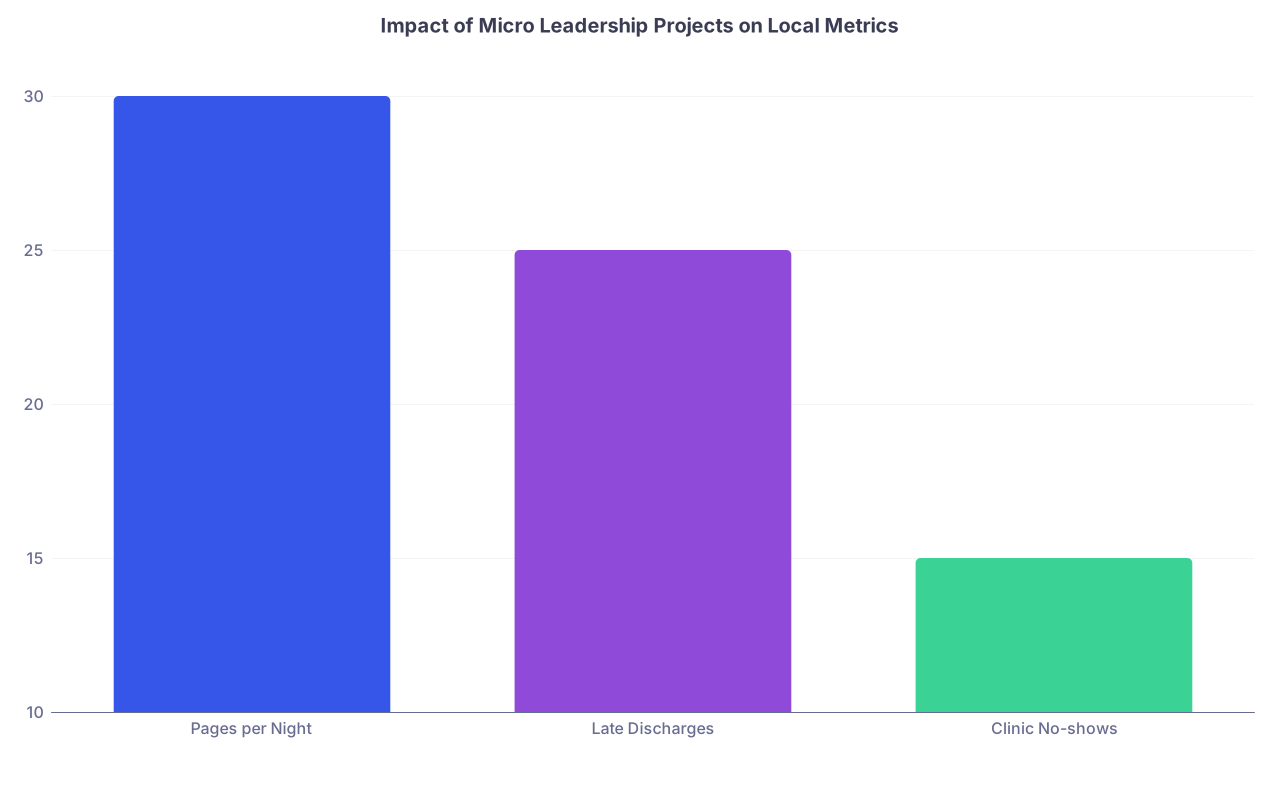
| Category | Value |
|---|---|
| Pages per Night | 30 |
| Late Discharges | 25 |
| Clinic No-shows | 15 |
PDs love these because they transform generic whining into something they can actually defend when dealing with hospital leadership.
Pro tip: Do not start with a committee. Start with a tally sheet.
4. The “Make the PD’s Life Easier” Backstage Work
Let me tell you something unglamorous: half of residency leadership is herding cats and assembling documentation for ACGME, GME, and the Dean.
Every time you run a project that helps with that paperwork—without calling it that—you gain points you don’t see.
Examples that have actually mattered:
Resident who redesigned the conference attendance tracking into a QR code sign-in feeding a Google Sheet that auto-calculated attendance by PGY level. Faculty hated sign-in sheets. PD hated manually tracking. This resident fixed both. Took him a weekend. Landed him chief.
Resident who turned a chaotic M&M into a structured, recurring format with a simple template: case summary, system factor, human factor, change proposed, follow-up at 3 months. PD used that exact format to demonstrate “robust peer review and systematic improvement” on the ACGME site visit. Guess whose name they remembered? His.
These are not flashy. They are the projects senior leadership quietly values because they solve their own headaches.
If you want to be “the resident we can trust with real responsibility,” intersect your project with one of:
- Scheduling
- Attendance and duty hours
- M&M and peer review
- Documentation of educational activities
You’ll never read that in a brochure, but it’s exactly what moves the needle.
5. The Cross-Discipline Bridge Project
Any project that builds a real working bridge to another department or profession gets disproportionate attention. PDs know silo-busting makes the program look enlightened and collaborative.
A few formats that work:
Joint Noon Conference: EM and radiology co-run a monthly “Imaging Pitfalls” where EM residents present common misses, radiology walks through the reads, and they agree on practical “if you see X, ask for Y” rules. Simple, 30 minutes. Both chairs like it. PDs love seeing their residents driving it.
Pharmacy Partnership: A resident in heme-onc worked with pharmacy to build a one-page, resident-friendly guideline for starting certain high-risk chemo adjuncts and anticoagulants. They co-presented it at resident conference. Fewer desperate “STAT pharmacy” calls, fewer ordering errors. This becomes part of the program narrative: “Our residents proactively collaborate with pharmacy to improve patient safety.”
The secret: Cross-discipline makes your PD look good at the table with other departments. If your name is attached to that goodwill, you’re in their mental “future leader” bucket.
What PDs Quietly Dismiss As “Fake Leadership”
Let’s be a little blunt.
There’s a class of “leadership” activity that residents overvalue and faculty barely notice, unless something remarkable came out of it.
Here’s how it sounds in the back room:
- “Oh, they were ‘chair’ of the wellness committee. Did they actually do anything?”
- “Everyone is ‘founder’ of something on their CV now.”
- “If I see one more vague ‘advocacy’ project with no concrete outcome…”
The weak projects usually share features:
- High on talk, low on deliverables (“We hosted monthly safe spaces…” with no data, no changes, no nothing).
- Purely social (“organizing happy hours”) unless tied to measurable wellness or burnout outcomes.
- Advocacy with no specific policy or institutional change (just “raising awareness”).
It isn’t that social and advocacy work don’t matter. They do. But PDs are looking for evidence that you can move something from idea → execution → visible change. If your “leadership” line looks like 90% brainstorming and 10% implementation, it quietly gets discounted.
If you must run something like a wellness or advocacy project, anchor it to tangible outcomes:
- Short burnout survey before and after a specific intervention.
- Concrete policy drafted and adopted.
- A change in clinic scheduling, not just a discussion of how bad clinic is.
How To Pick the Right Project For Your Level
You don’t need a massive initiative. You need the right-sized one.
Think of scope like this:
| PGY Level | Good Project Scope |
|---|---|
| PGY-1 | Fix one micro-workflow on your home unit |
| PGY-2 | Lead a recurring teaching or QI micro-project with simple data |
| PGY-3+ | Cross-discipline or program-level process with handoff plan |
PGY‑1: Your job is to survive and to see the system. But even interns can lead something tiny.
- Standardize a sign-out phrase or template on your team.
- Create a one-pager for common orders on your unit and share it.
- Build a med student orientation sheet that actually helps them.
PGY‑2: You have enough experience to see upstream patterns and enough clout to nudge them.
- Own a recurring 5–10 minute teaching series.
- Fix a specific bottleneck on nights or weekends.
- Run a tiny QI loop with real before/after numbers.
PGY‑3 and above: Now you can step into bridging roles.
- Create a cross-discipline project.
- Take over something that outlives you: sign-out structure, M&M format, conference tracking.
- Design something you can hand off with a written playbook.
The mistake I see is PGY‑2s trying to “solve burnout” across the hospital while their own sign-outs are a disaster. Scope mismatch kills credibility.
How To Make Sure Your PD Actually Notices
Here’s the cynical truth: good work that no one knows about doesn’t count at evaluation time. PDs are juggling dozens of residents; they don’t see everything.
So you have to surface your project without looking like a politician.
Here’s the play:
Loop them in late, not early. Don’t open with, “I have an idea.” Their brain hears, “Work for me.” Start and pilot on a tiny scale. When you have a basic version working, then send the email:
“Dr. X, over the last month we’ve been piloting a quick discharge huddle on 6E. Pages from case management dropped from 9/day to 4/day. If you’re interested, I’d be happy to share what we did.”Bring one page, not a thesis. PDs do not want a 40-slide deck. Summarize: problem, what you did, rough numbers, and what you recommend next. That’s it.
Name others. Give credit to interns, nurses, pharmacists. PDs like residents who share credit. It signals maturity and makes them more comfortable putting you in charge of things.
Hand off. If you’re graduating, hand the project to a junior with a simple template and timeline. PDs are much more impressed by a sustainable project than a one-off blitz that dies when you leave.
If you want to see how this project attention compounds mentally, think of it like a slow build:
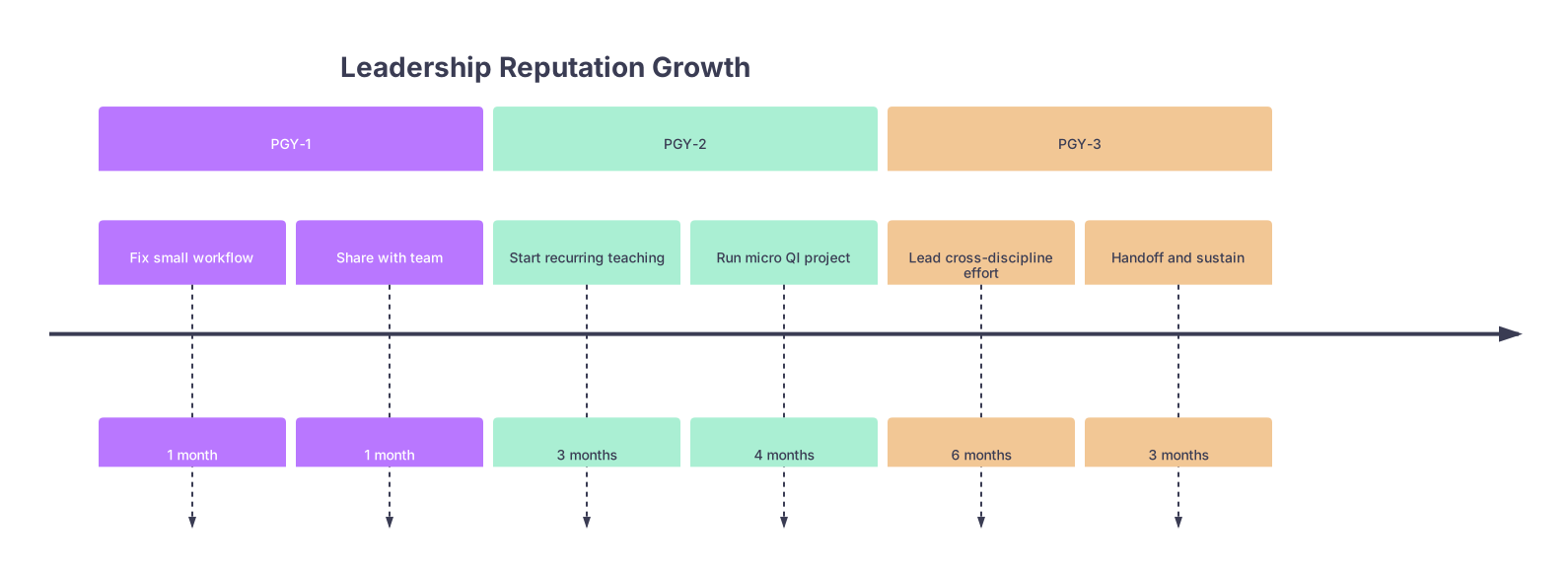
| Period | Event |
|---|---|
| PGY-1 - Fix small workflow | 1 month |
| PGY-1 - Share with team | 1 month |
| PGY-2 - Start recurring teaching | 3 months |
| PGY-2 - Run micro QI project | 4 months |
| PGY-3 - Lead cross-discipline effort | 6 months |
| PGY-3 - Handoff and sustain | 3 months |
The resident who accumulates 3–4 of these projects over training ends up in a very different category than the one who just “participated” in eight committees.
Turning Your Work Into a Killer CV Line (Without Lying)
You can do a great project and still undersell it on paper. PDs skim. They’re scanning for “real work, real outcomes.”
Weak:
“Co-led wellness initiatives for residents.”
Strong:
“Designed and implemented a monthly 10-minute peer check-in at end of clinic; 62% of residents reported improved sense of support on post-intervention survey.”
Weak:
“Participated in discharge QI project.”
Strong:
“Led micro-QI project standardizing discharge huddle on 6E; late discharge summaries decreased from 45% to 28% over 6 weeks.”
See the pattern: ownership + specific action + concrete impact.
Do not inflate. Don’t make yourself “director” of something that was clearly a group effort. Faculty see right through that. But do not hide your actual role. If you drove it, say so.
A Very Short Reality Check
You are not going to transform your hospital. You’re not redesigning Epic. And your program director doesn’t expect you to.
What actually impresses them is much simpler:
- You saw a problem and did something concrete about it.
- You respected other people’s time.
- You left the system a little better than you found it.
If you can string together a few of those projects, you’ll be the resident they call when there’s a real leadership slot to fill.


