

The process of becoming chief resident is more politics than meritocracy, and everyone in leadership knows it.
People will smile and tell you it’s “about leadership” and “serving your peers.” That’s the brochure version. The real conversations—the ones that decide who gets the title—happen behind closed doors, in quick hallway huddles, late-night emails, and whispered chats between attendings who’ve formed opinions about you that no one has spelled out to your face.
Let me walk you through what actually happens and what’s really being weighed when your name comes up on that chief list.
How Chief Residents Actually Get Picked
Here’s the part everyone glosses over: very few programs have a truly transparent, standardized process for choosing chiefs. They’ll claim they do. They do not.
Most places fall into one of a few models, but all of them are layered with behind-the-scenes interpretation.
| Model Type | Who Really Decides |
|---|---|
| PD-only appointment | Program director + 1-2 allies |
| PD + faculty vote | PD steers, faculty co-sign |
| PD + resident vote | PD filters, resident vote tweaks |
| Pure resident vote | Senior residents + quiet PD veto |
| Rotation-based chief | Admin leadership, not peers |
The “PD Knows Best” Model
In many IM, surgery, anesthesia, neuro programs, the PD basically picks. They might “solicit input” from faculty, APDs, or chiefs, but that’s mostly to confirm what they already think. The meeting looks like this:
“Okay, who are we thinking?”
Name A: “Strong clinically, very reliable, maybe a bit quiet but solid.”
Name B: “Great with patients, but disorganized and honestly a bit needy.”
Name C: “Very smart, but rubs nursing the wrong way. A little sharp.”
Name D: “Big personality, gets things done, but some professionalism flags.”
Then someone says, “Who’s going to make my life easier next year?” That question carries more weight than your publications, your Step scores, or your advocacy projects.
The Fake Democracy: Resident Votes
Some programs brag: “The class votes for chief.” Here’s what you’re not told:
The PD and APDs already have a short list. If your name is not on that short list because:
- you annoyed the wrong attending
- you were late too many times on that one rotation
- nursing hates you
- your documentation is always behind
…you’re not becoming chief. I’ve seen resident vote tallies completely ignored because “that person wouldn’t be a good representative for the program.”
At a big-name IM program I know, the class overwhelmingly voted for one resident—charismatic, loved by co-residents, great teacher. Leadership overruled it because they saw him as “too oppositional” and “too outspoken about duty hours.” He never got an official explanation. The residents only realized what happened when the PD said, “We considered your feedback, but we also have to think about the needs of the program.”
Translation: We’ll pick someone we can manage.
What They Say Matters vs What Actually Matters
Official line: “We choose chiefs based on leadership, clinical excellence, teaching, and professionalism.”
Actual filter: “Can this person execute what leadership wants, not create chaos, not embarrass us, and keep the residency machine running without constant supervision?”
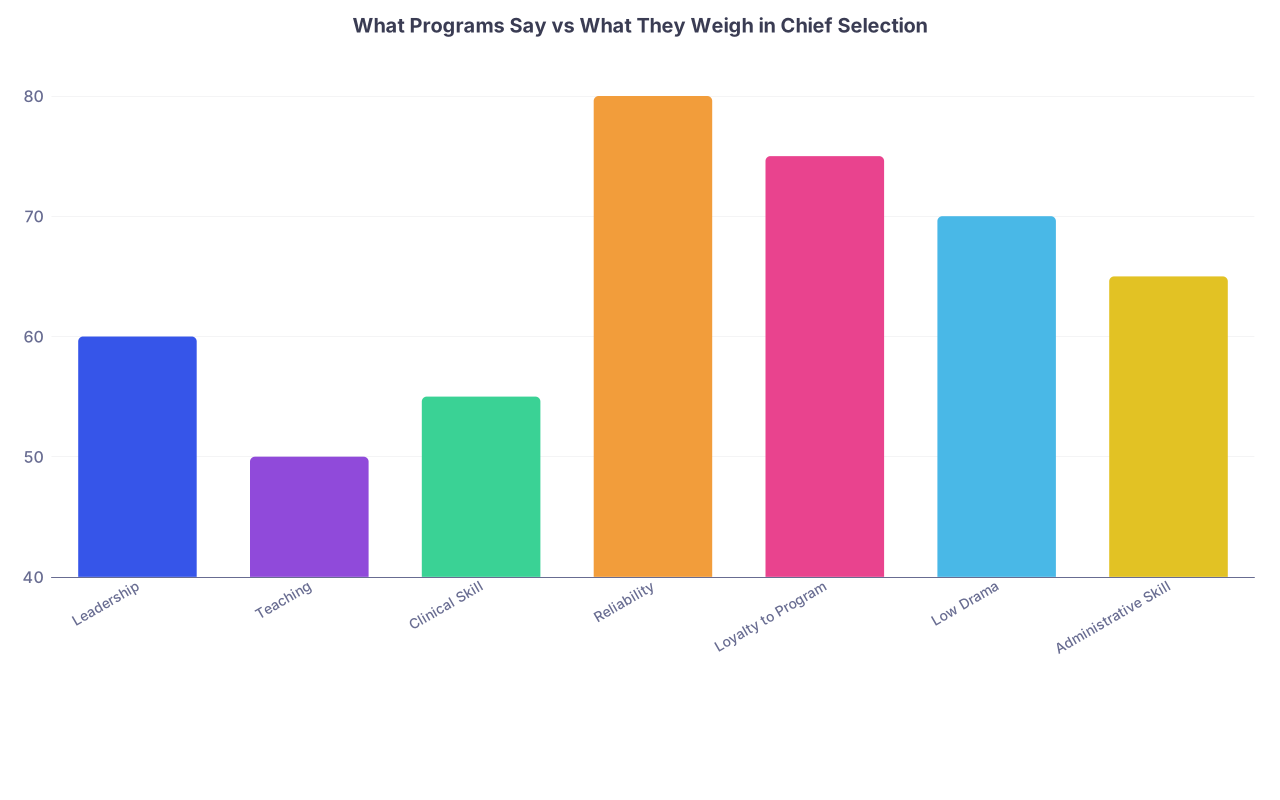
| Category | Value |
|---|---|
| Leadership | 60 |
| Teaching | 50 |
| Clinical Skill | 55 |
| Reliability | 80 |
| Loyalty to Program | 75 |
| Low Drama | 70 |
| Administrative Skill | 65 |
Those numbers aren’t from a paper. They’re from years of watching how discussions unfold. Reliability, loyalty, and low-drama behavior win far more arguments than pure brilliance.
Here’s how some specific traits get interpreted when your name comes up:
You’re outspoken about safety, duty hours, or unfair policies.
Publicly: “Advocates for residents.”
Privately: “Can be oppositional. Might be hard to manage.”You’re very academically driven, constantly at conferences, writing, presenting.
Publicly: “Highly productive.”
Privately: “Will they even be here? Will they do the grunt admin work?”You’re loved by co-residents but messy with notes, forget orders, or show up late.
Publicly: “Residents really support them.”
Privately: “We can’t reward poor professionalism.”You’re quiet, solid, not flashy.
Publicly: “Maybe not a strong leader?”
Privately (from faculty who like stability): “Honestly, they’d be so easy to work with.”
The biggest unspoken factor: How predictable you are. Chiefs smooth out the chaos. Programs pick residents who feel steady, controllable, and aligned with the institution’s culture.
The Real Power Players in the Decision
You think it’s just the PD. It’s not. There’s a small inner ring that shapes the conversation before your name is ever at the top of the list.
The Associate PD Who Sees Everything
There’s usually one APD who:
- runs CCC or semi-annual evals
- deals with remediation
- fields resident complaints
That person has a mental spreadsheet of who causes problems, who solves them, and who quietly keeps the floors running. Their single comment in a meeting can sink or save you:
“I never worry when they’re on nights.”
vs
“I’ve had to talk to them three times this year about follow-through.”
You’ll never see that comment written. But it hangs in the room when your name appears.
The Program Coordinator: The Silent Voter
No one says this out loud, but program coordinators’ impressions matter more than anyone wants to admit.
If you treat the coordinator like a clerk, blow off emails, or drop last-minute requests all year, then suddenly start being sugary polite in chief season—do not kid yourself. People notice.
I’ve heard versions of this:
“Honestly, [Name] is smart, but they’ve been a nightmare for scheduling.”
“We can’t have a chief who treats staff like they’re disposable.”
No coordinator gets a vote on paper. They absolutely get a voice in private.
Nursing and Ancillary Staff: The Shadow File
A PD may never say, “Nursing doesn’t like you” in your face. But they’ll hear it.
Charge nurses. Case managers. OR staff. They bring up names in passing: “Oh, we like working with her” or “He always disappears at sign-out.” Those moments stick.
At one surgery program, a resident who was adored by his class was quietly torpedoed because multiple OR nurses said, “He’s dismissive. When things get tense, he talks down to us.” The PD basically said to faculty: “I can’t make someone chief who alienates nursing. We’ll get destroyed on climate surveys.”
You’re being watched by people who don’t fill out your MedHub evaluation.
The Part No One Admits: The Politics of Being “Safe”
You want the hardest truth? Programs rarely pick the most visionary or disruptive leader as chief.
They pick a stabilizer.

| Step | Description |
|---|---|
| Step 1 | Potential Candidate |
| Step 2 | Not considered |
| Step 3 | Watch closely |
| Step 4 | Trusted |
| Step 5 | Short list |
| Step 6 | Not this year |
| Step 7 | Likely chief |
| Step 8 | Possible chief |
| Step 9 | Clinical concerns |
| Step 10 | Professionalism flags |
| Step 11 | Aligns with leadership |
| Step 12 | Resident support |
Here are the three “safe” archetypes that get picked again and again:
The Loyal Workhorse
Reliable, not flashy, rarely complains. They show up, finish notes, answer emails, and do every menial committee task. PDs love them because they under-react, not overreact.The Diplomat
Gets along with everyone, from attendings to interns to nurses. When there’s conflict, they melt it, not escalate it. Maybe not the smartest in the room, but the most smoothing.The “Mini-PD”
Already thinking like an administrator. Understands scheduling, coverage, recruitment optics. Talks about “the program’s needs.” Feels like a natural extension of leadership.
Who scares leadership?
- The crusader who wants to overhaul culture in one year.
- The lightning rod who’s constantly at the center of drama, even if they’re not the cause.
- The superstar who is visibly more interested in their own career than in the residency’s day-to-day grind.
Programs don’t say it that way. They hide it behind “fit” and “maturity” and “professionalism.” But the subtext is: Will this person make my job harder?
How Your Reputation Is Actually Built (Not How You Think)
By the time chief conversations start—early PGY-2 in many fields—your file is already mostly written. Not the official one. The informal one.
It’s built on small, forgettable moments you never thought anyone logged.
- The time you stayed late to help a co-intern with an ICU transfer and the fellow saw you, even if you never presented it as heroism.
- The time you rolled your eyes in front of a crusty attending about a consult and they decided you were “entitled.”
- The months you were always a little late on notes, always asked for one more extension, always “almost done.”
One PD I know keeps a private OneNote tab with a list of residents and quick hits like:
“Very reliable on nights. Good with patients. Needs to be less sharp with feedback.”
“Always pushing for schedule favors. Good teacher but high maintenance.”
“Low drama. Residents like her. Could be chief if she wants it.”
That’s the document that shapes the first version of the chief list.
How to Actually Position Yourself for Chief (Without Being Fake)
You can’t “game” politics completely, but you can stop being naive about it.
Decide If You Actually Want the Job
This part is under-discussed. Being chief is not some pure honor. It’s a job with very specific trade-offs.
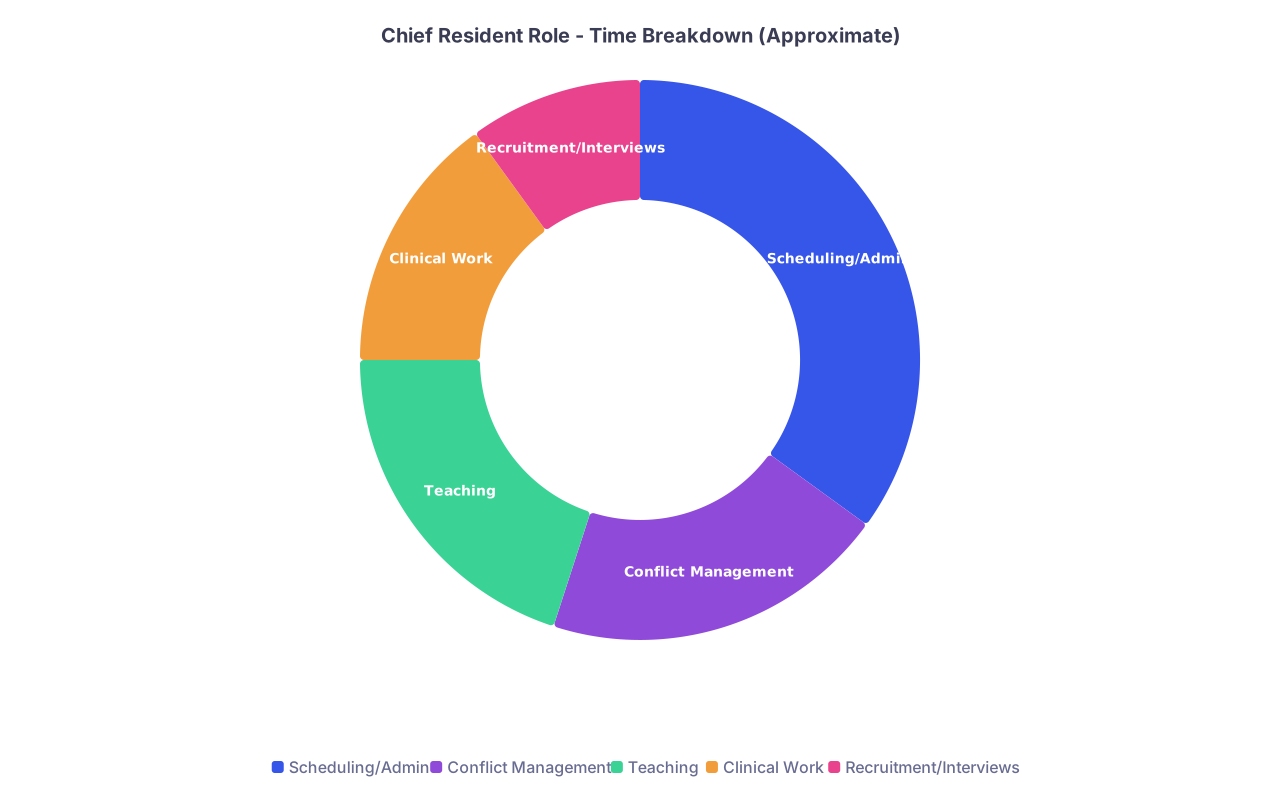
| Category | Value |
|---|---|
| Scheduling/Admin | 35 |
| Conflict Management | 20 |
| Teaching | 20 |
| Clinical Work | 15 |
| Recruitment/Interviews | 10 |
If you want it for:
- prestige on fellowship applications
- the title
- a vague sense that you “should”
…you’re going to hate it. You’ll be a middle manager between angry residents and overworked faculty. Some people thrive there. Some people burn out fast.
If you know you don’t want it, here’s the move: still act like the kind of person who could be chief. That reputation helps everything else—letters, fellowship, job offers—without you needing the role.
Behave Like Leadership Is Already Watching (Because They Are)
I’m not talking about smiling more or agreeing with everything. I mean:
- Stop treating staff like they’re background characters. Say “thank you” and mean it.
- Answer emails. Even if it’s a one-line “Got it, thanks.”
- If you’re going to push back on something, do it privately, with a plan, not in a chaotic group vent.
Faculty will forgive mistakes in knowledge or efficiency. They do not forget repeated patterns of flakiness or drama.
Become the Person Residents Go To… Who Doesn’t Light Fires
This one is subtle. Chiefs are resident-facing and admin-facing. Leadership loves people who:
- residents trust with real problems
- don’t immediately blast those problems as “systemic injustice” on group chats
- can filter, prioritize, and then bring the right things up in the right way
I’ve watched PDs say: “Everyone goes to her when something is wrong. And she doesn’t inflame it. She’s balanced.” That’s chief material.
The Ugly Side: Bias, Favorites, and the Unfair Stuff
You suspected it; here it is plain.
Implicit bias absolutely leaks into chief selection:
- Attractive, extroverted residents are more often tagged as “leadership material” even when quieter colleagues are just as capable.
- Women are often held to a warmer, more “approachable” standard; being blunt gets labeled “abrasive” faster.
- URiM residents who advocate for equity sometimes get coded as “always making it about race” while a white resident’s complaints are called “important feedback.”
None of this will show up in your file. It shows up in the pre-meeting chatter.
And then there are pure favorites. The resident who worked closely with one influential attending on research, went to conferences with them, got the “I’d hire them in a second” endorsement. That halo effect is real. If that attending pushes hard enough, your shortcomings shrink in the room.
This doesn’t mean you’re helpless. It means: know the system is not perfectly fair. Do not build your self-worth around whether you get a title decided in a biased room.
If You’re Passed Over: What That Actually Means (And Doesn’t)
Here’s the part people inside leadership rarely say out loud.
Not getting chief means exactly one thing: you were not the person they wanted as their chief that specific year, for their specific agenda, in their specific culture.
It does not mean:
- you’re not a leader
- you’re not respected
- you’ll have a worse career
I can name stacks of chiefs who plateaued early and non-chiefs who became division chiefs, chairs, national leaders. The selection process is just too noisy to predict long-term leadership.
What matters much more long term:
- your clinical reputation
- your integrity
- your ability to work with teams under pressure
- your habit of taking responsibility without needing a title
If you get passed over and it stings, you’re normal. Let it sting for a few days. Then do the most adult thing you can: walk into the PD’s office and ask for specific, honest feedback.
Not, “Why didn’t I get chief?”
Ask, “If you were writing my professional development plan, what would you say I do very well, and what gave you pause for a chief role this year?”
Some of that feedback will be political spin. Some of it will be the most valuable mirror you get in residency.
If You Do Become Chief: The Political Landscape You’re Walking Into
If you get it, understand you’re now sitting in the gray area. You’re not “one of the residents” in the same way. You’re not fully leadership either. You’re sitting in the no-man’s-land where everyone expects something from you.
Residents will test you: “Whose side are you on?”
Leadership will watch you: “Can they hold the line?”
You’ll have to make decisions that make your friends angry. Underfill vacations. Push someone to remediate. Enforce an unpopular call change.
The chiefs who do well are the ones who:
- keep confidences, but don’t promise outcomes they can’t deliver
- are transparent about process even when they can’t change the result
- refuse to bad-mouth residents to faculty or faculty to residents just to ingratiate themselves with either group
You will be tempted to play both sides. That’s how chiefs burn their credibility in under three months.
Perspective: What This All Looks Like 10 Years From Now
Years after residency, most people can barely remember who was chief which year. They remember who they trusted on sick nights. Who helped them out on their worst call. Who owned their mistakes.
Chief matters in the moment. It can help for fellowship. It can open a couple of doors. But it doesn’t define your ceiling.
The politics behind chief selection are messy, biased, and often short-sighted. Understand them. See the game clearly. Then decide how much of yourself you’re willing to shape for a title that lasts twelve months.
Because years from now, no one will care what was printed under your name on the schedule. They’ll care what it’s like to be in a room with you when things are hard.


