

It’s 7:12 a.m. You’re in the back of the rounding pack, half-hidden behind the computer-on-wheels, clutching your folded list so hard the paper’s bending. The attending fires off questions, the senior answers smoothly, the intern takes notes like a court stenographer.
You see something in the plan that’s… off. Or at least maybe off. You think: “I’m probably wrong. If I say something and it’s dumb, they’ll remember forever. I’ll be The Resident Who Doesn’t Know Basic Medicine.”
So you say nothing. And then stew about it for the rest of the day.
If that’s you, you’re not broken. You’re not “not a leader.” You’re just a normal resident in a hierarchy that’s very good at teaching fear. I’ve watched brilliant people shut down on rounds for years. I’ve done it myself. And then gone home replaying every moment, imagining the attending saying my name and the whole circle turning to stare while I choke.
Let’s talk about leadership moves that don’t feel like stepping off a cliff. The tiny, low-risk things you can do today that actually count as leadership, even if they don’t look like some chief resident standing at a podium.
First, let’s be honest: why speaking up feels terrifying
](https://cdn.residencyadvisor.com/images/articles_svg/chart-common-fears-residents-have-about-speaking-up-3062.svg "Common Fears Residents Have About Speaking Up")
| Category | Value |
|---|---|
| Looking stupid | 80 |
| Attending getting mad | 65 |
| Contradicting senior | 70 |
| Slowing rounds | 55 |
| [Being wrong about patient safety](https://residencyadvisor.com/resources/leadership-in-medicine/what-if-im-the-only-one-speaking-up-about-patient-safety-issues) | 40 |
Everyone likes to say, “There are no dumb questions,” but then you watch someone answer a basic question wrong and see the eye twitch from the attending, the long pause, the “we really should know this.” And you log that away as: Do not be that person.
Here’s what usually sits under “I’m afraid to speak up on rounds”:
- “If I’m wrong, they’ll think I’m incompetent.”
- “If I disagree with my senior, I’ll get labeled ‘difficult’ or ‘not a team player.’”
- “I’m too slow. My thoughts aren’t polished. Everyone else sounds crisp.”
- “I should know this already. If I ask, it just proves I’m behind.”
- “This attending is scary. I’ve heard the horror stories.”
You’re not irrational. The hierarchy is real. Some attendings are actually unkind. Some seniors do shut people down. You’re not imagining that.
But here’s the part most residents underestimate:
Leadership is not a binary of “say something brilliant” vs “stay quiet.”
There’s a whole middle ground of small moves that:
- Don’t put you on the spot as “The Expert”
- Don’t require you to contradict anyone loudly
- Still change how the team functions and how patients are cared for
Let’s live there for a bit.
Small leadership move #1: Ask “verifier” questions, not “challenger” questions
The scariest thing is openly challenging the plan. Totally fair. So don’t start there.
Start with verifier questions—questions that frame you as trying to understand and make the plan safer, not as arguing.
Example situation:
Plan is to send home a 78-year-old on new insulin. You’re worried. But saying, “I don’t think we should discharge her” feels huge and confrontational.
You can instead say:
- “Can I clarify her follow-up for the insulin teaching?”
- “I’m a little worried about how comfortable she seemed giving herself injections. Is there a way to reinforce that before she leaves?”
- “Just to be safe, should we double-check her pharmacy access for insulin and supplies?”
You’re not saying, “Your plan is bad.” You’re saying, “I’m trying to see this through.” That’s leadership. It’s seeing the edge of the cliff even if you can’t move the whole mountain.
Same with meds:
Instead of “That’s the wrong dose,” you can say:
- “Just to double-check the dose—should we be at 25 mg or 50 mg for this indication?”
- “This patient has CKD; do we need any renal adjustment on this?”
You’re asking with the team, not against the team.
Tiny, safe, but really powerful.
Small leadership move #2: Own one small domain on your team

If you’re waiting to feel like “a leader” in all domains of medicine before you act like one, you’ll be waiting until you’re an attending. And then you’ll still feel behind.
Pick one slice of the work where you quietly become the person who cares extra. Examples:
- You become “the med rec person” who always asks, “Do we have an accurate home med list?”
- You’re “the follow-up person” who always asks, “Is follow-up actually scheduled and in the discharge summary?”
- You’re “the communication person” who always asks, “Does the patient understand the plan?” or “Have we updated the family today?”
You don’t need permission. You just start asking those questions—gently, consistently.
On rounds, it sounds like:
- “I can call the PCP to confirm that med list after rounds.”
- “I’ll make sure the discharge summary clearly lists the med changes.”
- “I’ll circle back to the patient after rounds and re-explain the plan.”
That’s leadership. You’re taking responsibility for a piece of care that everyone else likes to assume “someone” is doing. Spoiler: a lot of the time, no one is.
This is also less scary, because you’re not making some grand, controversial statement. You’re offering help, taking ownership, and making the team look good. Attendings love that. Seniors love that. And your anxiety brain might finally calm down for five minutes.
Small leadership move #3: Use “I’m noticing…” instead of “You’re wrong…”
Your brain probably goes: “If I see something off, I either call it out or stay completely silent.” That false binary is what keeps you frozen.
Swap confrontation language with observational language.
Difference between:
- “We shouldn’t stop the heparin; they have a history of PE.”
vs - “I’m noticing they had a PE 6 months ago—does that change how we’re thinking about stopping heparin?”
Second one is softer. You’re not declaring The Truth From On High. You’re bringing data back into the room and inviting the team to look at it.
More examples you can basically memorize and reuse:
- “I’m noticing their creatinine has been trending up—are we okay keeping them on this dose?”
- “I’m noticing they’re on 4 pressors—are there any goals for when we’d change course?”
- “I’m noticing the family seems really confused; do we want to set up a family meeting?”
These phrases are shields. They buy you psychological safety. You’re not saying, “You messed up.” You’re saying, “Here’s a thing. What do we want to do with it?”
Still leadership. Still safe-ish.
Small leadership move #4: Do your speaking before or after rounds
I’m not going to pretend every attending is “psychologically safe.” Some are absolutely not. You know which ones. You can feel your heart rate jump when they walk onto the floor.
So adjust your strategy by person and by day. That’s not cowardly. That’s survival.
If on-rounds speaking feels like jumping into a shark tank, try off-rounds leadership:
Grab your senior before rounds:
“For Mr. X, I’m a little uneasy about discharging today because of [reason]. Can we watch for that when we present?”Stop the attending briefly after rounds:
“I was thinking more about Ms. Y’s plan—can I run a quick question by you about her anticoagulation?”Call or message your senior later:
“I saw Mr. Z’s blood pressure staying low all afternoon. I ordered a repeat CBC—just wanted to loop you in.”
You’re still speaking up. You’re still influencing plans. You’re just picking a context where you’re less likely to freeze and less likely to get humiliated in front of 10 people.
That counts.
Small leadership move #5: Lead with your prep, not your personality
A lot of “speak up!” advice assumes you’re extroverted and confident. If you’re reading this, I’m guessing you’re not feeling either.
So lean on something you actually can control: preparation.
If you know you’re terrified to be cold-called or to suggest changes, stack the deck:
- Before rounds, anticipate 1–2 questions per patient that are likely to come up: “What’s our plan if cultures are negative?” “What’s the alternative if they can’t tolerate this med?”
- Look up one guideline snippet or dose you’re unsure about. Keep it on your phone or written on your list.
- Write down 1–2 safe phrases you can say for each patient:
- “Overnight, I was watching X, and I noticed…”
- “I had a question about X that I looked up…”
Now you’re not relying on your brain to make smart, confident-sounding words under pressure. You’re reading from your own short script.
Here’s what that does: it helps break the “I never speak” identity. The first few times, you literally just read the line. Over time, your brain starts to believe, “Okay, I do sometimes talk. And nobody died.”
That identity shift is bigger than it looks.
What “small leadership” actually looks like on a real day

| Step | Description |
|---|---|
| Step 1 | Pre-round chart review |
| Step 2 | Note concern about plan |
| Step 3 | Tell senior 1 concern before rounds |
| Step 4 | Rounds - ask 1 verifier question |
| Step 5 | Volunteer to own 1 task |
| Step 6 | Post-round follow up with attending or nurse |
| Step 7 | End of day reflection - what worked |
Let’s walk through one hypothetical day, because the abstract stuff can feel fake.
You’re on medicine. You have 6 patients. You’re exhausted. Attending is intense but fair, senior is decent, intern is drowning.
Morning:
You’re pre-rounding on a cirrhotic patient getting diuresis. You notice their creatinine bumped from 0.9 to 1.3. Brain thought: “Oh no, did we overdo it?” Anxiety thought: “If I say something, they’ll think I don’t understand cardiorenal pathophys.”
Small leadership move:
You write on your list: “Cr 0.9 → 1.3. Ask: any adjustment to diuresis?” You highlight it.
Before rounds, you quietly tell your senior:
“I noticed Mr. A’s creatinine went up. When we present, I might ask about adjusting his diuresis—does that make sense?”
You’ve prepped your senior. You’ve protected yourself a bit.
On rounds at the bedside:
After the intern presents, you say:
“I’m noticing his creatinine bumped from 0.9 to 1.3 since yesterday—do we want to adjust our diuresis at all?”
The attending may say, “Good catch, let’s back off.” Or, “No, here’s why we’re okay with that bump.” Either way: you asked a real, clinical, reasonable question.
No one dies. The world keeps spinning. Your brain logs: “I spoke. Nothing exploded.”
That’s the win.
Tiny scripts for when your throat closes up

You don’t need a huge vocabulary to sound like a leader. Honestly, half the battle is having a sentence ready so your mouth can move even when your brain is screaming.
Here are some plug-and-play lines:
For asking a safe question:
- “Can I clarify one part of the plan?”
- “I had a question about how we’re thinking about X.”
- “Just to make sure I understand…”
For bringing up a concern without sounding accusatory:
- “I’m noticing [data point] and wondering if that changes anything for us.”
- “I might be off here, but I was thinking about [issue] because of [reason].”
- “One thing I was a little worried about was…”
For offering to lead a small piece:
- “I can take the lead on making sure [task] gets done today.”
- “I’ll call [consult/PCP/family] after rounds and circle back.”
- “If it’s okay, I’ll follow up on [result] and update everyone.”
You can literally write 3 of these at the top of your list every day. Circle the one you’re going to use at least once. That’s your assignment to yourself.
The unsexy truth: most leadership is this quiet
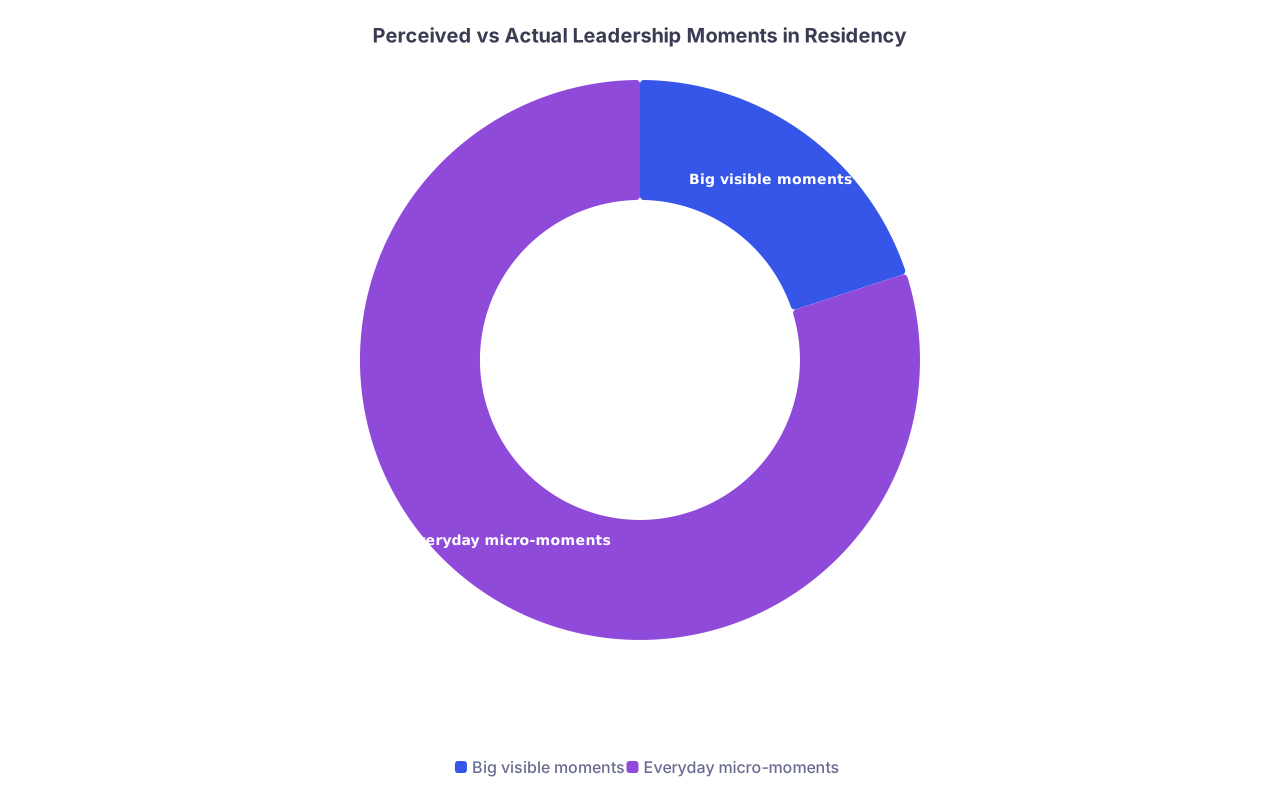
| Category | Value |
|---|---|
| Big visible moments | 20 |
| Everyday micro-moments | 80 |
Everyone pictures leadership as the dramatic stuff: stopping the team before a bad order, giving a big teaching talk, confronting a problematic attending. Those moments happen, sure. But they’re maybe 5–10% of the job.
The rest? It’s this:
- Asking the slightly awkward but necessary question
- Following through on the annoying, easy-to-forget detail
- Gently re-orienting the team to a piece of data they ignored
- Making the patient feel less like an object on the team’s schedule
You can do all of that without suddenly transforming into some bold, fearless, never-anxious superhero. You can be anxious, introverted, and soft-spoken—and still be a leader.
Honestly, some of the best residents I’ve worked with were quiet. But when they spoke, they asked sharp questions, they owned their tasks completely, and they made patients safer. That’s who people trust.
How to practice one tiny step today
You don’t need a full personality transplant. Just a rep.
Today (or tomorrow, if you’re post-call and exhausted), pick one of these:
- On one patient, ask exactly one verifier question on rounds.
- Before rounds, tell your senior one thing you’re worried about and say you might bring it up.
- Claim one domain for the day: meds, follow-up, communication—whatever—and ask related questions for every patient.
- After rounds, follow up with one nurse or one family member, then let your team know you did it.
And then tonight, ask yourself:
- Did anyone yell at me?
- Did anything catastrophic happen because I spoke?
- Did I feel even 2% more like I had agency?
If the answer to that last one is not “no,” you’re moving. Slowly. Quietly. But you’re moving.
| Situation | Small Leadership Move |
|---|---|
| Worried about med dose | Ask a verifier question about dosing |
| Discharge feels rushed | Clarify follow-up and patient understanding |
| Scary attending on rounds | Raise concern to senior before or after |
| Unsure where to start leading | Own one domain (med rec, follow-up, comms) |
| Afraid of sounding dumb | Prep 1–2 scripted questions per patient |
FAQ (you’re not the only one thinking these)
1. What if my attending actually does humiliate people?
Then you’re not obligated to be a martyr. You can still lead; you just shift where and how. Use your senior as a buffer. Ask more questions before or after rounds. Document your concerns in the note if needed. If it’s truly toxic, talk to your chief or PD—not about “they were mean once” but specific patterns that affect patient care. Protecting yourself isn’t weakness; it’s strategy.
2. I freeze and blank when they look at me. How do I fix that?
You don’t “fix” it overnight. You work around it. Script lines ahead of time. Write them on your list. When you feel your brain shutting down, literally read the line: “I’m noticing X and wondering if that changes anything.” It’ll feel robotic at first. That’s fine. Over time, your nervous system gets used to the feeling of speaking up, and you won’t need the training wheels as much.
3. I’m afraid my senior will think I’m questioning their judgment.
So frame it as curiosity and support. “I want to make sure I’m understanding how you’re thinking about this” or “I’m asking because I want to be able to explain it clearly to the patient.” Most decent seniors will hear that as engagement, not attack. And if a senior can’t tolerate any questions, that’s a them problem, not a you problem.
4. How do I know if I’m speaking up ‘enough’?
There’s no magical quota. But if you go whole days or weeks without asking a question, offering an observation, or owning a task, you’re probably selling yourself short. A good starting target: aim to speak up with something meaningful (not just “okay” or “got it”) on at least 2–3 patients per day. That’s it. Small, repeatable, sustainable.
Open your list (or your EMR sidebar) right now and pick one patient you’re seeing tomorrow. Write down a single, safe sentence you could say on rounds about them—an “I’m noticing…” or “Can I clarify…” line. That’s your next move. Not being fearless. Just being ready for one small moment.


