

The loudest person on the team is almost never the best leader.
If that sentence makes you feel both relieved and suspicious, you’re exactly who I’m talking to.
You’re in residency, or about to be. You’re surrounded by residents who seem born for the mic: they speak fast during rounds, they jump in first on new admits, they volunteer to present at grand rounds without breaking a sweat. Meanwhile, you’re standing there thinking:
“Am I too quiet for this? Are my attendings going to think I’m weak? Will my interns ignore me? Are my patients going to feel unsafe because I’m not this big commanding presence?”
I know that loop. The “I’m not a real leader” loop. It’s vicious.
Let me just say this bluntly: quiet does not equal weak. Quiet equals… unproven. And unproven you can fix. Step by step.
This isn’t some fluffy “introverts are magic” pep talk. This is about building credibility in a system that secretly rewards calm, reliable, thoughtful people way more than it rewards noise—especially in medicine.
The brutal fear behind “I’m too quiet”
Let’s not sugarcoat what you’re actually afraid of. It’s not just, “I wish I talked more.”
It’s more like:
- “My co-residents will walk all over me on nights.”
- “Interns will go to someone else with questions, even when I’m the senior.”
- “Attendings will think I don’t know anything.”
- “In a code, I’ll freeze and everyone will see who I really am: not a leader.”
And the really ugly one:
“If I don’t look like a leader, I’m going to hurt someone.”
That’s the fear that keeps you up at 2:17 a.m. after a rough cross-cover night.
Here’s the twist that no one tells you: leadership in residency is 80% reliability and clarity, 20% volume and “presence.” You can be quiet and still own all 80% of what matters.
You’re not trying to become the loudest person. You’re trying to become the person everybody quietly trusts.
What “credibility” actually means on the wards
Credibility isn’t “Do they like me?” or “Do I look confident in my headshot?”
Credibility in residency is more brutal and more concrete:
- Do people trust what you say?
- Do they feel safer when you’re around?
- Do they come to you with problems?
- Do they listen when you speak, even if you speak rarely?
You don’t earn that with rah-rah speeches. You earn it through patterns. Tiny, boring, repeatable patterns.
Let me break down how this actually shows up on a normal day.
On rounds
You don’t have to be the one who jokes the most or fills every silence. You build credibility by:
- Presenting clearly and concisely, even if your voice is soft.
- Knowing the details cold when someone asks.
- Owning your plan and explaining it like you’ve actually thought it through.
An intern who quietly presents a rock-solid plan with clear backup options looks like a leader. The loud, scattered senior who talks in circles? People stop trusting them fast.
On cross-cover nights
You know what nurses care about at 3 a.m.? Not your volume. Not your swagger. They care:
- Do you answer your pager?
- Do you actually come see the patient when they’re worried?
- Do you make decisions or just stall and say, “We’ll see”?
A quiet resident who actually shows up, examines the patient, adjusts meds, and documents? Nurses remember. They talk. “She’s calm but she’s good.” That’s credibility.
In codes or crises
Yes, this is the big one you’re secretly spiraling about.
Leadership in codes isn’t about who yells the loudest. It’s about:
- Saying things simply: “You—compressions. You—bag. I’ll run meds.”
- Sticking to the algorithm instead of panicking.
- Speaking rarely, but clearly: “Pause. Rhythm check. Go.”
Calm is not the opposite of leadership. In medicine, calm is the leadership flex.
Step 1: Pick your “credibility lane” and own it
You’re not going to transform into a charismatic TED Talk person in one rotation. So don’t try.
Instead, decide where you want to be quietly excellent first. One lane. Not everything.
| Lane | What It Looks Like Day to Day |
|---|---|
| Clinical Mastery | Knowing your patients and plans cold |
| Reliability | Always following through on tasks |
| Teaching | Being the intern/med student go-to |
| Communication | Clear sign-outs, clear notes, clear pages |
| Calm in Crisis | Steady during rapid responses and codes |
Pick one that feels closest to who you already are. If you’re anxious, “Calm in Crisis” might feel impossible right now. Fine. Start with “Reliability” or “Communication.”
Then you overdeliver there on purpose.
Concrete example for “Reliability” lane:
- You write your to-do list for every patient and actually finish it.
- You message the team when something gets delayed instead of pretending it’s done.
- You’re the one who remembers to update families when you said you would.
- If you say “I’ll check the CT,” there is never a world where you don’t check the CT.
People notice patterns faster than they’ll ever notice personality.
Step 2: Use your quiet to your advantage (yes, really)
Quiet people see things loud people miss. While the extrovert is talking, you’re actually watching.
You can lean on that.
Watch the room like it’s part of your job
Because it is.
In rounds, between notes, during handoffs—start paying attention to:
- Who looks confused but won’t say anything?
- Which nurse seems worried but hasn’t escalated yet?
- When does your attending’s voice change from neutral to “I’m concerned”?
Then do one very small, very leader-like thing: you check in.
You quietly ask the intern, “What part is tripping you up?”
You say to the nurse, “You seem worried. What are you seeing that I’m missing?”
You ask the attending, “You sounded concerned about that last lab—what are you watching for?”
That’s leadership. Not with a megaphone. With awareness.

Become the “it’s safe to be honest with me” person
Here’s something no one tells you: the person people confide in unofficially often has more real power than the official “leader.”
If med students and interns feel safe telling you:
- “I’m behind on notes.”
- “I didn’t understand that management decision.”
- “I’m worried I missed something.”
…then you’re already leading. You’re shaping how they learn, how safe they feel, how they practice.
You earn that by not freaking out when people are vulnerable with you. By listening. By being human.
You don’t have to “project confidence.” You have to project, “I won’t humiliate you if you’re honest.”
Step 3: Script your voice for the moments that matter
The scary part for quiet people isn’t usually saying anything. It’s saying something in high-pressure moments.
So you script the hell out of those.
Seriously. Write the words. Practice them in the shower, on your commute, under your breath between rooms. You can be anxious and still prepared.
Here are some plug-and-play scripts you can steal.
For codes / rapid responses
You don’t need a monologue. You need 1–2 sentences you can say clearly:
- “I’m the resident here. I’ll run this code.”
- “You—compressions. You—bagging. I’ll manage meds and timing.”
- “Everyone pause. Rhythm check… OK, resume compressions.”
You’re not performing. You’re reading from an internal script you’ve rehearsed 50 times when no one was watching.
For challenging attendings
You’re afraid they think you’re weak because you’re quiet, so you overcompensate by withdrawing even more. Don’t.
Try this:
- “My plan is X because… If that doesn’t work, my next step would be Y.”
- “I’m not certain about A vs B. Can I tell you my reasoning and get your take?”
You sound thoughtful, not timid. Even if your heart is pounding.
For leading juniors
You don’t have to sound like a chief. You just have to sound clear.
- “Today, I’d like you to focus on writing complete notes for patients 3 and 4. I’ll review them with you after rounds.”
- “On call tonight, I’ll handle admits, and I want you to focus on cross-cover. We’ll debrief in the morning.”
Simple. Specific. Limited words. Perfect for quiet people.
Step 4: Build a tiny, boring evidence folder that you’re actually a leader
Your brain is not going to believe “You’re a good leader!” just because you read this and nod. Mine wouldn’t either.
You need receipts.
Make a private “Credibility Wins” note in your phone. No one has to see it. On bad days, you’ll want to delete it. Don’t.
Every time something happens that even slightly suggests you’re trusted, you write it down:
- “Nurse paged me first instead of the other resident.”
- “Intern texted me later saying my explanation helped.”
- “Attending said, ‘Good call on starting antibiotics early.’”
- “Med student asked if I could write them a letter.”
Your anxious brain is great at documenting failures in 4K resolution. Fine. You’re going to start documenting wins with the same precision.
After a month, that list is going to look like something: a pattern. “People do trust me, even though I feel like a mess.”
That’s how you slowly rewire the story from “I’m too quiet to lead” to “I’m quiet and people still follow my lead.”
Step 5: Accept that you’ll feel fake before you feel capable
This is the part no “quiet leadership” article wants to admit: you are going to feel like you’re pretending.
You’re going to say, “I’ll run this code,” and inside you’ll be screaming, “Who let me be in charge? I need an adult.”
That doesn’t mean you’re not a leader. It means you’re a resident.
Nobody feels ready when they first start leading. Extroverts just hide it under more words.
You don’t have to wait until you “feel” like a leader to act like one in small, controlled ways. You build the feeling by stacking actions, not the other way around.
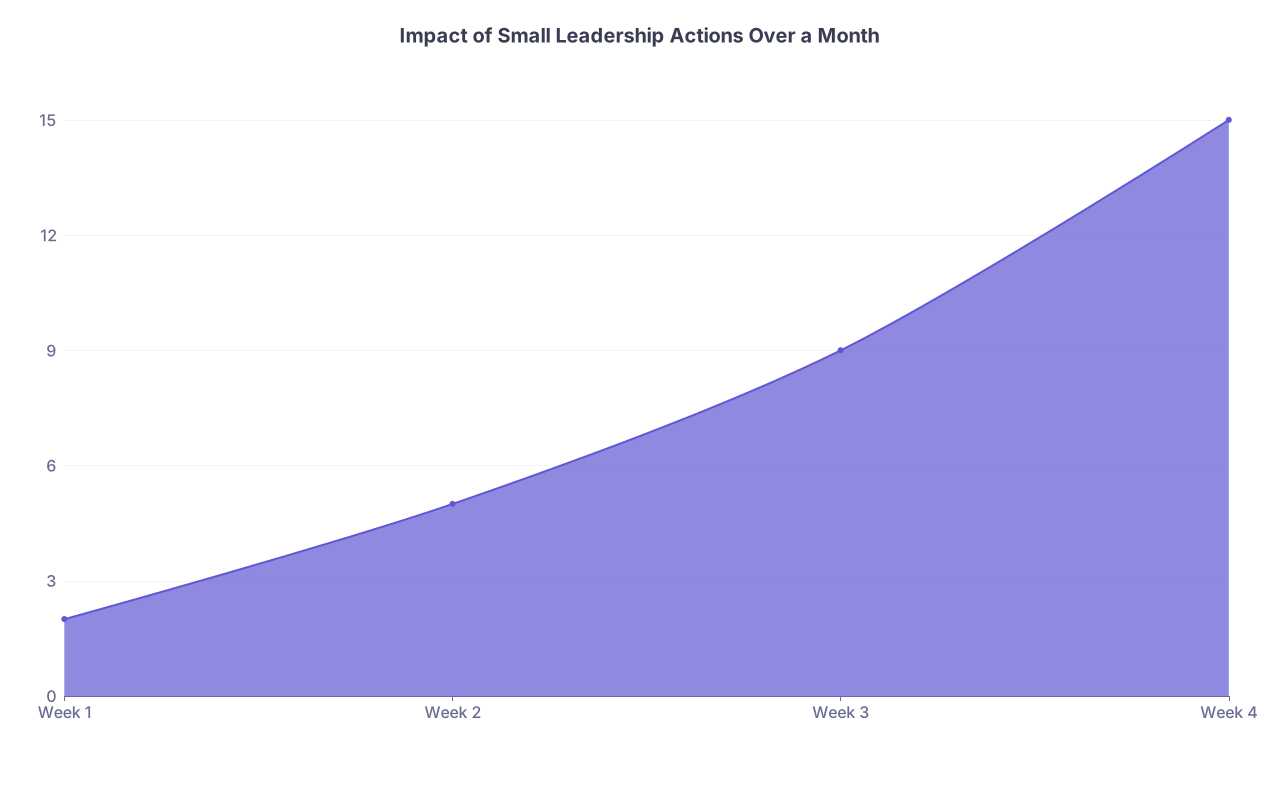
| Category | Value |
|---|---|
| Week 1 | 2 |
| Week 2 | 5 |
| Week 3 | 9 |
| Week 4 | 15 |
That chart is how this actually goes. Two small actions the first week. Then a few more. Then suddenly you look back over a month and realize you’re not the same terrified intern who whispered during rounds.
You didn’t “turn into” a different personality. You just quietly collected proof that people can and do rely on you.
What to do when you mess up publicly (because you will)
Here’s one more nightmare scenario:
You freeze during a code. Or you miss a result. Or you give a confusing plan on rounds and your attending dismantles it in front of everyone.
Your brain will use that as “proof” that you’re not a leader.
You counter it like this:
You own exactly what went wrong. Out loud, if appropriate:
“I got flustered and lost track of the sequence. I’m going to review the ACLS algorithm tonight.”You repair where you can.
Check back with the team: “That got messy. Next time I’ll assign roles sooner.”You add it to your evidence folder—but not as failure, as adjustment:
“Froze in code; made a new script and practiced with sim nurse after shift.”
Leaders aren’t people who never screw up. They’re people who don’t let one bad moment define the next 50.
Your anxiety wants to make every misstep into a prophecy. Don’t give it that much power.
You don’t need to become louder. You need to become consistent.
The attending who quietly runs a tight service? The chief who never yells but everyone respects? The senior who says, “What do you think?” and actually waits?
They all started somewhere near where you are. Unsure. Second-guessing. Convinced someone made a mistake handing them responsibility.
They didn’t magically find confidence. They did small, boring leadership behaviors over and over until their reputation caught up with who they actually were.
You can do that as a quiet person. In fact, it might be easier, because you’re already paying attention.
FAQ (Exactly 6 Questions)
1. What if my attendings tell me I need to “speak up more”? Aren’t they basically saying I’m not a leader?
Not necessarily. Often “speak up more” means “I think there’s more in your head than you’re sharing.” Translate it into something actionable: ask, “Could you give me an example of when you’d like to hear more from me—rounds, codes, sign-out?” Then pick one of those contexts and set a tiny goal: ask one question per patient, or state your plan before they ask. You’re not changing your personality; you’re giving them a clearer window into your thinking.
2. I’m terrified of running a code. Can a quiet person realistically lead one without freezing?
Yes, if you prepare like it’s a skill, not a personality trait. Run practice scenarios in sim if you can. Outside of that, memorize a few short leadership phrases (“I’m running this,” “You on compressions,” “Pause for rhythm check”). Practice them out loud when you’re alone. When the real thing happens, you’re not inventing words under stress—you’re pulling from a script you already own. You might still feel panicked inside. That’s normal. The team only sees the behavior, not your heart rate.
3. My co-residents dominate discussions and I can’t get a word in. How do I lead in that environment?
You don’t have to win the airtime war. Focus on the moments where your voice has leverage: your one-on-one interactions with interns, your pages with nurses, your sign-outs. Also, choose one slot in rounds (for example, after the plan is discussed) where you’ll consistently add a brief, useful comment: “Just to add, I checked the last three creatinines; they’ve been stable.” Over time, people start to associate your rare contributions with value, not absence.
4. I’m afraid people assume I don’t know anything because I’m quiet. How do I change that without becoming fake?
You change it with patterns, not personality. Start by being visibly prepared in one consistent way. For example, always having the most up-to-date vitals and labs before rounds, or always summarizing a clear plan at the end of your presentation. When people see you are reliably on top of details, the default assumption shifts from “quiet = clueless” to “quiet = prepared.” You don’t need to fake extroversion; you need to make your competence harder to miss.
5. What if I try all this and people still don’t see me as a leader?
Then you adjust, not quit. First, get targeted feedback from someone you trust: “When you think about who leads well on our team, what do they do that I’m not doing yet?” Painful question, but gold. Second, check whether you actually applied changes consistently for weeks, or just for a few anxious days. Leadership reputation is slow-moving. It might take a rotation or two for people to update their mental picture of you. That lag doesn’t mean it’s not working.
6. How do I deal with the constant fear that I’ll harm a patient because I’m not “decisive enough”?
You won’t think your way out of that fear; you’ll act your way out of it. Build a simple decision habit: when faced with a problem, you (1) gather a focused minimum of data, (2) name your top option out loud, (3) name a backup if you’re wrong, and (4) loop in help early when something feels off. That is decisiveness in medicine—structured judgment plus humility. Document each time you did this in your evidence folder. Over time, you’ll see a track record of safe, thoughtful decisions that directly contradict the story that you’re inherently dangerous or indecisive.
Open your notes app right now and start a “Credibility Wins” list. Add one thing from the last week—no matter how small—that suggests someone trusted you. That list is the first brick in the quiet, unshakable leadership identity you’re building.


