

What If My Co-Residents Don’t Respect Me as Chief? Recovery Plans
What happens if you finally become chief…and your co-residents quietly decide they don’t take you seriously?
That’s the nightmare, right? You fight through med school, survive intern year, build this idea of “when I’m chief, I’ll finally have some control” — and then you’re sitting in a morning report you’re running, and people are side-chatting, checking phones, rolling their eyes when you speak. Or worse, they’re polite to your face but ignore everything you ask them to do.
Let me just say the thing you’re scared to say out loud: you can be chief and still not be respected. It happens. I’ve watched it happen. It’s brutal.
But it’s not the end of your authority, your career, or your reputation. It’s a problem you can recover from — if you stop pretending it’s “just in your head” and treat it like what it is: a leadership complication that needs an actual plan.
, Favoritism, Emotional outbursts, [Avoiding conflict](https://residencyadvisor.com/resources/leadership-in-medicine/scared-of-conflict-how-to-handle-difficult-colleagues-as-a-resident)](https://cdn.residencyadvisor.com/images/articles_svg/chart-common-triggers-for-loss-of-respect-as-chief-9130.svg "Common Triggers for Loss of Respect as Chief")
| Category | Value |
|---|---|
| Inconsistent enforcement | 80 |
| [Poor communication](https://residencyadvisor.com/resources/leadership-in-medicine/what-attendings-really-notice-when-residents-take-initiative) | 70 |
| Favoritism | 65 |
| Emotional outbursts | 50 |
| [Avoiding conflict](https://residencyadvisor.com/resources/leadership-in-medicine/scared-of-conflict-how-to-handle-difficult-colleagues-as-a-resident) | 60 |
Step One: Admit the Worst-Case Scenario…Then Check If It’s Actually True
Your brain is probably already doing this:
“They don’t respect me.” “They’re laughing about me in their group chat.” “Attendings see it and think I’m weak.” “This will ruin my fellowship chances.”
And then you start either overcompensating (micromanaging, sending long policy emails at 1 am) or withdrawing (staying quiet, letting everything slide, telling yourself “whatever, it’s not worth the fight”).
First, you need data. Not vibes. Data.
Ask yourself very specifically:
- Where did I actually see disrespect?
- Who did it? One person? A sub-group? The whole class?
- Was it to my face, behind my back, or just non-compliance with what I’ve asked?
Examples that do count as real red flags:
- You set a call schedule. People trade behind your back without looping you in — repeatedly.
- You give a clear expectation (e.g., “everyone must be at sign-out by 6:45”) and half the residents routinely show at 6:55 and laugh it off.
- In a meeting, you speak and someone immediately interrupts you to contradict, in a dismissive tone, while others smirk.
Examples that might not be full-blown “they don’t respect me,” but still matter:
- One notoriously negative senior constantly criticizes every chief.
- A stressed intern snaps at you during night float.
- One offhand joke like “Oh, Chief [Your Name] the policy police” said once.
Here’s the painful part: you have to be honest with yourself. Are there patterns? Or just isolated crappy moments that your anxious brain has turned into a narrative?
If it’s a pattern, don’t panic. It’s still fixable. But we stop calling it “just residency culture” and start calling it a problem you’re going to actively address.

Step Two: Identify Why They Don’t Respect You (Brutally, Not Politely)
Respect doesn’t just evaporate. It usually dies from one (or several) of these:
Inconsistency
- You let your friends slide.
- You enforce a rule hard one day and ignore it the next.
- You talk big in meetings, then do nothing when people ignore you.
Over-identifying with “being liked”
- You’re terrified of people being mad at you, so you constantly soften everything:
- “If you guys don’t mind…”
- “I know this sucks, but…”
- “Maybe we could try…if that’s OK.”
- Residents quickly learn: if they push back, you’ll fold.
- You’re terrified of people being mad at you, so you constantly soften everything:
Poor communication
- You announce big changes last minute.
- You don’t explain the why behind a policy.
- You send long, unclear emails that nobody reads.
- You don’t own mistakes, you just quietly hope everyone forgets.
Perceived favoritism or cliquishness
- You’re closer with one class and always listen to them first.
- You socialize with a small group and others feel like outsiders.
- People think their feedback never gets heard but your friends’ feedback always does.
Emotional dysregulation
- Snapping at residents publicly.
- Passive-aggressive comments in emails.
- Crying in front of everyone after being challenged (yes, it happens; no, it’s not the end of the world, but you do have to manage it after).
You need to be willing to say: “Yeah, I’ve done some of this.” Because you probably have. Every chief does at some point.
Practical move: pick one trusted person who’s blunt and not overly diplomatic. A senior resident you respect or a former chief. And literally say:
“I feel like I’m losing respect as chief. I need you to be completely honest: what am I doing that might be causing this?”
And then shut up. Don’t defend. Don’t explain.
Just write down what they say. That’s your starting list.
Step Three: Reset Expectations — Out Loud, Not Just in Your Head
A huge mistake chiefs make: trying to quietly “fix” things without ever naming that something was off.
Residents are not mind readers. They’re also exhausted, cynical, and watching to see if you actually mean what you say.
You may need to do a mini reset with your group. That can look like:
- A short, direct statement at the start of a meeting.
- Or a concise email followed by in-person reinforcement.
Example script (for a meeting):
“I want to address something directly. Over the last few weeks, I’ve been inconsistent about enforcing some expectations — especially around sign-out and call coverage. That’s on me.
Going forward, here’s what’s changing:
– Sign-out will start at 6:45 sharp. If you’re covering, you need to be in the room by then.
– Call swaps must be approved before the shift, not after.I know some of you are frustrated with how things have been handled; I’m open to feedback. But I also have to be clear — these expectations aren’t optional.”
Notice what that does:
- You own your mistakes.
- You give clear behavior expectations.
- You send a clean signal: “I’m not here to be everyone’s buddy at the cost of safety.”
If your anxiety is screaming, “They’ll hate me,” remember: they already don’t fully respect you. That’s what we’re fixing. Respect rarely comes without some degree of firmness.

Step Four: Handle Disrespect in Real Time (Without Exploding or Shrinking)
Here’s the part everyone’s terrified of: what do you do when someone blatantly disrespects you in the moment?
You honestly need a couple of pre-planned lines, because your nervous system will be on fire when it happens.
Scenario 1: Someone interrupts you dismissively during conference
You’re saying, “For next month’s schedule…” and a senior cuts in: “Yeah, but that doesn’t make sense, we tried that last year and it was terrible.”
You can respond calmly:
“I hear you; I’m happy to get your input. Let me finish laying out the plan, then we can go through concerns.”
If they keep going or mock you?
“We can talk about this offline. For now, we’re going to move forward with the agenda.”
Not yelling. Not debating. Just a clear social boundary.
Scenario 2: Someone repeatedly ignores an expectation
You’ve said: “All jeopardy swaps must be approved 24 hours in advance.” And one resident keeps texting last minute, “Hey, I already swapped with X, just FYI.”
You respond:
“I want to be clear, last-minute swaps without approval can’t continue. This is the second time. Next time, I’ll have to bring it to the PD because of the patient safety and fairness issues.”
And if there is a next time? You actually do it. This is where most chiefs lose respect. They threaten consequences then never follow through.
Scenario 3: Subtle eye-rolls, side comments, quiet undermining
You might not address this publicly in the moment, but you absolutely can 1:1.
“During conference yesterday, I noticed some eye-rolling and side comments when I was going through the new call plan. I want to check in — is there specific feedback you have, or is there something else going on?
I’m open to criticism, but what happened yesterday felt disrespectful, and that’s not something I want to normalize.”
Do you sound “strict”? Maybe. But this is your job as chief. You’re not a cruise director.
| Situation | Typical Reaction | Better Move as Chief |
|---|---|---|
| Late sign-out repeatedly | Send annoyed group text | Private convo + clear consequence |
| Residents ignore new policy | Send longer email | Brief reminder + enforce once violated |
| Public challenge in conference | Argue defensively | Acknowledge, defer deep debate to later |
| Perceived favoritism | Overcorrect, appease others | Standardize decisions, be transparent |
| Group negativity / venting | Join in to be liked | Validate stress, redirect to solutions |
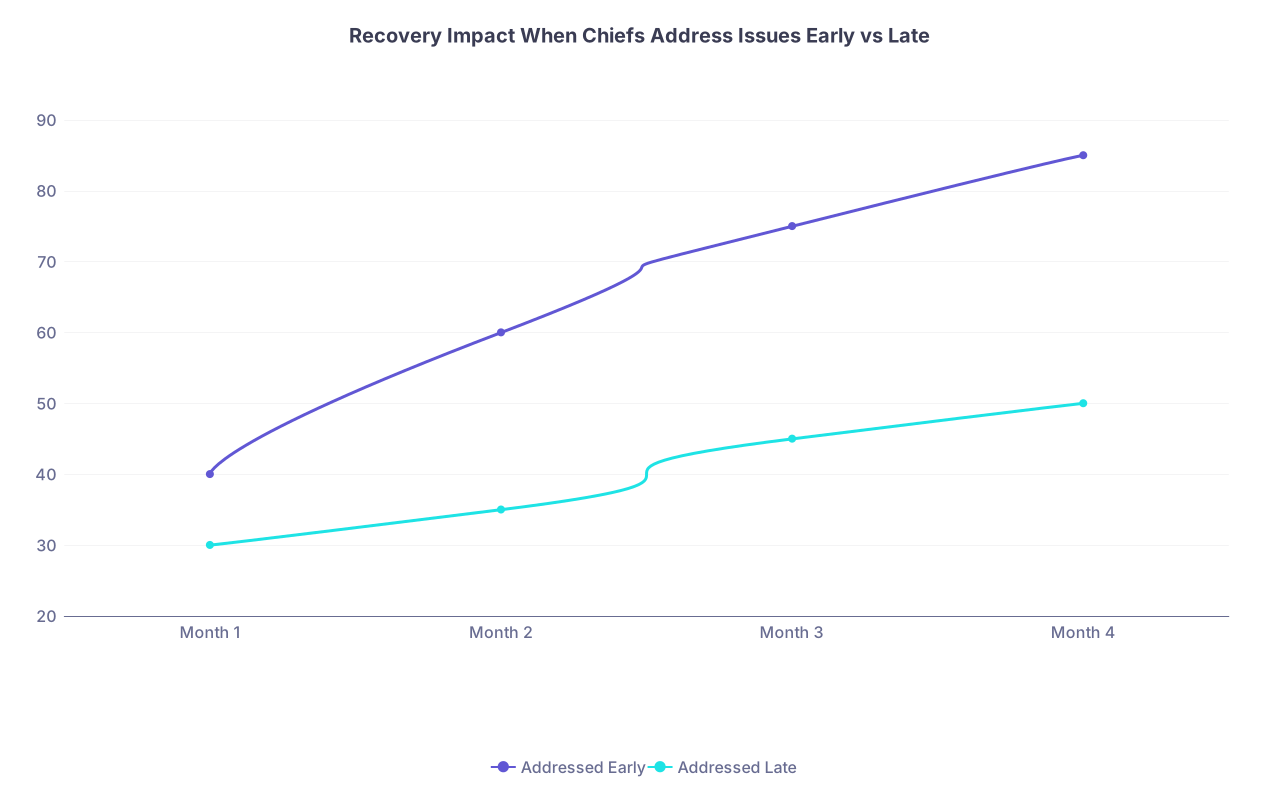
| Category | Addressed Early | Addressed Late |
|---|---|---|
| Month 1 | 40 | 30 |
| Month 2 | 60 | 35 |
| Month 3 | 75 | 45 |
| Month 4 | 85 | 50 |
Step Five: Repair Relationships Without Becoming a Doormat
Some residents may actually be hurt — not just “disrespectful.”
Maybe you:
- Backed admin on a decision that increased call burden.
- Didn’t advocate hard enough for a struggling class.
- Came off as dismissive when they brought you concerns.
You’re allowed to say: “I screwed that up.” That increases respect when done properly.
Grab residents 1:1 or in small groups and say:
“I’ve been thinking about how I handled [specific incident]. I realize I came across as siding with leadership without fully representing how much this affects you. That wasn’t fair, and I’m sorry.
I can’t promise I’ll win every fight with admin, but I do want you to trust that I’ll bring your concerns forward clearly. What’s the most important thing you want me to carry back to them?”
The key is this:
- Apologize for your behavior.
- Don’t apologize for having a leadership role.
- Don’t grovel or over-explain.
Then you actually follow through. If you say, “I’ll bring this to the PD,” you do it. And you report back what happened, even if the answer is “They said no.”
People don’t need you to magically fix everything. They need to believe you’re honest and not pretending.

Step Six: Manage Your Own Panic So It Doesn’t Run the Show
Here’s the part no one tells you: if you’re anxious (like, actually high baseline anxious), being chief will crank that up.
You’re going to catastrophize:
- “This PD conversation will destroy my career.”
- “If I call out this senior, they’ll poison everyone against me.”
- “If people complain about me, I’ll never match into fellowship.”
Reality check:
- Programs deal with messy chief years all the time.
- PDs don’t expect you to be universally loved; they expect you to be functional and honest.
- One difficult resident loudly hating you doesn’t cancel out your whole reputation.
You still need coping structures though, or you’ll burn out and either withdraw or snap.
Pick 1–2 of these and commit:
- A 15-minute weekly “debrief” with someone outside your program (friend, therapist, mentor) where you dump the worst-case thoughts.
- A simple rule: no major response emails after 10 pm. Draft them, fine. Send them in the morning after re-reading.
- A “wait 24 hours” rule before escalations (“I will talk to the PD about this tomorrow, not tonight while I’m furious or terrified”).
You’re allowed to be scared. You just can’t let fear be the one running the program.
The Uncomfortable Truth: Some People Still Won’t Respect You
You can do everything right and still have:
- One resident who badmouths every chief.
- A senior who thinks they should’ve gotten chief and is bitter.
- Someone who doesn’t respect authority, period.
That’s not a failure. That’s medicine.
Your goal is not:
- 100% approval.
- Zero complaints.
- Everyone thinking you’re “the best chief we’ve ever had.”
Your goal is:
- Clear expectations.
- Consistent behavior.
- Owning your mistakes and correcting course.
And if your anxiety is whispering, “But what if this ruins my fellowship chances?” — admissions and fellowship committees don’t see “had conflict as chief” as a red flag. They see “hid problems, lied, or retaliated” as a red flag.
You’re doing the opposite: seeing the problem and trying to repair it. That’s leadership.
FAQ (Exactly 4 Questions)
1. What if I’m already halfway through my chief year and feel like it’s “too late” to fix this?
It’s not too late. You won’t completely rewrite everyone’s narrative, but you can absolutely shift the second half of the year. Do a small reset: acknowledge where you’ve been inconsistent or unclear, set 1–2 concrete new expectations, and enforce them reliably. Even if only a subset of residents respond well, that subset becomes your anchor. Programs remember trajectories more than they remember the messy middle — “they struggled early, then grew into the role” is a story PDs like telling.
2. What if I confront someone and they go straight to the PD to complain about me?
That might happen. It’s not automatically bad. In fact, it can open the door for you to say to the PD, “Here’s what I saw, here’s how I tried to handle it, here’s where I think I could have done better.” Most PDs are far more worried about chiefs who never confront issues than ones who do it imperfectly. If you’ve been professional, specific, and calm, you’ll be fine. Document big incidents briefly — date, what happened, what you said — so if it gets messy, you’re not relying on memory.
3. How do I know when to loop in the PD versus handling it myself?
Rough rule: you handle one-off attitude, small non-compliance, and minor interpersonal friction. You loop in the PD when there’s a pattern that affects patient safety, significant professionalism concerns (bullying, harassment, persistent no-shows), or anything you’ve addressed twice without change. When in doubt, you can also say, “I need some guidance on this situation” rather than “Please fix this resident.” That keeps you in a leadership role but gives you backup.
4. What if I realize I never wanted to be chief and I’m just…bad at this?
You might not be naturally wired for leadership. That’s fine. Plenty of great physicians aren’t chiefs, and plenty of chiefs struggle. But “I’m bad at this” is usually actually “I’m new at this and uncomfortable.” Lower the bar: don’t aim to be everyone’s favorite chief, aim to be a decently reliable one who learns from mistakes. And if, at the end of the year, you conclude you truly hate this kind of work? That’s useful data. It’ll shape the kind of attending role or specialty culture you pick later. It’s not a moral failing; it’s a preference.
Open your calendar and block 30 minutes in the next 48 hours labeled “Chief Reset.” In that time, list three concrete behaviors you’ll change (one communication tweak, one enforcement change, one relationship repair), and write the exact sentence you’ll use the next time someone crosses a line with you. That’s your starting line.


