

What do you do when you realize, mid-call, that the resident covering with you is actually dangerous to patients?
Not just slow. Not just inexperienced. Unsafe.
You’re the senior on overnight medicine. Or the co-resident on surgery night float. And somewhere between the third admission and the rapid called on 7E, it hits you: this person cannot safely run a solo cross-cover list.
Here’s what you do next, step by step, without tanking your own career and without pretending “it’ll probably be fine.”
First, draw your line: what counts as “unsafe”?
You need a mental threshold. Because “not how I would do it” is not the same as “dangerous.”
Patterns that usually move this from “concerning” to “unsafe”:
- Repeated near-misses or actual harm:
- Almost gave 100 units of insulin instead of 10.
- Missed a clearly hypotensive patient on cross-cover and didn’t re-evaluate for hours.
- Fundamental knowledge gaps at a level that blocks safe care:
- Does not know what to do with a K+ of 6.8 with EKG changes, even after prompting.
- Cannot recognize sepsis or impending respiratory failure.
- Unreliable or impaired behavior:
- Disappears for long stretches on call.
- Markedly intoxicated, sedated, or otherwise impaired.
- Falling asleep mid-sentence repeatedly while writing orders, despite you trying to compensate.
If you’re thinking, “If I left them alone with this list for 6 hours, someone might die,” that’s unsafe. You do not ignore that.
Step 1: Stabilize tonight. Patient safety first, feedback later.
Tonight is about keeping patients safe. You are not going to “fix” this resident in one call. You are going to contain risk.
A. Quietly change how you run the night
Without making a scene, you change the workflow.
Concrete moves:
- You shadow their admits.
- “Hey, I’m trying to keep up with new admits for my learning log. Mind if I join your H&P?”
- Translation: you’re checking if they’re missing bombs (GI bleeds, sepsis, ACS) before they get buried in sign-out.
- You double-check high-risk orders:
- Drips (pressors, insulin, heparin).
- Electrolyte replacements.
- Warfarin/heparin bridging.
- Anything with narrow therapeutic index. You can phrase it as: “Let me just co-sign and eyeball this—we got burned last week with a dosing error.”
- You take the more complex pages yourself.
- Ask the operator or nurses to page you for anything involving:
- Chest pain
- Hypotension or tachycardia
- New confusion
- Respiratory distress
- You can tell the resident: “I’ll grab the unstable-ish stuff so you can keep working through admits.”
- Ask the operator or nurses to page you for anything involving:
You are not “covering for them” in the ethical sense. You are covering for them in the “prevent a bad outcome tonight” sense. Big difference.
B. In an acute crisis, you escalate immediately
If you see something dangerously wrong in real time:
- High-risk order about to be placed (e.g., 10x dose error, wrong route, no indication for tPA, etc.) → you stop it. Directly.
- Resident refuses to see a clearly sick patient → you see the patient and call the attending.
You do not argue at length. You do the safe thing and then bring in backup.
Phrase to attendings that works and doesn’t sound hysterical:
“I’m concerned about a patient-safety issue involving the resident on with me tonight. I’ve intervened already on a few things, but I need your help to make sure we’re managing this safely.”
You’re not accusing them of malpractice. You’re describing a pattern.
Step 2: Document what actually happened — same night, while it’s fresh
You will forget details tomorrow. Do not rely on memory.
I’ve seen careers ruined by vague accusations with no facts. I’ve also seen unsafe residents continue for months because everyone only talked in generalities: “They’re kind of scary on nights.”
Tonight, start a private, de-identified record. Not the chart. Your own file.
Include:
- Date / call type:
- “Night float, Gen Med, 7/12, 7p–7a.”
- Specific incidents:
- “2300 – Nurse paged cross-cover for K+ 6.8, peaked T waves on EKG. Resident X said ‘Just recheck in the morning, patient looks fine.’ I intervened, went to bedside, ordered calcium, insulin/D50, repeat K+.”
- “0100 – Resident X wrote order for insulin gtt 10 units/hr without bolus or protocol, for random BG 210 without DKA. Pharmacy called me; I clarified and discontinued.”
- Your actions:
- “I corrected order, informed nurse, saw patient, updated attending at 0200.”
Keep it factual. No adjectives. No drama. This is your raw material for later conversations.
Step 3: Decide your role — co-resident vs senior vs chief vs attending
Your next steps depend on where you sit in the hierarchy. The principles stay the same, but how you move changes.
| Role | Minimum you must do tonight | Who you tell within 24–48 hours |
|---|---|---|
| Co-intern | Protect patients, document incidents | Senior on service / chief resident |
| Senior resident | Protect patients, adjust workflow, document | On-call attending + program leadership |
| Chief resident | Protect patients, consider immediate pull from call | Program director |
| Attending | Protect patients, potentially remove from patient care | Program director + GME/HR if needed |
If you’re the co-intern or same-level co-resident:
- You do not own remediation. You own recognition and escalation.
- Your job: keep patients safe tonight, then bring concrete examples to someone who has authority: senior, chief, or PD.
If you’re the senior:
- You effectively become the “shadow attending” tonight.
- You adjust resident assignments so that they are not making high-risk decisions alone.
- You call the attending if risk remains high despite you compensating.
If you’re the chief or attending:
- You don’t just “note it.” You decide if this person can safely continue on call.
- That might mean:
- Pulling them from nights.
- Reducing autonomy temporarily.
- Planning a formal evaluation the next day.
Step 4: Within 24 hours, tell the right person, the right way
You are not tattling. You are reporting a patient-safety risk. That’s leadership.
Who you approach:
- On inpatient wards: your service attending and/or program director.
- On surgery: service chief resident and attending, then PD as needed.
- On ED/ICU: attending in charge, then PD if ongoing concern.
How you say it (example as a senior):
“I need to discuss a serious concern about last night’s call. I had to intervene multiple times to prevent potentially harmful orders and missed critical issues. I’ve documented specific cases. I’m worried Resident X cannot safely manage independent call.”
Do not:
- Lead with “They’re an idiot” or “Everyone thinks they’re unsafe.”
That’s gossip. Not leadership. - Make it about personality: “They’re so lazy” or “They’re annoying.”
Do:
- Lead with facts.
- Offer your written examples.
- Make an explicit safety statement: “I do not feel comfortable with them alone on call.”
A good PD or attending will ask for details. That’s why you wrote things down.
Step 5: Protect yourself politically while still doing the right thing
You’re not paranoid to think about retaliation or social fallout. Medicine is full of fragile egos and whisper networks.
Here’s how you avoid getting wrecked for speaking up:
Stick to objective behavior.
“They nearly gave tPA to a patient without imaging” is solid.
“They’re dumb and shouldn’t be a doctor” will make you look unprofessional.Avoid one-on-one “venting” to random peers.
What you say to the PD and chief is official.
What you say to three co-residents in the workroom becomes drama.Loop in someone you trust.
One chief, APD, or faculty mentor who knows your character and can vouch for your intentions.
Tell them: “I’m worried about being seen as the problem, but I can’t ignore what I saw.”Do not email a rant.
If you put it in writing, keep it structured, factual, and calm. No adjectives like “incompetent,” “horrifying,” or “a danger to society.”
Step 6: What if your attending or PD shrugs it off?
This happens. Too often.
You say, “I’m worried they’re unsafe.”
They say, “They’re just a bit behind; they’ll grow.”
Your move:
- Clarify, calmly but firmly.
“I want to be very clear that I’m not talking about slowness. I’m describing events where patients were at real risk of harm. For example…”
(then give 1–2 concrete cases)
- Ask a pointed question.
“Based on what I’ve described, do you feel comfortable with them handling solo cross-cover tonight?”
Make them own the answer.
- If you’re still dismissed and the risk is serious and ongoing, you escalate carefully.
That might mean:
- Talking to:
- Another attending who takes safety seriously.
- The chief residents.
- The Designated Institutional Official (DIO) or GME office in truly extreme cases.
This is rare. But if it gets to that, your documentation becomes critical. Feelings don’t move institutions. Specific events do.
Step 7: Immediate interventions leadership can/should take
If you are the chief/attending/PD, or you’re advising them, here’s what actually works in the real world. Not the fake “we’ll keep an eye on it.”
Real levers:
- Pull from call temporarily.
Short-term, while you figure out whether this is fatigue, knowledge, or something deeper. - Supervised call:
Keep them on nights but:- Senior or attending must co-sign all orders.
- No independent admits.
- Clear expectation: this is a probationary period, not business as usual.
- Focused evaluation block:
- Move them to a rotation with high supervision (ICU with a hands-on attending, for example).
- Use structured tools, not vibes: mini-CEXs, direct observation checklists.
- Formal remediation plan:
- Clear goals: “By X date, must independently manage basic sepsis, electrolyte emergencies, ACS triage.”
- Concrete actions: extra didactics, simulation, extra call shadowing.
- Time-bound, not “work on it and we’ll see.”
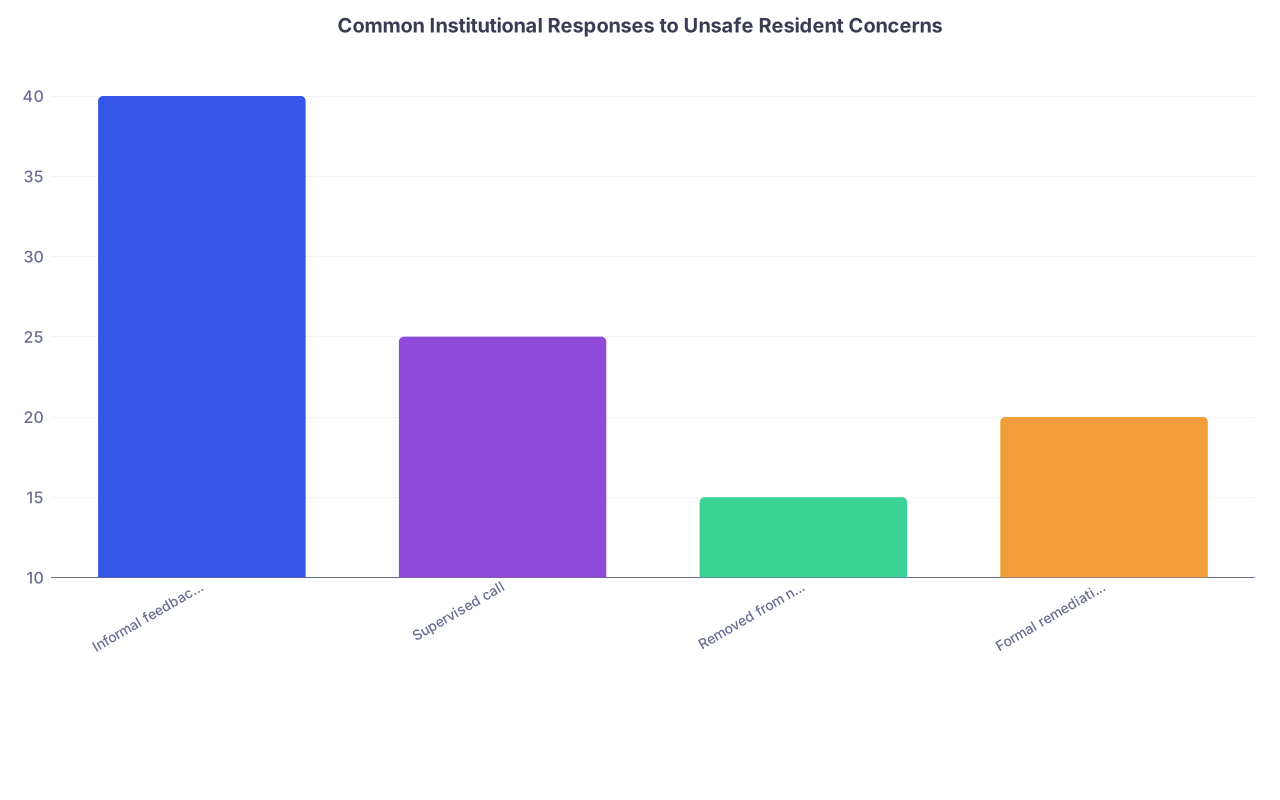
| Category | Value |
|---|---|
| Informal feedback only | 40 |
| Supervised call | 25 |
| Removed from nights | 15 |
| Formal remediation | 20 |
If leadership’s entire response is “We’ll give them feedback,” and they stay alone on call with no other changes, that’s weak. And risky.
Step 8: Dealing with the emotional side (yours and theirs)
You will feel conflicted.
You’re not a robot. You’re watching someone struggle, maybe spiral, and you’re the one pulling the alarm.
Common reactions I’ve seen in residents in your position:
- Guilt: “What if this ruins their career?”
- Anger: “Why did the system promote them to this level?”
- Fear: “What if they find out I reported them?”
And on the other side, if the resident finds out or senses it:
- They might be defensive: “You’re overreacting.”
- They might be devastated: “I didn’t realize I was that bad.”
- They might be in denial: “Everyone’s out to get me.”
If you end up in a direct conversation with them (and sometimes you will):
Stick to specific behavior.
“On that night, these things happened. This is what worried me.”Keep the focus on patient safety, not their worth as a person.
“This is about what our patients need from whoever is on call. Right now, there are gaps we have to address.”You’re not their therapist.
It’s okay to say: “I think you should talk with the PD/mentor about this. They can help you figure out next steps.”
Step 9: What if the unsafe resident is your friend?
This one burns.
You study together. You’ve cried in the stairwell together. And you also watched them almost send a DKA patient to the floor without fluids or insulin.
Here’s the line: friendship does not outweigh a patient’s right to safe care.
Your sequence:
- Have a direct, private conversation first (if they’re not acutely dangerous).
“I care about you, and because I care, I have to tell you this honestly. On call, I’ve seen some things that really scared me for patient safety.”
Mention 1–2 specific examples. Not 12. You are not ambushing them.
Ask if something else is going on.
Severe burnout, depression, substance use, family crisis—these show up as unsafe behavior.Encourage them to proactively approach leadership.
“You’ll be in a much stronger position if you go to the PD and say ‘I need help’ than if they hear about it only as a complaint.”
- If they refuse and the risk is serious, you still report.
You can’t let loyalty override your license, your integrity, or someone else’s life.
Step 10: Learn from this as a leader-in-training
This situation is ugly, but it’s also part of becoming a real physician leader. Not just someone who’s good at notes and checklists.
Things to take away for your future self:
- “Trust but verify” is not cynical. It’s safe. Especially with new interns or struggling residents on nights.
- Systems fail. Promotions happen that shouldn’t. Your job is to reduce harm where you can.
- Calling someone unsafe is serious. Use that word carefully, but be brave enough to use it when it’s true.
Also: burn this into your own trajectory—if multiple people tell you they’re worried about your safety on call, you listen. You don’t spin it. You don’t hide. You fix it before the institution is forced to.
A practical script library for when you’re stuck
Here are phrases you can borrow verbatim.
To your attending that night:
“I’m concerned about patient safety with the resident on with me tonight. I’ve already corrected several high-risk orders. I’d like your guidance on how to proceed and may need you more involved than usual.”
To your PD the next day:
“I wanted to formally report safety concerns from last night’s call. I’ve documented specific incidents. I do not feel they can safely cover solo call right now.”
To a trusted mentor:
“I’m struggling with how to handle this. I’m worried about being labeled difficult, but I genuinely think patients are at risk if nothing changes.”
To the resident, if you decide to speak to them directly:
“I’m saying this because I’d want someone to tell me: on call, I saw some decisions that really scared me. I’m worried about how safe things are when you’re covering alone.”
A quick visual: when to escalate and to whom

| Step | Description |
|---|---|
| Step 1 | Notice unsafe behavior on call |
| Step 2 | Intervene directly and call attending |
| Step 3 | Adjust workflow to protect patients |
| Step 4 | Document events after shift |
| Step 5 | Report to senior or chief within 24h |
| Step 6 | Report to attending and PD within 24h |
| Step 7 | Consider removal from call and formal eval |
| Step 8 | Immediate danger to patient? |
| Step 9 | Your role |
FAQs
1. What if I’m wrong and they’re just slow, not unsafe?
Then your specific examples will show that. A solid PD or attending can review the cases and tell the difference between slowness and dangerous gaps. You’re not making a final judgment; you’re raising a flag. As long as your report is factual and not exaggerated, “being wrong” is far less of a problem than being silently right while someone gets hurt.
2. Can I get in trouble for reporting an unsafe resident?
Legally and institutionally, programs are supposed to protect good-faith reports about patient safety. Informally, yes, some people may grumble or label you dramatic. That is exactly why you keep your communication professional, concrete, and focused on specific events. Most PDs and serious faculty will respect what you did, especially if you clearly tried to protect patients first.
3. Should I tell the unsafe resident that I reported them?
Usually, no—not right away, and not on your own. That conversation is best mediated or at least timed by program leadership. There are exceptions if you’re close friends and it’s safe to have that talk, but even then, I’d first say to the PD or mentor: “How do you suggest we handle transparency with them?” Do not blindside anyone or create a side conflict you’re not equipped to manage.
4. What if I’m actually the unsafe resident and I’m realizing it reading this?
Then do something about it now, before someone else is forced to pull the alarm. Pick one person in leadership you trust—a PD, APD, chief, or faculty mentor—and say the uncomfortable sentence: “I don’t feel safe on call right now, and I need help.” That doesn’t automatically end your career. In fact, I’ve seen people salvage their path precisely because they asked for help early and engaged fully with remediation, instead of pretending everything was fine.
Open a blank note on your phone right now and write today’s date. Under it, jot down any concrete patient-safety incidents you’ve seen from colleagues in the last month that still bother you. If you can think of two or more from the same person, it’s time to schedule a quiet, serious conversation with a supervisor this week.


