

You walk into work expecting a normal call shift and walk out as “interim chief.” The PD pulls you aside, closes the door, and says, “We need you to step in. Starting Monday.” Your inbox explodes, your co-residents start texting, and you’re thinking: I barely manage my own life — what do I do now?
Good. Let’s treat it like what it is: an emergency leadership consult. You did not plan for this, the timing sucks, and you still need to graduate, pass boards, and not burn out. Here’s how to stabilize the situation, fast.
Step 1: Stabilize Yourself in the First 48 Hours
Your first job is not schedules, not emails, not the PD. It’s your own bandwidth. You are now both resident and interim chief. If you don’t protect yourself early, you’ll drown.
Day 0–2: Set the Ground Rules
Book a 30-minute meeting with the PD immediately.
Do not “figure it out as you go.” Go in with a mini-agenda:- What exactly are my responsibilities?
- What is off my plate now that I’m interim?
- What authority do I have to make decisions without asking you?
- How long is this interim role expected to last?
- What are the 3 biggest current problems you want me to prioritize?
Take notes. And repeat back: “So to confirm, I’m responsible for A/B/C, not D/E/F. For urgent decisions about X, I can decide; for Y/Z, I loop you in.” Get explicit.
Trim your own commitments. Immediately.
You’re not a hero if you try to keep everything. You’re just naïve. Look at:- Research projects
- Extra teaching sessions
- Committee work
- Electives that are flexible
For anything non-essential in the next 4–8 weeks, send a short, direct message: “I’ve unexpectedly stepped into interim chief responsibilities and need to pause/reduce my involvement until [date/phase]. I’d like to stay involved long-term if possible, but I can’t commit to deadlines right now.”
Tell your closest people what’s happening.
Your partner, family, or whoever keeps you upright. You’re about to be less available and more drained. Say it clearly: “I just became interim chief; the next few weeks might be rough. I’ll need some slack and maybe some reminders to sleep.”Create one “command center” for chief tasks.
If you scatter tasks across random emails, notes, and sticky notes, you’ll miss something important. Use:- A single digital task list (Notion, Todoist, OneNote, whatever),
- Or an old-school notebook labeled “Chief”
Have three lists:
- URGENT: Must be handled in 24–72 hours (schedule gaps, coverage crises)
- ACTIVE: Projects/problems you’re working on this month
- LATER: Non-urgent ideas/complaints that don’t need immediate action
You’re not trying to be perfect in 48 hours. You’re buying yourself breathing room.
Step 2: Rapid “Situation Scan” of the Program
You can’t lead a team you don’t understand, and midway through the year, the culture is already set — for better or worse. You’re stepping into a moving train.
Your goal in week 1 is to quickly map what’s actually going on. Not what the PD thinks. Not what one loud resident insists. The real picture.
Talk to Three Groups — Fast
Program Director (deeper dive, after the initial meeting).
In a second, more focused conversation, ask:- What’s working well this year? (You don’t want to break those.)
- What’s been painful? (Last-minute sick calls, clinic chaos, night float disasters?)
- Which residents or rotations are “hot spots” right now?
- What have you and the previous chief already tried that didn’t work?
Senior residents on each major rotation.
Grab them between cases or on call. Short and blunt:- “What’s the most broken thing in our schedule right now?”
- “What’s one thing chiefs do that actually helps you?”
- “Where are people burning out the most — which month, which rotation?”
You’ll hear the same 2–3 issues over and over. That’s your priority list.
Core staff who feel the pain daily.
Charge nurse on medicine. Clinic manager. Night float attending. Ask:- “Where are residents struggling this month?”
- “What patterns have you noticed this year compared to last?”
- “What makes things unsafe or unsustainable from your viewpoint?”
This is where you find the operational landmines.
Step 3: Set Communication Rules Before Chaos Hits
You’re about to get buried in texts, emails, and “Hey, quick question…” hallway ambushes. If you let everyone contact you however they want, whenever they want, you will never think straight.
You need simple communication rules and you need to tell everyone, early.
Define Channels by Problem Type
Here’s a model that works in most programs:
| Issue Type | Preferred Channel |
|---|---|
| Same-day sick call | Text (specific number) |
| Future schedule change | Email only |
| Professional conflict | Email to schedule 1:1 |
| Wellness/urgent concern | Call or text anytime |
| Routine questions | Weekly office hours |
Then you send a short message to the residency group chat or email list:
“Hi all — as I step into interim chief, I want to avoid missing anything important.
Please use:
- Text for same-day sick calls/coverage issues
- Email for routine schedule changes or vacation requests
- Email me to set up a 1:1 if there’s a serious concern or conflict
If it’s a wellness/safety concern, call or text anytime, that takes priority.”
Does everyone follow this forever? Of course not. But you’ll cut the chaos by half.
Set Office Hours (Yes, Really)
Block a protected 60–90 minutes once a week where people know they can bring non-urgent issues. “Chief time: Fridays 1–2 pm in the resident work room / via Zoom.” This gives you a designated outlet for complaints, ideas, and slow-burn problems instead of dealing with them one by one at 2 a.m. on nights.
Step 4: Prioritize Like You’re Running a Code
Mid-year interim chief duties are not about grand redesigns. You’re stabilizing and preventing fires. Think: ACLS of program operations.
Here’s the triage:
Safety and coverage
- Coverage gaps that leave services unsafe
- Residents going >80 hours regularly
- Violations that could trigger ACGME trouble
Fix these first, even if your solutions are clunky or unpopular.
Workload and fairness
- One class getting crushed every block
- Chronic “favorite rotations” protected for a few people
- Unfair distribution of nights, weekends, or holidays
Aim for “good enough and equitable,” not perfect.
Morale-killers that are easy wins
- Miscommunication about expectations
- Ridiculously confusing call sign-out rules
- Broken processes everyone hates that you can tweak in a week
Do not get seduced by big, shiny projects (full schedule redesign, completely new evaluation system, etc.) when you’ve got coverage holes today. You’re interim. Think: stabilize, simplify, make it survivable.
Step 5: Handling Schedules and Sick Calls Without Losing Your Mind
This is usually where interim chiefs get buried. If you’re mid-year, the base schedule is already built, but reality has punched holes in it.
Build a Simple Coverage Playbook
Write this down and share it with your co-residents and PD:
Sick call rules
- Who residents contact
- How early they must notify (e.g., at least 2 hours before shift)
- What counts as acceptable “I’m too sick” (hint: if you wouldn’t drive, don’t work)
Coverage hierarchy (example)
- Float/pull from elective
- Swap with same-level resident on a lighter day
- Rarely: ask for voluntary extra call, comp time later
- Never: leave a service uncovered unless cleared by PD
Compensation rules
Whatever your program does — future day off, switch a lighter shift, schedule protection — define it. Ambiguity is where resentment brews.
You share these rules with everyone. You’ll still handle exceptions, but most situations will follow this script.
Learn to Say “No” Without Being an Ass
Residents will ask for last-minute vacations, elective changes three days before a rotation, or magical rearrangements that solve their problem and screw three other people.
You need a stock, calm response:
- “Given the timing and coverage, I can’t make this change without creating gaps elsewhere. I can help you explore options for [future block/next month] instead.”
- “I hear why this rotation isn’t ideal right now. At this point in the year, swapping it would unfairly burden others. Let’s talk about what can make it more tolerable while you’re on it.”
You’re not their concierge. You’re running a system for 20–80 people.
Step 6: Dealing With Conflict and Complaints Without Burning Bridges
Mid-year, the emotional temperature is higher. People are tired. Some are disillusioned. You’re stepping into the crossfire between residents and faculty, or between residents themselves.
Don’t try to be a therapist. You’re a translator and a buffer.
A Simple Script for Resident Complaints
Resident corners you: “The ICU attending is toxic. This is ridiculous. I’m done.”
You:
Validate briefly, don’t escalate.
“That sounds rough, and not how your learning environment should feel.”Get specific.
“Tell me concretely what happened — one or two examples, not ‘they’re always terrible’.”Clarify what they want.
“What outcome are you hoping for? Schedule change? Feedback to the attending? Just to vent?”Set expectations.
“Here’s what I can do: I can bring anonymized feedback to the PD and see what they can address. I can’t promise this specific attending will be removed from your rotation mid-block.”Follow up once.
Even if you can’t fix it, close the loop: “I spoke with the PD. Here’s what they’re going to do. I know it’s not perfect, but you were heard.”
Your credibility lives or dies on whether people feel you followed through, even if the final outcome isn’t what they wanted.
When the Problem Is the Resident
Sometimes the complaint is about someone who is chronically late, unsafe, or nasty. You’re not the disciplinary committee, but you can’t ignore patterns.
- Document repeated issues (dates, rotations, impact).
- Bring patterns to the PD privately: “I’m noticing X concerns from multiple people about Y resident. This is beyond chief-level conflict; can you take this on formally?”
- Don’t gossip. Don’t hint. Don’t “warn” other residents in vague terms.
You’re interim, but your integrity still matters.
Step 7: Protecting Your Own Reputation and Future
Taking over mid-year is risky. If things go badly, people will blame “the chief.” If things stabilize, most will forget how messy it was when you started. So you need to be deliberate about how you show up.
Decide Who You Want to Be as Chief
Pick 2–3 identity anchors. For example:
- “I respond quickly to safety/coverage issues.”
- “I’m fair even if I can’t always say yes.”
- “I tell the truth, even when it’s uncomfortable.”
Then act accordingly, repeatedly. You want people to be able to predict how you’ll behave: that’s trust.
Make Your Work Visible Without Bragging
You shouldn’t spam everyone with “Look what I did!” emails. But people need to know that things are being actively managed.
Occasional short updates help:
- “Coverage: We’ve adjusted X service so that sick calls hit the float system first instead of random volunteers.”
- “Schedules: We’ve redistributed weekend calls for PGY-2s to make it more balanced across blocks.”
You’re signalling: someone is minding the store.
Step 8: Use the PD Wisely — Not as a Crutch, Not as a Ghost
Some interim chiefs either 1) run to the PD for every micro-decision, or 2) go rogue and then get blindsided when the PD disagrees.
You need a middle path.
When to Loop in the PD
- Anything that might trigger ACGME issues
- Significant resident wellness concerns (SI, harassment, discrimination, stalking, pregnancy accommodation, disability)
- Major schedule redesigns, not just small swaps
- Conflicts involving faculty behavior, not just resident-resident drama
Short email template: “Quick flag: We’re seeing X happen repeatedly on Y rotation. I can manage the schedule side, but this may have larger implications. Can we discuss how you’d like me to handle this?”
When to Decide on Your Own
- Individual schedule swaps that don’t break rules
- Minor coverage tweaks
- Day-to-day friction between residents that hasn’t escalated into something serious
- Small quality-of-life changes (e.g., standardizing sign-out templates, call-room assignments)
Make a decision, apply it consistently, and if it backfires, tell the PD, “Here’s what I tried, here’s what happened, here’s my next plan.”
They’ll respect that more than “I didn’t do anything because I wasn’t sure.”
Step 9: Structure Your Week So Chief Duties Don’t Eat Your Life
If you handle chief work whenever it randomly appears, it’ll swallow you. You need a basic structure.
Here’s a simple pattern that works even on busy rotations:
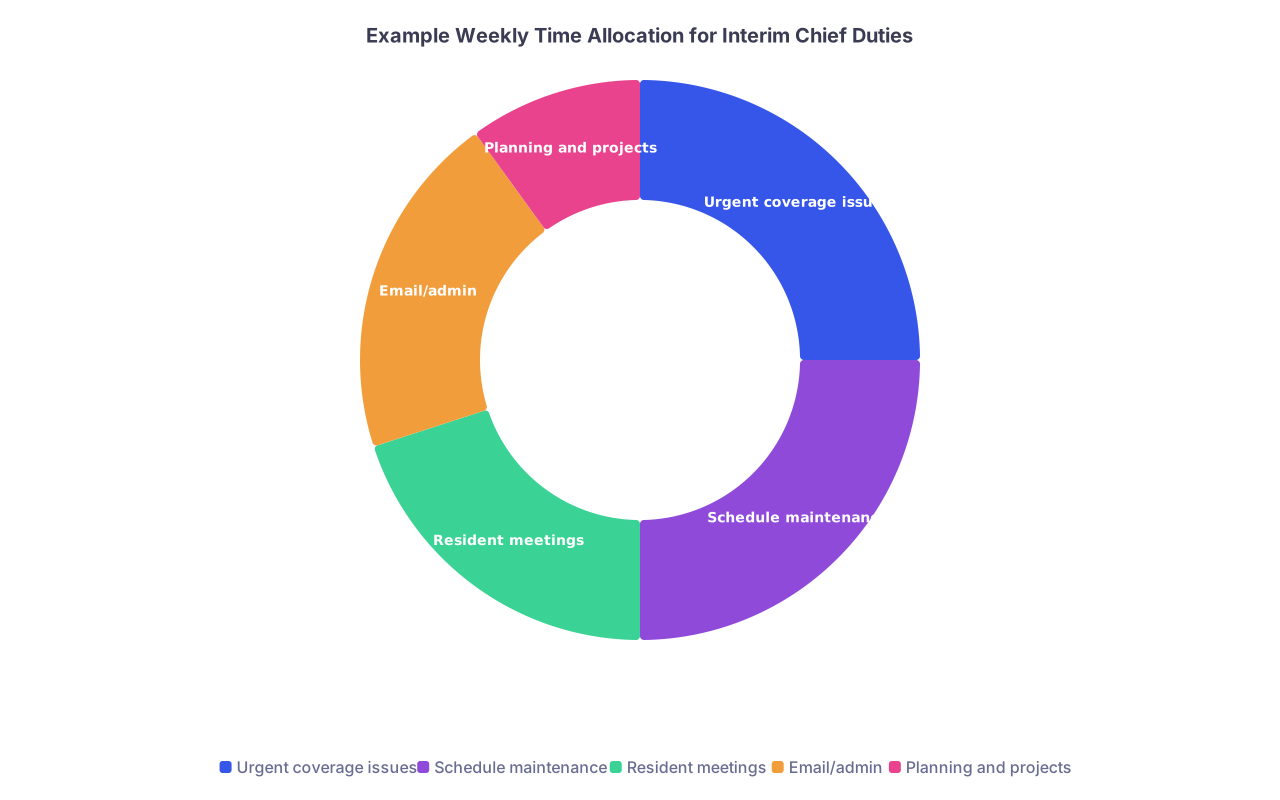
| Category | Value |
|---|---|
| Urgent coverage issues | 25 |
| Schedule maintenance | 25 |
| Resident meetings | 20 |
| Email/admin | 20 |
| Planning and projects | 10 |
You can translate this into real time like this:
Daily 15–20 minutes
- Scan emails/texts for urgent coverage/safety issues.
- Update your URGENT list and knock out 1–2 items.
Twice weekly 30–45 minutes
- Tackle schedule maintenance: swaps, next-block adjustments.
- Respond to non-urgent resident emails in batches.
Weekly 60–90 minutes (your “chief block”)
- Office hours / 1:1 conversations.
- Work on one small improvement project (not 10).
Monthly 30–60 minutes with PD
- Quick check: “Here’s what I’m seeing. Here’s what I’m doing. Anything you want me to shift?”
You won’t follow this perfectly. But having a structure stops the job from expanding to fill all free time.
Step 10: Turn This From “Crisis” Into Career Capital
You didn’t ask for this role, but you can absolutely use it.
Capture What You Actually Did
Keep a simple running list, updated once a month:
- Coverage crises resolved and what you implemented
- Schedule changes that improved fairness or compliance
- Processes you created (sick call policy, handoff standards, whatever)
- Feedback you gave the PD that led to real changes
Later, this turns into:
- Residency portfolio content
- Talking points for fellowship or job interviews
- Letters of recommendation content where your PD can be specific, not generic
Learn the Politics Without Becoming Political
You’re getting a front-row seat to:
- Which attendings quietly run the program
- Which administrators actually get things done
- How decisions about fellowship recommendations are made
Pay attention. Ask smart questions. “I noticed we keep hitting roadblocks with X. How have previous chiefs handled that?” You’re building pattern-recognition that will serve you as an attending.
A Simple Mental Model to Use on Bad Days
Some days, you’ll feel like everyone is mad at you. Residents, faculty, admin. You’ll question why you agreed to this at all.
Use this mental checklist:
- Is anyone unsafe today?
- Is the schedule collapsing this week?
- Am I communicating honestly, even if people don’t like the answer?
- Did I protect at least a small part of my own life outside work?
If you can answer “yes” to those most days, you’re doing the job well enough. Interim chief isn’t about perfection. It’s about preventing chaos from turning into collapse.
You walked into this mid-year, mid-stream, mid-chaos. You didn’t get the luxury of a clean start, a full handoff, or a leadership course. You got an urgent ask and a very public role.
Now you’ve got an emergency game plan: stabilize yourself, scan the situation, set clear communication rules, fix coverage and safety first, handle conflict with a cool head, and use the PD strategically instead of constantly or never. The rest you’ll learn fast — because you have to.
Handle this phase with some intention, and when the year turns over, you won’t just be the person who “filled in as interim chief.” You’ll be the resident who’s already done real leadership work under pressure. From there, stepping into future roles — chief, fellow, junior faculty — stops feeling theoretical and starts feeling familiar. And that’s where your next chapter begins.


