

The lack of a formal chief role is not a ceiling. It is an opening most residents are too tired or too timid to walk through.
If your program has no official chief position, you are in a strange gray zone: no title, no stipend, no protected time—but the same chaos, the same gaps, the same unspoken expectation that “someone” will keep things running. You can complain about it. Or you can quietly become the person who runs the place.
This is not about martyrdom. It is about leverage. About leaving residency with real leadership skills, real stories, and real influence—even if your badge just says “PGY-3.”
Let’s get specific.
Understand the Terrain You’re Actually In
Before you start “leading,” you need to understand how power actually works in your program. Not the org chart. The real thing.
Every residency has its shadow structure:
- The attendings everyone listens to.
- The fellowship director who influences everything.
- The senior resident who “just handles stuff.”
- The program coordinator who knows where every body is buried.
Your first move is reconnaissance, not action.
Walk through a typical month in your program and ask yourself:
- Who makes the call when there’s a sick call at 4:30 a.m.?
- Who decides call schedules, even informally?
- Who do interns go to when the EMR breaks, before they email IT?
- Who does the program director ask, “So how are people actually doing?” when no one else is around?
Those people already have informal authority. If there’s no chief role, they are the chiefs, just without the title.
Your job? Do not compete with them. Join them. Make yourself useful in the spaces they hate dealing with or don’t have time for.
Pick a Lane: Where You’ll Actually Lead
Trying to be “the leader” of everything as a resident is delusional. You’ll burn out and people will resent you.
You need one or two clear lanes where you become the default person. The person whose name comes up when that topic is mentioned.
Think “micro-chief roles” instead of global chief.
Common lanes that matter in residency:
- Scheduling and workflow
- Education and teaching
- Wellness and culture
- Quality improvement / patient safety
- Technology / EMR optimization
- Recruitment / interview season
You’re looking for a Venn diagram overlap:
- Something you’re good at or can become good at.
- Something everyone currently complains about.
- Something no one has clearly claimed.
Example:
In one internal medicine program I worked with, there was no chief. But one PGY-3 quietly became “the schedule guy.” He learned QGenda better than anyone, made call swaps less painful, and built a simple Google Form for requests. Did administration magically create a chief title? No. But every attending, PD, and resident started saying, “Ask Sam, he runs the schedule.” That sentence is influence.
Pick your lane. And say it out loud to yourself: “I’m going to be the person who fixes X this year.”
Build Influence in Three Concrete Arenas
You have three real levers as a resident with no title:
- The day-to-day frontline work.
- The “how we do things here” culture.
- The interface with leadership.
If you want to function like a chief without a badge, you need to touch all three.
1. Command the Day-to-Day (Without Acting Like a Mini-Attending)
On the wards, title matters less than competence, calm, and clarity.
Where you build authority here:
a) Be frighteningly reliable
If you say you’ll cover a cross-cover shift, you show up. If you offer to update a sign-out template, it’s done by tomorrow, not “when I get to it.” People follow the person who does what they say.
b) Be the person who thinks two steps ahead
End of day on a heavy inpatient service:
- You ask: “What can we preemptively order now so night float doesn’t get slammed?”
- You clarify discharge plans before 3 p.m.
- You reassign tasks when the intern’s drowning instead of asking, “You good?”
Interns and juniors do not remember your rousing speeches. They remember you quietly taking three pages from their pager when they were falling apart.
c) On busy days, narrate the plan
Not in an overbearing way. Just clear, simple direction.
On rounds:
“Here’s how we’ll do this. I’ll take admissions 1 and 2. You (gestures to intern) take admission 3. Student, you’re on follow-up notes and discharge paperwork. We’ll regroup in two hours and see who needs help.”
No one crowned you chief. You just behaved like a competent leader. Half the battle.
2. Shape the Culture in Small, Repeated Ways
Most programs without chiefs suffer from one thing: no one owns the culture. Things just “happen.” Which usually means they slowly decay.
You can move culture more effectively in 5-min actions than in 90-min wellness lectures.
Practical plays:
a) Own one recurring ritual
Maybe your program has:
- Thursday didactics
- Monthly journal club
- M&M conference
- Pre-call huddle
Pick one and make it better.
Examples:
- Turn a chaotic journal club into a 30-min, resident-led critical appraisal with a consistent structure. You prep the first few and then delegate.
- Start a 5-min “wins and fails” at the end of M&M where residents can share one thing they learned that changed their practice.
When you consistently show up and improve the same ritual, people start to see you as one of the few stable pillars in a constantly shifting mess.
b) Protect psychological safety in public
If an attending tears into an intern unfairly in front of the team, you cannot fix that systemic problem in the moment. But you can walk with the intern afterward and say, “That wasn’t about you. Here’s what you actually did well on that case. And here’s what you can tighten up so they have nothing to latch on to.”
You do that consistently? People trust you. Trusted residents have more informal power than any committee.
c) Be selective with your complaints
Constant complainers lose all influence. The PGY-3 who says nothing for weeks and then calmly says in a meeting, “Look, this night float system is unsafe for patients and here are three real examples”—that voice lands differently.
You want that person to be you.
3. Become the Resident Leadership Actually Listens To
No chief role usually means the PD and APDs are flying semi-blind. They need residents who can speak for the group without turning everything into a personal therapy session.
This is your opportunity.
a) Translate chaos into patterns
Instead of venting: “Everyone is burned out and hates nights.”
Show up with:
- “Of 10 interns, 7 told me the same thing about nights.”
- “The themes are: no dedicated time for cross-coverage sign-out, unclear expectations on admissions after 2 a.m., and never seeing their own patients in the morning.”
- “Here are two specific low-cost changes we’ve brainstormed.”
This is how chiefs talk. You’re doing the job without the label.
b) Volunteer for one unsexy committee and actually engage
Example committees:
- Program evaluation committee
- Clinical competency committee (sometimes limited to faculty, but some invite residents)
- Wellness or QI committees
- Recruitment committee
If they say, “Any resident want to be on this?”—this is where you raise your hand once and then show up prepared.
Do not join four committees. Join one and be the most prepared person in the room.
c) Close the feedback loop
Residents get cynical because they never hear what happened after they gave feedback. You can fix that.
Say leadership modifies call cap rules after multiple complaints. You send a brief message in the group chat or bring it up at didactics:
“Quick update: After talking with Dr. X about night admissions, they agreed to cap at 3 after 2 a.m. for interns. That came directly out of specific examples you all shared.”
You just made leadership look responsive, you made residents feel heard, and you positioned yourself as the connector. That’s influence.
Use Micro-Projects to Build Credibility (Not Just Opinions)
Nobody cares how “passionate” you are about wellness if you never finish anything.
You need visible wins. Small ones. Resident-level, not CEO-level.
Aim for 2–3 micro-projects in a year. Each with:
- A clear problem.
- A simple outcome.
- A short timeline (4–8 weeks).
- People besides you who benefit.
Examples that actually work in chief-less programs:
Sign-out overhaul
Problem: Sign-outs are chaotic and unsafe.
Micro-project: Create a standardized sign-out template in the EMR or a shared doc, run a 15-min intro at noon conference, get buy-in from one supportive attending. Follow up 1 month later with “what’s working / what’s not” and tweak.Intern survival guide (actually useful)
Problem: Interns are lost and asking the same questions.
Micro-project: One Google Doc with:
- How to page radiology overnight.
- Where to find central line kits on each floor.
- Who to call for psych consults after 5 p.m. You solicit tips from co-residents, clean it up, share widely. Done.
- Simple wellness thing that doesn’t suck
Problem: Morale is low.
Micro-project: Start a once-monthly 20-minute debrief after the last Friday conference, peer-led, off the record. Three prompts, no forced sharing. You run the first two, then rotate facilitators.
None of these require a chief title. All of them make you look like you’re already functioning at that level.
Manage the Politics So You Don’t Get Crushed
Here’s the part most residents ignore: if you start acting like a leader without a title, you can step on toes. Fast.
You need some basic political survival skills.
1. Align with at least one attending “sponsor”
Not a formal mentor. Just one faculty member who:
- Knows you.
- Likes how you think.
- Is willing to quietly back you.
Before you roll out anything bigger than a Google Doc, sanity-check it with them.
“Dr. Lee, I’m thinking of standardizing how we do weekend sign-out to reduce missed labs. Does this step on anything I don’t see?”
You’re showing respect for existing structures. You avoid walking into the PD’s office having already pissed off 3 senior attendings.
2. Give credit away aggressively
You want to be “the person who makes things happen,” not “the person who wants the spotlight.”
When you present something:
“Interns suggested X, Y, and Z. Dr. Patel gave feedback on the first draft. I just pulled it together.”
Leaders above you notice who hoards credit and who distributes it. They trust the latter more.
3. Avoid the trap of “residents’ union boss”
If you become the person who delivers every angry message from the residents to leadership, you won’t be seen as a leader. You’ll be seen as an emissary.
Filter. Synthesize. Prioritize.
Phrase things like:
- “Here are three issues residents raised most often this month. If we can address even one, it’ll go a long way.” Instead of:
- “People are furious and say nothing ever changes.”
One sounds like a partner. The other like a threat.
Balance: How Not to Destroy Your Own Residency
This all sounds great until you’re cross-covering 60 patients and post-call.
So let’s be blunt: if you try to run your program and crush every rotation and do research and be wellness chair and run journal club, you will implode.
You need boundaries.
a) Cap your leadership bandwidth
Decide ahead of time:
- “I will own 1–2 specific domains this year.”
- “I will do at most 2 micro-projects per year.”
- “I will say no to anything that doesn’t serve those.”
When someone says, “Can you also organize the residents’ holiday party?” you can say:
“I’d love to help, but I’m already committed to fixing the sign-out system and working on the intern guide. I’d burn out if I took on more.”
That’s not selfish. That’s how actual leaders operate.
b) Protect your clinical competence first
No one will follow the “leader” who can’t manage a septic patient, write a decent note, or show up on time.
When you’re choosing between:
- Perfecting your new QI project slide deck, or
- Reviewing your patients’ imaging for tomorrow’s rounds,
pick the imaging. Leadership built on weak clinical ground is a house of cards.
c) Use protected time ruthlessly if you have any
If your program gives even one half-day a month for “admin” or “scholarship,” guard it. Do not let it dissolve into “I just caught up on notes.”
Make a running list on your phone:
- Fix template.
- Email PD with resident feedback themes.
- Draft orientation handout for interns.
Then attack that list during your admin time.
Turn This Into Career Capital
You’re not doing this just to make residency marginally less awful. You’re also building stories and skills you can use for the rest of your career.
If your program has no chiefs, your ERAS or job application will not say “Chief Resident.” Fine. It can say something better, if you’re smart.
Translate your informal leadership into concrete bullets:
- “Led resident-driven overhaul of weekend sign-out process, reducing missed critical lab follow-up events from X to Y over 6 months.”
- “Served as informal resident liaison to program leadership, synthesizing concerns from 30+ residents into actionable changes to night float and didactic structure.”
- “Developed and maintained intern on-boarding manual used by 100% of incoming class, improving early-rotation evaluation scores on ‘preparedness’ from X to Y.”
No title. Lots of proof.
And when interviewers ask, “Tell me about a time you led without authority,” you will not have to dig for a story. Your entire senior year will be one long case study.
If You’re a PGY-1 or PGY-2: Start Small, Now
You do not need to be a senior to start this. In fact, starting earlier is smarter. You build trust before you try to change things.
For juniors, your moves are simpler:
- Be the intern who always knows where stuff is and shares it.
- Run one segment of noon conference well.
- Take on one micro-project tightly scoped to your level (e.g., “clinic precharting tips sheet for interns”).
- Ask seniors, “What’s something that constantly breaks here that no one has fixed?”
You are not “leading the program” yet. You are building a track record as the resident who gets things done. Later, that’s who people listen to—even without a chief badge.
If You’re Already a Senior: You Still Have Time
Even if you’re 6–9 months from graduation, it’s not too late.
Pick one concrete issue you can meaningfully touch in that time:
- Fixing handoff safety.
- Improving recruitment materials.
- Cleaning up rotation-specific orientation.
You will not “rebuild the residency” in 9 months. Do not try. But you can absolutely leave one specific part of it objectively better than you found it.
That matters more than the line “Chief Resident” on your CV.

| Step | Description |
|---|---|
| Step 1 | Notice missing chief structure |
| Step 2 | Pick one leadership lane |
| Step 3 | Run 1 to 2 micro projects |
| Step 4 | Earn trust of residents |
| Step 5 | Become go to for that domain |
| Step 6 | Engage with program leadership |
| Step 7 | Translate work into career capital |

A Quick Reality Check: What This Won’t Do
Let’s be realistic about the limits.
- You won’t fix systemic underfunding as a resident.
- You won’t magically get protected chief time or a stipend to appear.
- You won’t win over every bitter co-resident who just wants to survive and graduate.
But you can:
- Make your own life and your team’s life meaningfully better.
- Learn to move people and systems without a fancy title.
- Leave residency with real, tangible leadership reps while others leave with just scars and anecdotes.
That trade is worth it.
| Move Type | Example | Effort Level | Impact |
|---|---|---|---|
| Low-effort, high-impact | Standardizing sign-out template | Low | High |
| Low-effort, medium-impact | Sending monthly feedback summary to PD | Low | Medium |
| Medium-effort, high-impact | Creating intern survival guide | Medium | High |
| High-effort, variable-impact | Redesigning entire didactic curriculum | High | Uncertain |
| High-effort, low-impact | Planning elaborate social events | High | Low |
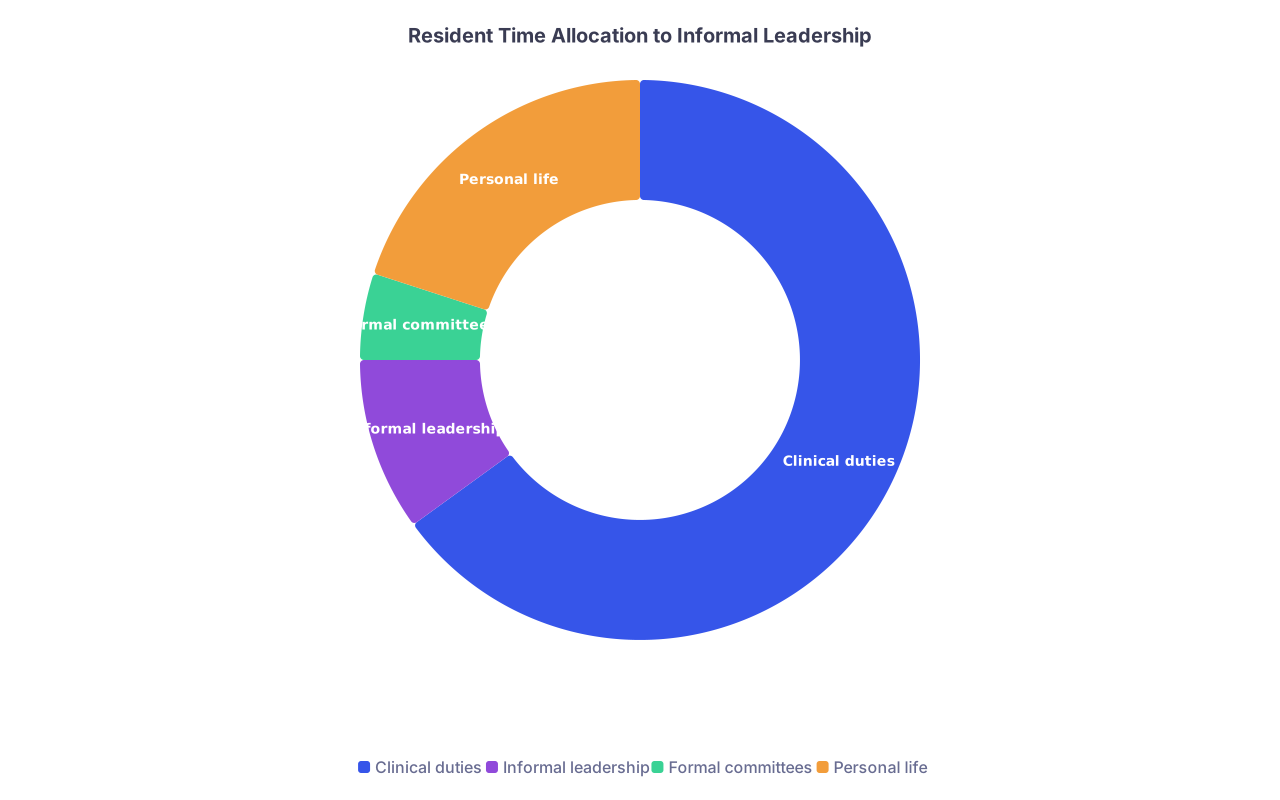
| Category | Value |
|---|---|
| Clinical duties | 65 |
| Informal leadership | 10 |
| Formal committees | 5 |
| Personal life | 20 |
Here’s your next step, today:
Pick one lane and one micro-project.
Right now, write this on a note or in your phone: “This year, I will be the resident who fixes ______.” Fill in that blank with something specific and real—sign-out, intern orientation, clinic chaos, whatever’s actually broken where you are.
Then, in the next 48 hours, send one concrete message to a peer or faculty member that starts that project. Not a manifesto. A simple: “I’ve noticed X is always a mess. I’m interested in trying Y to improve it. Would you be open to chatting about it for 10 minutes?”
That’s how informal chiefs are made. Not by title. By action.


