

What do you do when you realize the entire call schedule you just built violates labor rules, angers half the program, and your PD wants to “talk tomorrow morning”?
That’s the kind of chief resident nightmare you actually need to prepare for. Not the abstract “leadership challenges” they mention in the brochure. The real, messy, politically loaded ones that can wreck relationships, morale, and your own sanity before September.
You step into chief year thinking: “I’ve been a good resident. How hard can this be?”
That assumption is your first mistake.
Let me walk you through the classic first-year chief leadership mistakes I’ve seen over and over—from medicine, surgery, EM, peds, you name it—and how to not become the cautionary tale people whisper about for the next five years.
Mistake #1: Thinking “I’ll Just Be Everyone’s Friend”
This is the most seductive trap. You know the junior residents. You were just on nights with them. You swore you’d be the “cool chief” who:
- Protects everyone from scut
- Always says yes to schedule requests
- Pushes back on attendings and admin for your people
So you start the year trying to be liked.
Here’s what happens next.
You say yes to every “I absolutely can’t do nights in August” email. You accommodate the resident who wants 3 straight weeks off for a wedding, a honeymoon, and a board review course. You shuffle things around to help the intern who’s “really struggling” with nights.
By mid-July, your schedule looks like Frankenstein’s monster. And the people who didn’t lobby aggressively? They get quietly punished.
The nightmare moment:
A PGY-2 corners you in the workroom: “So, I guess the people who email you first get protected? Because I’ve had four straight weekends in-house.”
You’ve just been exposed. Not as cruel. Worse— as unfair.
The deeper problem: leadership isn’t a popularity contest. When you try to be everyone’s friend, you sacrifice:
- Consistency
- Transparency
- Credibility
Once people think the system is arbitrary, they stop trusting you. And good luck fixing that during influenza season.
How to avoid this mistake
Before July 1, you need:
Clear scheduling rules
Not in your head. Written. Shared. Defensible. For example:- No one gets more than 2 golden weekends per block
- Religious holidays are honored if requested by X date
- Weddings get priority over “friend’s birthday trips”
- Requests after the deadline are only honored if safety or legal rules are involved
A standard way to say no
You’re going to say no a lot. Practice a line like: “I can’t approve that without violating our fairness rules. I want to be consistent so everyone feels like they’re getting a fair shake.”A willingness to tolerate discomfort
Someone will be annoyed no matter what. Measure your success by whether your decisions are fair and explainable, not by whether everyone smiles at you.
If you’re loved by everyone as chief, you’re almost certainly doing something wrong. Or you’re not actually doing the job.
Mistake #2: Confusing Busyness with Leadership
Another classic: the Overfunctioning Chief.
They’re always in the hospital. Always answering texts. Fixing every small thing themselves.
A cross-cover issue at 2 a.m.? They come in.
A med student assignment glitch? They fix it personally.
An intern struggling emotionally? They become that intern’s therapist, coach, and life planner.
They look like heroes—for about 6 weeks. Then they crash.
Your nightmare moment:
It’s October. You’ve been covering holes, redoing the chalkboard, editing lectures, managing every tiny drama. Then you realize you’ve:
- Missed multiple PD meetings
- Let your academic project stall
- Ignored your own mental health
- Become weirdly resentful of residents you’re “helping”
Leadership isn’t “do everything yourself and suffer quietly.” That’s martyrdom. And it backfires.
The hidden damage when you overfunction:
- You train residents that every problem goes to the chief, not the chain of command
- You undercut senior residents who should be solving issues at their level
- You lose any bandwidth for big-picture work (e.g., fixing systemic problems)
How to avoid this mistake
You need to get brutally clear on what is actually chief work and what is not.
| Task Type | Chief-Level? | Comment |
|---|---|---|
| Block scheduling | Yes | Core responsibility |
| Med student daily assignments | No | Delegate to seniors/firm chiefs |
| Daily pager triage | Sometimes | But not every small complaint |
| Wellness events | Yes | But don’t run every detail |
| EMR credential issues | No | Direct to admin/IT |
If something can be handled by:
- A senior resident
- A rotation director
- Clinic staff
- GME / HR
…then your first move should be to direct it there, not to volunteer as tribute.
A good test: if you disappeared for 48 hours, would the system implode or adapt? If the answer is “implode,” you’re overfunctioning and under-leading.
Mistake #3: Making Scheduling Your Identity (and Your Prison)
Scheduling is the sharpest weapon you hold as chief. It’s also the easiest way to destroy trust, burn yourself out, and trigger formal complaints.
The rookie chief mistake is doing scheduling like this:
- Accepting ongoing “just one more favor” changes all year
- Making exceptions for people who are loudest or closest to you
- Rebuilding the entire call schedule every time someone swaps
- Not documenting why you made controversial decisions
Eventually, you’ll dig yourself into a hole you can’t climb out of.
Your nightmare moment:
Someone files a “hostile work environment” or “pregnancy discrimination” complaint—and your schedule is Exhibit A. Every tiny change gets dissected. And you’re sitting in a meeting thinking, “I was just trying to help people.”
Doesn’t matter. Perception and process matter more than intentions.
How to avoid this mistake
You need to treat scheduling like a reproducible, auditable process.
Decide and post hard deadlines
Requests for time off? Give a clear cutoff. Late requests go into a separate category: “only granted if patient safety or legal risk is involved.”Document everything
When you make an exception, write:- Date
- Reason (short, factual: “medical leave,” “bereavement,” “ADA accommodation,” “program director directive”)
- Impact (who picked up what)
Separate personal favors from policy-adjusted exceptions
Favors cause resentment. Policy-based exceptions, explained openly (within privacy boundaries), cause far less.Limit schedule revision cycles
For example:- Major reshuffles: at specific intervals only (e.g., every 2 months)
- Minor swaps: residents coordinate, then you approve or deny quickly
- No last-minute switches without both parties confirming in writing
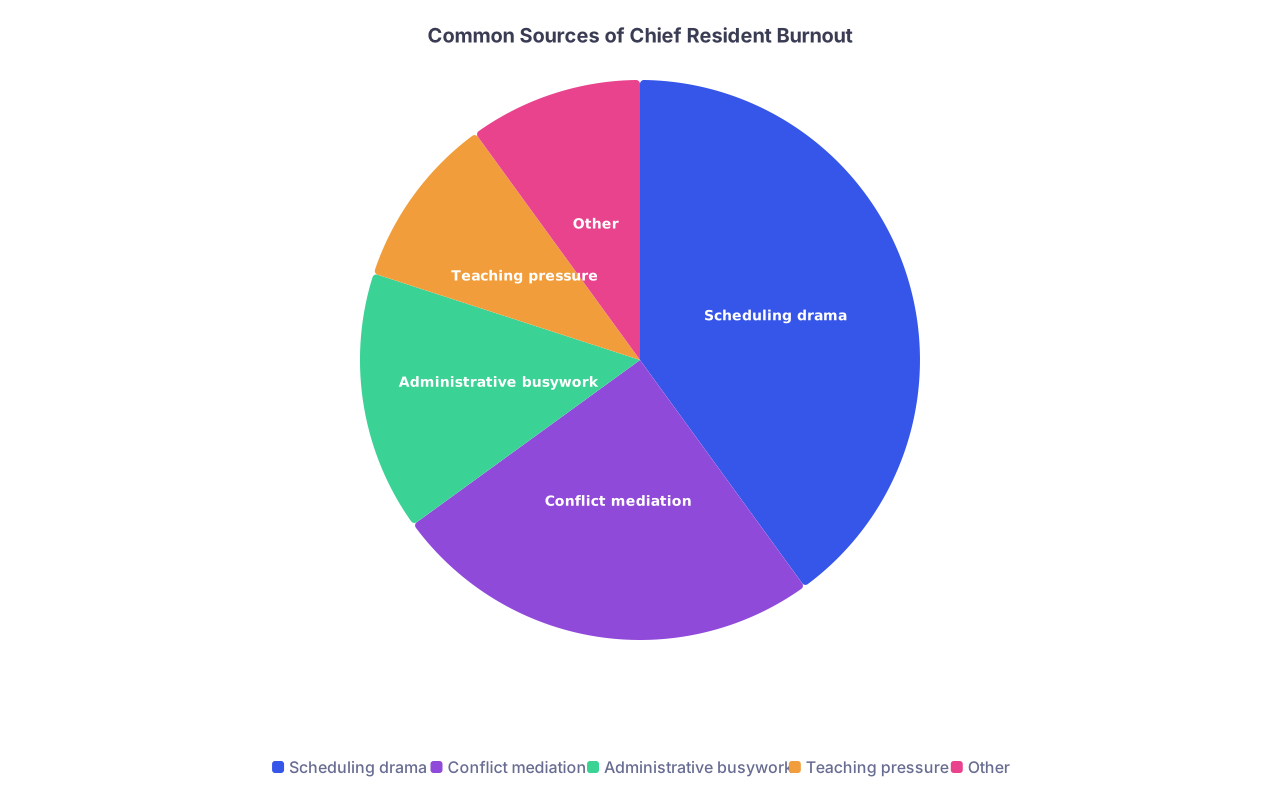
| Category | Value |
|---|---|
| Scheduling drama | 40 |
| Conflict mediation | 25 |
| Administrative busywork | 15 |
| Teaching pressure | 10 |
| Other | 10 |
The ugly truth: you will make someone furious over scheduling. Your job is not to avoid that. Your job is to make sure, when someone is furious, your process is defensible, consistent, and not personal.
Mistake #4: Avoiding Conflict Until It Explodes
A PGY-1 routinely disappears on nights. Nurses hate working with them. Cross-cover is constantly paging, “I can’t find them.”
You hear about it. You think, “They’re just adjusting. I don’t want to crush them.”
So you wait. You drop a vague hint on feedback forms. You hope the problem resolves on its own.
It doesn’t.
By the time you’re forced to act, three things have happened:
- The nurses think leadership doesn’t care about safety
- Other residents are furious they’re picking up the slack
- The intern has gotten months of the message: “This behavior is basically fine”
Your nightmare moment:
You’re in a multi-person meeting with the PD, APD, maybe HR, and that resident. Everyone looks at you and says, “When did you first hear about these concerns? What conversations did you have?”
And your answer is: “Uh… I didn’t really address it directly.”
That’s how you lose credibility with both leadership and your peers.
How to avoid this mistake
You need a simple, repeatable script for early intervention. Something like:
“Hey, I’m hearing a consistent pattern from multiple people: difficulty finding you on nights. I’m not here to punish you, I’m here to keep this from becoming a bigger deal. Help me understand what’s going on, and let’s agree on some specific changes I can follow up on.”
Then you:
- Get specific behaviors, not labels (“disappears” → “leaves unit for 45+ minutes without telling anyone”)
- Agree on clear, small, measurable changes
- Set a follow-up timeline (“We’ll check in again after this block”)
- Document that the conversation happened
Most chiefs delay tough conversations because they’re afraid of being “mean.” In reality, you’re doing the resident a favor by intervening early, while the stakes are still small.
Silence is not kind. Silence is how careers quietly derail.

| Step | Description |
|---|---|
| Step 1 | Notice pattern |
| Step 2 | Informal check in |
| Step 3 | Monitor quietly |
| Step 4 | Document behaviors |
| Step 5 | Discuss with PD/APD |
| Step 6 | Formal plan or remediation |
| Step 7 | Follow up and adjust |
| Step 8 | Improvement? |
Mistake #5: Taking Sides in Faculty–Resident Wars
Here’s the political landmine that blows up many first-year chiefs.
Scenario:
A notoriously harsh attending humiliates residents on rounds. Publicly. Often. Your team is furious. They come to you, heated: “You have to do something. This is abusive.”
You’re also angry. You’ve been that resident.
You fire off an email to leadership: “Honestly, everyone hates working with Dr. X, it’s toxic, something has to change.”
And suddenly, you’re in the middle of a decades-long faculty drama you barely understand.
Your nightmare moment:
You get pulled into a closed-door meeting with PD, Chair, and maybe that faculty member. You’re asked to “clarify” what you meant, who exactly complained, what incident, when. You’re now:
- The spokesperson
- The evidence
- The shield
You will lose. Either with faculty, with residents, or both.
How to avoid this mistake
You must separate three roles clearly in your mind:
- Advocate
- Messenger
- Judge
You can advocate for residents’ safety, fairness, and decent treatment. But you are not the investigator, not HR, and not the one to adjudicate faculty behavior.
When residents report serious concerns, your response should look like:
- Listen without promising outcomes you can’t deliver
- Validate that their experience matters
- Clarify whether this is:
- A one-time conflict
- A pattern
- A potential professionalism / safety / harassment issue
Then:
For professionalism/safety/harassment:
- Encourage formal reporting channels (PD, ombuds, HR, GME)
- Offer to attend a meeting with them, not speak for them
- Stick to specific behaviors, not sweeping character attacks
For one-off conflicts:
- Help them craft a feedback conversation if appropriate
- Or bring pattern-based, anonymized feedback to leadership at the right time (e.g., faculty eval review), not over email at 1 a.m.
Never let yourself become the only source of a complaint. And never put sweeping accusations about a faculty member in writing without talking to your PD first.
You’re not hiding things. You’re being strategic about how problems are raised so they actually get addressed instead of boomeranging back onto you and the residents.
Mistake #6: Forgetting You’re Still a Trainee (And Acting Like You’re Administration)
Another rookie chief error: you get a small taste of authority, and suddenly you start thinking of yourself as “leadership” instead of “resident with extra responsibilities.”
You start speaking for “the program.” You send emails saying things like:
- “The program has decided…”
- “Administration will not permit…”
- “We reviewed your request and determined…”
No, you didn’t. You’re not GME. You’re not HR. You’re not the PD.
Your nightmare moment:
Your PD forwards you an email you sent to a resident about parental leave, call coverage, remediation, or duty hours, with a subject line: “We need to talk about this.”
You overstepped. Maybe legally. Maybe politically. Maybe both.
How to avoid this mistake
Draw a thick line between:
- Things you own as chief (scheduling within defined rules, basic communication, daily operations)
- Things that belong squarely to PD/GME/HR (contracts, pay, leave, remediation, investigations, accommodations)
If a question touches:
- FMLA, maternity/paternity leave
- Disability or ADA accommodations
- Potential discrimination or harassment
- Formal remediation or probation
- Institutional policy disputes
Your script is very simple:
“I’m glad you brought this up. Parts of this are above my pay grade, and I don’t want to give you bad info. I’ll connect you with [PD / GME / HR], and I’m happy to support you however I can.”
You’re not weak when you say that. You’re smart.
Your job isn’t to be the system. Your job is to help residents move through the system without getting crushed.
Mistake #7: Ignoring Your Own Career Until It’s Almost Too Late
Chief year has a nasty way of devouring your time and your attention. You start July thinking you’ll:
- Finish that QI project
- Submit two papers
- Prepare for fellowship applications
- Network with faculty in your interest area
Then you blink and it’s February and all you’ve done is answer pages, put out fires, and build schedules.
Your nightmare moment:
You realize ERAS opens in 6 weeks and you have:
- No updated CV
- No recent letters
- No real scholarship progress
- No clear narrative for your application
And you’ve spent a year advocating for other people while neglecting your own career.
How to avoid this mistake
You have to treat your own career like a protected patient. Non-optional. Not “if there’s time.”
Block your year:
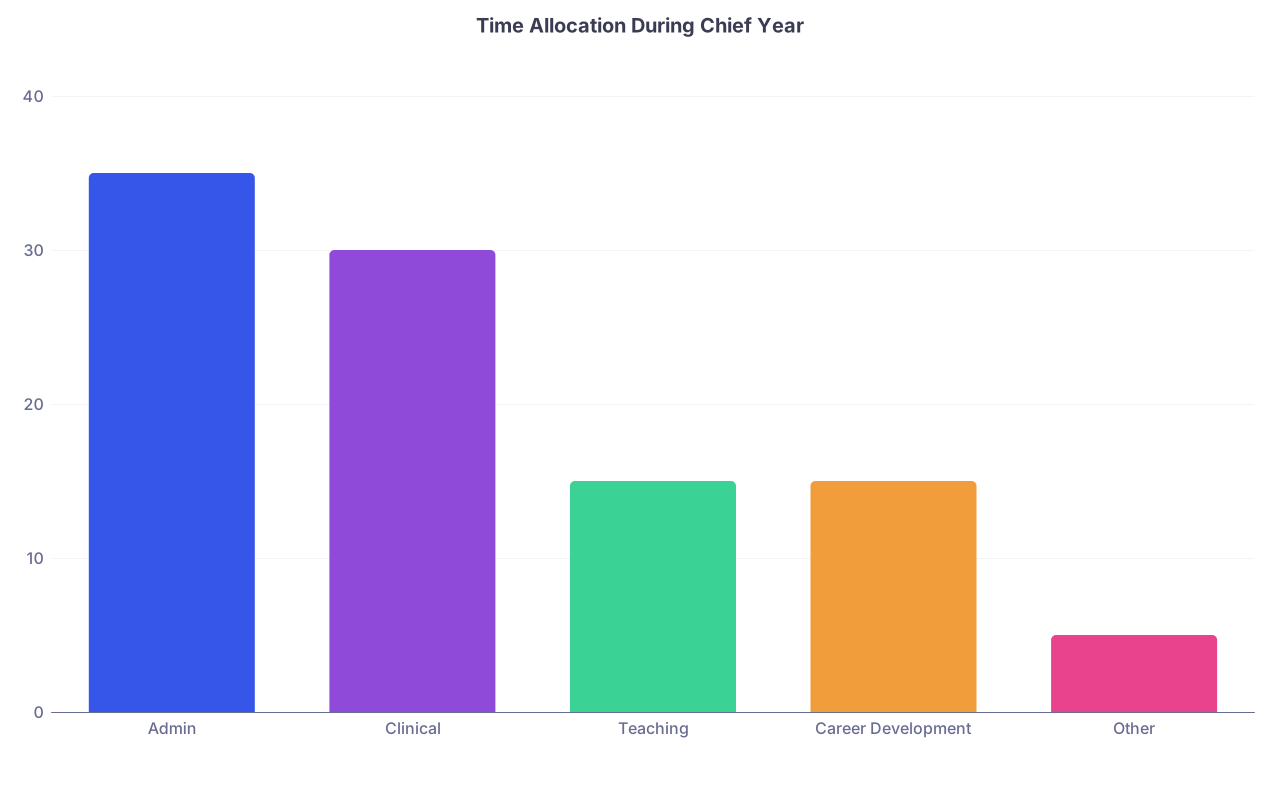
| Category | Value |
|---|---|
| Admin | 35 |
| Clinical | 30 |
| Teaching | 15 |
| Career Development | 15 |
| Other | 5 |
If “Career Development” drops to 0 because you’re constantly saving everyone else, you will regret it.
Practical moves:
- Schedule recurring protected time (e.g., Friday 1–4 p.m. = career work only) and defend it
- Tell your PD explicitly what your goals are and ask for accountability check-ins
- Say “no” to extra committees and projects that don’t align with your actual goals
Chief year is not some heroic pause from your life. It’s part of your trajectory. Treat it that way, or you’ll pay for it when apps season hits and you’re scrambling.
Mistake #8: Overestimating How Much People Understand Your Role
Residents often think chiefs have unlimited power. Faculty often think chiefs have unlimited time. Admin often thinks chiefs are the perfect dumping ground for anything involving “resident wellness” or “communication.”
You stand in the middle taking fire from every direction, and—here’s the critical part—you rarely explain your constraints.
Your nightmare moment:
The program is in chaos over a new night float rule. Everyone is mad at you because “the chiefs agreed to this,” and you’re thinking, “We were informed, not consulted.”
If you don’t shape the narrative of what your role actually is, everyone else will make it up. And they’ll usually be wrong.
How to avoid this mistake
You need a “What a Chief Does / Does Not Do” talk early in the year. At a resident meeting. With your PD present and nodding along.
Spell out, clearly:
- What decisions you own
- What decisions you influence but don’t control
- What decisions you’re just the messenger for
And repeat this in email form. Something like:
“As chiefs, we do:
- Build and manage schedules within program rules
- Escalate concerns to leadership
- Facilitate communication between residents and faculty
- Support residents during crises
We do not:
- Set institutional or GME-wide policies
- Control hiring/firing or pay
- Override PD or HR decisions
If you’re frustrated about a system-level issue, we want to help you bring it to the right place, but we can’t unilaterally change those policies.”
Clear boundaries reduce misplaced anger. Not completely—but enough to keep you sane.
Mistake #9: Treating Wellness Like Pizza Parties and Toxic Positivity
Some chiefs make this error: they think “resident wellness” means organizing:
- Yoga nights
- Ice cream socials
- “Fun” email challenges
Meanwhile, schedules are brutal. Communication is opaque. Struggling residents are ignored until they implode.
Residents are not fooled. They’ll go to your pizza event, but they won’t feel protected by you.
Your nightmare moment:
A resident has a mental health crisis or serious burnout. People start asking, “How did this get this far?” And your contribution so far? A few wellness emails and a donut day.
How to avoid this mistake
Wellness from a chief actually looks like:
- Making schedules fair and predictable
- Backing people up when life hits hard (illness, death in family, new baby)
- Normalizing talking about therapy, fatigue, and limits
- Pushing back—respectfully but firmly—when someone tries to solve a systemic problem with a “resilience lecture”

Actually helpful chief behaviors:
- Quietly arranging coverage for someone who needs a mental health day—and not broadcasting why
- Going with a resident to meet with PD or GME if they’re scared to go alone
- Asking in real terms, “How are you doing? No performance answer needed,” and then shutting up and listening
You can do your yoga nights if you want. Just don’t confuse that with being the kind of chief who actually keeps residents from breaking.
Mistake #10: Believing You Have to “Tough It Out” Alone
Here’s the last, and maybe most dangerous, chief resident mistake: isolation.
You convince yourself that because you’re “leadership” now, you can’t:
- Admit you’re overwhelmed
- Say you made a bad scheduling call
- Acknowledge you’re burned out
- Ask for real help from PDs or co-chiefs
So you armor up. You keep saying “It’s fine, I’ve got it.” You get snappier. You detach. You start resenting the very residents you’re supposed to protect.
Your nightmare moment:
You hit a wall. Maybe you explode at a meeting. Maybe you ghost emails. Maybe you quietly start making sloppy decisions. And everyone is surprised, because you insisted you were “fine” for months.
How to avoid this mistake
You need your own safety net. On purpose.

Set up, in July:
- A recurring check-in with your PD: not just operational, but “how are you holding up?”
- A monthly call with last year’s chief to sanity-check your instincts
- An agreement with your co-chiefs that you’ll tell each other early if you’re drowning, not when you’re underwater
And if you’re really struggling—sleep, mood, anxiety, dread going in—treat it like you’d tell any resident: get help. Counselor. Therapist. PCP. Whatever it takes.
Chief year can be incredibly meaningful. It can also quietly traumatize you if you pretend you’re invincible.
You’re not. No one is.

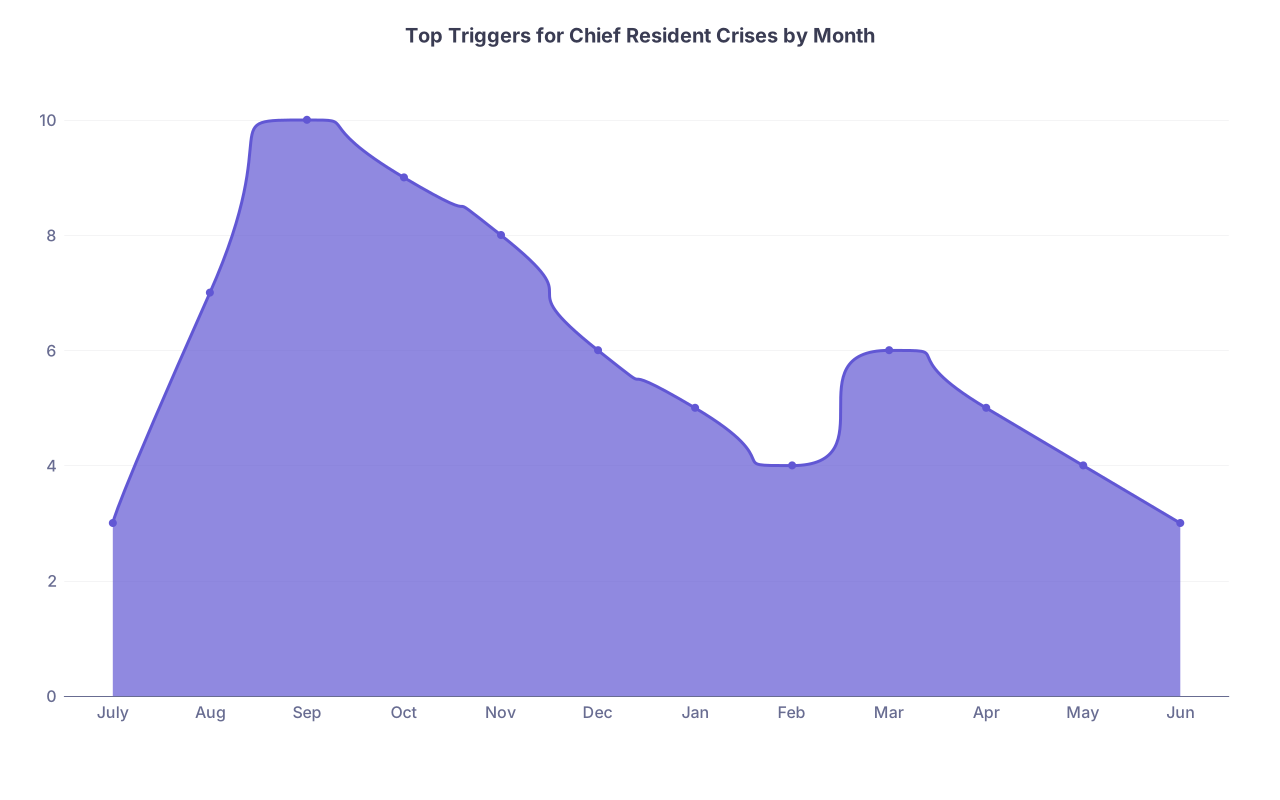
| Category | Value |
|---|---|
| July | 3 |
| Aug | 7 |
| Sep | 10 |
| Oct | 9 |
| Nov | 8 |
| Dec | 6 |
| Jan | 5 |
| Feb | 4 |
| Mar | 6 |
| Apr | 5 |
| May | 4 |
| Jun | 3 |

Your Next Step (Do This Today)
Don’t wait until July 1 to figure this out.
Today—yes, today—do one concrete thing:
Open a blank document and draft your Chief Year Rules. Three columns:
- “What I will not sacrifice” (sleep minimums, one protected career block per week, basic boundaries)
- “Non-negotiable fairness principles” (how you’ll handle schedule requests, conflict, and exceptions)
- “When I will escalate instead of handling it alone” (what goes to PD, GME, HR)
If you’re already chief, revise it based on the messes you’re currently dealing with.
Then share a cleaned-up version with your co-chiefs and ask, “Where do we need to be stricter to protect ourselves and the residents?”
Get that right early, and you’ll avoid most of the chief resident nightmares that keep people up at 3 a.m. staring at a broken call schedule.


