

Most resident-led QI projects are cosmetic. They generate posters, not change.
If you want to design a small QI project that actually alters how care is delivered on your ward, you have to stop thinking like a student doing an assignment and start thinking like a ruthless process engineer who happens to write progress notes.
Let me walk you through how to do that, step by step, in a way that fits real residency constraints: call shifts, cross-cover chaos, rotating services, and attendings who “support QI” as long as it does not delay discharges.
1. Start with a Problem that Actually Hurts Someone
The biggest mistake I see: residents pick problems that are easy to measure but clinically irrelevant. Or vaguely defined. “Improve communication” and “reduce burnout” sound noble. They are also impossible to fix in one tiny resident-led project.
You want something:
- Concrete
- Frequent
- Painful to patients or clinicians
- Changeable within your sphere of control
Examples that usually work well for residents:
- Delays in discharge summaries being signed, causing readmission confusion
- Missed VTE prophylaxis orders in eligible inpatients
- Poor documentation of code status on admission
- Inconsistent follow-up for abnormal lab or imaging results
- High rate of “inadequate bowel prep” notes for colonoscopy admits
- Repeated pages overnight for the same predictable issue (e.g., hypoglycemia from usual insulin orders on NPO patients)
If you cannot state your problem in one sentence with a specific “who / what / where,” stop and tighten it.
Good:
“On 6 West medicine floor, >30% of CHF patients do not have a documented weight within 24 hours of admission.”
Bad:
“Improve CHF care.”
That first sentence you write is not fluff. It becomes your anchor for every design decision.
2. Define a Brutally Clear Aim Statement
Vague goals kill QI. If your aim is “increase awareness” or “improve workflow,” you are already lost.
You need an aim that is:
- Specific
- Time-bound
- Measurable
- Ambitious but feasible within 3–6 months
Structure it like this:
“By [date], we will [change] from [baseline] to [target] for [population] on [unit/service].”
Examples:
- “By June 30, we will increase the proportion of admitted patients on 7 East with a documented code status within 24 hours from 52% to 85%.”
- “By March 1, we will reduce insulin-related hypoglycemia events (BG <70) on the surgical step-down unit from 8 per 100 patient-days to 4 per 100 patient-days.”
This is where you decide: Is this actually a “small” project or are you trying to fix the entire hospital in one PGY year?
If you cannot define what success looks like numerically, the project will devolve into “we did a thing” instead of “we changed care.”
3. Scope It to What a Resident Team Can Actually Do
You are not the CMO. You do not control IT budgets or nursing staffing. If your project requires:
- An EHR build that needs 6 months and 4 committees
- Extra nursing FTEs
- A new service line or clinic
- A new piece of capital equipment
…park it. It is not a resident-scale project.
Your sweet spot:
- Changes to order sets, if your hospital has a lightweight process
- Standardized notes/templates that clinicians can adopt tomorrow
- Simple checklists or bedside tools
- Education coupled with a structural change (education alone is useless)
- Changes in who does what and when in existing workflows
Think: “What can we implement using only:
- Resident time
- A bit of nursing goodwill
- Maybe a minor EHR tweak
- Existing meetings and communication channels”
If your intervention requires extra resources, redesign it to require fewer. Strip it down until it is almost embarrassingly simple.
4. Map the Current Process (For Real, Not in Your Head)
You think you know how the process works. You are probably wrong.
This is where you put on your process engineer hat and walk through the grimy details.
- Pick 3–5 recent real patients that went through the process (e.g., admissions with CHF, patients starting insulin, ICU transfers).
- For each, map every step from trigger (e.g., “patient arrives to floor”) to outcome (e.g., “code status documented in EHR orders and note”).
Talk to people:
- Night float resident: “When do you usually ask code status?”
- Day nurse: “When do you see that code status? Where?”
- Unit clerk: “What papers or flags do you rely on?”
- Pharmacist: “When do you review these orders?”
Then draw the process.

| Step | Description |
|---|---|
| Step 1 | Patient admitted |
| Step 2 | Admitting resident evaluates |
| Step 3 | Resident writes H and P |
| Step 4 | Code status in note only |
| Step 5 | No code status anywhere |
| Step 6 | No order placed |
| Step 7 | Nurse checks orders for status |
| Step 8 | Code status unclear on floor |
| Step 9 | Code status asked? |
The point is to see reality, not policy. Policies lie. Work as done is what you must change.
5. Choose a Metric That Will Not Waste Your Time
Measurement is where resident projects either become elegant or die in endless data hunting.
You want:
- One primary outcome metric
- At most one process metric
- At most one balancing metric (to ensure you did not break something else)
Keep it lean.
Examples:
Problem: Code status not documented.
- Outcome: % of admissions with code status documented in EHR order within 24 hours of admission.
- Process: % of H&Ps that contain a filled-out “Goals of Care” section.
- Balancing: None or “% of admissions longer than 60 minutes from room arrival to note completion.”
Problem: Missed VTE prophylaxis.
- Outcome: % of eligible inpatients with pharmacologic VTE prophylaxis ordered within 24 hours.
- Process: % of admission order sets where VTE prophylaxis choice is explicitly selected.
- Balancing: Rate of major bleeding events (or at least watch for new safety flag).
Notice what I am not measuring: “attitudes,” “awareness,” or “satisfaction” unless they are essential. Those belong to bigger projects.
Now make your life easier. Do this:
- Beg someone for baseline data help (quality office, data analyst, pharmacy, informatics). Show them your concrete aim; they are much more willing when you are specific.
- If you cannot get automated data, sample. For example, audit 10 charts per week on the target unit. That is enough to see a signal for many small projects.
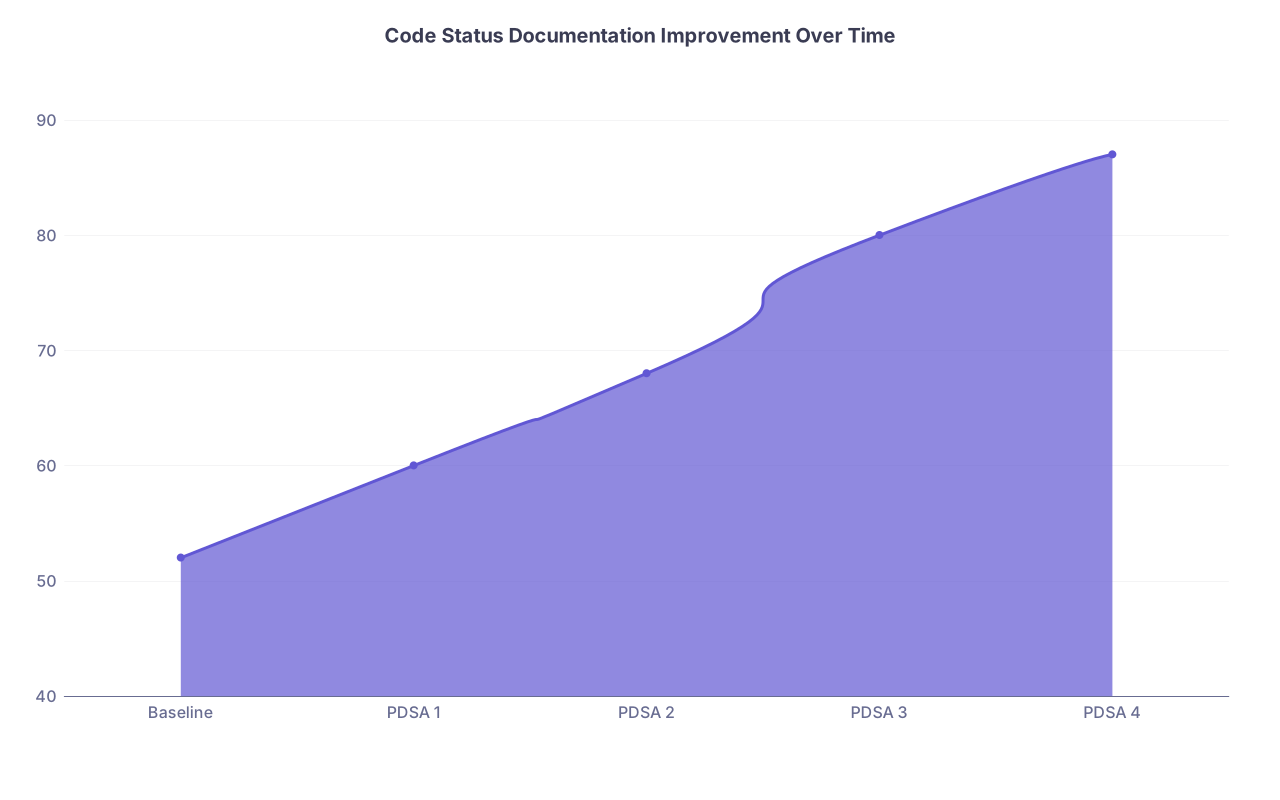
To keep yourself from overcomplicating data sources, use a run chart:
| Category | Value |
|---|---|
| Baseline | 52 |
| PDSA 1 | 60 |
| PDSA 2 | 68 |
| PDSA 3 | 80 |
| PDSA 4 | 87 |
That is all you need to see if something is moving.
6. Design a Real Intervention, Not a Lecture Series
Education alone is the junk food of QI. Easy to consume. No lasting effect.
If your intervention is “we gave a noon conference,” you did not change care. You changed slide fatigue.
You need to bake the new behavior into the workflow so that the easiest thing to do is the right thing.
Common resident-scale interventions that actually work:
- Add a mandatory field or hard-stop in an admission template (e.g., code status field that must be completed to sign)
- Modify an existing order set so that:
- Desired behavior is preselected (default VTE prophylaxis choice)
- Undesired options are hidden or require extra clicks
- Create a unit-based checklist that aligns with nurse/resident handoff (“Is code status documented in orders?” as one of 5 bullets)
- Use visual cues at point-of-care (e.g., laminated door signs for patients without code status documented that nurses can place until ordered)
- Shift task ownership explicitly (“Night float will always enter code status orders before sign-out”)
The trick: pair a structural change with minimal education.
Example:
- Structural: Admission H&P note template now has a bold “Code Status and Goals of Care” block at the top that autopopulates an order if filled.
- Education: 10-minute walk-through at morning report plus 1 email with a screenshot.
If you feel like you are begging people to remember new behavior, your intervention is weak. Strengthen the structure, not the pleading.
7. Run Tight, Fast PDSA Cycles (Not One Giant Rollout)
QI frameworks are not sacred texts. But PDSA (Plan–Do–Study–Act) is actually useful—if you do it quickly and honestly.
Think in 1–2 week cycles, not 3-month monoliths.
Cycle 1 example:
Aim: Test whether adding a simple paper checklist to night float sign-out improves code status orders on one medicine team.
- Plan: For the next 5 nights, the night float on Team A uses a 1-page checklist that includes “Code Status documented in orders?” for each new admit.
- Do: Implement it, collect data on 10 consecutive admissions.
- Study: Compare to baseline on that same team. Talk to the night float; what worked, what was annoying?
- Act: Revise the checklist, or decide to move from paper to an EHR note template based on feedback.
Cycle 2:
- Expand to 2 medicine teams with the revised template.
- Collect another 2 weeks of data.
- Maybe now consider a soft nudge in the EHR.
You are deliberately testing on small samples before scaling. That is how you avoid designing something that collapses the day it faces a weekend surge.
And yes, document each PDSA explicitly. Not for the poster. For your own discipline. If you cannot say what you tested and what you learned each cycle, you are just making noise.
8. Build a Minimal, Functional QI Team
You cannot do this alone. You should also not build an army.
Core team for most resident projects:
- You (project lead)
- One co-resident or intern who actually cares about the topic
- One nurse from the unit you are targeting
- One attending who is:
- Physically present on that unit at least some weeks
- Not allergic to change
- One “system person” if possible:
- Quality officer, QI director, or data analyst
- Or the person who owns order sets/templates in the EHR
Meet for 30 minutes every 2–4 weeks. Standing time. Agenda:
- Review most recent run chart / data snapshot
- Feedback from frontline users (1–2 minutes only)
- Decide next PDSA cycle and who is doing what
If your meeting turns into philosophical debates about “culture” without concrete next steps, you are drifting.
9. Deal with the Two Biggest Resident Realities: Time and Turnover
This is where most “resident-led QI” dies: July happens or you get slammed with ICU month, and the project evaporates.
Design against that from day one.
Do these three things:
Make the intervention self-sustaining.
If the success of your change requires a new resident champion every month, you have failed. The ideal is:- EHR default, order set, or template that just exists
- Standard checklist embedded into a nurse-run or hospitalist-run process
- A change that, once adopted, is clearly easier for staff
Build a simple project one-pager.
Outline:- Problem
- Aim
- Measures
- Current intervention
- PDSA cycles completed
- Data snapshot (one graph)
This is what you hand off to the next resident or chief. It keeps the project from restarting as “brand new” every July.
Align with existing institutional priorities.
If your project helps with a known metric the hospital already tracks (e.g., readmissions, CLABSI, falls, sepsis bundle compliance), your project is more likely to survive rotations, because someone beyond you cares.
| Element | Status Options |
|---|---|
| EHR / workflow change | Planned / Done / None |
| Nurse partner identified | Yes / No |
| Attending champion | Yes / No |
| One-page summary created | Yes / No |
| Handoff plan for July | Yes / No |
If you cannot check most of those boxes, you are probably designing a short-lived school project, not a care change.
10. Show Your Work Without Pretending You Cured Healthcare
You will be pushed to present this project: noon conference, QI day, maybe a regional meeting. That is fine. But present it honestly.
Smart QI presentations from residents include:
- A clear problem statement and aim
- A simple process map or swimlane diagram
- Run chart or before–after graphic with dates of each PDSA cycle marked
- 2–3 concrete lessons learned (e.g., “Education alone moved our metric 0%”)
- Next steps, including what you would do differently
Avoid overselling. You did not eliminate sepsis mortality in 3 months. But maybe you increased early lactate orders from 40% to 80% in your ED pod. That is real.
And be clear about limitations:
- Sample size small
- Single unit
- Manual chart review
- Short follow-up period
Ironically, the more honest you are, the more likely people will trust the work and consider scaling it.
11. Three Small Project Blueprints You Can Steal Tomorrow
If you are still not sure where to start, here are three plug-and-play project skeletons that I have seen residents pull off successfully during busy years.
A. Improve Code Status Documentation on Admission
Problem: Patients on your medicine floor frequently have “full code by default” with no explicit conversation or order.
Aim:
“By June 30, increase the proportion of medicine admissions on 7 East with a code status order placed within 24 hours from 50% to 85%.”
Measures:
- Outcome: % admissions with code status order within 24 hours
- Process: % H&Ps with code status section filled
- Balancing: Median time from room arrival to signed H&P
Intervention ideas:
- Add a required “Code status discussed and order placed?” field to the admission H&P note template.
- Night float “Admission Checklist” including code status.
- Day nurse handoff: if no code status order present by 10am, page resident with standard script once.
PDSA cycles:
- Week 1: Pilot checklist with one night float.
- Week 3: Add code status block to H&P template for one team only.
- Week 5: Expand template hospital-wide, add nurse reminder step.
B. Reduce Missed VTE Prophylaxis on General Med Floor
Problem: Eligible inpatients on general medicine frequently have no pharmacologic VTE prophylaxis ordered.
Aim:
“Within 3 months, increase the percentage of eligible adult medicine inpatients on 6 West with pharmacologic VTE prophylaxis ordered within 24 hours from 70% to 95%.”
Measures:
- Outcome: % eligible patients with pharmacologic prophylaxis ordered in 24 hours
- Process: % admission orders using the standardized “Medicine Admission” order set
- Balancing: Chart review for any new bleeding events temporally linked to prophylaxis (if feasible)
Intervention ideas:
- Modify admission order set so VTE prophylaxis is pre-selected for appropriate patients with a simple risk screen.
- Build a pharmacy daily check and pager message to resident for any eligible no-prophylaxis patient.
- 5-minute refresher at morning report about VTE risk categories.
PDSA cycles:
- Cycle 1: Pharmacy notification for one ward only.
- Cycle 2: Change order set default, with small group of residents briefed.
- Cycle 3: Scale order set plus brief nurse education.
C. Decrease Post-Call Lab-Related Pages (Efficiency + Safety)
Problem: Post-call residents are bombarded with predictable pages for routine lab abnormalities that could have been pre-addressed.
Aim:
“Over 8 weeks, decrease the number of overnight pages to the post-call resident related to common predictable lab abnormalities (K, Mg, sliding scale insulin issues) from 20 per week to 10 per week on Team B.”
Measures:
- Outcome: # relevant lab-related pages per week
- Process: % of discharging team notes that include specific lab-action plans (“If K <3.3, replete with…”)
- Balancing: # of missed or delayed responses to critical values (safety check)
Intervention ideas:
- Standard discharge / sign-out template line: “Anticipated lab issues and if-then plan: …”
- Quick card for nurses outlining standard repletion / insulin parameters agreed with attendings.
- Mini-intervention: short huddle between post-call and on-call residents discussing typical lab triggers.
PDSA cycles:
- Cycle 1: Template + huddle on one team for 2 weeks.
- Cycle 2: Adjust template based on confusion / misuse.
- Cycle 3: Roll to second team.
All three of these share the same pattern: narrow scope, structural change, simple measurement, and built around things residents and nurses already do.
12. The Leadership Angle: Why This Matters More Than the Poster
If you are in residency and reading this, I want you to see the real prize here. It is not the HI-QI day award.
Designing a small QI project that actually changes care teaches you core leadership muscles:
- Seeing systems instead of “dumb providers” or “noncompliant patients”
- Negotiating and aligning incentives across disciplines
- Making change with almost no formal authority
- Handling data and feedback without getting defensive
- Thinking in experiments, not edicts
Those skills translate directly to chief roles, fellowship, hospital committees, and eventually department leadership.
The residents who can say, “We changed X process on Y unit, sustained for 12 months, and here is our data,” stand out. Not because it looks good on a CV. Because it proves they know how to lead in the messy, constraint-heavy reality of hospital life.

FAQs
1. How small is “small” for a resident-led QI project?
Small means one unit or one team, one primary outcome metric, and an intervention that can be designed, tested, and refined over about 3–6 months with a few hours per week. If your project spans multiple hospitals, multiple services, or requires formal institutional policy changes, you are out of “small” territory.
2. Do I really need statistical process control charts, or is a simple before–after comparison enough?
For most resident projects, a simple annotated run chart is good enough. Plot your metric over time, mark when each PDSA cycle started, and look for sustained shifts, not tiny one-week bumps. If your institution has QI support that loves SPC charts, fine, use them—but do not let statistical sophistication substitute for a weak problem or sloppy intervention.
3. How do I get buy-in from attendings who think this is a distraction from “real medicine”?
Show them their pain points. For example: “You know those 5am pages about unclear code status? We are trying to cut those in half” or “We are reducing readmissions from med errors that you get called about in clinic.” Brief, concrete, and tied to their daily annoyance works better than “I need this for my QI requirement.”
4. What if I cannot get EHR changes approved in time?
Then you design around that constraint. Use resident note templates that you control, checklists, standardized phrases in sign-out, or manual audit and feedback. Yes, EHR changes are powerful, but they are not the only lever. I have seen a laminated nurse checklist near the charge nurse desk move metrics more than a half-baked order set revision.
5. How do I keep the project going when I rotate off the service?
Plan continuity from the start. Recruit at least one junior resident, one nurse, and one attending who will stay connected to the unit. Create a one-page summary of the project and a short handoff (even 10 minutes at a noon conference) to the next resident cohort. The more your change is embedded in standing workflows (nurse checklists, standard note templates), the less it depends on your physical presence.
6. How do I know if my project is “good enough” for a poster or publication?
If you have: a clear aim, a defined process map, at least 2–3 PDSA cycles, a simple run chart showing some signal (even if modest), and an honest discussion of what worked and what did not, you already have the bones of a solid abstract. Journals and meetings care more about rigor and clarity than about you achieving perfection. A clean, honest “we improved this metric by 15% and learned these three things” beats a vague “we educated everyone and people liked our slides” every time.
Key points to keep in your head:
- Pick a narrow, clinically painful problem and define a sharp aim.
- Change structure, not just knowledge—build the new behavior into the workflow.
- Run small, rapid PDSA cycles with simple measurement, and design the project so it survives you rotating off the service.


