

The average residency team does not have a “feedback problem.” It has a feedback culture problem. The difference is everything.
You are not going to fix this with one big curriculum, a new evaluation form, or yet another “360” process. You fix it with small, repeatable behaviors. Micro-leadership habits. The things you do on rounds at 6:15 a.m. when everyone is tired and the attending is late.
Let me break this down specifically, from the vantage point of someone who has watched dozens of teams either quietly thrive or quietly rot depending on how they handle feedback.
Why Feedback Culture in Residency Is Weirdly Hard
Residency is structurally designed to kill honest feedback unless you actively fight back.
You are dealing with:
- Power gradients everywhere (PGY‑1 to PGY‑3, resident to attending, resident to nurse, etc.).
- Rotating teams every 2–4 weeks, so relationships are shallow and time-limited.
- Evaluation anxiety: every shift feels like an audition for a letter or a fellowship.
- Psychological exhaustion: when people are just trying not to drown, “let’s have a reflective feedback chat” sounds like punishment.
So what happens? Three predictable pathologies.
Polite silence.
“Nice job, any questions?” at the end of rounds. Everyone shakes their head. No one learned anything concrete.Surprise summative attacks.
Mid-rotation feedback was vague and positive. End-of-rotation eval: “Needs to work on efficiency, knowledge, ownership.” The resident reads this at home at 11 p.m. and feels betrayed.Weaponized feedback.
Feedback used to vent frustration (“You’re not committed”) instead of targeting behavior (“You arrived after sign-out three days this week; that disrupts the team”).
You will not fix this with a feedback lecture. You fix it by changing the daily micro‑interactions.
The Core Principle: Make Feedback Routine, Small, and Predictable
Feedback culture improves when feedback becomes:
- Expected, not exceptional.
- Behavioral, not personal.
- Two-way, not top-down.
That means shifting from “feedback as an event” (monthly evaluation meeting, end-of-rotation form) to “feedback as a rhythm” (short, focused exchanges laced into the workday).
Think of it like hand hygiene. If you make it a separate “activity,” people skip it. If it is built into workflow (foam in/out every room), it sticks. Same with feedback.
To make this real, you need habits you can run even on the worst trauma call.
Habit 1: The 3-Minute Expectations Huddle
On day one of a rotation, most seniors mumble: “We start pre-rounds at 6, run the list at 7, any questions?” Then they wonder why their interns miss targets.
Instead, you run a 3‑minute expectations huddle. Not a TED Talk. A script.
Here is a concrete version you can steal:
“Alright, quick expectations so we are all on the same page.
What I care about most:
- Safety: no one goes home worried they missed something.
- Communication: no surprises with nurses or attendings.
- Growth: each of you should leave this month clearly better at something specific.
How I give feedback:
- I will try to give you tiny pieces of feedback most days. Sometimes in front of others if it is about the medicine, privately if it is about your behavior.
- I am not saving things for your eval. If there is an issue, you will hear about it early.
How I want feedback from you:
- You are allowed to tell me what is not working. If my running style or teaching is off, I want to know.
- Easiest way: at the end of a day, just say, ‘Can I give you one piece of feedback?’ I will say yes.
We will do a quick check‑in mid‑month. Two minutes. What is helping, what is not. Sound fair?”
That is it. No slides. No grand philosophy. But now:
- Feedback is named as normal.
- You have pre‑authorized the resident to speak up.
- You have promised not to hoard criticism until the evaluation.
You have also subtly made a commitment you are now socially pressured to keep. Which is the point.
Habit 2: Micro-Debriefs After Discrete Events
The most underused real estate for feedback in residency: the two minutes right after a discrete event that went either well or badly.
Code. Family meeting. Difficult consent. Botched presentation. Perfect presentation. That window is gold.
Most teams use it to…walk silently to the next task. Or complain about the pager.
You adopt a different reflex: “90-second debrief.”
Concrete structure: The 1–1–1 pattern
Right after the event, you pull aside the intern or student (or the whole group if appropriate) and run a tight script:
- “One thing you did well was…”
- “One thing to work on next time is…”
- “One thing I could have done to support you better is…”
Note the third piece. That is where culture shifts. You are not just the judge; you are part of the system.
Example. After a family meeting where the intern fumbled explaining the plan:
“Quick debrief.
- One thing you did well: you paused when they got emotional instead of talking over them. That matters.
- One thing to work on: your explanation of ‘comfort-focused care’ was heavy on jargon. Next time, lead with one plain sentence, like ‘We are going to focus on keeping her comfortable rather than trying treatments that are not helping.’
- One thing I could have done better: I should have asked you beforehand what you planned to say so we could tighten it up together.”
Done. That is less than 90 seconds.
You showed:
- Specific behavior-level praise.
- Specific behavior-level improvement.
- Humility and shared responsibility.
Do this three times in a week and learners start asking for it instead of dreading it.
Habit 3: The “Name It in the Moment” Technique
Most seniors and attendings wait until “a good time” to give feedback. That time rarely arrives. So the comment instead appears two weeks later, buried in an evaluation.
You break that by naming behavior in the moment with short, neutral labels.
The pattern is simple:
“Pause. I want to name something: [behavior]. Effect: [impact]. Next time: [tweak].”
Example: During morning rounds, an intern discusses a patient but glosses over vitals trends.
You interrupt kindly but firmly:
“Pause. I want to name something. In that presentation, you skipped the overnight vitals trend. The effect is I cannot quickly appreciate if the patient is stable or spiraling. Next time, give me the highs and lows for heart rate, blood pressure, and oxygen in one sentence near the start. Try again with this patient.”
You are not attacking their intelligence. You are not saying “You are disorganized.” You are labeling a discrete pattern and a concrete fix.
Key tactics that make this work:
- Keep your tone flat and brief. The more emotional you sound, the more it feels like scolding instead of calibration.
- Immediately let them retry. That turns feedback into practice, not just commentary.
- If it is sensitive (tone with nurses, lateness, attitude), name it privately.
Over time, people will mirror this and start naming micro‑behaviors back to you. Which is exactly what you want.
Habit 4: Normalize Upward and Lateral Feedback
If feedback only flows downhill, you do not have a feedback culture. You have a grading culture.
Residents constantly complain that “no one ever gives me feedback.” Then they lead a team and never ask for feedback themselves. That is hypocrisy, and learners smell it instantly.
You have to model asking for and accepting feedback in ways that do not look staged.
Use the “1 thing” request
Do not say, “Any feedback for me?” That question is too big and too risky for a student who met you yesterday.
Say this instead to your intern at the end of the day, while walking to the parking lot:
“Give me one thing I could do differently to make this rotation more useful for you.”
Or to your co‑resident after a sign‑out:
“Quick thing—how is my sign‑out from your side? Give me one thing I should tweak.”
You are asking for something specific and constrained. Easier to answer, less threatening to give.
Then, crucially:
- Do not defend. If they say, “You talk very fast in the afternoon when I am taking notes,” your only acceptable first words are “Thanks, that helps” or “Good catch.”
- Pick one piece and visibly act on it. “I will try to slow down and chunk my teaching a bit more. If I slip, wave your pen at me as a reminder.”
Once people see that giving feedback to you is not career‑suicide, they will try it again. That is how you chip away at hierarchy.
Habit 5: Convert Complaints into Feedback
Residency is a factory for low‑value complaining. About attendings, about night float, about consults, about “the system.” Most of that venting goes nowhere.
A leader with micro‑leadership habits treats complaints as raw material for feedback. You do not have to crush the emotion. You just do not let the conversation die as a rant.
Example. Your co‑resident says between cases: “The ICU attending is impossible. They always criticize my plans.”
You could say, “Yeah, they’re rough,” and walk away. Same old culture.
Or you could say:
“Let’s turn that into something you can use. What exactly are they criticizing? Is there a pattern? Can you ask them, ‘What would a strong plan have included that I am missing?’ Then we can work on that piece.”
You are not pretending the situation is fine. You are reframing: What is the actionable feedback buried inside this misery?
Once you start doing this, your team starts catching themselves. “Okay, I am complaining. What is the feedback version of this?”
That is culture shift.
Habit 6: Small, Predictable Feedback Rituals
Micro‑habits are easier to execute if they are attached to existing anchor points in the day. You do not want to “remember to do more feedback.” You want feedback wired into routines.
Pick one or two of these and run them consistently for a month:
End-of-rounds “plus/delta” (3 minutes).
“Give me one thing about how we ran rounds that worked well (plus), and one thing we should change tomorrow (delta).”Mid-rotation one-minute check‑ins.
On day 7 or 8, tell each learner: “Tomorrow, let’s take one minute after rounds. I will share one strength and one growth area I see; I want one ask from you for the rest of the month.”End-of-shift “what stuck” question.
“Before you go home, what is one thing you are going to do differently tomorrow based on today?”
None of these are complicated. The difficulty is not conceptual; it is emotional. You have to be willing to look a colleague in the eye for 60 seconds and say something real.
Habit 7: Anchor Feedback in Behaviors, Not Identity
The fastest way to destroy feedback culture is to make comments about character instead of conduct.
“You are sloppy.”
“You are not motivated.”
“You’re not a team player.”
These are lazy, and they are clinically useless. They do not tell the learner what to change.
Instead, discipline yourself to stick to observable behaviors:
- “Your notes have multiple copy‑paste errors and missing updated plans.”
- “You left sign‑out early twice this week, and cross‑cover did not know two key updates.”
- “On rounds, you check your phone multiple times in front of patients and nurses.”
Then you connect behavior to impact:
- “That makes it harder for the night team to trust your documentation.”
- “That forces cross‑cover to chase basic information and delays care.”
- “That signals to the team that you are disengaged, even if you are listening.”
Then you suggest a specific next move:
- “Tomorrow, I want you to double‑check the assessment and plan for three patients with me before we sign out.”
- “Let us agree on a rule: you own staying until the last patient is signed out unless we explicitly excuse you.”
- “On rounds, keep your phone away unless you are looking up data; if it is a family emergency, just say it.”
This is much harder work cognitively. You actually have to observe and think. That is leadership. It is also how you avoid the bias and character assassination that haunt residency evaluations.
Habit 8: Protect Psychological Safety Without Going Soft
People misunderstand “psychological safety” and turn it into “no one is allowed to feel bad.” That is nonsense.
Real psychological safety is: “I can say what I see, ask for help, and admit mistakes without being humiliated or punished.” It is not “no one ever challenges me.”
Your micro‑leadership job is to create an environment where:
- Errors are discussed frankly but without shaming.
- Concerns can be raised to you without retaliation.
- Feedback is frequent enough that a single comment does not feel like a verdict on someone’s worth.
Specific moves:
- When someone admits a miss, you start with, “Thanks for owning that,” before dissecting it.
- When you correct someone firmly, you end with a forward‑looking path: “Here is how we are going to handle this going forward.”
- When you see someone taking a risk (presenting a plan they actually generated instead of parroting), you praise the risk even if the content is off.
Example. Intern: “I did not call the family last night; I lost track of time.”
You: “Thanks for saying that rather than pretending you did. The effect, though, is they are waiting and anxious this morning. Today, I want you to call them after rounds and apologize briefly. Tonight, what is your plan so that family calls do not fall off the list again?”
You neither minimize nor humiliate. That balance is the sweet spot.
Habit 9: Use Data Wisely, Not as a Weapon
Residency is full of metrics: length of stay, throughput times, note completion, on‑time discharges. Many residents experience these as faceless pressures, not feedback.
As a micro‑leader, you translate data into constructive, individualized feedback. A few rules:
- Never surprise someone with data you have had for weeks. If you know someone’s notes are consistently late, tell them early, not on a formal evaluation.
- Frame data as signal, not judgment: “This tells me something about how you are working; let us figure out what.”
- Pair data with observation. Numbers alone are rarely the full story.
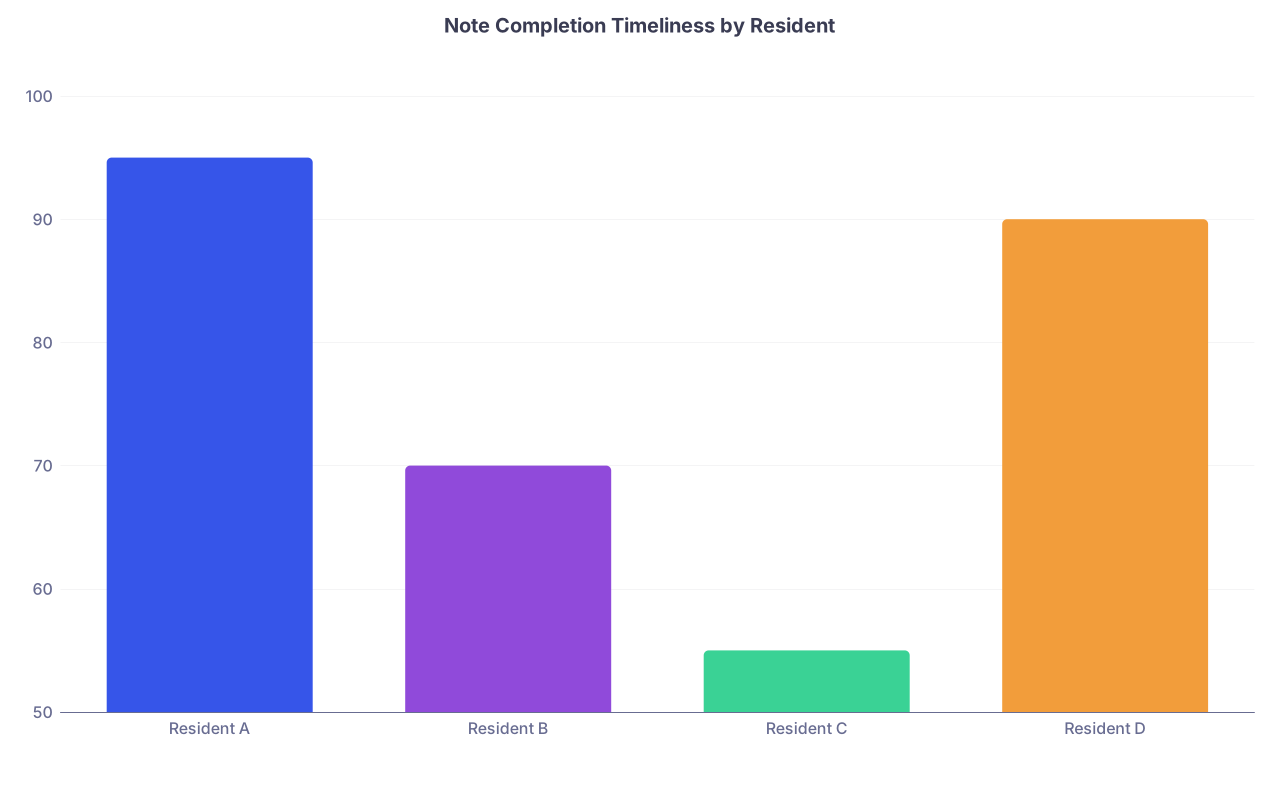
| Category | Value |
|---|---|
| Resident A | 95 |
| Resident B | 70 |
| Resident C | 55 |
| Resident D | 90 |
Take that sort of pattern. Resident C looks bad at first glance.
You could say, “You are not pulling your weight.” Or you could say:
“I am seeing that 55% of your notes are done by 5 p.m., while the rest of the team is around 90%. I also notice you spend a lot of time at the bedside, which is good. Let us walk through your day and see where the bottleneck is. Maybe we can move some of your note work earlier or have you pre‑chart differently.”
Now data is not a blunt object; it is a hook for problem‑solving.
Habit 10: Close the Loop
The last habit almost no one does: closing the loop on prior feedback.
When you ask someone to change something, your responsibility does not end there. If they change it, you must name that explicitly. Otherwise the message is: “Only your failures are visible.”
Example trajectory:
Week 1: “You have been late to sign‑out twice this week; I need you here five minutes early so the night team can prep and not get stuck staying over. What would help that happen?”
Week 2: They have been on time every day.
Your move: “I want to acknowledge something: you have been early to sign‑out all week. That fixes a big pain point for the team. Keep that up.”
Ten seconds. But the effect is huge:
- Reinforces the change as part of their identity now (“I am someone who shows up early to support my team”).
- Signals that feedback can lead to a positive narrative, not just a permanent red mark.
- Makes people more willing to engage with future critiques.
Without loop‑closing, feedback feels like a one‑way drain. With it, feedback feels like a dynamic process.
Example: A Week of Micro-Leadership on Wards
To make this less abstract, let’s sketch how a senior resident could run a single week on an inpatient service with these habits.

| Step | Description |
|---|---|
| Step 1 | Day 1 Expectations Huddle |
| Step 2 | Day 2 Micro Debriefs |
| Step 3 | Day 3 Upward Feedback Ask |
| Step 4 | Day 4 Name It in the Moment |
| Step 5 | Day 5 Mid Rotation Check Ins |
Day 1 (Monday):
- 3‑minute expectations huddle at 6:15 a.m.
- On rounds, name one specific positive behavior for each learner.
Day 2 (Tuesday):
- After a complex discharge, 90‑second debrief with the intern: 1 thing good, 1 thing to tweak, 1 thing you could have done to support.
- Convert one team complaint (about consult delays) into “what feedback would they need from us?”
Day 3 (Wednesday):
- Ask your intern on the walk to lunch: “Give me one thing I could do differently as a senior.”
- End-of-day, ask everyone: “What is one thing we should change about how we run rounds tomorrow?”
Day 4 (Thursday):
- During rounds, briefly pause to correct a presentation structure, then let them retry immediately.
- After someone owns a missed lab follow‑up, start with “Thanks for flagging that” and then problem-solve.
Day 5 (Friday):
- One-minute mid‑rotation check‑in: each learner gets one named strength and one growth area, plus one ask from you for the rest of the rotation.
- Close the loop on any behavior that improved since Monday (e.g., timeliness, prep, calls).
None of this required a single new form or meeting. But by Friday, the team has experienced:
- Frequent, specific, behavior-level feedback.
- Upward feedback that did not backfire.
- Direct correction without shaming.
- Recognition when change happened.
That is what a feedback culture actually feels like.
Common Failure Modes (And How to Avoid Them)
A few patterns I have watched sink good intentions:
Trying to “fix everything” in one feedback conversation.
Residents hear a laundry list and shut down. Limit yourself to one or two key behaviors per interaction. Save the rest.Delivering feedback only when frustrated.
If the only time you pull someone aside is when you are angry, feedback becomes synonymous with punishment. Force yourself to give micro‑praise for specific behaviors as often as you correct things.Delegating all hard feedback to the attending.
Seniors sometimes say, “I don’t want to be the bad guy, I’ll let the attending handle it.” That is abdication. Your interns work most closely with you; your words carry more day‑to‑day weight. Use that.Over‑scripted, inauthentic language.
You do not need to sound like an HR manual. It is fine to say, “Hey, can I give you a quick piece of feedback?” and then speak in normal, direct language. Clunky frameworks die on busy nights.Ignoring your own blind spots.
If no one ever gives you feedback, that is not because you are perfect. It is because you are unapproachable. Start by asking for one thing you could change. And mean it.
Where to Start: A Minimal, High-Yield Package
You cannot implement ten new habits tomorrow. You are not a full-time leadership coach; you are a resident doing notes at midnight.
So here is the minimalist starter kit I would insist on for any senior resident:
| Habit | When You Do It | Time Cost |
|---|---|---|
| Expectations Huddle | First morning of rotation | 3 minutes |
| Micro Debrief (1–1–1) | After 1–2 key events per day | 2 minutes each |
| Ask for "1 Thing" Feedback | Once mid-week | 1 minute |
| Name It in the Moment | During rounds, 1–2 times/day | 30 seconds |
If you do just those consistently, your team’s feedback culture will look radically different from the average service.
The Bottom Line
You do not need a title to lead feedback culture on your team. You need habits.
Three core points to keep in your head:
- Feedback culture is built in micro‑moments, not grand initiatives. Short, specific, behavior-level comments given frequently beat any formal evaluation form.
- You must model both giving and receiving feedback. If you never ask for critique or only offer feedback when angry, you are teaching fear, not growth.
- Close the loop. When people change, say so. That single act turns feedback from a threat into a path forward.
Start with one habit tomorrow. Run it ruthlessly for a week. That is how leadership in medicine actually changes—one resident, one team, one small interaction at a time.


