

Most code blues fail at the moment the leader opens their mouth.
Not because they are unprepared clinically, but because their role assignment is vague, hesitant, or chaotic. If you want high‑performance resuscitation, you start by fixing that.
You are a resident. On nights, you are the code leader more often than you like. Nobody formally taught you how to assign roles at a blistering pace while five people talk at once and the monitor is screaming. So you copy what you have seen: “Can someone…?”, “Anybody available for…?”, “Let’s get…”. That is low‑performance leadership.
Let me walk you through a stepwise, ruthless, reproducible way to assign roles in a code blue that actually holds up at 3 a.m.
The First 10 Seconds: Owning The Room
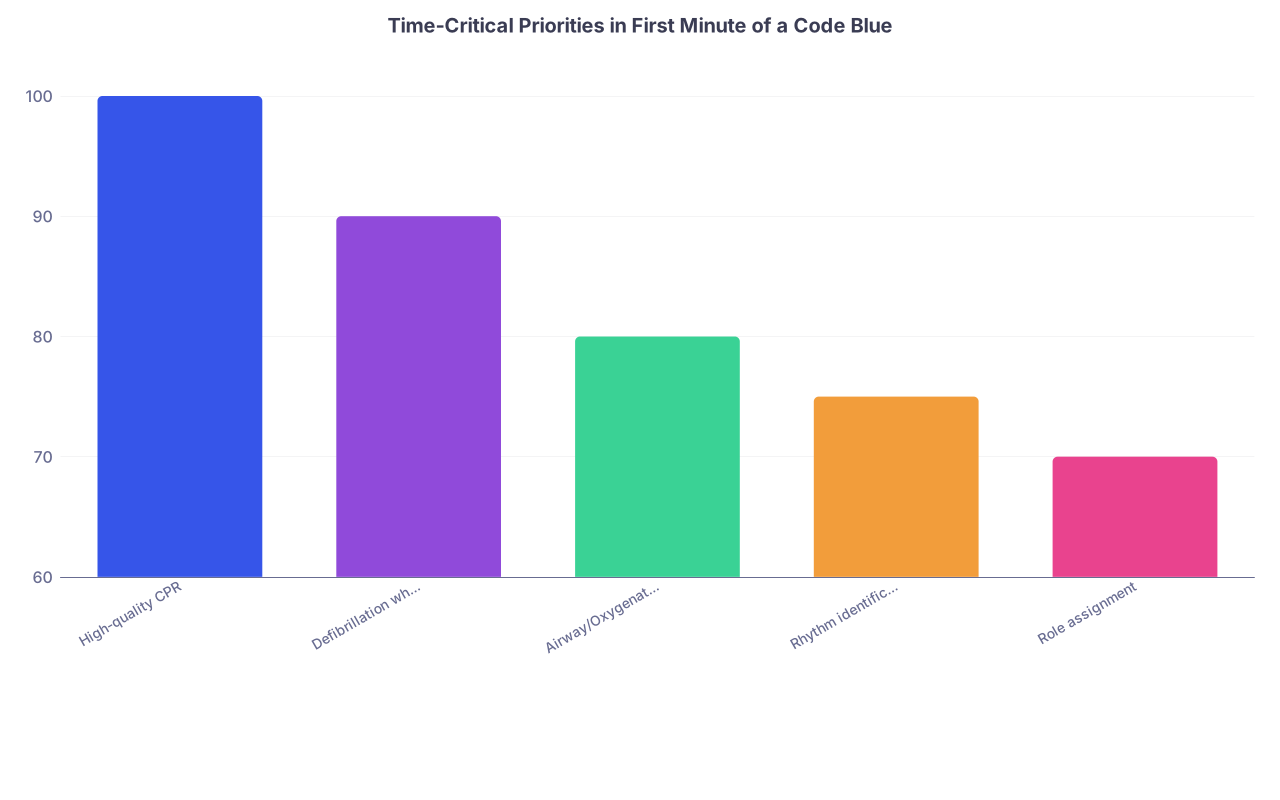
| Category | Value |
|---|---|
| High-quality CPR | 100 |
| Defibrillation when indicated | 90 |
| Airway/Oxygenation | 80 |
| Rhythm identification | 75 |
| Role assignment | 70 |
The leadership mistake I see over and over: the resident walks into the room and blends into the chaos. No introduction, no structure, no center of gravity.
You fix that in two sentences.
Walk in. Quickly scan ABCD (airway, breathing, circulation, device/defibrillator). Then say, loud and clean:
- “I am Dr [Name], I am leading this code.”
- “Everyone STOP talking except the compressor and me.”
You are not being rude. You are preventing diffusion of responsibility and missed information. The background chatter is literally dangerous.
Then, within those first 10 seconds, your job list is:
- Confirm there is CPR going on and that it looks like proper depth and rate.
- Confirm someone is activating the code team / overhead response (if not already).
- Establish your physical position.
I want you at the foot of the bed, eyes on:
- The chest (CPR quality).
- The monitor/defibrillator.
- The airway area.
- The room as a whole.
If you squeeze yourself onto the side of the bed near the chest, you will get trapped doing tasks. Foot of the bed = command station.
Now we start the stepwise role assignment.
The Core Team: A Fixed Mental Template
High‑performance code leadership means you run every code off the same mental template. You do not “wing it” based on who happens to be around.
Your core roles:
- Compressor
- Airway
- Monitor/Defibrillator
- Medication/Nurse Recorder (often split into two people, but combined if staffing is thin)
- Runner
- Family / Crowd Control (often a spare provider)
Then you, the Code Leader, doing nothing with your hands if you can avoid it.
Think of this like a trauma bay. Clear primary roles first. Everything else is optional.
Stepwise Role Assignment: Exact Phrasing and Order
This is where most residents fall apart. They use group requests and weak language:
- “Can someone get on the chest?”
- “Let’s get a nurse to push meds.”
- “We should probably hook up the defibrillator.”
Wrong energy. Wrong structure.
You assign roles in sequence, with direct address, and you point when possible.
Step 1: Lock In Continuous High‑Quality CPR
Before anything else, you guarantee compressions.
You:
“YOU in the blue scrubs, on the chest now, hard and fast. Call out every 30 compressions for breaths if we are bagging.”
If CPR is already happening but looks weak:
“You, on the chest now, switch with them. Hard and fast, 100–120, full recoil. I will tell you when to switch.”
Then you time‑box it:
“Compressor, you will go for 2 minutes. I will call when we switch.”
This sets the expectation you, not they, control the timing.
Step 2: Airway – One Person Owns It
Next, assign airway. Even if RT, anesthesia, or EM is on the way, someone owns airway right now.
You:
“YOU with the bag at the head of the bed, you are airway. Give two good breaths after every 30 compressions. Say ‘Breath’ out loud when you squeeze.”
If the patient is already intubated:
“You, at the head, manage the airway and confirm we have good chest rise and ETCO₂. Let me know the number out loud.”
If RT arrives:
“You are RT? Good. You are now primary airway. Take over from them on the bag. Tell me ETCO₂ and sats out loud every 30 seconds.”
Again, direct, personal assignment. No “someone”.
Step 3: Monitor/Defibrillator – This Is Its Own Job

Too many codes have the monitor/defibrillator being “sort of” managed by whoever is near it. That is how you get delays in shocks and wrong doses.
You:
“YOU by the monitor, you are monitor and defibrillator. Put on the pads, show me the rhythm, and do not charge or shock unless I say so.”
Then, after pads are on:
“Monitor, speak the rhythm out loud at each pulse check. You and I confirm it together.”
If there is already a telemetry tech in the room or an ICU nurse familiar with the monitor, they are your best pick. If not, anyone with basic defibrillator literacy is acceptable, but you clearly define the boundaries: they do not freelance shocks.
Step 4: Medications + Recorder – Protect Your Brain
If you want to fry your own cortex halfway through the code, try tracking every epinephrine time, amiodarone dose, rhythm change, and reversible cause yourself while also giving orders. That is how residents get lost and start repeating epi every minute.
You need someone whose primary job is meds + documentation.
You:
“YOU with the badge ‘RN [Name]’—you are meds and recording. Pull up the code narrator in the EMR or the paper sheet. You will push all medications only after I order them and say them back to me. You will also call out epi timing.”
Give them very concrete parameters:
“Tell me out loud when it has been 3 minutes since the last epi. Repeat every drug and dose before you push it.”
The verbal check‑back saves you from your own errors.
In an ideal world, you have:
- One nurse for meds/documentation.
- One for compressions.
- One “free” nurse to assist with IVs, drips, etc.
On nights, you may have fewer. Combine roles deliberately, but still name them:
“You are chest compressions. When we switch, you will become medications and recording. I will tell you exactly when.”
Step 5: Runner – The Invisible Lifeline
Everyone forgets this role. Then you waste 45 seconds mid‑code trying to find calcium, blood, ultrasound, or the crash cart key.
You:
“YOU by the door, you are runner. Your job is to stay at the edge of the room and fetch anything we need: extra IV access, meds from pharmacy, ultrasound, anesthesia, ICU attending. Do not leave without telling me where you are going.”
This person should not be involved in CPR, airway, or meds. Their entire value is speed and mobility.
Step 6: Family / Crowd Control – Protect The Space
You need one person to manage:
- Family presence / updates / removal if needed.
- Nonessential staff who wander into the room.
- Doorway noise and confusion.
Often this is a social worker, chaplain, off‑duty resident, or a spare nurse.
You:
“YOU at the back, you are family and crowd control. Keep nonessential people out. Speak with family if present, keep them updated or move them to a quiet area. Do not let anyone interrupt the compressor, airway, or meds nurse.”
This is not fluff. A chaotic door + frantic family directly degrades performance. I have seen compression pauses extended because someone is arguing with a visitor at the bedside.
Putting It Together: A 30‑Second Assignment Script
Let me give you a realistic script from the moment you walk in. Assume a typical ward code, patient pulseless on bed, one nurse doing CPR badly, chaos level medium.
You enter, plant at the foot:
“Everyone quiet except me and the compressor. I am Dr Smith, I am leading this code.
You on the chest—switch with them and start hard, fast compressions, I will tell you when to switch.
You at the head with the bag, you are airway—two breaths after every 30 compressions, say ‘Breath’ out loud.
You by the monitor, put on the pads now, you are monitor and defibrillator—show me the rhythm, do not shock without my order.
You with the meds tray, you are meds and recorder—open the code narrator, write everything down, repeat every medication and dose to me before you push.
You by the door, you are runner—get extra IV access, bring ultrasound to the door, and be ready to grab anything else we need. Tell me when you leave and when you come back.
Anyone not assigned a job, step back from the bed but stay in the room; I will assign more tasks.”
You can say all of that in under 30 seconds if you keep your voice firm and do not mumble. The first few times will feel forced. Later, it becomes muscle memory.
Dynamic Reassignment: Codes Are Not Static

| Step | Description |
|---|---|
| Step 1 | Initial Roles Assigned |
| Step 2 | Team Members Arrive |
| Step 3 | Upgrade Airway or Monitor Roles |
| Step 4 | Maintain Existing Roles |
| Step 5 | Leader Announces Change |
| Step 6 | Ongoing Reassessment |
| Step 7 | Switch Compressor, Reassign Runner |
| Step 8 | New Expertise? |
| Step 9 | Fatigue or Turnover? |
Real codes are living organisms. People come and go. Fatigue sets in. New expertise arrives.
Your job is to restructure intentionally instead of letting the team drift.
When Higher‑Level Help Arrives
Anesthesia walks in:
You:
“Anesthesia is here. You are now primary airway. Take over from RT. RT, stay to manage vent settings and ETCO₂. Airway, inform me when you are ready to intubate. We do not stop compressions for intubation unless I say so.”
Cardiology fellow appears in a VT/VF arrest:
“Cardiology is here. You are now my rhythm consultant. Stand next to the monitor. You and I confirm rhythm and next shock/med plan together. I am staying code leader.”
ICU attending rolls in:
“ICU is here. I will continue to run the ACLS algorithm. Please focus on post‑ROSC planning: pressors, targeted temperature management, possible cath lab. If you want to take over leadership, say so and we will switch clearly.”
Do not silently abdicate leadership. Verbally hand over if that is the plan:
“Team, Dr Patel will now lead this code. Dr Patel, do you accept leadership?”
Then shut up and shift to a technical role.
Fatigue and Rotation
Compressor fatigue is real, and residents routinely ignore it because they are busy thinking about H’s and T’s.
You bake this into your leadership:
- “We will rotate compressors every 2 minutes at rhythm check.”
- “Next compressor, be ready on this side of the bed. I will call you in.”
At every rhythm check:
“Stop. Rhythm check. [Look, decide]. Resume compressions—new compressor now.”
If your runner has been sprinting all over the hospital:
“You have been running for a while. You switch to recorder. Recorder, you move to runner. Tell me when you are swapped.”
Again, direct, explicit, and time‑bounded.
Communication Rules: How You Talk Under Fire
| Aspect | High-Performance Phrase | Low-Performance Phrase |
|---|---|---|
| Role assignment | "You in blue, on the chest now." | "Can someone start compressions?" |
| Medication order | "Epinephrine 1 mg IV push now, repeat back." | "Give some epi." |
| Defibrillation | "Charging to 200. Everyone clear on my count: 1, 2, 3, shock." | "Everybody clear! Shocking!" |
| Timing | "Switch compressor at the next rhythm check." | "We should probably switch soon." |
| Leadership clarity | "I am leading this code." | "Okay, we are all here, let's start." |
Bad communication kills roles. The structure I want you to burn into your brain:
- Use names or clear identifiers + eye contact.
- Use closed‑loop communication.
- Avoid multi‑part, vague requests.
Examples:
Instead of:
“Get calcium and maybe some bicarb too, I think pharmacy has it, someone go check.”
Say:
“Runner, go to pharmacy now and bring 2 amps calcium chloride and 2 amps sodium bicarbonate to this room. Tell me when you are back.”
Instead of letting meds silently happen:
You: “Meds, give epinephrine 1 mg IV push now.”
Meds nurse: “Epinephrine 1 mg IV push now.”
You: “Correct, push it.”
Meds nurse: “Epinephrine 1 mg IV is going in now.”
Closed loop. Every time.
When you correct, do it cleanly:
“Monitor, I heard you say asystole; look again—there is fine VF. Zoom in. Yes, that is VF. We are treating this as shockable.”
You correct the task, not the person. No sarcasm. No yelling.
Common Failure Patterns And How To Break Them
I will be blunt. These are the patterns I see in residents leading codes.
1. The “Hero‑Leader” Who Does Everything
They:
- Jump onto the chest.
- Push their own meds.
- Try to intubate while also calling out ACLS steps.
Outcome: terrible CPR, wrong med timing, chaos.
Fix: You physically step back from the bedside and refuse to do manual tasks unless the room is dangerously understaffed. Your job is cognitive bandwidth and orchestration.
2. The “Democracy” Code
Leader speaks softly, throws out suggestions, and lets the room collectively decide.
- “Should we shock here?”
- “Do you guys think we should give another epi?”
- “Anybody feel a pulse?”
Outcome: delays, disagreement, emotional exhaustion.
Fix: You are directive but not domineering. Solicit input at specific moments:
“At this rhythm check: any objections to shocking?”
“Cardiology, do you have a different plan than amiodarone here?”
But when action is needed, you decide and say it plainly.
3. The Role Creep
The meds nurse starts helping with compressions. The compressor is also trying to manage the monitor. The airway person keeps leaving to grab supplies.
Outcome: gaps in critical functions and nobody noticing.
Fix: You enforce role purity:
“Recorder, stay off the chest, your job is meds and documentation only. If we need another compressor, I will assign one.”
“You are airway. Do not leave the head of the bed without telling me and having someone take over.”
Yes, it sounds rigid. That is the point.
Integrating Teaching Without Breaking Performance
You are a resident; you are also supposed to teach. The mistake is trying to teach while the patient is dying.
The move is:
- Run a tight, structured code.
- Use micro‑teaching only when it does not delay care.
- Debrief after.
Micro‑teaching example that takes 5 seconds:
To a junior student watching compressions:
“See how the compressor is locking their elbows and using body weight. That is what you want. We will have you try that in the next simulation.”
Or while waiting for a rhythm check:
“To the intern: at the next pulse check, I want you to be the one who says ‘Stop, check rhythm, check pulse.’ Say it loud.”
But you do not derail the code for a lecture on H’s and T’s.
After the code (ROSC or not), you debrief roles explicitly:
- “Who knew what their role was right away?”
- “Did anyone feel they had two jobs at once?”
- “Did anyone feel like their role was unclear?”
This is where you teach the pattern so next time it runs smoother.
Practice Off The Battlefield
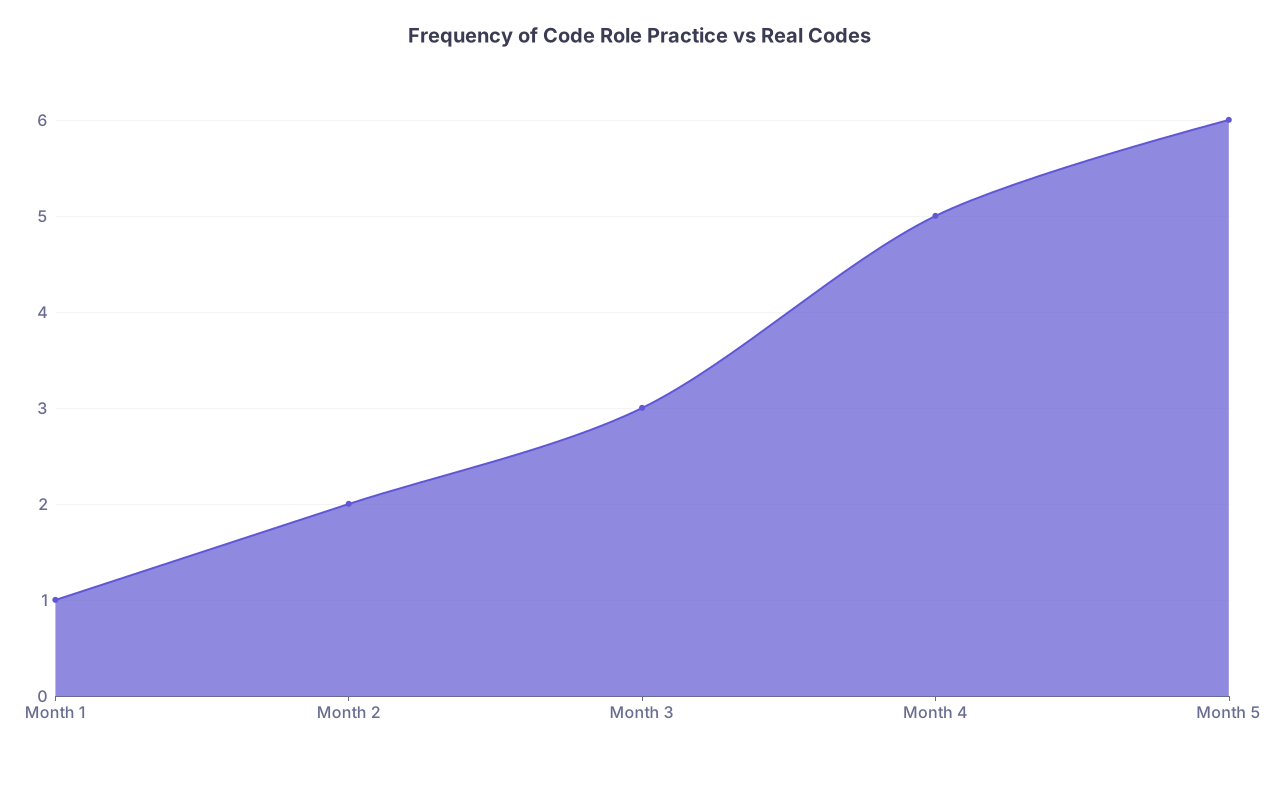
| Category | Value |
|---|---|
| Month 1 | 1 |
| Month 2 | 2 |
| Month 3 | 3 |
| Month 4 | 5 |
| Month 5 | 6 |
You will not build this skill in actual codes alone. There are not enough of them, and the stakes are too high.
You need deliberate reps:
- Sim lab: insist on being leader and practice the exact role‑assignment script.
- On the floor: run “micro‑drills” with your team on a quiet day.
Example: “On my signal, pretend this patient arrests. I will assign roles in 20 seconds. Go.”
Drill the language until it feels almost boring. Because in a real code, your adrenaline will blunt your vocabulary and you will regress to your training. If your training is vague, your leadership will be vague.
One simple habit: when you respond to a rapid response (not yet a full code), still assign light roles.
“Okay, this is not a full arrest yet, but just in case: you are airway if we decompensate. You are meds. You are runner. I am the leader.”
Then if the patient does crash, you are already in structure.
The Psychological Side: Staying Cold While Everyone Else Heats Up

Your voice and body language are not add‑ons. They are part of your resuscitation toolkit.
Characteristics of a high‑performance leader in a code:
- Volume: loud enough to be heard, not yelling.
- Pace: slightly slower than your heart rate wants. Pause for half a second after each instruction.
- Posture: shoulders open, both feet planted, not hovering over the chest.
- Face: neutral to slightly serious, not panicked, not blank.
If you feel yourself spiraling, anchor yourself with a script:
- “Check: we have compressions, airway, monitor, meds, runner. Yes.”
- “Next event: rhythm check at the 2‑minute mark, then decision: shock vs no shock.”
Your internal monologue should be what is the next decision point? not “Oh God this is going badly.”
You will have codes that are a mess despite perfect leadership. That is medicine. But your consistency in structure is what allows teams to perform at the top of their capabilities over time.
Putting It All Together
High‑performance code blue leadership is not magic. It is boringly systematic:
- Declare leadership and silence the noise.
- Assign roles in a fixed order with direct, specific language.
- Keep your hands off tasks; keep your brain on process.
- Reassign roles explicitly as expertise arrives or fatigue sets in.
- Debrief and drill until the script is automatic.
Next time the overhead pager shouts “Code blue, 7 West,” you are not walking into that room as a bystander who happens to be the senior resident. You are walking in as the only person in the building who has already decided how that room will be organized 30 seconds from now.
With this foundation of stepwise role assignment in place, you are ready to layer in the higher‑order work: advanced rhythm decision‑making, complex ethics in prolonged resuscitation, and leading post‑code debriefs that actually change behavior. That is the next level of leadership. And that comes after you prove you can run the room.


