

Peer coaching in residency is the most underused leadership tool in academic medicine. Everyone talks about “supportive culture” and “wellness”; almost nobody teaches residents how to actually coach each other through hard clinical and interpersonal cases.
Let me be very direct:
If your “peer coaching” is just venting in the call room, you are leaving a massive amount of growth, safety, and leadership development on the table.
What you need is a structured, repeatable framework that residents can use on a Tuesday night after a code went badly, after a disastrous family meeting, or when a co-resident is on the edge of burnout. And you need that framework to be simple enough that tired PGY-2s will actually use it at 2 a.m.
That is what I will lay out here.
Why Peer Coaching Matters More Than Another Wellness Lecture
There are three hard truths about residency that make peer coaching non‑optional:
- Most of the hardest moments never make it to a faculty mentor.
- Residents debrief with each other anyway, but usually with no structure.
- The people who see your blind spots most clearly are the ones on call with you.
I have watched this play out dozens of times:
- The intern who blew a sepsis case does not bring it to M&M. He brings it to the co-intern he trusts at 1 a.m.
- The resident who was steamrolled by a malignant attending does not email the PD. She decompresses with her senior on night float.
- The senior who snapped at a nurse and now feels ashamed does not schedule a professionalism coaching consult. He quietly asks his co-chief, “Did I screw that up?”
So the question is not whether peer coaching is happening. It is. The question is whether it is:
- Random, emotional, and sometimes counterproductive
- Or structured, psychologically safe, and growth-oriented
Right now, in most programs, it is the first.
To fix this, you need a framework that:
- Protects psychological safety
- Keeps you out of “I would have done X, Y, Z…” mode
- Pulls out learning points and action steps
- Works for clinical, interpersonal, and personal challenges
Let me give you that framework, then we will talk about how to use it in real residency scenarios.
The 4–Stage Peer Coaching Framework for Tough Cases
Think of this as a “micro debrief” model you can run in 15–30 minutes.
The four stages:
- Contain – Make it safe, slow the emotional hemorrhage
- Clarify – Build a clear, shared picture of what happened
- Coach – Shift from story to skill-building and options
- Commit – Lock in next steps and follow‑up
Residents do parts of this intuitively, but they skip steps or get lost in venting. The power is in keeping the order and keeping the roles clear.
I will walk through each stage, then show you how to run it as a reproducible “peer coaching session.”
Stage 1: Contain – Psychological Safety First, Analysis Later
If you rush into “what could you have done differently?” before the emotional temperature has dropped, you will get defensiveness, shame, or shutdown. Always start by containing.
The goals of containment:
- Signal that this space is nonjudgmental and confidential
- Acknowledge the emotional hit without marinating in it
- Stabilize enough to do useful thinking
Very practical phrases that work in real rooms:
- “You are safe here. Let us just walk through this as colleagues, not critics.”
- “You are not on trial. This is not M&M. This is just us trying to make sense of a hard case.”
- “Let us slow down. Start with what is hitting you the hardest right now.”
Three concrete moves in this stage:
Name the purpose explicitly.
“Let us use this as a quick coaching conversation, not just venting. I want you to walk out with at least one concrete thing you can try or think differently next time.”Set ground rules.
- Confidentiality
- Curiosity over judgment
- No retroactive heroics (“I would have totally done X”)
Normalize the experience.
Not with platitudes, but with grounded reality:
“Every PGY-2 I know has had a night like this,” or
“You are not the first person to feel steamrolled by that attending.”
Containment does not mean pretending everything was fine. It just means you do not let shame drive the conversation.
Stage 2: Clarify – Reconstruct the Case without the Noise
Once the emotional dust has settled a little, you move into Clarify. This is where most informal peer conversations either:
- Spiral into blame and speculation, or
- Get lost in irrelevant detail
Your job as the peer coach is to pull out the decision points and dynamics, not every lab value.
A simple structure that works extremely well:
Timeline first.
“Walk me through from the first moment you got involved to where things stand now. Short version, then we will zoom in.”Key inflection points.
“Pause. That sounds like a decision point. What were your options right there?”
“What information did you have at that moment, not what you know now?”Separate facts from story.
You will hear: “Nursing did not care,” or “The family was totally unreasonable.”
Ask: “What did they actually say or do that made you read it that way?”Surface constraints.
- “What else was going on that hour?”
- “Who was in the hospital? Who was not?”
- “What was your level of fatigue / page load?”
This is where your clinical brain and your systems brain kick in. You are not trying to re-run the entire case. You are trying to get to:
- What they saw
- What they did
- What shaped those choices
This is where cognitive biases and hidden assumptions usually show up if you listen carefully.
Stage 3: Coach – From Story to Skills
Here is where most residents screw it up.
The instinct is to launch into: “What I would have done is…” followed by a list of heroic interventions that ignore context, fatigue, and reality.
Good peer coaching does something different.
You organize the conversation around three lenses:
- Clinical reasoning and decision‑making
- Communication and conflict dynamics
- Self‑management (stress, emotion, identity)
You will not always hit all three, but you should at least check them.
Lens 1: Clinical Reasoning
Questions that actually move the needle:
- “At the time, what did you think was the most likely diagnosis or trajectory?”
- “What data would have changed your mind earlier?”
- “How did you prioritize among competing tasks / patients?”
- “Where do you think your mental model was off?”
You are watching for patterns:
- Anchoring on an early diagnosis
- Overtrusting a prior sign‑out narrative
- Underweighting vital sign trends
- Failing to escalate because “the attending will yell”
You are not re‑taking the test with the answer key. You are helping them see how their thinking process can be sharpened.
Lens 2: Communication and Conflict
This is where the hardest “tough cases” actually live: bad interactions with nurses, attendings, consultants, patients, families.
Examples:
- The neurosurgery consult who refused to see the patient
- The attending who humiliated the resident in front of the family
- The nurse who escalated straight to the PD without speaking to the resident
Useful questions:
- “How did you open the conversation?”
- “What exactly did you say when you asked for help / called the consult?”
- “Where do you think the interaction turned?”
- “If you could re‑record one sentence from that encounter, what would you change?”
And then: role‑play.
No one wants to do this. Do it anyway.
You: “I am going to be the neurosurgery resident. You call me again and ask for what you actually needed.”
Them: tries again, stumbles
You: “Better. Try adding: ‘I am worried this is time‑sensitive because…’ and set a clear expectation.”
You are building micro‑scripts they can actually use next time.
Lens 3: Self‑Management and Identity
Residency is not just about “What did you do clinically?” It is “Who did you feel like in that moment?”
Residents carry identity wounds from tough cases for years:
“I am the resident who missed that PE.”
“I am the one who lost it on that nurse.”
“I am the one who always cries in family meetings.”
You do not fix that by saying “You are fine.” You fix it by separating:
- The event
- The behavior
- The identity conclusion
Try:
- “What story are you telling yourself about what this means about you as a doctor?”
- “If your intern told you this same story, would you draw the same conclusion about them?”
- “What’s one alternative story that is also plausible and less brutal?”
You are not a therapist. But if you ignore this dimension, the learning never sticks because shame shuts it down.
Stage 4: Commit – Turn Insight into Action
Insight is useless without behavior change. This last stage is where peer coaching becomes leadership development instead of just catharsis.
You want them to walk away with:
- 1–3 specific actions they will take
- A timeframe
- A follow‑up touchpoint
Specific looks like:
- “Tomorrow I will email that attending to ask for a 10‑minute debrief, with 2 questions prepared.”
- “For the next three nights on call, I will force myself to explicitly say the worst‑case diagnosis out loud on any borderline patient.”
- “Next family meeting, I will open with this sentence we just practiced.”
Then you anchor the follow‑up:
- “Text me after that debrief and tell me how it went.”
- “Let us check in on this at the end of the week and see what you noticed doing it differently.”
If you skip Commit, the conversation feels good and then evaporates. This is where coaching becomes real.
How to Run a Peer Coaching Session in Real Time
Let me tie this together into something you can literally use on your next call night.
Imagine your co‑resident drops into the workroom at 11:30 p.m. after a failed code and says, “I think I killed that patient.”
You have 20–25 minutes between pages. How do you run this?
Step‑by‑Step Flow
Ask permission and frame it.
“This sounds rough. Do you want to just vent, or do you want to walk through it in a more coaching way so we can pull something out of it?”
If they say “just vent,” respect that. If they say “coaching,” proceed.Contain (3–5 minutes).
- Acknowledge the hit: “That is a brutal feeling. I have been there.”
- Ground rules: “This stays here. Not M&M, not evaluation.”
- Stabilize: “Let us slow it down and take it one piece at a time.”
Clarify (7–10 minutes).
- “Give me the short timeline first.”
- “Where do you feel it started to go wrong?”
- “At that exact moment, what were you seeing / thinking / juggling?”
Coach (7–10 minutes).
- Clinical: “What would future‑you want current‑you to notice earlier?”
- Communication: “How did you call the code? Any moments of miscommunication?”
- Self: “What story are you telling yourself about what this means about you?”
Commit (3–5 minutes).
- “What is one or two things you want to do differently next similar situation?”
- “Do you want to talk with the attending or chief about this in a structured way?”
- “I will check in with you after sign‑out tomorrow.”
You have just done a structured, 20‑minute peer coaching debrief that is light‑years beyond “That sucks, I have been there, want pizza?”
Common Tough Case Types and How Peer Coaching Adjusts
Not all tough cases are equal. A code debrief is not the same as a “my attending humiliated me” or “I am burned out and making mistakes” conversation. The basic 4‑stage framework still works, but you shift emphasis.

1. High‑stakes Clinical Event (Code, Rapid Response, ICU Deterioration)
Primary risks:
- Over‑pathologizing themselves (“I killed them”)
- Ignoring systems and supervision issues
- Getting stuck on a single missed detail
Emphasize:
- Clarify: timelines, decision points, supervision
- Coach: clinical reasoning and escalation thresholds
- Commit: concrete monitoring/escalation habits
You might also deliberately bring in system language: “A safe system would not depend on a single resident catching this.”
2. Interpersonal Conflict (Attending, Nurse, Consultant)
Primary risks:
- Black‑and‑white villain stories
- Learned helplessness (“This is just how that surgeon is”)
- Retaliation or passive aggression next time
Emphasize:
- Clarify: exact language used by both sides
- Coach: micro‑scripts, boundary‑setting, “I” statements
- Commit: one specific way to re‑approach that person or situation
Example micro‑script practice:
Resident: “Neurosurgery will just yell if I call again.”
You: “Try this: ‘I hear your concern about unnecessary consults. I am calling because X, Y, Z, and I am specifically worried about A. I need your help deciding whether this needs imaging tonight.’ Say it out loud.”
Then you role‑play the pushback and have them hold the line.
3. Chronic Overload and Burnout Behaviors
This one is trickier. The “tough case” might be:
- Snapping at staff
- Cutting corners on notes
- Avoiding complex patients
- Emotional numbing in family meetings
Here, the case is not one event; it is a pattern.
Emphasize:
- Contain: normalize burnout risk, avoid moralizing
- Clarify: What is actually happening? How often? At what times?
- Coach: focus on boundaries, micro‑recovery, realistic asks
- Commit: 1–2 tiny behavior experiments, not a wellness overhaul
Questions that cut through:
- “When are you most unlike the doctor you want to be?” (time of day, rotation, team)
- “If nothing changed in the system, what is the smallest thing in your control that might blunt this by 10 percent?”
And be honest when something exceeds peer scope: suicidal ideation, severe depression, substance use. Peer coaching is not a replacement for mental health care or formal remediation. Your job is to support and then escalate, not to treat.
Building a Micro‑Culture of Peer Coaching on Your Team
One resident using this framework is helpful. A team that uses this language consistently becomes a different environment entirely.
You do not need a two‑day retreat. You need a handful of specific habits.
Habit 1: Name It Explicitly
Use the word “coaching” out loud.
- “Do you want coaching on this, or just a listener?”
- “Can I coach you through that family meeting for 10 minutes?”
Labeling it changes the expectation: this will be structured, active, and oriented to growth, not just sympathy.
Habit 2: Anchor to Brief, Regular Touchpoints
Think 10–20 minutes, 1–2 times a week on a busy service, not hour‑long therapy sessions.
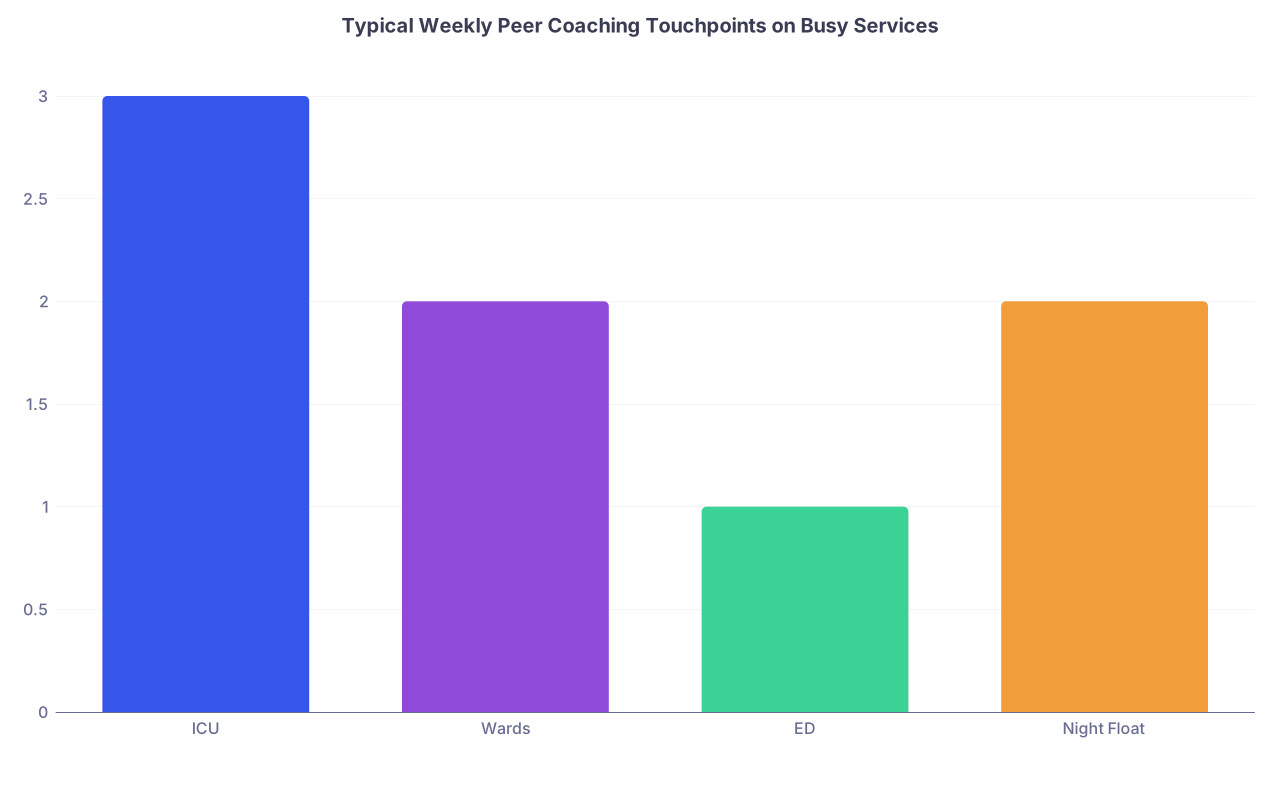
| Category | Value |
|---|---|
| ICU | 3 |
| Wards | 2 |
| ED | 1 |
| Night Float | 2 |
Use:
- Post‑call breakfasts
- End‑of‑shift huddles (“one hard thing, one learning point”)
- Unscheduled but intentional chats after very bad cases
Habit 3: Protect Boundaries
Peer coaching dies when:
- Residents weaponize what is shared (e.g., in gossip, evaluations)
- Attendings try to listen in or subtly supervise the conversation
- Sessions turn into complaining about specific colleagues with no action
Be explicit:
- “We are not bringing this case to group gossip.”
- “We are not writing this into anyone’s evaluation without their consent.”
- “If this needs to go to leadership, we will decide that together.”
Habit 4: Use Simple Shared Tools
A couple of quick tools that make this much easier:
| Tool | Use Case |
|---|---|
| 4-Stage Framework Card | Pocket reminder of Contain–Clarify–Coach–Commit |
| “Coaching vs Venting” Check | Quick question to set intention at start |
| Micro-Script Bank | Phrases for consultants, attendings, families |
| Debrief Trigger List | Which events auto-trigger a brief peer debrief |
You do not need a 20‑page manual. A half‑page one‑pager in residents’ phones is enough.
How This Ties Directly to Leadership in Medicine
Let me be blunt: leadership in medicine starts here, not in some future admin role.
If you can:
- Sit with a colleague in distress
- Ask sharp, clean questions instead of giving speeches
- Help them extract learning from failure
- Support them without rescuing or colluding
You are already functioning at a level above many formal “leaders” in academic centers.
Peer coaching in residency trains:
- Diagnostic clarity about human and system problems
- Communication precision in high‑stakes, emotional contexts
- Boundary‑setting between support and enablement
- Follow‑through and accountability with colleagues
These are exactly the muscles you will need as a chief, attending, PD, or CMO.

| Step | Description |
|---|---|
| Step 1 | Peer Coaching in Residency |
| Step 2 | Team Trust |
| Step 3 | Informal Leadership Role |
| Step 4 | Chief Resident or Lead Fellow |
| Step 5 | Attending Leadership Roles |
| Step 6 | Program or Hospital Leadership |
I have watched residents who took peer coaching seriously become the go‑to people on their teams for the “messy stuff”: difficult families, conflict with consultants, struggling interns. That reputation is leadership capital. Programs notice.
A Quick Word on What Peer Coaching Is Not
To keep this grounded and safe:
Peer coaching is not:
- Therapy
- A place to adjudicate serious professionalism violations
- A workaround to avoid formal reporting when safety is at risk
- A backdoor evaluation channel
If you uncover:
- Patient safety events that require reporting
- Harassment, discrimination, or abuse
- Self‑harm risk, severe impairment
You stop the coaching mode and say clearly:
- “This is beyond what we can hold as peers. I am with you, and we need to loop in X (chief, PD, mental health, GME). I will go with you if you want.”
Peer coaching is powerful. It is not unlimited.
Putting This Into Practice Tonight
You do not need institutional blessing to start. You need:
- One co‑resident you trust.
- One tough case that is still bothering one of you.
- Twenty minutes and the 4‑stage framework.
Try it. Literally:
- “Hey, can we run that last rapid response through a quick Contain–Clarify–Coach–Commit session? I want to see what we can pull out of it.”
It will feel slightly formal the first few times. Then it becomes how your team talks.

You will notice over weeks:
- Less chaotic venting, more directed processing
- Residents coming to you earlier, before burnout is catastrophic
- Sharper language around decision points, not just feelings
- A subtle but real sense: “We handle hard things together, on purpose”
That is leadership. Right there in the call room.
Key Takeaways
- Use structure, not just sympathy. Contain–Clarify–Coach–Commit turns random venting into actual growth after tough cases.
- Aim at skills, not self‑worth. Focus on clinical reasoning, communication behaviors, and small next actions, while challenging harsh identity stories.
- Practice as a team habit. Make brief, intentional peer coaching a normal part of residency life, and you are already building the next generation of clinical leaders.


