

The way most residents run M&M is weak. Too vague, too defensive, and too focused on “what happened” instead of “what we’re going to do differently next week.”
You want to run morbidity and mortality like a chief? Then you need two things people almost never get taught: a hard structure and specific scripts. Not platitudes. Actual phrases you can use when an attending is dodging, a co-resident is about to cry, or the room starts sliding toward blame and shame.
Let me break this down specifically.
What M&M Is Actually For (And What It Is Not)
Morbidity and mortality is not a public shaming ritual and it is not a storytelling hour.
Done correctly, M&M serves four purposes:
- Identify care failures and near-misses.
- Extract system-level and team-level lessons.
- Commit to concrete, testable changes.
- Reinforce a culture where people can admit mistakes without being destroyed.
Anything that does not serve those four purposes is noise.
The fastest way to lose control of an M&M is to let it become:
- A blame-fest: “Who ordered that?” “Which intern was on nights?”
- A retrospective hero narrative: “Then I came on service and fixed everything.”
- A vague educational talk: a 40-slide lecture on the disease with 2 slides on the actual case.
Your job as chief is to defend the purpose of the conference. That means you need a predictable spine to the session and a few lines you can lean on when things start to drift.
The Core Structure: A Repeatable Framework
You should run M&M with the same basic skeleton every time. People relax when they know the rules. They perform better too.
Here is a simple, powerful structure that works in most departments:
- Framing and ground rules (2–3 minutes)
- Case presentation – factual and lean (8–10 minutes)
- Timeline and key decision points (5 minutes)
- Analysis by domain (15–20 minutes)
- System fixes and commitments (10 minutes)
- Close-out with follow-up loop (3–5 minutes)

| Step | Description |
|---|---|
| Step 1 | Open and Ground Rules |
| Step 2 | Case Presentation |
| Step 3 | Timeline and Decisions |
| Step 4 | Analysis by Domain |
| Step 5 | System Fixes and Commitments |
| Step 6 | Close and Follow Up |
Now I will walk through each piece and give you the language.
Step 1: Opening the Room Like a Chief
The opening 2–3 minutes decide the tone. If you start soft and apologetic, the conference will drift. If you start like an execution, people will shut down.
You want calm, serious, psychologically safe, but not indulgent.
Your goals:
- Reaffirm purpose: learning and improvement.
- Explicitly reject blame and humiliation.
- Signal that emotions are expected but the focus is action.
- Clarify process: what will happen in the next 50–60 minutes.
Here is a script that works:
“Alright, let’s get started. Today is our morbidity and mortality conference. The goal here is simple: we review adverse outcomes and near-misses so we can improve our care as a system and as a team.
This is not about blaming individuals. Every person in this room has made or will make errors; that is the reality of clinical work. What matters is whether we are honest about them and whether we change what we do next week on the wards and in the OR.
So, ground rules:
We speak about decisions and systems, not personalities.
We assume good intent, but we do not hide behind it.
We keep patient identifiers out of the discussion.
We focus on concrete changes, not abstract regrets.”
If you are at a program with a more fragile culture, add one more:
“If at any point the discussion feels like it is getting personal or unproductive, I will pause and redirect. That is intentional.”
That last line tells people you own the room. And you are willing to use that authority.
Step 2: Case Presentation – Clean, Lean, and Non-Defensive
Most M&M presentations are bloated. You do not need 35 labs and a five-slide background on the disease unless the epidemiology is central to the error.
Teach your presenters this format:
- One-line summary
- Relevant background and comorbidities
- Initial presentation – key data only
- Hospital course in time blocks
- The adverse outcome (morbidity or mortality)
- Brief “what made this a case for M&M”
One-Line Summary Script
“A 64-year-old man with CAD, CKD stage 3, and insulin-dependent diabetes presented with shortness of breath and was admitted for presumed pneumonia, later complicated by septic shock and cardiac arrest on hospital day 3.”
Not “This is Mr. X, lovely gentleman, married, six kids.” Save the narrative for palliative care consults, not M&M.
Time-Blocked Course
Divide the course into clear segments:
- ED presentation and first 6 hours
- First 24 hours on the floor/ICU
- Subsequent days leading up to the event
- The event itself
This makes it much easier to identify decision points.
You, as chief, should enforce a time limit:
“Thanks, Dr. Patel. Let’s keep the formal presentation to 8–10 minutes so we have enough time for analysis and systems changes. I may cut in if we are getting into details that do not affect decision-making.”
You will need to actually cut people off a few times for them to believe you.
Step 3: Timeline and Decision Points – The Spine of the Discussion
After the narrative case, you need a visual. A simple timeline.
Time on the x-axis. Major decisions, tests, interventions, and handoffs plotted along it.

You are not just reciting events. You are highlighting “moments of choice.”
Examples of decision points:
- Admission decision: ICU vs floor.
- Antibiotic choice and timing.
- Code status conversation.
- Handoff episodes (ED to floor, day to night).
- Escalation or failure to escalate.
A simple way to introduce it:
“I am going to put up a timeline here. The goal is to mark where we had real choices to make – where a different decision might have changed the trajectory.
I want us to identify those points first, before we debate whether they were ‘right’ or ‘wrong’ at the time.”
Then you walk left to right and mark decision nodes.
That separation matters. It keeps the group from rewriting history with hindsight bias. First: where were the decisions? Then: were they reasonable with the information available?
Step 4: Analysis by Domain – Stop the Free-For-All
This is where conferences usually fall apart. Without structure, you get random comments jumping from ventilator settings to social work to bias to “back when I trained…”
You prevent that by breaking analysis into domains and running them one by one.
Typical domains:
- Clinical reasoning and diagnosis
- Communication and handoffs
- Team structure and supervision
- Protocols and guidelines
- System and logistics
| Domain | Anchor Question |
|---|---|
| Clinical reasoning | Did we have a coherent working dx? |
| Communication & handoffs | Did critical info follow the patient? |
| Team structure & supervision | Was the right person involved early? |
| Protocols & guidelines | Did our existing pathways support good care? |
| System & logistics | Did the environment make the right thing easy? |
You move through each explicitly. Sample script:
“Let’s start with clinical reasoning. We will focus on the thinking, not the logistics, for the next few minutes.
Question one: At each major time point on this timeline, what did the team believe was happening? And was that belief anchored to or drifting away from the data?”
Then shut up and let the team walk through it.
Handling Hindsight Bias: A Specific Line
Any time someone says “We should have known X because Y result came back later,” cut in with:
“Let us freeze the tape before we knew the CT report / blood culture / troponin. With the data that was actually available at 02:00, what were the reasonable options?”
You will use that line a lot. It is one of the best tools a chief can have.
Communication and Handoffs
You push for specifics, not “we need better communication.”
Try:
“Walk me through the handoff from ED to floor.
Who was talking to whom, and by what channel – in-person, phone, or written note?
What three pieces of information were most critical to convey, and did they actually make it across?”
That level of detail exposes the real failure: “It was in the note” almost never equals “it was communicated.”
Supervision and Escalation
This is where hierarchy and culture show up. Residents often under-call attendings because they are afraid of being judged “needy”. You can normalize early escalation.
Use something like:
“Looking at this 8-hour window, were there moments where the team felt uneasy but did not escalate? If so, what were the barriers – internal or external – to picking up the phone?”
If the room goes quiet, that is your sign. Residents are doing the mental calculus: “At 3 AM my attending always sounds annoyed when I call.”
You do not have to name individuals. But you do have to name patterns.
You can say:
“I am hearing a theme across several cases this year: overnight teams delaying escalation because they expect pushback. That is a systems and culture problem, not an individual failing. We will address that outside this room as well.”
You just told your attendings they are part of the problem, without making it a brawl. That is chief-level work.
Step 5: Converting Analysis Into Concrete Changes
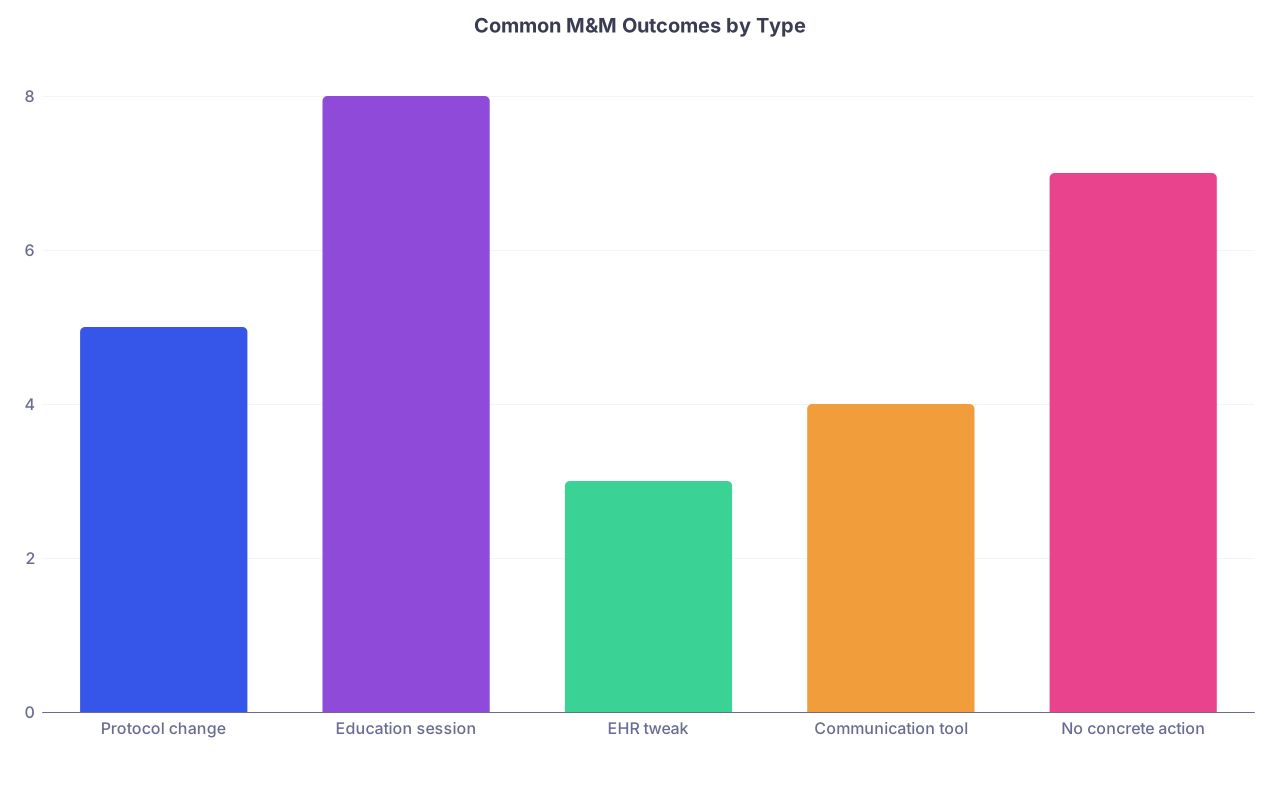
If your M&M does not regularly produce specific changes, you are wasting everyone’s time.
Analysis without operational follow-up is just intellectual guilt therapy.
You want, by the end of the conference, 2–5 concrete items with:
- A defined owner (person or committee).
- A clear deliverable.
- A timeline.
| Category | Value |
|---|---|
| Protocol change | 5 |
| Education session | 8 |
| EHR tweak | 3 |
| Communication tool | 4 |
| No concrete action | 7 |
Examples of good, specific outputs:
- “Create a one-click sepsis order set for ward patients that includes blood cultures, lactate, broad-spectrum antibiotics, and fluid bolus. Owner: Dr. Singh (QI chief). Draft for review by next M&M.”
- “Standardize ED-to-ICU verbal handoffs to include code status, goals of care, and two explicit ‘watch items.’ Owner: ICU APN group. Pilot on night shift for 2 weeks.”
- “Build an auto-page rule for lactate > 4 in admitted patients to the primary resident and charge nurse. Owner: Informatics liaison. Spec by end of month.”
Notice what is not on that list: “We need more education.” That is a cop-out unless tied to a defined session and audience.
Your script to force specificity:
“Let us stop and translate what we have discussed into actual changes. For this case, we are not going to fix every problem in the hospital. We will pick two to four specific things we will try in the next 30–60 days.
For each one, I want: what exactly changes at the bedside, who owns making it happen, and when will we know if it is in place.”
Then you write them down on the slide or whiteboard in front of everyone. Names included.
Residents pay attention when they see actual follow-through. Otherwise they tune out and treat M&M as a ritual of collective shame.
Step 6: Closing the Loop – Follow-Up as a Habit
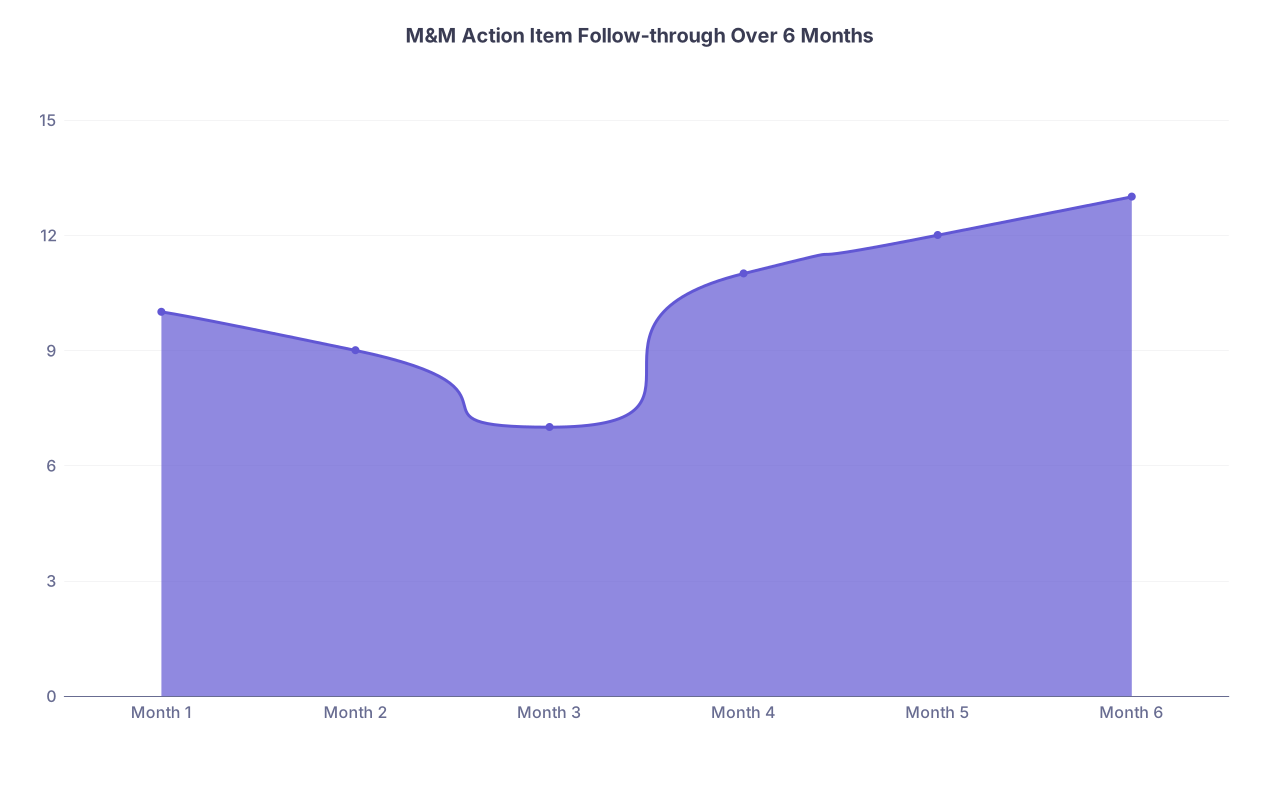
Here is where nearly every program fails: they never come back to the “action items.”
You want to be the chief who reliably closes loops. That builds massive credibility.
Simple habit: Start each M&M with a 3–5 minute “last month’s action items” segment.
| Category | Value |
|---|---|
| Month 1 | 10 |
| Month 2 | 9 |
| Month 3 | 7 |
| Month 4 | 11 |
| Month 5 | 12 |
| Month 6 | 13 |
Script:
“Before we start today’s case, quick follow-up on the changes we committed to last month.
- Sepsis order set for ward patients – Dr. Singh, can you give us a 60-second update on implementation status?
- ED-to-ICU handoff script – ICU APNs, did the 2-week night shift pilot happen, and what did you learn?
- Auto-page rule for lactate – Informatics, is that live, and have there been any unintended consequences?”
No rambling. No 10-minute QI talks. Just: did we do what we said, and what did we learn?
If nothing happened, say:
“None of these three items have moved since last month. That is on leadership, not the residents. We will re-commit and I will personally follow up with the relevant committees.”
You just modeled accountability. People notice.
Scripts for Tough Moments (Where Chiefs Usually Freeze)
You can learn structure from a slide deck. What they never teach you are the sentences you need when things get uncomfortable.
Here are the moments where I have seen junior chiefs get crushed, and the language that helps.
1. The Attending Becomes Defensive
Classic scenario: An attending feels their decision-making is being criticized and responds with, “Well, it is easy to say that now, but at the time…”
You do not let the dynamic turn into senior-attending versus PGY-2.
Use:
“You are absolutely right that our goal is not to judge you with information we did not have at the time. At the same time, the residents here are trying to understand the reasoning process so they can learn how to approach similar situations.
Can you walk us through, step by step, what you were weighing in that moment, and what tipped the scale?”
Respectful, but pulls them back into analysis, not ego defense.
If they keep pushing back or minimizing:
“I want to be clear this is not about assigning fault. It is about examining whether our current practice patterns give us the best chance of avoiding this outcome in the future. That includes how we, as attendings, supervise and respond.”
You used “we” and “as attendings” intentionally. You just put yourself with them, not with the residents, which paradoxically protects the trainees.
2. A Resident Is On the Verge of Tears
Sometimes the presenting resident is also the one who missed something. Or they feel that way, even if it is not fair. Their voice cracks, they shrink into themselves.
Your job is to protect them without derailing the session.
Line to use in the moment:
“I want to pause for a second. Dr. Lee, you are doing exactly what we ask of our residents: presenting a hard case honestly. The outcome here is heavy, and you were close to it.
Let me remind everyone: our focus is on systems and decisions, not on judging the worth of any individual clinician. If at any point you need to step out for a moment, that is entirely fine – just signal me.”
Then move back to the structure. Do not make it a therapy session. But you have acknowledged their humanity and the room will follow your lead.
Later, outside the conference, you check in privately.
3. The Discussion Becomes a Blame Storm
Someone starts: “Well, if the ED resident had just called earlier…” and another person adds, “Nights never…” You can feel the room tilt toward tribal warfare.
Cut it off early, not once it has escalated.
“I am hearing this drift toward ‘if only person X had done Y’ territory. Let me pull us back.
Our question is not ‘who dropped the ball,’ but ‘where did our system rely on a single person never having a bad night?’ Because that is not a safe system.
So instead of ‘ED should have,’ let us rephrase: how could we design the process so that even if the ED is slammed, critical information still reaches the admitting team reliably?”
Force the language shift from individuals to processes. Use “we” and “our system” relentlessly.
4. The Senior Attending Monologues and Eats the Clock
There is always one. Likes the sound of their own voice. Starts a five-minute anecdote about how “in 1998 we had a similar case…”
You cannot let that run your conference.
Wait for a natural breath, then:
“I am going to jump in to protect our time a bit, because I want to make sure we also hear from the current residents who were directly involved.
Can we distill that to one key takeaway you would like people to remember next week on rounds?”
You just cut them off, but gave them respect and a face-saving way to land the plane.
You will only have to do this a few times before people learn you are serious about structure.
Designing the Slides and Visuals So They Work For You
Your slide deck is not a thesis. It is scaffolding for your discussion.
Practical tips most people ignore:
- One-slide case summary (no more than 6–7 bullets).
- One-slide timeline with 4–8 key events.
- One-slide for each domain (diagnosis, communication, etc.) with 3–4 guiding questions.
- Final slide: “Concrete changes we are committing to today,” with an empty list you fill in live.
Avoid:
- Dense text blocks.
- Reading slides verbatim.
- Fancy animations.
The more people have to squint at the screen, the less they are thinking.
Pre-Game and Post-Game: What a Real Chief Does Behind the Scenes
You do not walk into M&M cold. Chiefs who do that get blindsided.
Before the Conference
- Meet with the presenting resident 3–5 days before.
Go through the case, help them trim to key points, and rehearse. - Talk to the primary attending if the case is politically hot.
Give them a heads-up: “The case is being presented; our goal is systems learning, not blame.” - Clarify with your PD or QI chair what changes are already in motion.
Nothing kills credibility like “We should create X protocol” when it already exists.
After the Conference
- Send a one-page summary to key stakeholders: 1–2 lines on the case, bullet points with agreed changes and owners.
- Check in with any resident who was particularly exposed during discussion.
- Update your “M&M action item” tracker (even a basic spreadsheet is fine).
You are building institutional memory. Programs with strong M&M culture can tell you exactly what changed after which cases. Programs with weak culture hand-wave and say “We talk about these things.”
Special Situations: Sentinel Events, Death of a Young Patient, or Legal Fog
Some cases are different. You know it walking in. The patient was young. The outcome was catastrophic. Legal or risk management is involved.
You still run M&M. But with tighter control.
- Coordinate with risk management and PD beforehand.
You want alignment on what can be discussed openly. - Be ultra-clear on framing: learning and patient safety, not adjudicating liability.
- Shorten open-floor discussion if emotions are too raw and move some processing to smaller debriefs.
One line that helps protect the space:
“We are not here to pre-try a lawsuit or assign legal responsibility. We are here in our internal, confidential quality space to figure out what, as clinicians and as a system, we can do differently to protect future patients.”
Residents need to hear that explicitly. They are afraid of being thrown under the bus.
The Cultural Play: What You Are Really Building
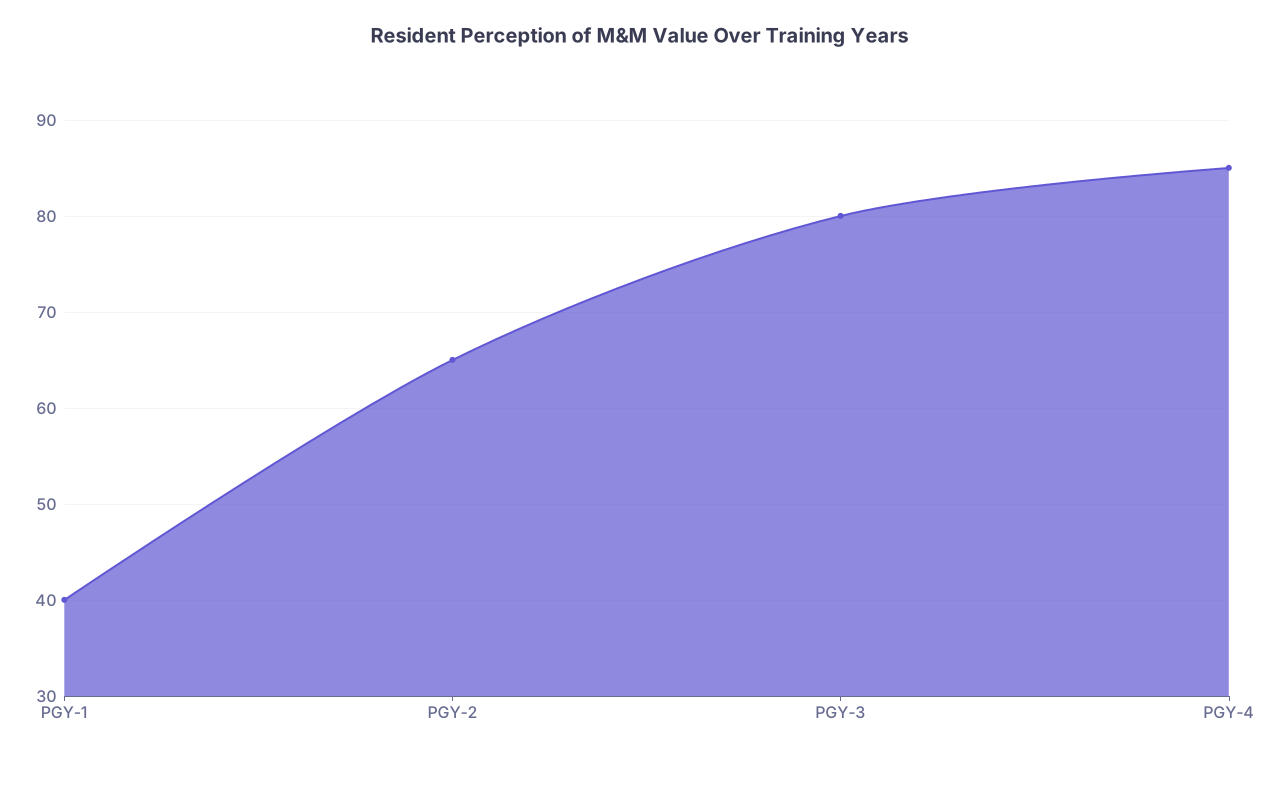
If you run M&M well for a year as chief, you change your program’s culture more than any single curriculum can.
Residents learn:
- It is possible to discuss errors without being destroyed.
- Leaders admit their own fallibility.
- System fixes are real, not theoretical.
- Speaking up about discomfort is valued, not punished.
Attendings learn (slowly):
- Residents are watching how they respond to scrutiny.
- Defensive posturing looks bad in a well-run room.
- Their authority does not exempt their decisions from analysis.
| Category | Value |
|---|---|
| PGY-1 | 40 |
| PGY-2 | 65 |
| PGY-3 | 80 |
| PGY-4 | 85 |
This is leadership. Not the “I made the schedule” kind. The “I changed how my peers think about mistakes” kind.
You will not get credit on your CV for that. But people will remember.
Key Takeaways
- M&M needs a rigid backbone: consistent opening, lean case presentation, explicit timelines and decision points, domain-based analysis, and concrete action items with owners and deadlines.
- Scripts matter. Have actual phrases ready for defensiveness, tears, blame storms, and attending monologues so you can protect the room and the purpose.
- Your follow-through – opening each session with updates on prior action items – is what separates a performative M&M from a real engine for culture and system change.


