

Most residents do not have a clinical problem on cross-cover. They have a systems problem and a prioritization problem.
Let me be blunt: if your approach to cross-cover is “answer pages in order and be nice,” you are going to get buried, miss important deterioration, and feel like a failure. Not because you are a bad doctor. Because you are using no real algorithm.
You need explicit triage rules, scripted decision trees, and a mental “command-center” model. This is leadership in medicine at its grittiest: alone, at night, with thirty active tasks and sixty people assuming you know exactly what to do next.
Let me break this down specifically.
The Reality of Cross-Cover: You Are Running an ED Without a Waiting Room
Cross-cover is emergency medicine without the luxury of a triage nurse and a waiting room. Every “chief complaint” comes directly to you, filtered poorly through whoever dialed the pager.
On a typical night on a busy medicine service, I have seen this multiple times:
- 30–60 cross-cover patients
- 1–2 interns also covering (if you are lucky)
- 40–80 pages between 5 pm and 7 am
And the distribution of urgency is brutal. A rough pattern:
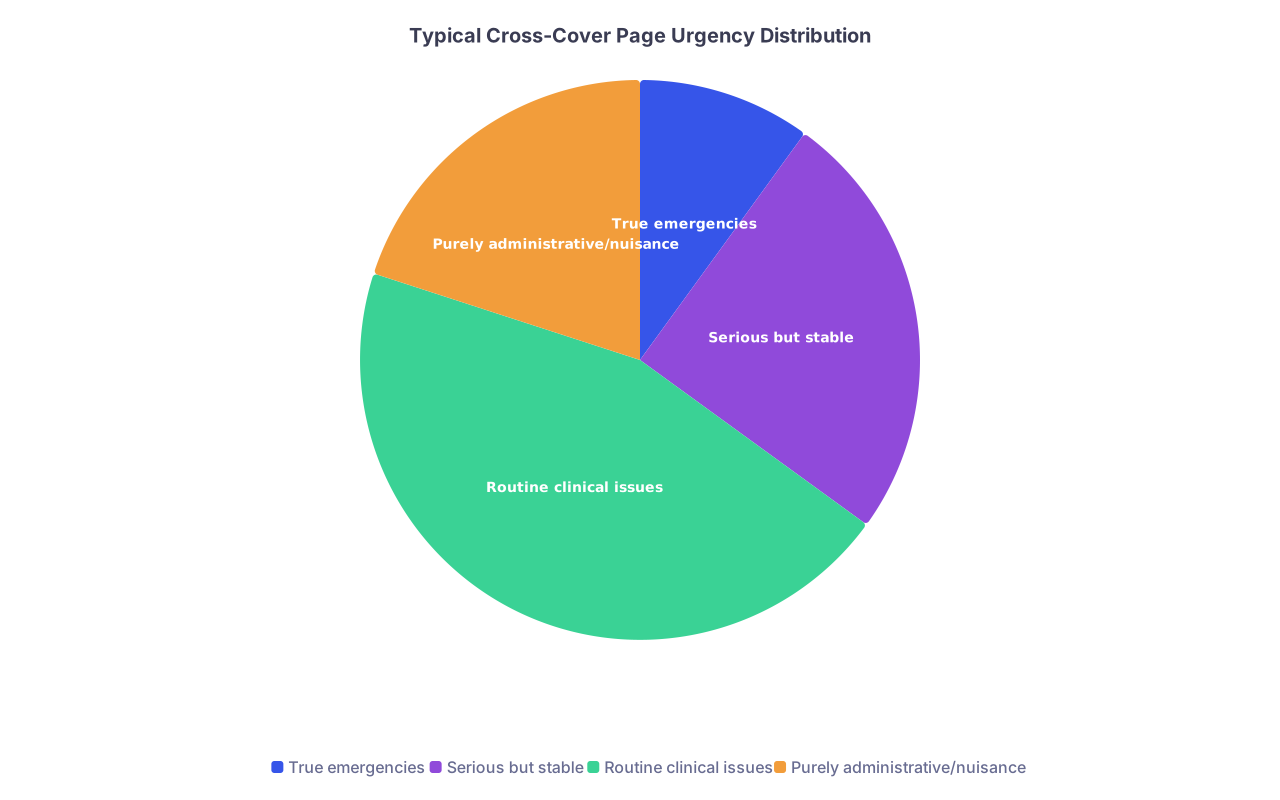
| Category | Value |
|---|---|
| True emergencies | 10 |
| Serious but stable | 25 |
| Routine clinical issues | 45 |
| Purely administrative/nuisance | 20 |
So if you treat every page as equal, you are wasting at least half your cognitive bandwidth on low-value work while high-risk patients quietly deteriorate.
Leadership here means two things:
- You set the rules for what gets your attention first.
- You enforce those rules consistently, even when people are annoyed.
You need a triage algorithm that can live in your head at 03:00.
First Principle: A Hard Priority Hierarchy (No Exceptions)
You cannot multitask 6 cross-cover crises. You need a rigid, default ranking system. Mine, which works across medicine, surgery, and subspecialties with small tweaks, looks like this:
- Airway / Breathing / Circulation / LOC changes
- “Something is wrong” vital sign or nurse gestalt
- Acute mental status / neuro change
- Uncontrolled pain, bleeding, or immediate safety risk
- New fever / sepsis signal / lab criticals
- Urgent but not emergent “fixable” issues (insulin, BP meds, acute retention)
- Order clarifications / med rec / routine labs / dispo administrative
It is not negotiable that #1–3 jump the line.
So when three pages hit simultaneously, you do not go by who paged first. You do this:
- Categorize each page into 1–7
- Tackle the lowest number first
- Defer or batch #6–7 aggressively
That is the spine of your triage algorithm. Everything else hangs on it.
The 3-Step Triage Script: Sort → Stabilize → Schedule
Think of every page as going through the same 3 filters:
- SORT – What is the level of risk?
- STABILIZE – What needs to happen right now to make this safer?
- SCHEDULE – When and how will the rest happen?
You can apply this in under 60 seconds per page once you have practiced it. Here is how it actually looks on call.
Step 1: SORT – A 60-Second Triage Interview That Works
The most common cross-cover failure is this: answering the page, hearing “patient is short of breath,” and immediately sprinting to the bedside without clarifying severity or context. Five minutes later you discover the sats are 96% on 2 L and the nurse mainly wanted to ask if you can restart home inhalers.
The phone is your first diagnostic tool. Use it well.
For every page, you run a standard triage script. I suggest something like this, pretty much verbatim:
- “Give me the MRN and room.”
- “What is the main concern in one sentence?”
- “What are the last vitals? Any changes from baseline?”
- “What is the oxygen requirement now vs baseline?”
- “Is the patient in distress or looking different to you?”
- “What have you already tried, if anything?”
You are listening for three things:
- Signs that this is unstable (category 1–3)
- Evidence that simple orders could help before you arrive
- Whether this can be batched or delayed safely
Here is the mental triage color code you should be assigning in real time:
| Color | Category Focus | Typical Response Time |
|---|---|---|
| Red | ABC issues, severe vitals, neuro crash | Immediate, drop all |
| Orange | Concerning change, not crashing | 5–15 minutes |
| Yellow | Needs in-person eval, stable | 30–90 minutes |
| Green | Orders/clarifications, no eval needed | Batch within 1–2 hrs |
You should literally say to yourself: “This is red / orange / yellow / green.” It forces prioritization.
Example:
Nurse: “HR just jumped to 150s, BP 90/50, patient diaphoretic.”
→ Red. Go now. Ask for a quick EKG and repeat BP if they can do it while you walk.Nurse: “Patient is ‘more short of breath’ but sats 94% on baseline 2 L.”
→ Orange or yellow. Clarify: is the work of breathing increased? Tachypneic? If minimal, you have a bit of time but still go.Nurse: “Patient wants sleep meds, same as home.”
→ Green. Batch for later.
If you are not assigning a color mentally, you are winging it.
Step 2: STABILIZE – Default Sequences for Common Cross-Cover Crises
Here is where most residents waste time: reinventing the wheel for every urgent scenario. You should have pre-built mental protocols for the 6–8 scenarios that cause 80% of your real overnight stress.
I will walk through the high-yield ones with “phone-first” and “at-bedside” algorithms.
1. Hypotension / Concern for Shock
Phone triage:
- Get: vitals trend, meds given recently (diuretics, antihypertensives), fluids last 12–24h, urine output, baseline BP.
- Ask: “Is the patient mentating normally? Any chest pain, dyspnea, new bleeding?”
On the phone, before you arrive (if red):
- Ask nurse to:
- Recheck BP manually (if automatic looks off)
- Put patient flat, legs up if tolerated
- Get a rapid fingerstick glucose
At bedside, you run a fixed sequence:
- Reassess ABCs, mental status.
- Look at monitor yourself – rhythm, HR, BP, O2.
- Quick exam: lungs, JVP/volume status, abdomen, extremities for cold/clammy, lines for bleeding.
- Check last labs, lactate if appropriate.
- Give a bolus if volume-depleted (500–1000 mL crystalloid) unless cardiogenic concerns dominate.
- If MAP still low (e.g., <65) and patient sick:
- Call senior / ICU early.
- Start thinking: infection? bleed? cardiogenic? obstructive?
Crucial leadership move: you call for help early and clearly. “I have a hypotensive patient, MAP in the 50s after a bolus, mentation drifting. I need you to come see with me and likely talk to ICU.”
Do not negotiate with yourself about this.
2. Acute Desaturation
Phone script:
- “Current O2 sat and device? Baseline? Respiratory rate? Is the patient in distress?”
- “Any new chest pain, cough, wheeze, froth, stridor, or altered mental status?”
If sats < 90% or significant work of breathing:
- Tell nurse:
- Increase O2 within safe limits of your service policy
- Sit patient up
- Put them on continuous pulse ox if not already
- Get a set of STAT vitals
At bedside, run this fixed pathway:
- Look at patient before monitor. Work of breathing? Can they speak in full sentences? Accessory muscle use?
- Check airway patency quickly (secretions, stridor).
- Listen: focal crackles vs diffuse vs wheeze vs almost nothing (PE/ARDS).
- Check legs for DVT signs if PE in differential.
- CXR and ABG/VBG if needed.
- If unstable / impending failure:
- Call rapid response / ICU. You are not managing this alone.
- Position, high-flow, and/or early BiPAP/CPAP depending on etiology and rules.
Again, the leadership behavior here is fast recognition and decisive escalation, not heroics.
3. Acute Mental Status Change
This one kills people if you are slow.
Phone triage:
- “What exactly changed and when?”
- “Last known normal? Vitals? Fingerstick glucose?”
- “Did they receive opioids, sedatives, any new meds recently?”
On the phone:
- Ask for a fingerstick glucose now if not done.
- Ask for a quick neuro check (face symmetry? moving all limbs? speech).
At bedside, you think in broad buckets:
- Stroke
- Hypoglycemia / metabolic
- Sepsis
- Medication / intoxication
- Structural (bleed, seizure, tumor)
Your sequence:
- ABCs. If airway is not protected, you are in “red” territory → call rapid.
- Repeat neuro exam. Document clearly (NIHSS if you are on a neuro-aware service).
- Check pupils, motor, sensory, cerebellar if possible.
- Review meds, vitals, I/O, recent labs.
- If stroke suspicion and within window → stroke team immediately.
- Order CT head noncontrast stat, labs including glucose, electrolytes, ammonia if hepatic concerns.
Leadership: you do not get paralyzed by the differential. You standardize your first 10 minutes.
4. “Something is off” – Trust the Nurse
The most underrated category. The experienced night nurse calling at 2 am just saying, “I do not like how this patient looks,” deserves respect.
Your algorithm is simple:
- Treat as at least orange.
- Go see the patient within 10–15 minutes unless you are in the middle of a red case.
- When in doubt, order a baseline panel: CBC, BMP, lactate if septic concern, CXR, EKG, maybe troponin.
I have seen more early sepsis and impending arrests caught because one nurse “just had a bad feeling” than because of a perfect differential diagnosis from the cross-cover resident.
Your job as leader is to validate that and act.
Step 3: SCHEDULE – How to Survive the Volume Without Drowning
After you have sorted and stabilized, you still have 20–40 other pages and to-do items. This is where most residents lose control of the night.
You need an explicit task management system, not a scrap of paper with random words.
Build a Real-Time Command List
You should have a single list for the night divided into three columns or sections:
- NOW (red/orange)
- SOON (yellow)
- LATER/BATCH (green)
And within each, you list by room/MRN and a 3–6 word descriptor.
Example:
NOW
- 734 – hypotension, post-op, s/p bolus, recheck vitals
- 622 – new O2 requirement, r/o PE
SOON
- 518 – SOB mild, reassess after CXR
- 509 – new confusion, check CT results
LATER/BATCH
- 612 – home gabapentin restart
- 701 – change diet to cardiac
- 620 – DVT px order clarification
Every time a page comes in, you assign a category and put it on the list. Then you physically (or digitally) reorder tasks as the situation changes.
Sounds basic. Almost no one does it systematically.
Pre-Built Micro-Algorithms for Common “Annoying but Important” Pages
If you can standardized the “green and yellow” stuff, you free enormous mental bandwidth for the truly sick.
1. Pain Control Page
Standard script with nurse:
- Is this new or chronic pain?
- Location, severity (0–10), character.
- Vitals and mental status?
- What meds already given in last 4–6 hours? Any side effects?
Your mental quick-tiers:
- Red: Pain with red-flag features (chest pain, acute abdomen, neuro deficits). Treat as workup, not just “give more meds.”
- Yellow: Poorly controlled post-op or chronic pain but stable vitals. Tailor orders, maybe escalate opioid or add non-opioid adjuncts.
- Green: Mild pain where non-pharmacologic or simple PRN reorder will suffice. Batch for charting time.
2. High Blood Sugar / Insulin Issues
You do not reinvent insulin strategy at 3 am.
Make a default algorithm (align with your institution) such as:
- BG 180–250, asymptomatic: sliding-scale coverage per protocol, no emergent changes.
- BG 250–350: coverage + consider modest increase in basal next day; leave note for day team.
- BG > 350 or symptomatic / ketotic: check anion gap, consider DKA/HHS protocol if indicated, call senior early.
And you keep yourself from overreacting to a single number.
3. Hypertension
Unless the patient is truly hypertensive emergency (neuro deficits, chest pain, AKI progression), cross-cover hypertension is almost never red.
Simple approach:
- Verify BP manually.
- Check for symptoms.
- If patient is asymptomatic and SBP < 180–190:
- Resume home meds if appropriate.
- Do not chase every single reading.
You are protecting the patient from you over-correcting.
Running the Room: How to Lead as the Cross-Cover Resident
There is a quiet leadership element that separates good cross-cover from chaotic cross-cover. It is how you interact with the system around you.
Set Expectations Early in the Shift
If you are senior or primary cross-cover, at 5–6 pm you do a 3-minute huddle on the ward, or at least with key nurses:
- “I’m covering X, Y, Z services tonight.”
- “If you see ABC issues (airway, sats dropping, chest pain, acute mental status change), call me stat and feel free to call rapid if I do not answer immediately.”
- “If it is routine med changes, pages are fine and I may batch some if we are busy, but I will get to them.”
This does two things:
- Signals you are responsible and reachable.
- Gives nurses explicit permission to escalate the real emergencies without feeling like they are “bothering” you.
Communicate Your Priorities Out Loud
When you are on the phone and have multiple urgent issues, say this:
“I am currently at a hypotensive patient in 734. I will come to 622 for the desaturation next, likely in 5–10 minutes. If this gets worse before then, please call a rapid response.”
You just modeled clear triage. You also protected yourself medico-legally and functionally.
Use Your Team Intelligently
If you have an intern or junior resident with you:
- Offload defined tasks:
- “You take 612, 620, 701 and clear all order clarifications. I will focus on 734, 622, and 518.”
- Always debrief quickly:
- “Anything worrisome from those? Anyone you think I still need to see?”
This is how they learn triage. By watching you do it explicitly.
A Visual Algorithm: How a Single Page Flows
Here is what your mental flow should roughly look like when a page comes in:

| Step | Description |
|---|---|
| Step 1 | Page received |
| Step 2 | Call back with triage script |
| Step 3 | Classify as Red or Orange |
| Step 4 | Classify as Yellow or Green |
| Step 5 | Give immediate phone orders if possible |
| Step 6 | Go to bedside now |
| Step 7 | Add to SOON list |
| Step 8 | Add to LATER list and batch orders |
| Step 9 | Reassess and stabilize |
| Step 10 | Do batched orders when time allows |
| Step 11 | Update task list and reprioritize |
| Step 12 | Red flags present |
| Step 13 | Needs in person eval |
If you are doing something wildly different from this, you are probably improvising too much.
Building Triage Muscles Before You Are Thrown In
You do not wait until your first big night on cross-cover to invent this.
Here is how you actually train it:
Shadow a strong senior on a heavy night and watch how they prioritize, not just what they order.
On day shifts, practice the same triage script when nurses call. Do not only “do triage” at night.
Create 1-page personal “cheat sheets” for:
- Hypotension
- Desaturation
- Chest pain
- Delirium
- Fever / sepsis
- Insulin problems
- Pain, hypertension, insomnia
Before each cross-cover shift, pick one scenario to consciously optimize that night. For example:
- “Tonight I am going to be very disciplined about how I handle insulin pages.”
Incremental upgrades beat heroic resolutions.
Protecting Your Brain: Cognitive Load Management
Leadership is not just about what you do. It is how you preserve enough mental bandwidth to keep doing it at 04:30.
A couple of concrete strategies that actually work:
- One information hub only. Do not let tasks live in three places (sticky notes, EMR task list, your memory). Use one master list.
- Batch EMR work. Instead of clicking into the chart after every single page, cluster micro-tasks: do all order clarifications every 30–60 minutes unless there is red-flag content.
- Default phrases for documentation. For quick cross-cover notes, have a mental template:
- “Called for X. On arrival, patient Y. Vitals Z. Exam A. Assessment B. Plan C.”
- Hard ceiling on perfectionism for low-risk issues. You do not need a literature-quality workup of mild insomnia at 2 am.
And yes, hydrate and eat something. You are a human, not middleware.
Typical Night: Putting It All Together
Here is a realistic snapshot of how a 2-hour block might actually play out when you apply these algorithms:
19:30 – You get:
- Page 1: “HR 140s, BP 88/50, s/p 1 L LR, still altered.” → Red
- Page 2: “Patient wants home melatonin, cannot sleep.” → Green
- Page 3: “New temp 38.7, HR 105, BP 110/70, looks ok.” → Orange/Yellow
You:
- Call Page 1, run hypotension triage, ask for repeat BP, fingerstick, then go immediately.
- While walking, you quickly acknowledge Page 2, say: “I will batch all sleep med requests in about an hour unless there is a safety issue.”
- You call Page 3: get more detail, realize this is likely early sepsis in immunosuppressed patient. Put them #2 on your NOW/SOON list.
At 20:10 – You stabilize hypotensive patient, make ICU call. On your command list:
- NOW: 734 (hypotension – follow lactate, reassess), 522 (new fever).
- SOON: 609 (nurse gestalt “not right”).
- LATER: 612, 701, 620 (routine stuff).
From there the pattern repeats. You never work from your pager queue alone. You work from your evolving triage list.
That is cross-cover leadership.
FAQs
1. How do I balance being thorough with not overworking up every cross-cover call?
You commit to thoroughness on red and orange problems and “good-enough” care on yellow and green. That means detailed bedside assessment, broad labs, and early calls for backup in unstable patients. It also means you explicitly decide not to chase every minor abnormality at 2 am. If a mild anemia can be rechecked in the morning and addressed by the day team, document your reasoning and move on. Thoroughness is about risk-appropriate depth, not maximal testing.
2. What if nurses get upset when I batch non-urgent requests?
Some will. The solution is not to cave; it is to communicate. Early in the shift, you lay out your priorities: emergencies get immediate attention, everything else may be grouped. When you do batch, tell them: “I have two unstable patients right now; I will enter all routine orders in about 45 minutes. If anything becomes urgent, page me again.” Most appreciate that you are transparent and responsive to acuity, even if they do not love waiting for Ambien.
3. How do I know when to call my senior or attending overnight?
Use a simple rule: if a patient is unstable, getting worse despite your first interventions, outside your comfort zone, or even making you feel uneasy, call. Persistent hypotension, escalating O2 needs, rapidly changing mental status, concern for stroke, or any time you are considering ICU transfer or stat imaging that could change management — those are non-negotiable. Your job is not to prove independence at 3 am. It is to recognize when the situation deserves another brain.
4. Any tips for documenting cross-cover encounters efficiently?
Yes. Use a minimalist, structured approach that covers the legal and clinical bases without writing a novel. I recommend a 4-line skeleton:
- “Reason for call: X.”
- “On eval: relevant vitals, one-line exam.”
- “Assessment: brief differential or main concern.”
- “Plan: specific actions, follow-up, and who was notified.”
Chart it once you have a brief lull, not after each single page, unless it is a major event. That way you stay clinically present while still leaving a clear trail for the day team and for yourself if the patient deteriorates later.


