
Introduction: Stepping Into the Chief Resident Role
The transition from resident to chief resident is one of the most defining leadership milestones in medical training. It is often the first formal opportunity to lead teams, shape educational culture, and influence healthcare management within your program. Far more than an honorary title, the chief resident role combines frontline clinical work with leadership development, mentorship, and complex operational responsibilities.
Serving as chief resident places you at the intersection of Medical Training, education, and systems-based practice. Decisions you make can impact patient care, resident wellness, and the learning environment for years to come. For many, this year becomes the foundation for future roles in academic medicine, hospital administration, or clinical leadership.
This guide will help you:
- Understand the scope and expectations of the Chief Resident Role
- Build leadership competence during residency (even before you’re chief)
- Strategically prepare for the selection process
- Navigate the transition from peer to leader
- Lead effectively while sustaining your own well-being
Whether you are early in residency and curious about leadership opportunities, or actively preparing to become chief, these strategies will help you lead with clarity, purpose, and impact.
Understanding the Chief Resident Role in Modern Medical Training
What Is a Chief Resident Today?
A chief resident is a senior trainee selected—by faculty, peers, or both—to serve as a formal leader within a residency program. While specifics vary by specialty and institution, several core themes are consistent across programs:
- You are a bridge between residents and program leadership
- You are a role model for professionalism, clinical excellence, and teamwork
- You are a manager of schedules, workflows, and daily operations
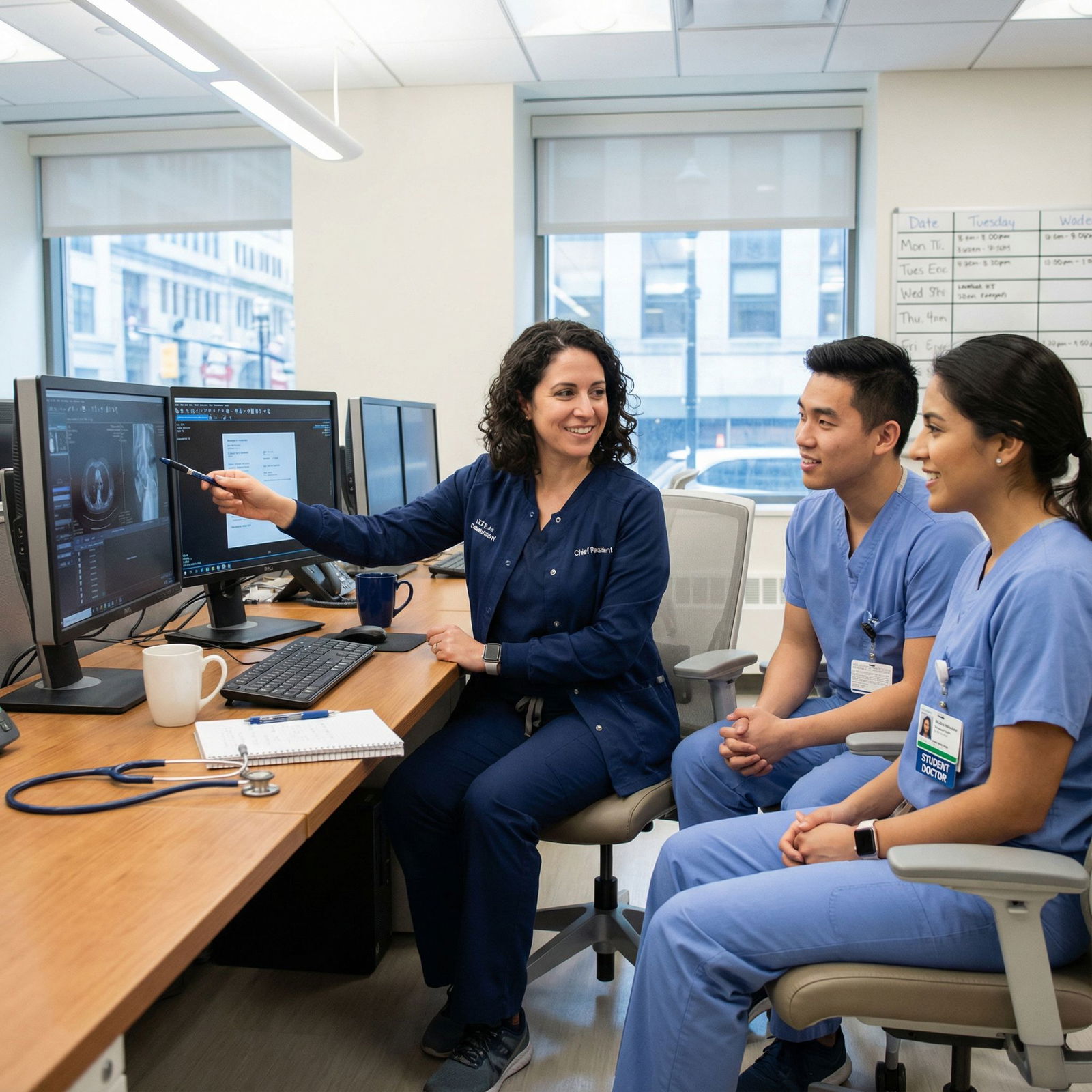
- You are a teacher and mentor for residents and medical students
- You are a change agent for program improvement and healthcare management initiatives
In many programs, the chief year is recognized as a capstone leadership experience that prepares you for roles as an attending, fellowship trainee, or early-career clinician leader.
Core Domains of the Chief Resident Role
1. Leadership and Operational Management
Chief residents are often the operational backbone of the residency:
- Creating and troubleshooting call and rotation schedules
- Balancing service coverage with educational needs
- Managing last-minute call outs, coverage gaps, and crises
- Coordinating with nursing, administration, and ancillary services
Practical example: You may be the person who gets a 5 a.m. text that a night resident is sick and must quickly reshuffle the schedule while preserving duty hour compliance and patient safety.
2. Mentorship and Professional Development
You are a primary source of mentorship for junior residents and medical students:
- Supporting interns through their early months
- Helping peers navigate performance concerns, remediation, or burnout
- Coaching residents on career decisions (fellowship, job search, academia vs. community practice)
- Informally modeling how to handle difficult conversations, code situations, and adverse outcomes
Effective mentorship doesn’t mean having all the answers. It means listening, normalizing challenges, and connecting people with resources and appropriate faculty mentors.
3. Communication and Conflict Mediation
Chief residents serve as liaisons among:
- Residents and program leadership
- Residents and attending physicians
- Different services or departments (e.g., medicine and surgery, ED and inpatient teams)
You’ll often be the first person approached when there are:
- Concerns about fairness in workload
- Tension between residents and attendings
- Communication breakdowns between teams
- System issues impacting patient care
Strong communication skills—clear, calm, and respectful—are pivotal in maintaining trust on all sides.
4. Program and Quality Improvement
Most programs expect chief residents to contribute directly to:
- Curriculum design and evaluation
- Simulation training, didactics, or board review sessions
- Quality improvement (QI) projects and patient safety initiatives
- Wellness, diversity, equity, and inclusion efforts
This is a prime opportunity to practice Healthcare Management skills and lead concrete projects that can be highlighted in your CV, job talks, and future leadership applications.
5. Advocacy and Resident Wellness
Chief residents are often the most accessible advocate for resident needs:
- Raising concerns about unsafe patient loads or call structures
- Advocating for lactation rooms, call rooms, or schedule flexibility
- Supporting colleagues facing personal crises, illness, or family issues
- Helping leadership understand the lived experience of trainees
Done well, this advocacy improves both resident well-being and patient care.

Leadership Development During Residency: Building Competence Before You’re Chief
You do not need the title of chief resident to start behaving like a leader. In fact, the strongest chief candidates begin laying the groundwork during their first years of Medical Training.
1. Seek Early Leadership Opportunities
Look for formal and informal roles that let you build your leadership muscle:
Join Committees and Task Forces
Examples include:
- Residency education or curriculum committees
- Quality improvement and patient safety groups
- Morbidity and Mortality (M&M) planning committees
- Diversity, equity, and inclusion initiatives
- Wellness or social committees
These experiences expose you to department operations and healthcare management, while allowing you to practice consensus-building and project execution.
Take on Teaching Roles
Teaching is both a leadership skill and a core expectation of chief residents:
- Lead small-group sessions for medical students
- Volunteer for simulation labs, OSCEs, or bedside teaching rounds
- Create short teaching handouts, pocket cards, or online modules
- Offer intern “survival guide” talks or orientation sessions
Teaching improves your own clinical knowledge, communication skills, and visibility to faculty.
Engage in Community and Institutional Projects
Leadership also extends beyond the hospital:
- Community health outreach or free clinic leadership
- Public health campaigns or advocacy initiatives
- Interprofessional projects with nursing, pharmacy, or social work teams
These experiences highlight your commitment to systems-level thinking and patient-centered care.
2. Develop Strong, Adaptive Communication Skills
Chief residents communicate with many different stakeholders daily. Start honing these skills now:
Practice Active Listening
When colleagues approach you with concerns:
- Listen fully before responding
- Reflect back what you heard (“It sounds like you’re feeling…”)
- Clarify expectations and what they’re hoping you can do
People remember leaders who make them feel heard—even when solutions are limited.
Give and Receive Feedback Skillfully
Feedback is central to leadership development:
- Ask for specific feedback from attendings and peers (“What is one thing I could do better when leading the team?”)
- Practice delivering feedback that is timely, behavior-focused, and nonjudgmental
- Separate intent from impact—even good intentions can have negative effects that must be addressed
Developing comfort with feedback will make the chief year far less stressful.
Learn Basic Conflict Resolution
You will inevitably be involved in disagreements—over schedules, patient care plans, or interpersonal slights. Foundational steps include:
- Hear both sides separately before bringing people together
- Focus on shared goals (e.g., safe patient care, fair workload)
- Use neutral, non-blaming language
- When needed, involve faculty or program leadership early rather than letting conflicts escalate
Many institutions offer workshops on conflict management—take advantage of them.
3. Foster a Positive and Psychologically Safe Environment
A key aspect of Leadership Development is your ability to shape team culture.
Model Encouragement and Recognition
Small actions can have outsized effects:
- Publicly recognize residents who handled a challenging case well
- Send quick emails or texts acknowledging great teamwork
- Highlight contributions during sign-out or debrief sessions
Recognition improves morale and reinforces the behaviors you want to see repeated.
Be Approachable and Supportive
Even as a junior resident, you can:
- Offer to debrief difficult codes or bad outcomes with interns
- Normalize the learning curve and occasional mistakes
- Help peers access mental health or employee assistance program resources
These behaviors build trust—critical when you later step into the chief resident role.
Promote Healthier Work-Life Integration
You may not control the schedule, but you can:
- Encourage peers to actually use their days off
- Share strategies for efficiency and time management
- Support boundaries around non-urgent communication outside work
- Participate in or organize social and wellness events
Leaders who visibly prioritize wellness send a powerful message that burnout is not “just part of the job.”
Preparing for the Chief Resident Role: Strategy and Application
Becoming a chief resident usually involves a formal selection process during your PGY-2 or PGY-3 year (depending on specialty). Treat it with the same seriousness as applying for fellowship or jobs.
1. Understand Your Program’s Selection Process
Each program has its own structure:
- Are chiefs elected by residents, appointed by faculty, or both?
- Are there distinct roles (e.g., administrative chief, academic chief, wellness chief)?
- What are the unofficial expectations (e.g., strong teacher, team builder, schedule guru)?
Talk with current and former chiefs to understand the nuances, time demands, compensation (if any), and how the role fits with fellowship interviews or research.
2. Build Strong Relationships and a Positive Reputation
Selection is rarely based on CV content alone. Programs look for residents who:
- Are reliable and accountable
- Treat all staff respectfully (including nurses, techs, and administrative staff)
- Demonstrate emotional maturity, humility, and professionalism
- Are seen as “team players” rather than self-promoters
Actionable tips:
- Be the person who shows up on time and stays to help when needed
- Own mistakes openly and work to correct them
- Thank schedulers, nurses, and ancillary staff—relationships with them will be invaluable as chief
3. Demonstrate Clear Leadership Impact
When applying, be ready to discuss specific examples where you:
- Led a QI project or curriculum change and measured its outcomes
- Intervened in a team conflict and improved the working environment
- Designed or delivered impactful teaching sessions
- Advocated for a resident or student in a meaningful way
Document your projects and outcomes. Data and concrete stories are powerful during selection discussions and future job interviews.
4. Craft a Compelling Chief Resident Personal Statement
If your program requires an application or statement, focus on:
- Your motivation: Why leadership? Why now? Why in this program?
- Your vision: What specific goals or improvements would you prioritize as chief (e.g., simulation curriculum, wellness programs, schedule transparency)?
- Your readiness: Which experiences have prepared you? What strengths and growth areas do you bring?
- Your values: How do you see mentorship, equity, patient safety, and professionalism shaping your decisions as a chief?
Avoid generic statements about “wanting to give back.” Show you understand the realities—as well as the rewards—of the role.
Navigating the Transition: From Peer to Chief Resident
Once you’ve matched into the chief resident role, your identity will shift significantly. You are now both colleague and leader, peer and supervisor.
1. Embrace the Role Shift Deliberately
It is normal to feel ambivalent at first:
- You may supervise people who were previously on equal footing
- You may need to deliver difficult messages or performance feedback
- You may be privy to confidential information you cannot share
Approach this transition intentionally:
- Have explicit conversations with close peers: “Our relationship is important to me, and my new role also requires some boundaries. Let’s talk about how to navigate that.”
- Ask your program director for guidance on common dilemmas and expectations
- Clarify decision-making authority—what you can handle alone vs. what must involve leadership
2. Set Clear Expectations and Shared Goals Early
At the beginning of your chief year:
- Host a resident meeting to discuss your leadership style and priorities
- Share what residents can expect from you (e.g., transparency, fairness, responsiveness)
- Define how you prefer to receive concerns (email, anonymous forms, open-door policy)
- Co-create shared goals for the year (e.g., improve board pass rate, reduce duty hour violations, strengthen wellness initiatives)
Upfront clarity reduces misunderstandings and builds credibility.
3. Lead by Example in All Arenas
Your behavior will set the tone:
- Professionalism: Show respect to all staff, own mistakes, and maintain confidentiality
- Work ethic: Be visible on the wards, willing to pitch in, and avoid using your role for preferential treatment
- Clinical care: Maintain high standards in documentation, communication, and patient safety
Residents notice everything—from how you speak to nurses to how you handle being called in late at night. Your actions will carry more weight than any speech.
4. Protect Your Own Well-Being and Boundaries
The chief resident year can be one of the most rewarding and also one of the most stressful of your training:
- You may absorb a lot of emotional and logistical “waste” from the system
- You may experience compassion fatigue from handling distress and conflict
- Your own research, fellowship planning, or personal life can be squeezed
Strategies to protect yourself:
- Schedule protected time for your own clinics, research, or exam prep—and treat it as non-negotiable
- Share leadership responsibilities with co-chiefs; avoid centralizing all problems on yourself
- Have regular check-ins with a mentor or program director to debrief challenges
- Seek professional support if you experience signs of burnout, depression, or anxiety
Taking care of yourself is not selfish; it is essential to sustainable leadership.
Translating the Chief Resident Experience Into Your Future Career
The Chief Resident Role is not just one more line on your CV; it’s a formative experience that can shape your trajectory in medicine.
1. Articulating Your Leadership Experience
When applying for jobs or fellowships, be prepared to describe:
- Leadership challenges you faced and how you navigated them
- Measurable outcomes from your projects (e.g., reduced handoff errors, improved satisfaction scores, increased didactic attendance)
- Lessons learned about team dynamics, communication, conflict resolution, and Healthcare Management
Frame your experience in terms of skills that are valuable across clinical, academic, and administrative roles: strategic thinking, systems-based practice, and emotional intelligence.
2. Building a Long-Term Leadership Path
Your chief resident year can be a launching pad for:
- Division, service line, or program leadership
- Medical education roles (clerkship director, program director, simulation director)
- Quality improvement or patient safety leadership
- Hospital or health system administration roles
Stay connected with mentors in these areas, and continue formal Leadership Development through:
- Hospital-based leadership academies
- Master’s programs (e.g., MEd, MPH, MHA, MBA)
- Regional or national leadership development programs in your specialty society
3. Continuing Your Mentorship Legacy
Perhaps the most enduring impact of your chief year will be the people you mentored:
- Residents you supported through crises who later thrive
- Students who chose your specialty because of your example
- Peers who adopt your leadership style and carry it forward
Approach each mentorship conversation as an investment in the future of your field.
FAQs: Chief Resident Role, Leadership, and Medical Training
1. What qualities make an effective chief resident?
Strong chief residents demonstrate reliability, emotional intelligence, and excellent communication. They are approachable yet maintain appropriate boundaries, advocate for resident wellness, handle conflict constructively, and consistently model professionalism, clinical competence, and respect for all team members.
2. How can I prepare for becoming a chief resident while still an intern or junior resident?
Start by seeking small leadership roles: teaching medical students, joining a QI project, or serving on a wellness or curriculum committee. Ask for feedback on your teamwork and communication, observe how current chiefs handle complex situations, and cultivate relationships with mentors who can support your growth and eventually endorse your candidacy.
3. What are the biggest challenges new chief residents typically face?
Common challenges include transitioning from peer to supervisor, managing complex scheduling demands, mediating conflicts between residents and attendings, and balancing personal clinical/research duties with constant administrative requests. Many also struggle with setting boundaries and avoiding burnout when “everyone’s problem” becomes “your problem.”
4. How should a chief resident handle serious conflicts or unprofessional behavior within the team?
Start with private, nonjudgmental conversations focused on specific behaviors and their impact, not on character. Listen to all sides, document significant issues, and involve faculty or program leadership early when patient safety, harassment, discrimination, or persistent unprofessional behavior is involved. Never try to manage high-risk situations entirely alone.
5. Is the chief resident position worth the added time and responsibility?
For most who pursue it intentionally, the chief year is profoundly worthwhile. You gain real-world leadership and healthcare management experience, build deep mentorship relationships, and develop skills that accelerate your career in any setting—academic, community, administrative, or private practice. It is demanding but can be deeply meaningful if aligned with your values and long-term goals.
By approaching the chief resident journey as a deliberate, structured opportunity for Leadership Development—rather than just an extra year of service—you can transform it into a powerful stepping stone for your entire career in medicine.