
The data tells a brutal story. Applicants who scored below 220 on USMLE Step 1 (in the pre-pass/fail era) matched at rates between 55% and 70%, depending on specialty. Those who supplemented low scores with three or more peer-reviewed publications saw match rates climb by 10 to 18 percentage points in several analyzed cohorts. Three publications. That is the threshold I want you to internalize before reading another word.
Let me break this down specifically, because the conventional wisdom around research papers for low-Step applicants is full of half-truths, wasted effort, and misunderstood leverage points. Most advisors will tell you to "get involved in research" as if that single sentence means anything actionable. It does not. You need to understand what kinds of papers count, how many you actually need, and which specialties reward publication volume versus quality.
This article is not a pep talk. It is a working manual for applicants who need every possible edge.
This article is for educational purposes only. It is not financial advice, not legal advice, and not tax advice. Figures vary by individual circumstances, consult a qualified professional before acting.
The Core Challenge
The mismatch between Step scores and research output is one of the most underutilized levers in the residency application. Programs filter applicants by numerical cutoffs long before a human reads your personal statement. When your Step 1 or Step 2 CK score sits below a program's threshold, your application often never reaches the secondary review pile. Research papers serve as a filter bypass, a signal of academic seriousness that survives the initial cull.
But here is the problem. Most low-Step applicants approach research the wrong way.
Common Pitfalls
Mistake one: Chasing quantity without substance. I have seen applications with fifteen abstracts and zero first-author publications. Program directors see through this instantly. Listing "submitted" or "in preparation" on fifteen projects signals desperation, not productivity. Quality of authorship matters more than the raw count of citations.
Mistake two: Pursuing irrelevant research. Publishing a case report in ophthalmology does not help you match in internal medicine. I do not care how prestigious the journal appears. Specialty alignment matters because reviewers assume your research interest mirrors your career interest. A poorly aligned publication portfolio creates cognitive dissonance.
Mistake three: Starting research too late. Publications take time. A retrospective chart review might take six months from data extraction to journal acceptance. A prospective study takes longer. If you are reading this in the spring of your application year, you have already lost the timeline for some publication types.
Mistake four: Confusing posters with papers. Conference posters and oral presentations have value, but they do not carry the same weight as a PubMed-indexed publication. If your CV shows ten posters and zero papers, you have demonstrated conference attendance, not research productivity.
How to Navigate Them Successfully
The applicants who successfully compensate for low Step scores with research do several things differently.
They target specific journals. They identify faculty at their home institution who publish regularly in their target specialty. They volunteer for projects already in progress rather than proposing novel work from scratch. They negotiate first authorship explicitly and early, before months of labor go uncredited.
They also pursue case reports aggressively. Case reports are the fastest path to a PubMed-indexed publication. A well-written case report on an unusual presentation, a rare complication, or a novel treatment approach can go from concept to publication in four to six months. For low-Step applicants working against a timeline, this is the single highest-yield strategy available.
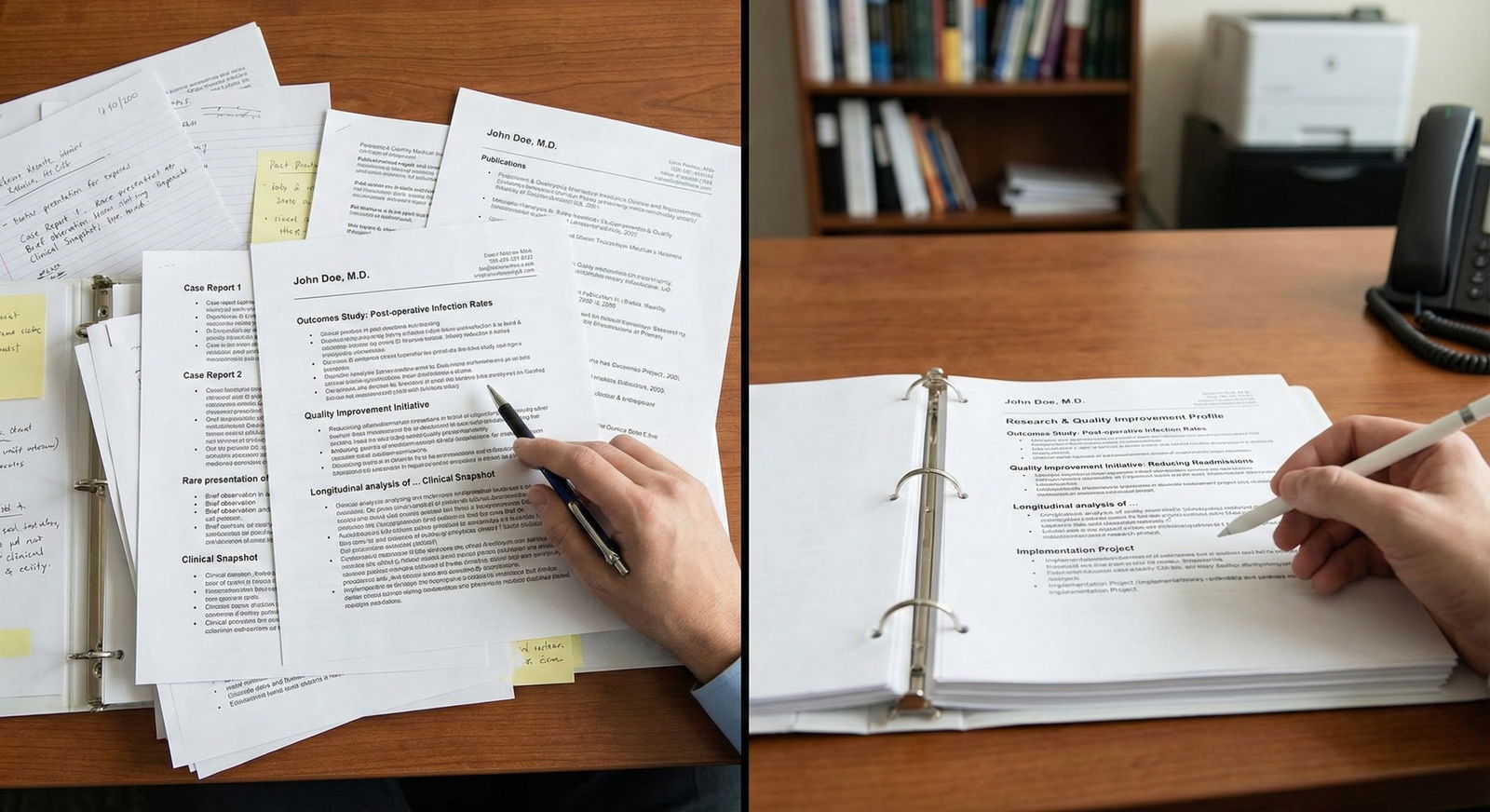
Let me give you concrete numbers from published match data. The 2022 NRMP Charting Outcomes reports showed that matched applicants in competitive specialties had an average of 3.2 research publications. Unmatched applicants in the same specialties averaged 1.8. The gap widens dramatically for applicants with low Step scores, where the matched cohort averaged 4.1 publications compared to 1.4 for the unmatched.
Notice that low-Step applicants who matched had nearly double the publication count of high-Step applicants who matched. Research is doing compensatory work. It has to.
Actionable Next Steps
Stop reading. Start doing. Here is the specific plan.
Step 1: Audit Your Current Position
Pull your CV right now. Count your existing publications. Categorize them by type: peer-reviewed original articles, case reports, review articles, abstracts, posters. Identify your authorship position on each. First-author original research in your target specialty is the gold standard. Everything else is supporting evidence.
If you have zero publications and a low Step score, you are behind. Acknowledge it. Move to step two.
Step 2: Identify Three Concurrent Projects
You need three active research projects running in parallel. This is not overcommitment. This is the minimum throughput to produce three publications within twelve months.
Project one should be a case report. Find an interesting patient from your current rotation. Draft the manuscript yourself. Do not wait for an attending to assign it. Volunteer, propose the topic, and write a 1,500-word draft.
Project two should be a retrospective study. These are the workhorses of medical student research. Pull charts from your institution's electronic medical record. Identify a clinical question, define inclusion criteria, extract data, run basic statistics. Your home institution almost certainly has faculty working on studies that need student labor. Attach yourself to one.
Project three should be a collaborative project with residents or fellows. Larger projects often have openings for students willing to do grunt work. The payoff comes when you negotiate inclusion as a co-author. Be explicit about your authorship expectations before contributing.
Step 3: Target the Right Journals
Submitting to a journal with an 80% rejection rate will waste six months. Match your work to the journal's typical acceptance rate and impact factor.
For case reports, journals like Cureus, BMJ Case Reports, and Journal of Medical Case Reports have student-friendly acceptance rates and fast review timelines. For original research, target specialty-specific journals rather than generalist mega-journals like JAMA or NEJM. A first-author paper in a mid-tier specialty journal outranks a middle-author paper in a top-tier journal every time.
Step 4: Optimize Your Authorship Position
Second author on a Nature Medicine paper means less than first author on a specialty journal paper for your application. Reviewers scan the author list. They look for the name listed first.
When you join a project, ask directly: "What is the authorship order, and what determines it?" If the answer is vague or noncommittal, walk away. Your time is limited. Spend it on projects where your contribution will be credited.
Step 5: Leverage the Publication Strategically
Once you have publications, do not bury them in a list on page four of your ERAS application. Mention your research in your personal statement. Reference it in your interview answers. Be prepared to discuss your methodology, findings, and clinical implications in depth. Program directors will ask, and vague answers destroy credibility.
Resources to Use
- PubMed: Search for faculty at your institution publishing in your target specialty. Read their recent papers. Identify gaps you could fill.
- Google Scholar: Track citation counts and h-indices for potential mentors. A mentor with no recent publications cannot help you.
- ResearchGate: Many faculty list their ongoing projects here. Reach out directly.
- Your home institution's IRB office: Understand the approval process before you commit to a project. IRB delays kill timelines.
- Medical student research forums: Platforms like Student Doctor Network and specialty-specific Reddit communities surface opportunities other students have abandoned.

Here is a realistic twelve-month timeline for an applicant targeting three publications:
- Month 1-2: Project identification, mentor meetings, topic finalization
- Month 3-4: Data collection, chart review, case report drafting
- Month 5-6: Manuscript preparation, co-author review, initial journal submission
- Month 7-8: Revisions and resubmissions for first two projects
- Month 9-10: Third project manuscript preparation
- Month 11-12: Final submissions, ERAS entry, interview preparation
The first paper acceptance often arrives around month eight. The second around month ten. The third may not arrive until after your application is submitted. That is acceptable. You can still list "accepted" or "in press" status on ERAS.
Key Takeaways
Three publications. First-author where possible. Specialty-aligned without exception. Case reports as the fast-track strategy. Authorship negotiation before labor commitment.
The low-Step applicant who publishes three papers demonstrates something beyond academic capability. They demonstrate persistence, project management, and the willingness to do unglamorous work. Program directors read these signals. They compensate for Step scores precisely because they cannot be filtered by automated screening.
Do not chase research for the sake of checking a box. Chase it because each publication is a permanent line on your CV, a talking point in every interview, and a counterweight to the number that worried you in the first place.
Start tomorrow. The timeline does not wait.