
You hit submit. You feel great. Then, three days later, you're reviewing your saved PDF and your stomach drops. You entered a B+ instead of an A- for Organic Chemistry. Or you accidentally logged 400 hours of clinical volunteering under "Research." Or your transcript timing is completely botched. Panic sets in.
Breathe. Most mistakes can be fixed or explained. But timing and documentation are everything. Admissions committees aren't looking for flawless robots; they're looking for how you handle imperfection.
Here is your 8-step, time-specific recovery plan. What to do today, this week, and over the next month.
Step 1 (Day 0-1): Identify the mistake precisely, and gather evidence
At this point you should pause. Don't just start clicking around the portal in a panic. Categorize the error. Is it coursework? Transcript entry? Activities? Demographics?
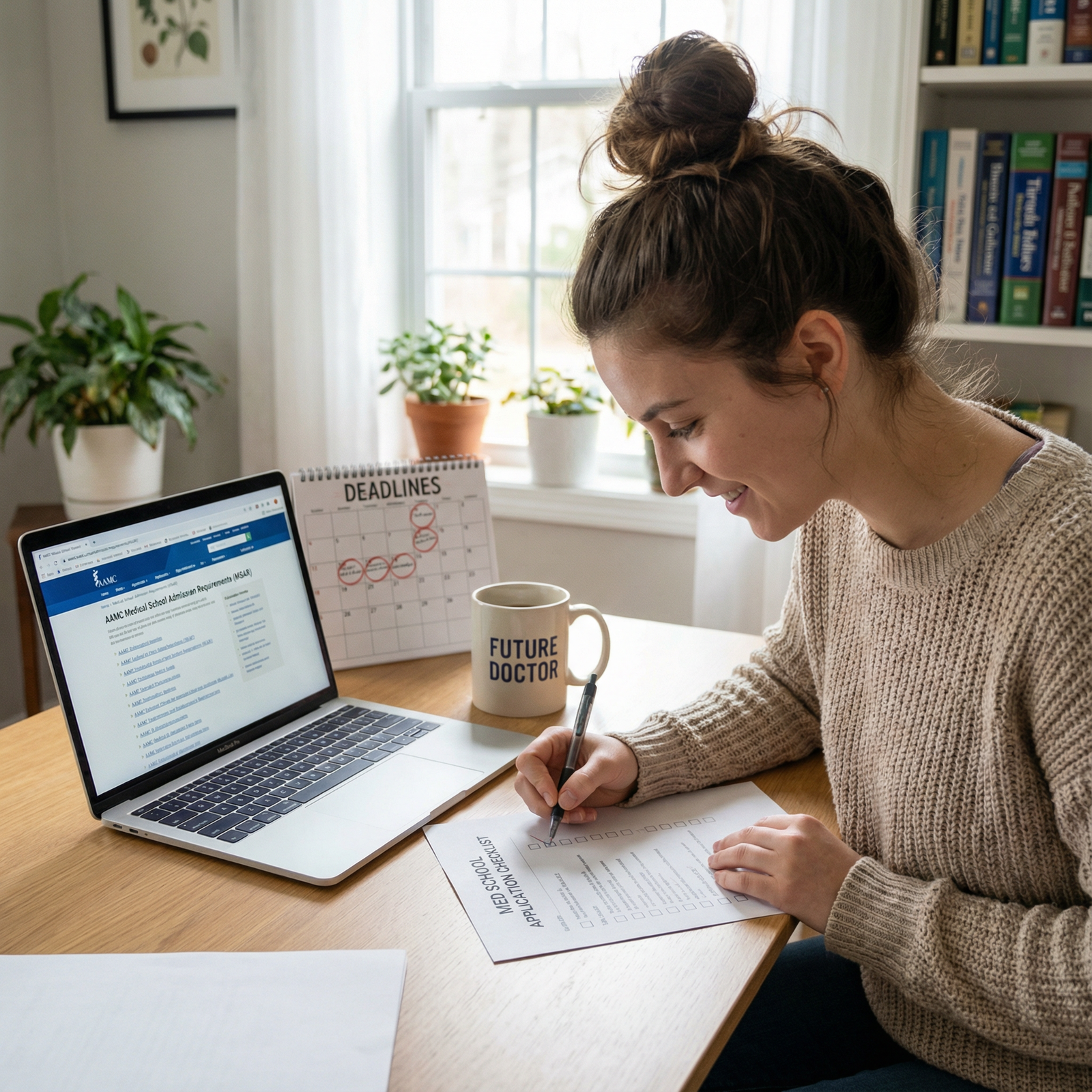
Collect your "proof packet" immediately. Pull your unofficial transcript, syllabus pages, the resume you used to fill out the application, and course descriptions. Take screenshots of what you submitted and what it actually should be.
Make a one-page mistake log. Keep it ruthless and factual:
- Date noticed:
- Platform: AMCAS vs. AACOMAS
- Section affected:
- What is wrong:
- What is correct:
Step 2 (Day 1-3): Check the portal status + deadlines (don't guess)
At this point you should confirm your exact application status. Is it verified? In progress? Received but not processed? Stop guessing.
Look for specific portal alerts like "pending transcript," "course not found," or "verification hold." Build a mini-deadline map. When does verification typically complete? When do schools download? If you miss a change cutoff, your correction won't be seen.
Step 3 (Week 1): Make the correction the "right way" (platform-specific)
At this point you should correct entries directly where the platform allows. Fix coursework, repeated courses, credit hours, term mapping, and activity dates.
Use a strict consistency rule. What appears in your portal must match your transcript and your documented intent. If you cannot correct a specific item in the portal, like a locked personal statement, prepare a written clarification for the school.
Avoid the classic pitfalls. Don't overwrite dates incorrectly. Don't change activity intent without explanation. I've seen applicants create three new discrepancies while trying to fix one old typo. Don't be that applicant.
Step 4 (Week 1-2): Draft a targeted "what happened + what changed" explanation
At this point you should write a short, factual clarification. Keep it dry. Never emotionally charged. No sob stories about how stressed you were during finals week.
Structure it tightly:
- The mistake: One sentence.
- Accurate info: What it actually is.
- Why it occurred: Briefly (e.g., "administrative oversight during data entry").
- What you did: Portal update dates.
- Reassurance: Confirmation of correctness.
Match your tone to the situation. An administrative error requires a different tone than a genuine reporting mistake. Prepare two versions: one for centralized support and one for individual schools.
Step 5 (Week 2): Send updates strategically (and only to the right recipients)
At this point you should decide who actually needs to know. Decide whether to contact the specific program, the general admissions office, or centralized support. Base this entirely on what the portal allows and what the schools have already downloaded.
When updating schools, include your application ID, the section corrected, the date of correction, and your short clarification statement.
Avoid spam. Batch your communication once per correction cycle. Keep a strict log of who you contacted and when. Emailing an admissions dean every 48 hours won't speed up verification; it will just annoy the person reading your file.
Step 6 (Month 1): Track downstream effects (verification, secondary timing, interviews)
At this point you should run a weekly status audit. Does the portal reflect the changes? Did verification re-run? Are transcripts updated? Did the schools actually receive the refreshed version?
Monitor your secondary prompts. If your correction affects coursework or activities, be ready to answer consistently in those essays. If you changed an activity list or grade mapping, update your interview talking points. You need to answer questions clearly and uniformly. If you used letters or coursework explanations elsewhere, ensure alignment across all materials.
Step 7 (Month 1-2): Handle outcomes calmly and prepare for questions
At this point you should treat the correction as part of your application story. You acted responsibly and transparently. That's a net positive.
Prepare "two levels" of response for interviews. A short, 30-second version for casual questions, and a longer, 2-minute version if an adcom probes deeper.
If a school appears to penalize your timing, leverage professionalism. Reiterate what you fixed, confirm the impact, and remain responsive. If the mistake involved major misreporting, prioritize accuracy verification above all else. Consider professional editing only for clarity, never to change the underlying facts.
Step 8 (Month 2 onward): Prevent repeat issues + maintain clean records
At this point you should finalize a personal "application master file." Every correction, date, screenshot, and proof document goes into one centralized folder.
For future cycles, or for adding late updates, build a verification checklist. Check transcript matches, course units, terms, activity dates, and naming consistency. If you are reapplying next year, review what happened and adjust your data-entry workflow. Use template-based entry, final copy/paste checks, and a mandatory 24-hour cooling-off period before hitting submit.
Mistakes corrected transparently are usually manageable. Your job now is consistency and readiness.
Summary: Your 8-step recovery plan (what to do next, in order)
Here is your tight sequence:
- Identify + evidence (Day 0-1)
- Confirm status + deadlines (Day 1-3)
- Correct via portal (Week 1)
- Draft targeted clarification (Week 1-2)
- Send updates strategically (Week 2)
- Track weekly effects (Month 1)
- Prepare for questions (Month 1-2)
- Prevent repeats and maintain records (Month 2+)
Act quickly. Be factual. Keep your documentation ironclad. Then, let the corrected information work its way through verification and school review. You've got this.