
You can tell the same joke in two hospitals and get two completely different outcomes.
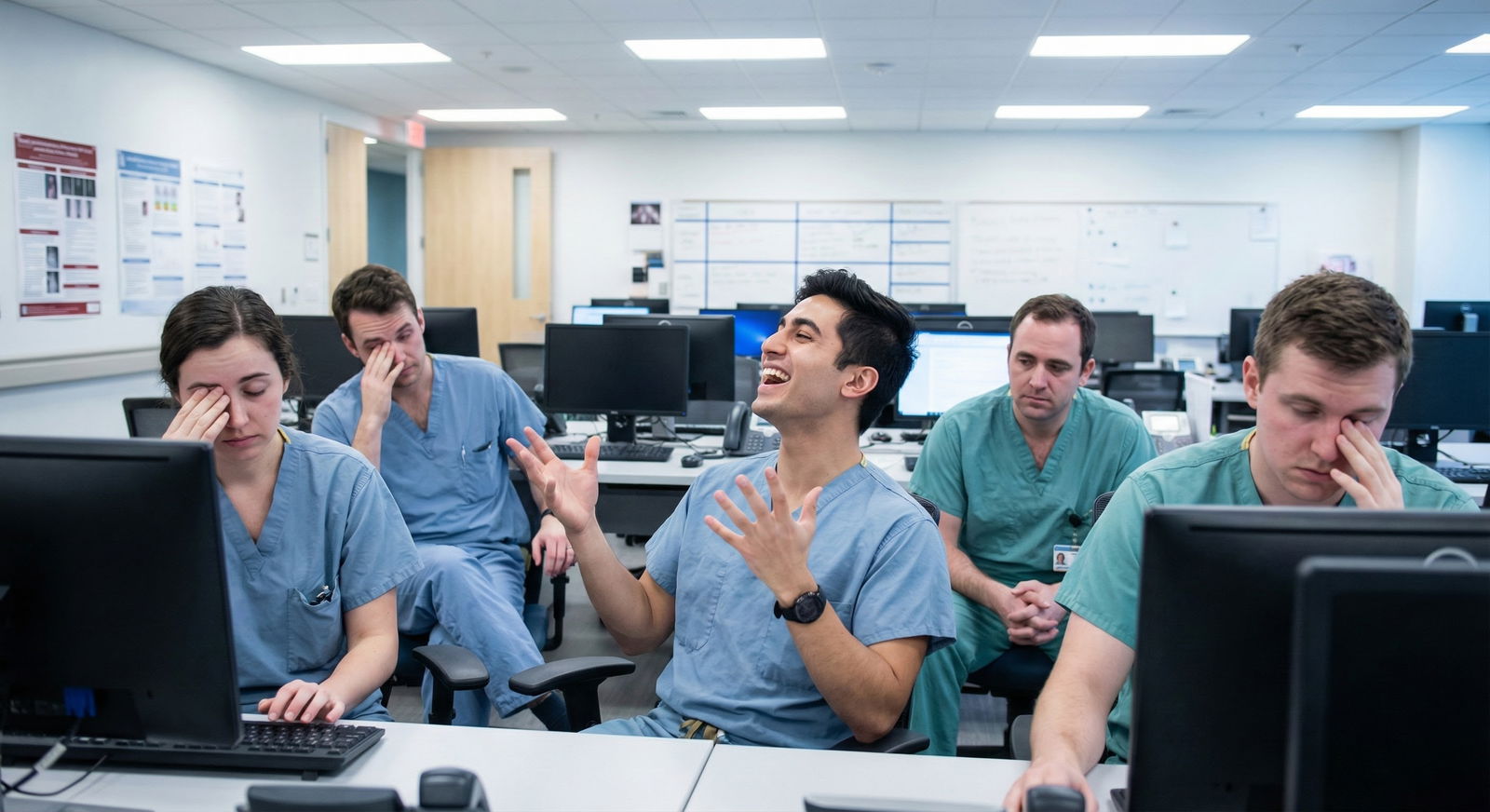
In one building, the attending smirks, the chief resident adds a sharper version, and the joke becomes part of the teaching moment. In the other, the same line lands like a dead pager battery. Nobody laughs. Somebody glances at the charge nurse. And just like that, you’ve told the room something about yourself that you didn’t mean to say.
That’s the part people outside medicine miss. Hospital humor is rarely just humor. It’s social signaling with a stethoscope on. It tells people whether you understand hierarchy, whether you know how fast the day is moving, whether you’re secure enough to be light without being sloppy, and whether other people feel safe laughing with you. I’ve watched interns tank their credibility by trying to be “the funny one” in the wrong setting. I’ve also watched seasoned attendings defuse a brutal day with one perfectly timed sentence that didn’t punch down, didn’t waste time, and somehow made the whole team breathe again.
Here’s the real contrast. Academic hospitals usually tolerate a broader range of self-aware, teaching-centered humor. Community hospitals usually reward humor that is faster, safer, and built on actual working relationships. Not because one setting is smarter or kinder. Because the currencies are different.
So no, this is not about being funnier. That’s amateur thinking. This is about reading the room, reading the patient flow, and knowing who feels empowered to laugh. That’s the real skill. And yes, the rules are different.
Academic Hospital Humor: The Culture of Cleverness
Let me tell you what really happens in academic centers. Humor often functions as proof of fluency. Not just social fluency. Institutional fluency. You’re showing that you understand the language, the hierarchy, the rituals, and the strange little sport of sounding relaxed while discussing something medically complicated.
That’s why academic humor often skews dry, layered, and niche. A callback to an obscure trial. A joke about a consultant note that reads like a philosophical essay. A deadpan line about the differential diagnosis having “grown more branches than the department’s promotion committee.” That stuff can kill on rounds at a big teaching hospital. Why? Because it signals that you belong in a place where performance is partly intellectual theater.
Attendings and senior residents know this. They use humor to teach, but also to position themselves. A polished attending can make a joke about an overengineered workup, get the residents laughing, and still steer the conversation right back to the actual clinical point. That’s the sweet spot. The humor isn’t random. It’s attached to a lesson. It says, “I’m smart, I’m calm, I’ve seen this before, and you’re safe learning here.”
But there’s a catch. Actually, several.
First, academic medicine loves wit right up until it embarrasses the wrong person. If a conference joke makes a trainee look stupid, the room may laugh, but people will remember it as a character reveal. Not a good one. Same if the joke drifts anywhere near a patient’s dignity. In public teaching spaces, the tolerated humor is polished, subtle, and usually framed as being “in service of education.” That phrase does a lot of work. More than people admit.
Second, the more formal the institution, the more style matters. You can be sharp, but you’d better be controlled. Broad sarcasm reads crude. Sloppy joking reads insecure. A well-timed, almost surgical piece of dry humor? That can thrive. Especially in places where everybody is performing competence all day long.
I’ve seen this on grand rounds stages, in noon conference, and in those post-call table huddles where everyone is half-awake but still very aware of status. The attending who says, “That sodium corrected itself out of sheer fear of nephrology,” gets a laugh because it’s clean, niche, and harmless. The trainee who tries a more aggressive version too early can look like they’re auditioning. Nobody likes an audition.
That’s another hidden rule in academic hospitals: if your humor feels like a bid for approval, it dies. If it feels effortless and useful, it lives.

Community Hospital Humor: Fast, Practical, and Relationship-Driven
Community hospital humor runs on different fuel. Less performance. Less verbal embroidery. More speed, more warmth, more teamwork.
The best jokes in community settings are often one-liners tossed out while everybody is doing three things at once. At the nurse station. Walking to CT. Waiting for transport that’s somehow both “on the way” and nowhere in sight. The humor lands because it relieves pressure without adding friction. That matters.
Behind the scenes, people in community hospitals usually value humor that makes the shift easier. Full stop. If the joke lowers tension, builds trust, and keeps the machine moving, it works. If it feels too clever, too rehearsed, or too self-consciously academic, people get tired fast. They don’t want your conference voice. They want you to be useful, sane, and pleasant at 4:45 p.m. when the ED is backing up and two discharges just fell apart.
This is where a lot of people misread the culture. They assume community settings are less sophisticated because the humor is more direct. Wrong. It’s often more socially intelligent because it’s grounded in real relationships. Nursing, techs, respiratory, physicians, unit clerks—everyone is reading everyone. The joke is not a status marker. It’s a team survival tool.
And yes, the room can smell performative cleverness immediately. I’ve watched new hires try a polished academic-style quip about Bayesian reasoning or tertiary care overtesting and get absolutely nothing back except polite blinking. Not because the team didn’t understand it. Because it didn’t help. It sounded like someone trying to prove they belonged somewhere else.
Community humor rewards a different kind of competence. Quick self-deprecation. Gentle absurdity. Shared-eye-roll humor about workflow nonsense. The kind of line that says, “I know this is a mess, but I’m in it with you.” That travels. That gets remembered.
The person who can make the charge nurse laugh without slowing the room down? Powerful. The physician who can joke kindly with staff across roles without ever sounding above the work? Even more powerful. That’s not small talk. That’s credibility.
The Real Rulebook: What Gets You Laughs vs What Gets You Side-Eyed
Here’s the unwritten rulebook nobody hands you at orientation.
Never punch down. Not at trainees, not at staff, not at patients, not at families, not at the person barely holding the shift together. If the joke depends on someone having less power than you, it’s a bad joke. I don’t care how often you’ve heard versions of it. Bad habit. Bad look.
Also off-limits: humor that leans on patient vulnerability, poverty, language barriers, body size, addiction, psych illness, nonadherence without context, or medical error. People still cross these lines, of course. Medicine is full of tired people with uneven judgment. But the room remembers who does it. Especially now.
Sarcasm is where people get themselves into trouble. In some academic spaces, dry sarcasm among peers is practically a dialect. In some surgical spaces, it’s woven into the wallpaper. In many community environments, especially interdisciplinary ones, the same tone can read as contempt. Same sentence. Different consequence.
And then there’s the truth nobody says out loud: attendings laugh differently depending on who says the joke. A senior faculty member can get away with more. A chief resident can push farther than an intern. A beloved hospitalist with ten years of goodwill has latitude a new grad simply does not have. Fair? Not always. Real? Absolutely.
Timing matters even more than wording. If the ED is boarding fifteen, the ICU is stretched, the floor is down two nurses, and transport is melting down, this is not the hour for your elaborate bit. Even a harmless joke can feel tone-deaf when the unit is already angry. On overloaded days, the best humor is brief, gentle, and task-adjacent. Something that releases pressure without asking people to stop what they’re doing and admire you.
That’s the secret. A joke is never judged in isolation. It’s judged in context: your role, your reputation, the room’s stress level, the patient situation, and whether people feel like you’re helping or performing.
Where the Humor Actually Lands: Hierarchy, Specialty, and Professional Identity
Humor doesn’t just vary by hospital type. It varies by what the culture rewards.
Academic environments often reward intellectual identity. Being quick, well-read, subtly ironic, comfortable with complexity. Community environments more often reward being dependable, efficient, and easy to work with. So the humor that lands in each place reflects that. One setting laughs at cleverness that proves fluency. The other laughs at competence that makes the day lighter.
Specialty matters too. A lot.
Surgeons often traffic in bluntness, compression, and status-aware sarcasm. If you don’t know the room, don’t imitate it. What sounds crisp coming from a senior surgeon can sound reckless from a rotating student. Internists tend to favor layered, talky humor—wordplay, overthinking, little digs at complexity itself. Emergency physicians like speed. The joke is often one sentence, usually born from absurd logistics, and gone before the chart opens again. Pediatric teams often use warmth, silliness, and emotional cushioning because the surrounding work can be so heavy. Intensivists? Darker edge, tighter circle, much more dependent on trust and timing.
And yes, gallows humor exists. Of course it does. Anyone pretending otherwise hasn’t spent enough nights in hospitals. But gallows humor is the most misunderstood category in medicine. Outsiders think it’s cruelty. Insiders know it’s sometimes a pressure valve. Still, it only works inside the right relationship, in the right space, with the right people, and never at the expense of the patient in a way that dehumanizes them. Most people are worse at this boundary than they think.
The hidden politics are brutal. The same joke can read as confidence in one setting and arrogance in another. A new fellow making a dry joke on day two may be seen as trying too hard. The exact same line from someone who has already shown humility, work ethic, and reliability can land beautifully. Why? Because humor is interpreted through trust. Always.
I’ve seen newcomers fail because they copied style without earning context. That’s a common mistake. They heard residents in one institution roast each other lightly, so they tried it in a different place where the culture was more protective and less theatrical. Disaster. Or they tried ultra-polished academic wit in a community environment that prized directness. Equally bad. They weren’t reading the room. They were imitating a script.
That’s why humor becomes a fast test of whether someone “gets it.” Not whether they’re funny. Whether they can detect the culture beneath the culture. Whether they know when people are open, when they’re brittle, and whether they understand that being liked in medicine usually has less to do with charm than with making everyone else’s life a little easier.
Closing Reminder: The Best Humor Is the One That Makes the Room Safer
Here’s the standard that actually matters.
Not who has the sharpest line. Not who can get the biggest laugh at conference. Not who built a reputation as “the funny attending.” That stuff is overrated. The real test is simpler and harder: after you speak, does the room feel lighter, safer, and more able to keep working?
Good hospital humor reads the environment first. Audience. Hierarchy. Stress level. Patient context. If you skip that and go straight to the joke, you’re not being witty. You’re being careless.
The best clinicians I’ve known were not the funniest in every room. They were the most calibrated. They knew when a quiet one-liner could rescue a tense moment, and when silence was the smarter, kinder move. That’s judgment. That’s maturity. And frankly, that’s more impressive than being clever.
So yes, academic and community hospitals absolutely differ in their humor rules. Different pace. Different incentives. Different signals of belonging. But the core truth doesn’t change: the safest medical humor is rarely the cleverest one on paper. It’s the one that fits the room, respects the people in it, and never forgets that medicine is already hard enough without someone trying to be the star of the scene.