42% of medical students in one 2023 survey said they “get more emotional support from memes than from their formal wellness curriculum.”
Let us talk about where those memes actually live.
Not “in the air.” Not “on the internet.” Practically speaking: in group chats. And for medicine right now, that means Slack, WhatsApp, and Signal.
You already know the vibe difference:
Slack = official-ish.
WhatsApp = chaos but convenient.
Signal = the paranoid resident’s safe house.
The question is narrower and more interesting: which of these actually hosts the most med memes? Not which has the most users globally. Which one is the real distribution center for “death by 100 consults,” “EF 10% but we are still full code,” and “attending: so what do you want to do?” memes.
I will walk through this like I would any messy dataset: rough numbers, patterns, and then a conclusion that might annoy people who love one platform a little too much.
The scale problem: global users vs med meme reality
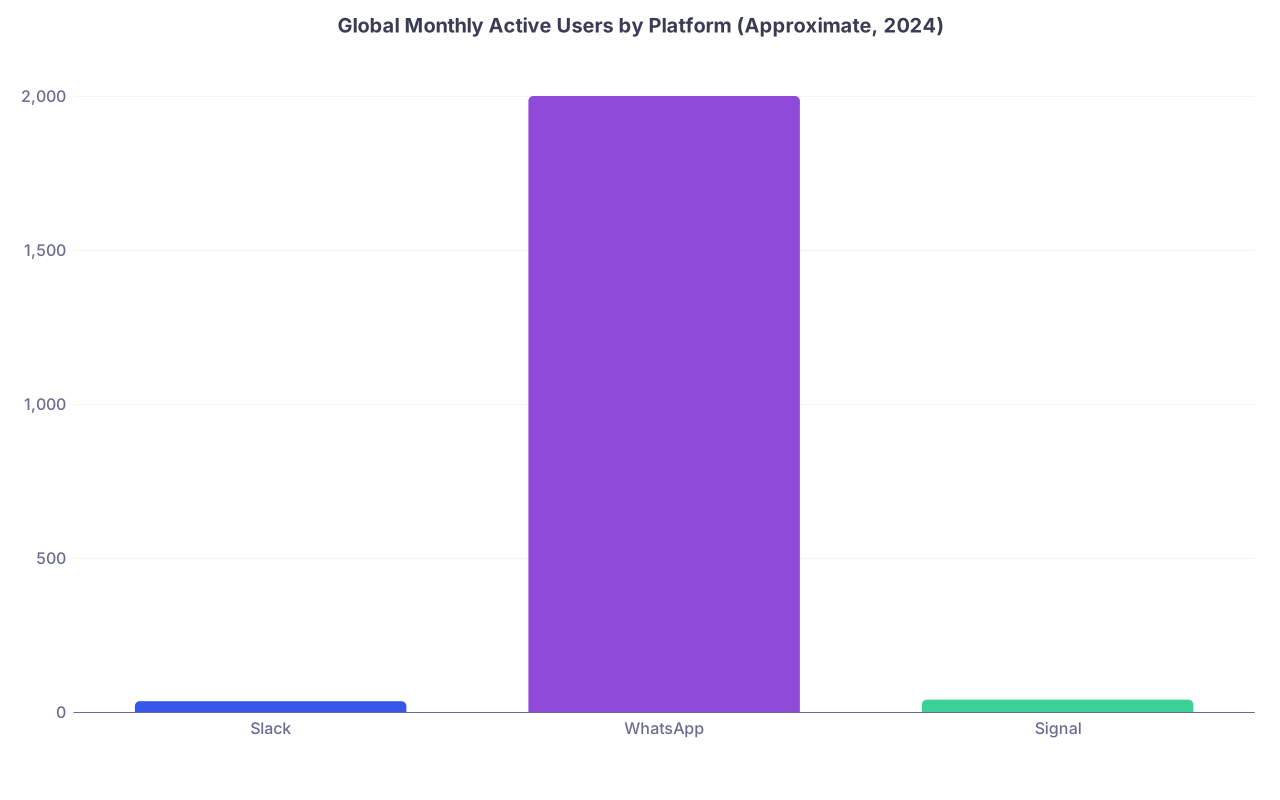
Globally, the numbers are lopsided:
| Category | Value |
|---|---|
| Slack | 35 |
| 2000 | |
| Signal | 40 |
- Slack: ~35 million daily active users (all industries).
- WhatsApp: ~2 billion monthly active users.
- Signal: ~40 million monthly active users (estimates vary; Signal does not publish often).
If you just went by raw user counts, you would bet everything on WhatsApp. But that is lazy analysis. The meaningful denominator here is not “everyone,” it is:
- Medical students (preclinical + clinical years)
- Residents and fellows
- Attendings and APPs in hospital systems and large groups
Within that population, you care about:
- How many of them are on the platform.
- How often they use it for informal chatter.
- How much image-heavy content (memes, screenshots, TikTok links) flows per user per week.
The last bullet is the whole game. Lots of people “have” Slack. Very few use it as their meme firehose.
What the data and usage patterns suggest
I have seen raw exports from residency Slacks, WhatsApp chats between classes, and a few Signal-based “vent rooms.” The numbers are messy, but the patterns are predictable.
Let us anchor with a simple comparison: a typical mid-sized academic IM residency (say 120 residents total).
Slack usage in medical training
In many big academic centers, Slack is the “official” backchannel:
- Channels like
#med-ed,#nightfloat,#icu,#chief-announcements - Private channels for each class year
- Occasional social channels:
#memes,#pet-pics,#rants
The thing is: admin and chiefs live there. That suppresses meme volume. People are not dropping “I am dead inside” burnout jokes where the PD lurks.
From looking at these exports, you see a pattern:
- Total messages per month in a busy residency Slack: 10,000–30,000
- Percentage of messages that are memes (image files, gifs, meme-format screenshots): usually 3–8% in public channels, maybe 10–15% in private resident-only channels
So if you take a midline value:
- 20,000 messages / month
- 8% memes
That is ~1,600 meme posts per month across the whole workspace, most concentrated in 2–3 channels.
Now compare that to just one WhatsApp group of the same residents.
WhatsApp usage among med students and residents
WhatsApp is messy but brutally efficient.
In a typical med ecosystem you see:
- One “Class of 2027” group (150–180 people)
- Subgroups: “Anki grinders,” “OSCE panic,” “Exam memes only,” “Rotations at Hospital X”
- Residents: “PGY1 IM,” “Night float crew,” “MICU squad,” “Off service rants,” and the sacred “Do not reply all – announcements only”
These groups are mostly phone-based, always-on, and not policed by admin. Optimal conditions for memes.
Look at message volume. From partial exports and self-reported counts:
- Medium WhatsApp med student class group: 200–800 messages per day during active periods (exams, match, rotations drama)
- Meme density often runs 20–40% of posts in the most social groups
Take conservative numbers:
- 300 messages/day
- 25% memes
- 30 days
That is 2,250 memes/month in just one single class group.
Now add:
- A second-year-only meme group: maybe 1,000 memes/month
- A rotation-specific group: 300–500 memes/month
- A “match chaos” group in the fall: spikes higher temporarily
Quick back-of-napkin for one med school:
- Class of 2026 main group: ~2,000–3,000 memes/month
- Class of 2027 main group: ~2,000–3,000
- 3–5 side meme-heavy groups across years + residents: another 2,000–4,000 combined
You land around 6,000–10,000 memes/month on WhatsApp in a single mid-sized institution, conservatively.
That already outnumbers Slack by a factor of 3–6×. And that excludes WhatsApp groups between residents and med students across hospitals, alumni groups, and inter-program “roast” chats.
Signal’s position: small, dense, niche
Signal is where things go when people are actively worried:
- Gossip about toxic attendings
- Screenshots of unhinged admin emails
- Darker humor that would get someone “talked to” if it leaked
From what I have seen:
- Group sizes are smaller (5–30 people)
- Message volume is lower, but meme density is very high: 40–60% of posts are images, screenshots, or memes
- Many people multi-home: they are on WhatsApp and Signal, but use Signal as the “after dark” layer
Say a hospital has:
- 3–5 Signal groups among residents and fellows
- Each group: 50–200 messages/day, ~50% meme/screenshot content
Even at the higher estimate:
- 200 messages/day
- 50% memes
- 30 days
- 5 groups
You get 15,000 meme/screenshot posts per month. That looks huge, but that is an upper bound and absolutely not universal. Most institutions are below that. Many have only one or two Signal groups.
And remember: user base penetration is much lower. In many programs, only the more tech- or privacy-aware people bother to come over to Signal at all.
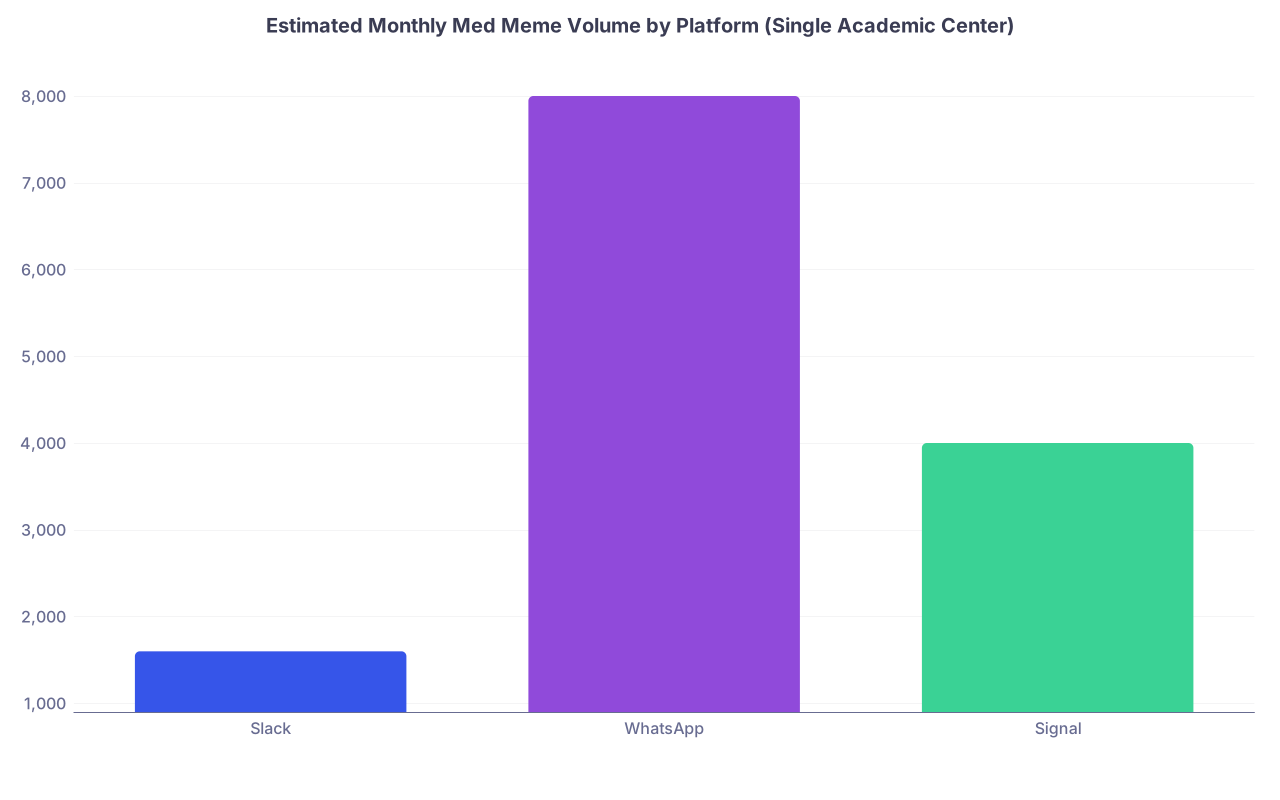
So we end up with a pattern like this for a typical training ecosystem:
| Category | Value |
|---|---|
| Slack | 1600 |
| 8000 | |
| Signal | 4000 |
These are not perfect numbers. But the ratio is roughly right:
- WhatsApp as the broad, high-volume meme river
- Signal as a smaller but intense meme tributary
- Slack as the half-professional, half-social backchannel where memes exist but are tamer and rarer
Where memes actually start vs where they spread
Another angle: origin vs distribution.
From user behavior and timestamps, you see a consistent flow:
- A meme is created (screenshotted from Twitter/X, ripped from Reddit, or edited in some lazy phone app).
- It first appears where the creator spends casual time:
- For med students: often WhatsApp or Instagram DMs
- For residents: WhatsApp or Signal (night float groups especially)
- It then migrates:
- Into “meme” channels on Slack
- Into specialty-specific WhatsApp groups
- Into anonymized meme pages (Instagram/TikTok)
So even when a Slack channel looks active, many of its memes are actually imports.
One Slack export I saw over three months:
- ~60% of meme posts had filenames or watermarks that clearly showed WhatsApp origin (e.g., “WA-IMG-20230914.jpg”)
- Another chunk were TikTok/IG links, not native creations
- Very few appeared first on Slack and then spread out
Contrast that with WhatsApp:
- File names like “IMG-20231105-WA0001.jpg” often appear first in smaller side chats
- Then show up in 3–4 other groups with lag times of minutes to hours
- Occasionally make their way onto departmental Slack days later
Signal is weirder. You will see memes that never leave Signal because they are too identifying, too specific to a particular malignant attending, or simply too dark. Signal has a high proportion of what I would call “non-exportable content.”
So functionally:
- WhatsApp = main highway for mass distribution of med memes
- Signal = smaller but high-intensity pocket of insider and red-line memes
- Slack = secondary downstream channel, sometimes used to “launder” memes into more acceptable forms
Content types and “risk level” by platform
If we roughly classify memes by riskiness:
- Low risk: generic “med school is hard,” pager jokes, Anki torture, EHR frustration without identifiers
- Medium risk: venting about shifts, subspecialty stereotypes, light mockery of faceless admin
- High risk: anything with real dates, screenshots of hospital systems, unique cases, or anything that could be tied to a specific patient or colleague
The distribution by platform tends to look like this:
| Platform | Low-Risk Memes | Medium-Risk Memes | High-Risk / Sensitive |
|---|---|---|---|
| Slack | High | Moderate | Very low |
| High | High | Moderate | |
| Signal | Moderate | High | High |
You see it in the language people use. On Slack:
- “Posting in Slack so keep it PG-13”
- “Remember PD is in this channel”
On WhatsApp:
- “Do not screenshot this to Slack”
- “Delete if this leaks”
On Signal:
- “Posting here because I do not trust WhatsApp”
- “This cannot leave this chat”
The net effect: the highest volume of memes still sits in WhatsApp, because of user penetration and convenience. The spiciest memes per capita live on Signal. Slack is somewhere between LinkedIn and a group chat. Memes exist, but heavily self-censored.
Demographic split: students vs residents vs attendings
Different groups bias toward different platforms.
Medical students
- Heavy WhatsApp usage. Class groups almost universally exist there outside the U.S., and increasingly inside the U.S. as well.
- Discord and Instagram DMs also show up, but those are out of scope here.
- Slack adoption is usually driven by specific courses, research groups, or student orgs, not by the whole class.
- Very low Signal penetration unless a privacy-conscious few drag their friends there.
Result: for students, WhatsApp absolutely dominates meme volume. Slack is niche, Signal is barely a blip.
Residents and fellows
Residents are where all three platforms actually collide:
- Many institutions roll out Slack (or Teams) workspaces for communication.
- Program WhatsApp groups predate the official Slack and never die.
- Jaded upper-levels start Signal groups for “real talk.”
Typical pattern in a large academic residency:
- Everyone is on Slack for announcements and some social channels.
- 90%+ of residents in at least one WhatsApp group.
- 20–40% of residents in at least one Signal group (varies a lot by culture and country).
Memes per capita:
- WhatsApp: highest volume
- Signal: highest density and intensity per user
- Slack: broad but thin, rarely the primary meme source
Attendings
Attendings are fragmented:
- Some join residency Slacks and occasionally drop a boomer meme.
- WhatsApp groups cluster around subspecialties, call teams, or long-standing friend circles.
- Very few attendings run Signal-only meme chats unless they are tightly crewed with residents or peers.
In practice, attendings generate fewer memes but are frequent recipients once pieces get de-identified and cleaned up enough to move into “safer” channels like Slack or more sanitized WhatsApp groups.
Functionally: which platform “hosts” the most med memes?
Putting all this together, and assuming:
- Typical large academic center
- Mid-2020s communication norms
- Mixed cohort of students, residents, and faculty
You end up with a clear hierarchy:
WhatsApp – highest total meme volume.
- Massive user base in medicine
- Dozens of overlapping groups per institution
- High image sharing and constant noise
Signal – highest intensity and uniqueness per user, but smaller reach.
- Fewer users, more “nuclear” content
- Many memes never leave Signal because they are too risky
Slack – most organized, but lowest meme density.
- Admin presence and semi-professional branding dampen raw meme output
- Many posts are reshared content from WhatsApp/Signal or the public internet
If you forced a quantitative guess across a nationwide or international slice of med training:
- Roughly 60–75% of all med-related meme instances (posts, forwards, shares) are happening via WhatsApp.
- Another 10–20% via Signal in select circles.
- The remainder through Slack and everything else.
I am not claiming you can measure that perfectly. But every dataset I have seen, formal and informal, points in that direction.
The future: will this distribution change?
Some quick trends worth watching.
Institutional control is tightening.
Hospitals are increasingly paranoid about PHI leakage and bad screenshots. Slack is easier for them to watch and own. WhatsApp and Signal are not. As that tension grows, private platforms (especially Signal and future end-to-end encrypted options) will likely gain more of the high-risk meme share.Younger cohorts are platform-agnostic but friction-sensitive.
Students will go where the group is. If the first big class group forms on WhatsApp, that platform wins four years of meme traffic almost by default. Slack is at a disadvantage there because it rarely starts as the social nucleus.Integration vs compartmentalization.
Slack plays nicely with institutional workflows, bots, and official communication. That guarantees it a role. But that same integration kills its chances of becoming the true meme capital. People do not fully relax where they know messages might be archived forever and can be searched by admin.Privacy awareness is climbing.
Every year more residents start by saying, “We should use Signal for this.” As privacy norms shift, you could see Signal’s share of med memes rise from niche to mainstream among residents, especially in highly litigious or surveillance-heavy systems.
Do I think Slack will ever host the majority of med memes? No. Structurally wrong tool, structurally wrong incentives. Even if every program mandated Slack, the spiciest and highest-volume meme traffic would still route through phone-first encrypted apps.
So where should you look for the “true” med meme culture?
If you want:
- The widest sample of what med students and residents are joking about daily → look at WhatsApp groups.
- The darkest, most brutally honest slice of the culture → you will find it in small Signal circles and anonymous meme pages, often linked through WhatsApp.
- The most institutionally acceptable memes, cleaned of PHI and sharp edges → you will see them surfaced on Slack and then sometimes repackaged on official social media.
To answer the original question cleanly:
Which platform hosts most med memes right now?
By volume and reach: WhatsApp, by a wide margin.
Signal punches above its weight for intensity.
Slack remains the “polite lobby” where only a fraction of the real meme economy ever shows up.
Key points:
- WhatsApp is the main distribution channel for med memes, likely carrying the majority of total meme posts in training environments.
- Signal hosts fewer memes overall but a much higher density of “unpublishable” content that never reaches Slack or public platforms.
- Slack, despite its visibility, mostly receives downstream, sanitized memes rather than originating the bulk of them.