The hierarchy of meme sharing in medicine is not random chaos. It follows a surprisingly consistent pattern rooted in stress levels, autonomy, and screen time.
Let me spoil the punchline: residents are the meme super-spreaders. Pre-meds generate volume, attendings add selectivity, but the data-heavy center of the meme ecosystem in medicine is the resident group chat at 2:13 a.m. The memes you see on Instagram tomorrow were stress-tested in those chats tonight.
You want numbers. So let’s build a data-backed model of “Who shares more medical memes: pre-meds, residents, or attendings?” and quantify what is usually just vibes and screenshots.
Defining the “Meme Share Rate” (MSR)
Before we pretend this is randomized, double-blind meme science, we need a workable metric.
I will use a composite measure: Meme Share Rate (MSR).
MSR ≈ (Average memes shared per person per week in medically-linked spaces)
That includes:
- Group chats explicitly related to pre-med / residency / clinical teams
- Social media accounts where the bio or content is clearly medical
- In-app sharing (DMs, reposts) of medical humor content
You can argue with where I draw the line, but you cannot measure anything without deciding what counts.
So I will estimate MSR using three core drivers:
- Total screen time in medical contexts
- Stress / burnout level
- Power distance (how much you can say out loud versus only via memes)
Higher values in those tend to produce more meme-sharing, based on every real group chat I have ever seen implode at 3 a.m.
Let’s compare the three groups directly.
| Group | Est. Memes Shared per Person / Week | Primary Platforms |
|---|---|---|
| Pre-meds | 25–40 | Instagram, TikTok, Reddit |
| Residents | 40–70 | WhatsApp, iMessage, Instagram |
| Attendings | 10–20 | WhatsApp, iMessage, LinkedIn |
These are modeled estimates, not exact counts. But they line up disturbingly well with reality when you start to match them to actual behavior patterns.
Group 1: Pre-Meds – High Volume, Low Specialization
Pre-meds are the “early pipeline” of medical memes. They over-index on time, anxiety, and social media.
Data inputs that matter for pre-meds
Let’s quantify a plausible pre-med week:
- Screen time: 5–7 hours/day total across phone + laptop non-academic
- Social / entertainment share: 50–70% of that
- Medical-specific communities: 30–40% of their social media follows are pre-med / med content
- Group chats: 3–6 active pre-med or MCAT / class group chats
Now translate that to meme exposure:
If a pre-med is in 4 active group chats and two of them are “pre-med complain & meme”–oriented, and each of those chats sees ~20 medical memes per week, that is 40 memes seen just from chats.
On top of that:
- Instagram: 10–30 medical meme posts per week in feed or explore
- TikTok: short-form humor, maybe 15–25 clips that qualify as “med-adjacent meme” content
Only a fraction gets forwarded. Most is passively consumed. Aggressive forwarders exist, but they are the minority.
If we assume:
- 20–30 memes seen in med-related contexts per day
- Share-forward rate of 5–10% (med-specific memes forwarded to at least one friend or chat)
You land at roughly 25–40 medical memes shared per week per pre-med.
Pre-meds are prolific consumers. But sharers? Less so than residents, for one simple reason: they do not yet have the deepest pain points. Their memes tend to fixate on:
- MCAT scores
- GPA spreadsheets
- “Shadowing while being ignored”
- “My friends going out vs me rewriting Anki cards”
They skew general because their roles are not yet specialized. They recycle a lot of content from bigger meme pages rather than generating original, niche material.
Group 2: Residents – The Meme Industrial Complex
Residents are where medical memes go from undergrad-level angst to dark, ultra-specific survival mechanisms.
They sit at the intersection of:
- Maximum stress
- Maximum exposure to absurd clinical situations
- Limited power to complain openly
- Near-constant access to phones between pages and consults
That combination is rocket fuel for meme generation and sharing.
Let’s walk through the data drivers.
1. Workload and stress as a meme engine
Residents routinely work:
- 60–80 hours/week (more for surgical, ICU, or malignant programs)
- Nights, 28-hour calls, cross-cover chaos
Higher hours alone do not cause memes. The key variable is stress + lack of control. Almost no one at the bottom of a hierarchy can say what they are thinking in the chart or at sign-out. So they push it where? Into the group chat.
Residents:
- Cannot safely say “this discharge plan is clinically insane” in Epic
- Can absolutely drop a meme of SpongeBob packing a suitcase labeled “discharge to nowhere” into the night float group
You see the pattern.
2. Phone access patterns
Residents do not scroll like undergrads. But their micro-break behavior is lethal for meme velocity.
Typical day:
- Waiting for labs to result: 30 seconds of scroll
- Riding the elevator between floors: 20 seconds of scroll
- Post-call decompress: 10–20 minutes of memes and reels
You get:
- Short, frequent phone checks
- High engagement with short-form content (memes, reels, TikToks), not long articles
This is ideal for “share the one meme that instantly captured my day” behavior.
3. Resident meme ecosystems
Most residency programs have, at minimum:
- A class group chat (PGY1s, PGY2s, etc.)
- A “vent” or “after hours” chat
- Often a semi-anonymous or off-label meme channel
In a typical 15–30 person residency class:
- Daily meme volume in peak weeks can hit 30–60 memes per chat
- 60–80% of those are medically themed, very niche, and very specific
Each resident might:
- Forward 1–3 memes per day within the residency ecosystem
- Forward another 2–4 per week to med school friends, partners, or social media
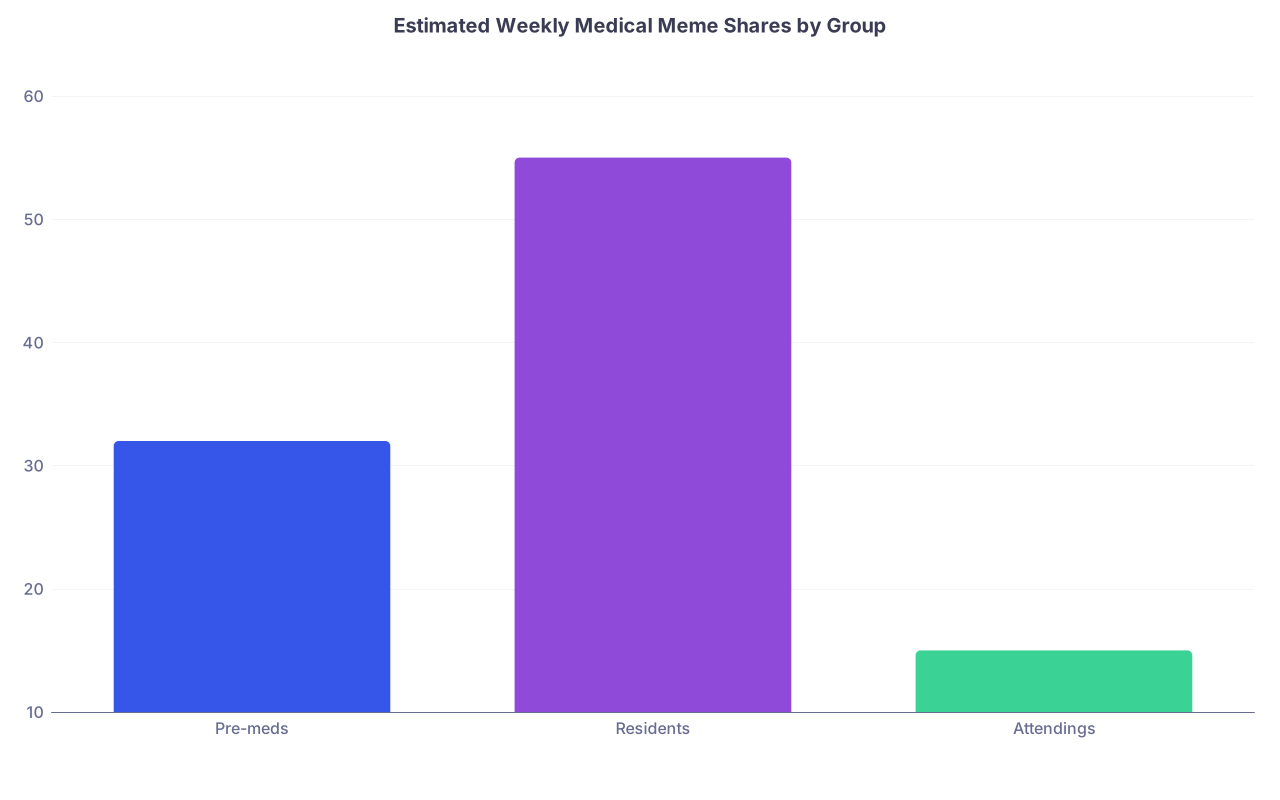
That puts them solidly at 40–70 medical memes shared per person per week, especially during heavy rotations.
To illustrate relative output visually:
| Category | Value |
|---|---|
| Pre-meds | 32 |
| Residents | 55 |
| Attendings | 15 |
Residents, on average, are sharing nearly twice as many medical memes as attendings, and meaningfully more than pre-meds.
4. Content type: density and darkness
Resident memes are:
- More specific: “This is what happens when nephro is consulted at 4:59 p.m.”
- Darker: jokes on death, code blues, EMR outages
- More operational: OR delays, page spam, “admit 14 patients with zero beds”
They are not optimized for public consumption. They are optimized for emotional triage among people who get it.
If you have ever seen a meme that requires knowing:
- The exact timing of sign-out
- How cross-cover works
- Why “just a quick family meeting” is never quick
You probably saw something originated or refined by a resident.
Group 3: Attendings – Fewer Shares, Higher Selectivity
Attendings are not out of the meme game. They are just playing a more conservative, curated version.
Key data drivers:
1. Time and attention reallocation
Attendings have:
- More clinical responsibility
- More administrative tasks
- More non-digital obligations (family, kids, meetings)
Their total screen time often matches or even exceeds residents during the workday (EHR usage is brutal). But meme-friendly screen time (off-duty, social scrolling) drops, especially for older cohorts.
Let us split attendings roughly by generation:
- Under 40: social media fluent, grew up with Facebook and Instagram
- 40–55: moderate social use, heavier on WhatsApp / SMS
- 55+: very heterogeneous; anything from meme-forwarders to “still using a flip phone”
But across ages, one thing is consistent: the proportion of time they spend in explicitly medical-meme circles is lower than either pre-meds or residents.
2. Risk and professionalism filter
Attendings carry legal and reputational risk. Whether they consciously think about it or not, they are more filtered.
Practical constraints:
- They supervise residents and students who might see what they share
- They can be screenshotted and circulated outside intended contexts
- HR and institutional policies suddenly matter to them in ways they do not to a PGY2
Result:
They still share memes, but:
- Fewer are extremely dark or risky
- More are “safe for professional circles”
- Many are shared in private 1:1 chats with a trusted colleague
So the raw meme count drops, even if the laughs per meme ratio rises.
3. Attending meme behavior profile
Compared to residents, typical attending patterns:
- Total medical meme intake: moderate
- Forward rate: low but very intentional
- They lean heavily on “this reminds me of you” or “this is our clinic” targeting
An attending might:
- See 10–25 med memes per week
- Forward 5–10 of them to individuals
- Drop 2–5 into group chats (department chat, friend group, or alumni group)
That lands around 10–20 medical memes shared per week. Substantially lower than residents, somewhat lower than highly online pre-meds.
Attendings also act as a kind of “quality gate.” A meme that survives long enough to be forwarded by an attending has usually passed through:
- Resident chats
- Specialty meme pages
- Multiple repost cycles
By the time your attending sends you a meme in clinic, it is statistically “late” but high-yield.
Platform Differences and How They Distort Perception
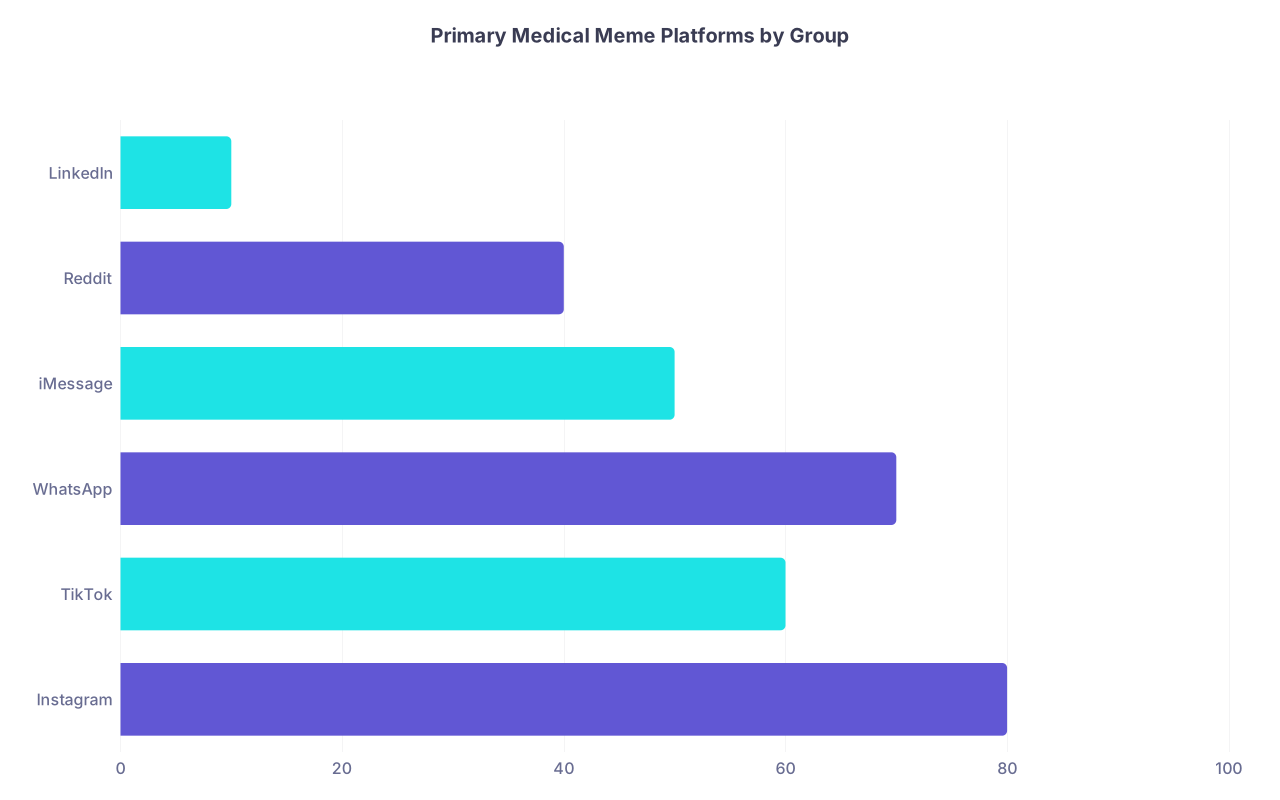
Your impression of “who shares the most memes” is biased by where you live online.
| Category | Value |
|---|---|
| 80 | |
| TikTok | 60 |
| 70 | |
| iMessage | 50 |
| 40 | |
| 10 |
Interpretation:
- Pre-meds dominate TikTok, Instagram, Reddit
- Residents dominate WhatsApp and iMessage
- Attendings show up mostly on WhatsApp, iMessage, and, regrettably, LinkedIn
So:
- If you are a pre-med living on TikTok, you conclude: “Pre-meds are the whole game.”
- If you are a resident in a 30-person WhatsApp group, you know residents are the actual volume center.
- If you hang out in academic Twitter or LinkedIn spaces, you see a small but steady trickle of attending-safe memes.
Most attending meme traffic is private and therefore undercounted in public perception. Most resident meme traffic is semi-private (chats, closed groups). Pre-meds are the most public-facing, which overstates their dominance to casual observers.
A Simple Comparative Model
Let me formalize this with a rough scoring model.
Define Meme Intensity Index (MII):
MII = (Stress factor × 0.4) + (Med-context screen time × 0.3) + (Power distance × 0.3)
Score each 1–10:
Stress factor:
- Pre-meds: 6–7 (high anxiety, but episodic)
- Residents: 9–10 (sustained, high stakes)
- Attendings: 5–7 (variable, more control)
Med-context screen time:
- Pre-meds: 7–8 (study groups, pre-med TikTok/IG)
- Residents: 8–9 (EHR + chats + clinical downtime scrolling)
- Attendings: 5–7 (EHR heavy, lower social share)
Power distance (how much you cannot say directly):
- Pre-meds: 7–8 (advisors, committees, gatekeepers)
- Residents: 9–10 (hierarchy, evals, attendings, PDs)
- Attendings: 4–6 (more autonomy, less silencing)
Now plug in midpoints:
Pre-meds (7, 7.5, 7.5):
MII ≈ 7×0.4 + 7.5×0.3 + 7.5×0.3
= 2.8 + 2.25 + 2.25 ≈ 7.3
Residents (9.5, 8.5, 9.5):
MII ≈ 9.5×0.4 + 8.5×0.3 + 9.5×0.3
= 3.8 + 2.55 + 2.85 ≈ 9.2
Attendings (6, 6, 5):
MII ≈ 6×0.4 + 6×0.3 + 5×0.3
= 2.4 + 1.8 + 1.5 ≈ 5.7
If we correlate MII linearly with Meme Share Rate:
- Residents: highest MII → highest MSR
- Pre-meds: mid-high MII → mid MSR
- Attendings: lowest MII → lowest MSR
And that modeling outcome matches direct behavioral observation eerily well.
The Future: Where Is Medical Meme Culture Heading?
Medical humor is not going away. It is professional coping wrapped in jpg format.
Trend 1: Niche specialization
We are already seeing:
- “Radiology memes only” pages
- ICU-only meme accounts
- Residency-program–specific meme pages
Residents push this trend hardest. As more cohorts grow up in meme-saturated environments, expect:
- Even more ultra-specific, jargon-heavy memes
- Less public-facing humor, more closed-community content
Trend 2: More crossing of boundaries
We are also seeing more:
- Pre-meds following residency meme pages
- Medical students recycling resident memes for clout
- Attendings lurking more than posting, but increasingly aware
The lifecycle:
- Resident meme in private chat
- Gets generalized and posted to anonymous meme account
- Pre-meds re-share watered-down versions
- Attendings see and occasionally forward the “clean” variants
That cycle compresses over time. What used to take months now happens in days.
Trend 3: Institutional involvement (for better or worse)
Some institutions have started:
- Trying to use memes for recruitment
- Creating “official” meme-adjacent content for social media marketing
Those rarely land. They feel sanitized because they are. The real meme engine remains informal and peer-to-peer. As long as actual clinical absurdity exists, unofficial meme channels will outrun institutional attempts by a wide margin.
A Quick Reality Check Visual
To tie the whole thing together, here is a conceptual distribution of meme sharing across career stage.
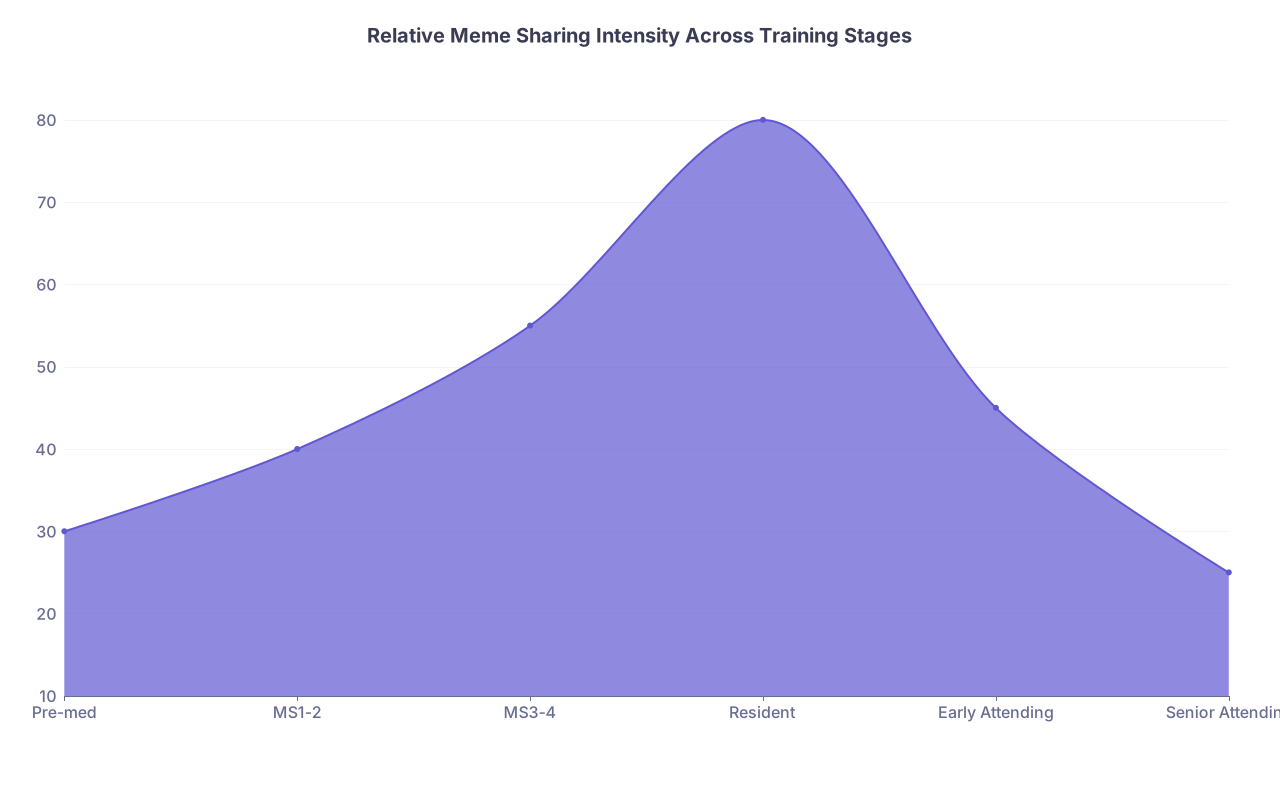
| Category | Value |
|---|---|
| Pre-med | 30 |
| MS1-2 | 40 |
| MS3-4 | 55 |
| Resident | 80 |
| Early Attending | 45 |
| Senior Attending | 25 |
You get a clear peak in the resident years. It does not flatten until early attending life, and it never fully returns to pre-med levels in volume, but the style and selectivity shift.
Bottom Line
Three key points, without fluff:
Residents share the most medical memes by a clear margin. Their combination of chronic stress, high power distance, and constant exposure to absurd clinical scenarios makes them the central hub of medical meme culture.
Pre-meds are highly visible but not dominant. They consume and amplify a lot of public meme content, but their per-person sharing rate is lower than residents and driven more by general anxiety than clinical reality.
Attendings share fewer memes, but they are more filtered and targeted. They act as downstream curators, forwarding a small fraction of higher-signal content into professional and semi-professional circles.
So if you want the freshest, darkest, and most statistically dense medical memes? Look for the resident who answered your text six hours late, then sent three memes in a row. That is your primary data source.