
What do you do when the whole team laughs at your “joke”… and the only person not laughing is the patient?
If you’re even slightly funny in normal life, you’re at high risk on the wards. Because you will eventually try to be witty at the bedside. And if you are not careful, it will go badly. Not “oops” badly. Career‑limiting badly.
This is the part almost nobody warns you about: the most dangerous thing you bring to the hospital is not your lack of knowledge. It is your untested sense of humor in a high‑stakes environment.
Let’s walk through the traps. Where med student comedy blows up most often. What it looks like in real life. And how to avoid becoming the story that gets retold in resident workrooms for the next five years.
The Core Misunderstanding: Your Audience Is Not Your Friends
The biggest mistake is simple: you think the hospital is an extension of your social life. It is not.
With friends, you have shared context. You know their politics, traumas, boundaries, and what they find funny. On the wards, you know almost nothing about anyone’s internal world. Yet students routinely talk as if they do.
Common misplaced assumptions that cause disasters:
- Assuming shared cultural references
- Assuming shared politics or beliefs
- Assuming shared irreverence about illness, death, or the system
- Assuming “we’re all tired so dark humor is fine”
You are wrong on all four. Frequently.
I have seen a student try a “Grey’s Anatomy” joke about interns hooking up in the call room… in front of a chief resident whose spouse caught them cheating during residency. Stone face. Instant dislike.
You overestimate how much people “get you” and underestimate how much they’re evaluating you. Attendings are not just hearing your words. They are filing impressions: judgment, professionalism, respect for patients.
Your default assumption must be: nobody shares your humor style, and your joke will land with the most humorless person in the room.
If that sounds harsh, good. It should.
The High-Risk Zones: Where Jokes Go To Die
Some settings are almost guaranteed to amplify any misstep. These are places where your comedy should be on a strict lockdown.

1. Bedside on Rounds
This is where most students blow it. They forget the patient is not an extra in the scene; they are the main character.
The classic mistakes:
- Making the team laugh about the patient in front of them
- Using sarcasm the patient cannot decode
- Trying to “lighten the mood” when the patient has not consented to levity
Example:
Attending: “This is a tough infection; we might need a longer course of IV antibiotics.”
Student, trying to be cute: “So… you are not getting out of here that easily!”
Team: brief chuckle.
Patient: looks down, clearly deflated.
You just turned a clinical plan into a punchline about their lack of control.
If the patient is in the room, your primary job is clarity and respect. Not entertainment. If you are tempted to joke, ask yourself one question: “If this were my parent in the bed, would I want someone to say this?”
If the answer is anything but an immediate yes, swallow it.
2. Pre‑op, Post‑op, and Any Procedure Area
People are scared and vulnerable. Sedation is involved. Clothing is minimal. Families are anxious.
And students think now is the time for:
- “At least you get a good nap out of it!”
- “We have done this a thousand times… only lost power three times!”
- “You will be fine; our surgeon has only had like two malpractice suits.”
The patient remembers none of the physiology you explained. They remember that line.
You must treat pre‑op and procedures as humor‑restricted zones. If an attending or anesthesiologist uses gentle, clearly appropriate humor to calm someone, you are not automatically invited to join the bit. They have clinical authority, relationship, and years of reading patients. You do not.
3. The OR
Students hear surgeons making sharp, dry, sometimes brutal jokes with each other and think, “This is how I belong here.”
No. That is how you get blacklisted.
Common OR comedy failures:
- Joking about blood, anatomy, or “gore” like it is a movie
- Laughing too hard at gallows humor that attendings use sparingly
- Making any comment about the patient as a person while they are anesthetized
- Trying to be witty on the first day you scrub with a team
The hierarchy in the OR is brutal and very real. Your job is to signal judgment, not personality. You can be warm. You can be normal. You cannot try stand‑up on the Mayo stand.
4. Charting Areas and Workrooms (Where You Think It Is Safe)
Students often assume that if the patient is not physically present, anything goes. They forget about:
- Thin walls
- Family hovering outside the door
- HIPAA
- The attending you did not realize was in the corner
- The off‑service consultant listening silently
I have heard:
- A student doing a mocking impression of a patient’s accent in the hallway.
- A student joking about “frequent flyers” within earshot of a patient’s daughter.
- A student laughing about a patient’s bizarre story while that patient was quietly in the next bay, curtain drawn.
Every one of those stories ended the same way: complaint + bad eval + reputation damage. Sometimes across multiple departments.
Types of “Humor” That Almost Always Go Wrong
Some categories are so consistently toxic they deserve to be called out directly. If you recognize yourself in any of these, fix it now.
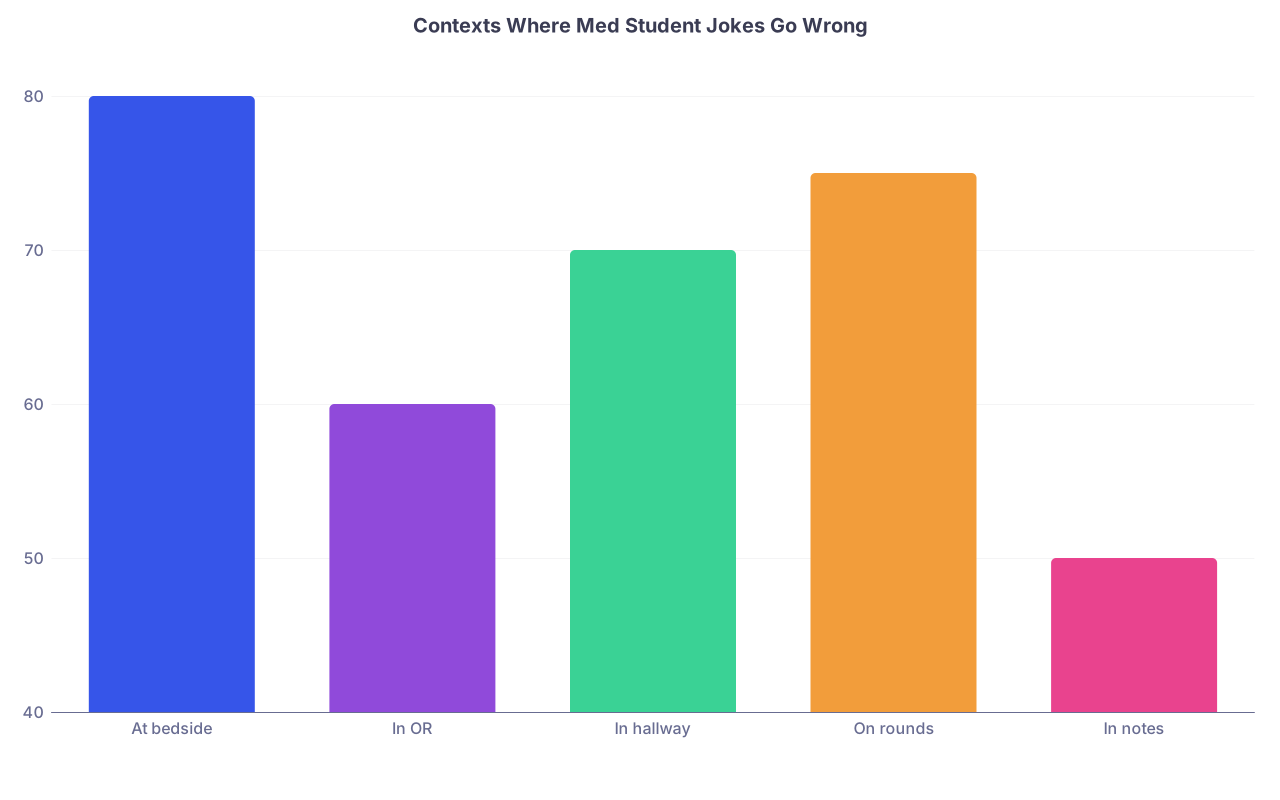
| Category | Value |
|---|---|
| At bedside | 80 |
| In OR | 60 |
| In hallway | 70 |
| On rounds | 75 |
| In notes | 50 |
1. Mocking or Imitation Humor
Any humor where the joke is “this person is ridiculous and I am not” is a time bomb in medicine.
Mocking voices, accents, mannerisms, beliefs, or body shapes is not edgy. It is unprofessional. It is also lazy comedy.
Even if your target is a colleague and not a patient, bystanders hear: this person feels comfortable tearing others down. That does not inspire trust with confidential, vulnerable people.
Reality: attendings and residents routinely decide who they would trust with a complex, emotionally intense patient. If you sound like the kind of person who will go to the workroom and perform a reenactment, you will not be chosen.
2. Dark Humor About Death, Suicide, or Tragedy
Let me be precise. Dark humor is real in medicine. People use it to cope. I have heard trauma surgeons say things that would horrify outsiders.
Here is the difference:
- They say those things quietly, to colleagues they know, in private, away from patients, families, and students.
- They do not perform dark humor in front of people still learning where the lines are.
Med students who try to join that club too early often misjudge the tone. They crack a joking reference to “bed 8 circling the drain” loud enough for a nurse or relative to hear. Then they discover that not everyone shares their coping style.
If you need dark humor to survive emotionally, keep it in therapy, in private group texts with trusted peers, or not at all. Do not test new material at the nurse’s station.
3. Self‑Deprecating Humor That Undermines Trust
You think you are being relatable. “I am just a useless med student, haha.” Or, “Well, I have no idea what I am doing but I will try!”
Patients do not always hear the joke.
They might hear: the people involved in my care do not know what they are doing, and nobody is in control. That is not funny when you are intubated, in pain, or terrified.
Light, controlled self‑deprecation can work with colleagues after you have proven you are competent. For students, it usually just reinforces the suspicion that you are in the way.
4. Punching Down at “Non-Compliant” or “Difficult” Patients
Med student comedy disaster classic:
- “I mean, if he does not want to take his insulin, we can just save the bed for someone who cares.”
- “She says she cannot stop smoking; I wish someone would tell my loans that.”
You sound judgmental, detached, and frankly cruel. You also reveal that you do not understand social determinants of health, addiction, or trauma. That is not a good look in 2026.
The blunt truth: many attendings will decide your capacity for empathy based on how you talk about challenging patients when you think nobody important is listening. This is how.
Attending and Resident Humor: The Worst Thing To Copy
Students see attendings making jokes and assume, “If they do it, it is okay for me.”
No. There are real differences:
- They have pre‑existing relationships with staff and sometimes with patients.
- They have decades of context and usually know what they’re doing.
- They carry the risk; you piggyback on their authority without the same skin in the game.
- They are being judged less harshly than you, because they are already established.
| Scenario | Attending | Resident | Med Student |
|---|---|---|---|
| Light joke with long-term patient | Sometimes okay | Rarely, if known | Almost never |
| Dark humor in private workroom | With trusted peers | With trusted peers | Extremely risky |
| Sarcasm on rounds | Occasionally | Rarely | Do not do it |
| Jokes about system/administration | Carefully | Carefully | Avoid |
Do some attendings abuse this? Absolutely. There are toxic role models who use humor to bully, belittle, or show off. If you mimic them, you will not be seen as “one of them.” You will be seen as unprofessional. They are insulated by power. You are not.
If you feel pressure to participate in a joking culture to “fit in,” your safest move is to stay slightly under‑reactive. Small smile. Maybe a brief chuckle. No added commentary. No tag‑on joke.
You can be “in on” the moment without adding fuel.
Humor That Accidentally Becomes Documentation
Here is a newer, underappreciated trap: anything you say in front of others can be referenced, repeated, or even end up in the chart.
Examples that have backfired:
- Student joking in front of family: “Yeah, grandpa is our favorite bed blocker!” Family later writes that down word‑for‑word in a complaint letter.
- Student “jokingly” documents in a note: “Patient appears to be milking symptoms for Dilaudid.” That note is now a legal document.
- Student says on bedside rounds, “We all know the diet thing is not happening,” and the patient later quotes that in a message to the hospital.
There is no such thing as a purely throwaway line in a clinical setting. People remember. People write. People sue.
How To Use Humor Safely Without Being a Robot
You do not have to be humorless. You just have to be very selective. Think surgical precision, not shotgun blast.

| Step | Description |
|---|---|
| Step 1 | Want to make a joke |
| Step 2 | Do not say it |
| Step 3 | Say it gently and watch response |
| Step 4 | Use mild, neutral humor only |
| Step 5 | Is patient present |
| Step 6 | Is joke about illness, death, body, or care |
| Step 7 | Have you built rapport over days |
| Step 8 | Would this be ok with your own parent |
| Step 9 | Are staff only audience |
| Step 10 | Is joke mocking patients or colleagues |
Safer directions to channel your humor:
Situational absurdity about the system, not the patient
“We printed this on three different forms and five people signed it, so naturally the scanner jammed.”Shared student struggles, when you are alone with peers
“I spent thirty minutes memorizing this rash description and then the patient refused to take off the blanket.”Gentle, humanizing bedside warmth, not jokes
- Light comments on your own coffee addiction
- Brief, sincere encouragement
- Noticing something the patient clearly enjoys (“That is a serious crossword. You are way ahead of me.”)
If you are going to use humor with patients at all, it should:
- Never be about their diagnosis, body, or prognosis
- Never be sarcastic
- Never put you in the center of attention
- Always be easy to retreat from if they do not smile
Watch their face. If you see even a flicker of confusion or discomfort, that is your cue to drop it immediately.
Personality vs. Professionalism: You Do Not Have To Choose
The fear some students have is: if I never joke, I will seem stiff, fake, or boring. That is not actually what happens.
What people really want from you:
- Predictability
- Emotional control
- Respectful curiosity
- Clear communication
You can show those while still being human. Warmth does not require comedy.
Small, safe ways to show personality:
- Asking patients about their hobbies and listening like you care
- Reacting with genuine amusement when they make a joke, without trying to top it
- Sharing one or two small, neutral details about yourself if it builds trust (“My dad also hates hospitals, so I get it.”)
You do not need to be “the funny student.” Frankly, that label usually does more harm than good. Be the student who never makes the room worse. Every team values that.
When You Already Messed Up: Damage Control
You will slip at some point. You will say something you wish you could vacuum back into your mouth. The question is whether you handle it like an adult or double down.
If the patient looks hurt or confused:
- Stop talking. Do not keep explaining the joke.
- Apologize plainly. “I am sorry, that came out wrong. I did not mean to make light of what you are going through.”
- Redirect to their concerns. Ask a practical clinical question or clarify the plan.
If a resident or attending calls you out:
- Do not defend the joke.
- Say, “You are right, that was inappropriate. It will not happen again.”
- Then actually make sure it does not happen again.
The worst move is to roll your eyes or act like everyone is too sensitive. That tells them your judgment is the real problem, not just the joke.
The Future of Med Student Humor: It Is All On Record
You are training in an era of:
- Constant phones
- More vocal patients and families
- Higher scrutiny of professionalism
- Digital trails that do not vanish
Jokes in hallways can end up on TikTok. “Private” resident‑student banter can be recorded. That snarky comment in chat during a virtual lecture can be screenshot and emailed to the dean.
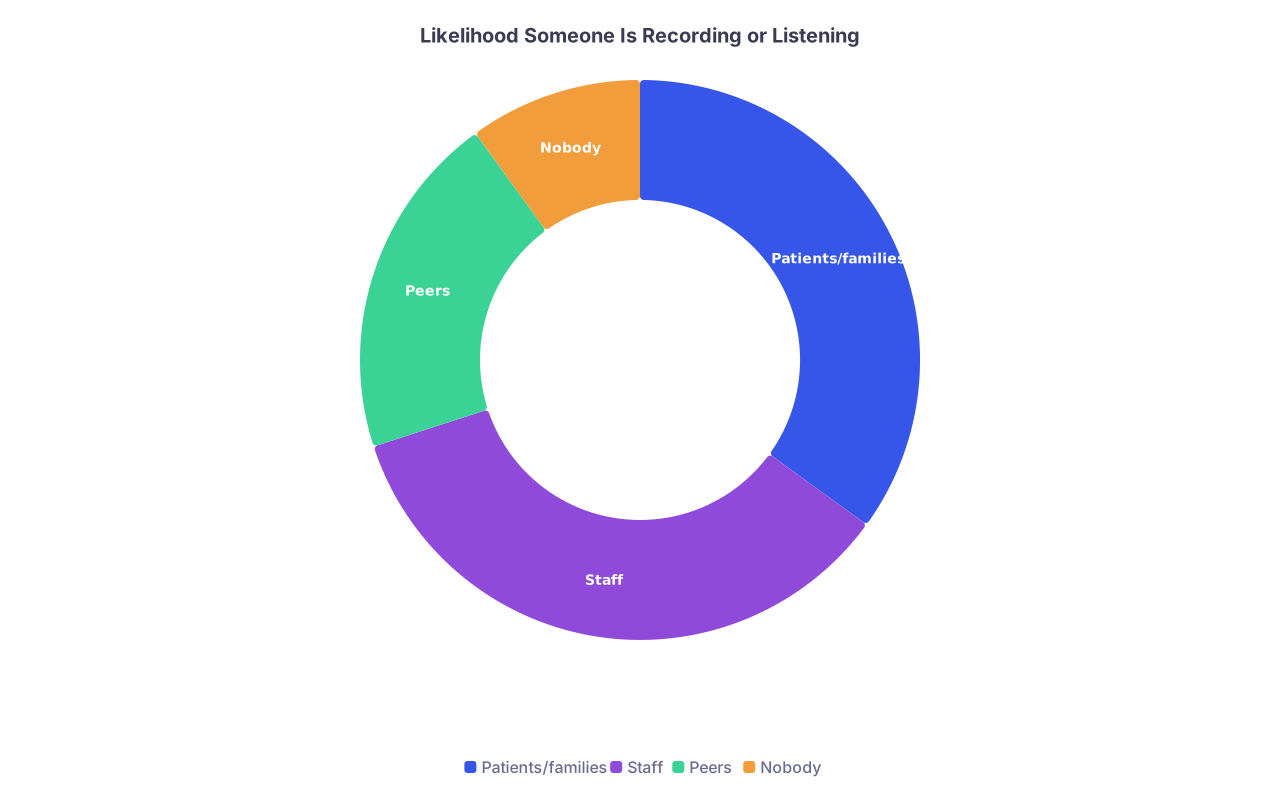
| Category | Value |
|---|---|
| Patients/families | 35 |
| Staff | 35 |
| Peers | 20 |
| Nobody | 10 |
So the bar is higher than it was 20 years ago. Old attendings will tell stories about jokes they made that would get them fired today. They are not wrong.
You are not allowed to practice like it is 1995. You are responsible for the environment you are training in now.
—
Key Points To Remember
- Your sense of humor is not automatically safe in clinical spaces; assume your audience does not share your context or tolerance.
- Never joke about patients’ illnesses, bodies, or prognoses, especially at the bedside or within earshot; mocking or dark humor almost always backfires for students.
- You are judged more harshly than attendings and residents; resist the urge to copy their edgy jokes and aim to be the person who never makes the room worse.