
The OR is funnier than the call room for one simple reason: hierarchy turns into theater the second the scrub nurse says, “Scalpel.”
When you’re not the intern, you finally get to enjoy the show.
The OR vs. Call Room: Different Kinds of Misery
The call room is where humor goes to die at 3:47 a.m.
The OR is where people weaponize humor to survive eight-hour cases, passive-aggressive attendings, and a pager that won’t shut up.
On paper, the call room should be hilarious. Overtired residents, bizarre consults, text chains, terrible cafeteria food. In reality, it’s mostly you, horizontal, questioning your life choices while an admitting resident screams on speakerphone about “one more chest pain rule-out.”
In the OR, though, there’s structure. Timing. Roles. There’s a captive audience who can’t walk away because they’re literally scrubbed in and sterile. And that’s exactly why it ends up being funnier—if you’re not at the absolute bottom of the food chain.
The intern doesn’t get the joke. The intern is the joke.
Everyone else? They’re doing improv backed by anesthesia gas and ketamine.
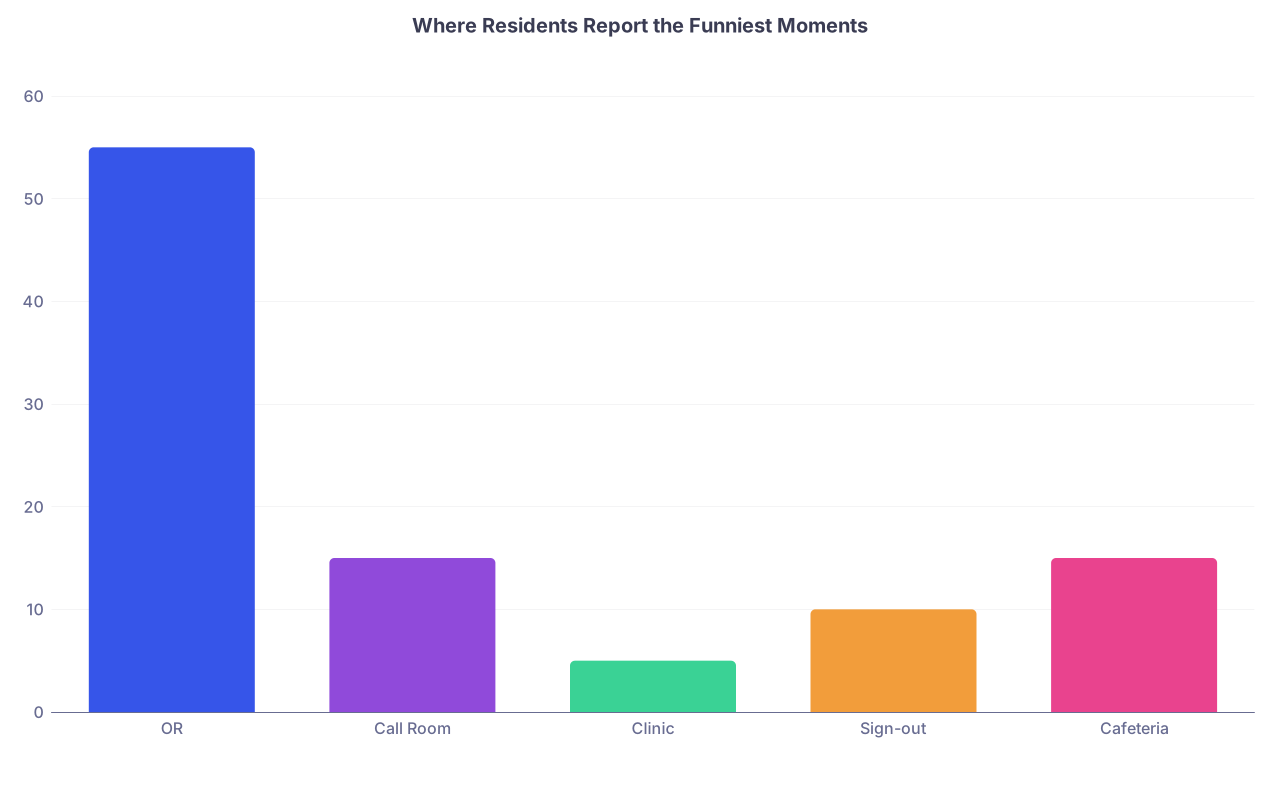
| Category | Value |
|---|---|
| OR | 55 |
| Call Room | 15 |
| Clinic | 5 |
| Sign-out | 10 |
| Cafeteria | 15 |
Why the OR Becomes Comedy Central (Once You’re Not the Sacrificial PGY-1)
Let me tell you what actually happens behind those double doors.
1. Everyone’s Trapped — So the Banter Has to Be Good
In the OR, nobody can storm off mid-conversation. You’re scrubbed, gowned, gloved, and tethered to the table by suction tubing and cords.
That changes how people talk.
Attendings who are marble statues on rounds suddenly start workshopping tight five-minute sets about their fellowship director from 1998. CRNAs will roast your knot tying like they’ve been waiting all week. Circulators will absolutely call you out if you say something idiotic.
The trapped factor makes everything sharper, quicker, and weirder. There’s nowhere else to put your attention. So the random comment about what playlist is on or the way the attending says, “Knife,” becomes a running gag that lasts four hours.
Call room “humor” is scattered, diluted, constantly interrupted by pages, cross-cover, and sleep deprivation. In the OR, people commit to bits.
I’ve seen a vascular attending spend a full laparotomy narrating the case as a cooking show:
“Now we’re going to gently sear this artery… see that? Golden brown, that’s what we like.”
It would’ve been dumb on the wards. In the OR, the scrub tech was crying laughing and anesthesia almost dislodged the tube because they were shaking.
2. Anesthesia Is Basically Stand-Up on a Stool
You know who really sets the tone? The anesthesiologist or CRNA. They’re the only ones who can sit down, sip coffee, and scroll their phone while you’re elbow-deep in someone’s abdomen.
So they get bold.
They make the quiet jabs:
- “Did you mean for the blood pressure to be 60?”
- “Just let me know when you want the patient to have a pulse again.”
- “Do you want me to give drugs, or are we just hoping?”
Are they actually worried? Not usually. If they are worried, they go dead silent. So when they’re playful, that’s your green light that things are under control.
In the call room, people vent about anesthesia. In the OR, anesthesia is half the comedy team.
I saw a CRNA once, during a routine lap chole, pull up Yelp: “Hey, doc, patient lives five minutes from here. Nearest restaurant with a 3.5-star rating or higher?”
The attending: “Why?” CRNA: “Because if this operation takes as long as your last hernia, I’m ordering DoorDash.”
You can’t get material like that in the call room. Too chaotic, too transient. The OR is live theater with recurring cast members.

| Step | Description |
|---|---|
| Step 1 | Intern |
| Step 2 | PGY 2-3 |
| Step 3 | Senior Resident |
| Step 4 | Fellow |
| Step 5 | Attending |
| Step 6 | Quiet, laughed at |
| Step 7 | Occasional one liners |
| Step 8 | Controls vibe |
| Step 9 | Weaponized sarcasm |
| Step 10 | Stories and roast rights |
Why It Sucks When You’re the Intern
Make no mistake. The OR is not funny when you’re the intern. It’s about you, not for you.
Here’s the real hierarchy nobody spells out during orientation.
You Are the Designated Punching Bag
Not always malicious. But absolutely real.
You’re the one:
- Retracting in a shoulder position that will give you neuropathy by PGY-3
- Getting blamed (jokingly… “jokingly”) for the missing stitch
- Being told, “Don’t contaminate… again” loud enough for everyone to hear
Everyone else’s humor runs through you. You’re the reference point.
Even the jokes that sound “light” land heavy when you’re terrified of making a mistake.
“Don’t worry, the intern doesn’t need fingers after residency,” hits differently when you’ve been standing still for 3 hours and can’t feel your hand.
The call room, for the intern, at least has occasional solidarity. Another intern who’s also drowning. Maybe a senior who tosses you a line. It’s bleak, but it’s not performative bleak.
In the OR, you’re performing under stage lights. There’s a sterile drape, a literal spotlight, and someone staring over your shoulder at your every move. That amplifies every joke at your expense.
So yes, the OR is funnier—just not to you. Not yet.
You Don’t Get the References
Real insider humor is layered. It references:
- That one disastrous case from three years ago
- The attending’s residency in the 90s
- The time anesthesia accidentally extubated the patient and pretended it was “planned”
As an intern, you don’t have this shared history. So the room howls, and you force a polite laugh while trying not to drop the DeBakey.
In the call room, the jokes are more your speed. “The ED consulted me for toe pain” is intern-level comedy. It’s surface-level, but at least you understand it.
In the OR, it’s callbacks and roast culture. You will not be in on it for a while.

The OR Humor Ecosystem: Who Does What
Let me walk you through the real cast list.
Attendings: Storytellers and Executioners
There are two main attending species.
- The Storyteller
They do entire monologues while suturing: old-school residency horror tales, fellowship gossip, who slept where on call in the ‘80s. They’ll roast former trainees by name. They’ll tell you exactly who cried during a vascular clamp and which chief “never made it to attending level.”
They are the backbone of OR humor, and once you’re senior enough, they will absolutely roast you to your face and then take you out for coffee.
- The Executioner
No jokes. Just sharp one-liners that make the whole room freeze.
Resident: “Do you want 3-0 or 4-0?” Attending: “I want someone who knows what they’re doing, but I guess that’s off the table.”
Everyone laughs. Nervously. And you, as the intern, reconsider your career.
But once you’re a senior, watching that same attending push a new intern to sweat and then later say, “You did fine, don’t overthink it,” is darkly entertaining. Because you survived it. That’s the psychological shift.
Residents: The Glue (and the Real Comics)
PGY-2 to PGY-4 is peak OR humor.
You’re competent enough not to be terrified. Still junior enough to be appropriately cynical. You’ve seen enough insanity to have material. And you know who you can joke with and where the lines are.
By the time you’re a senior:
- You set the music
- You cue the attending stories
- You protect the intern when the jokes start cutting a little too deep
- You fire shots at anesthesia about how “some of us are working”
The call room rarely gives you that. Everyone’s scattered, someone’s crying over a note backlog, someone’s on tele hold for 30 minutes. The rhythm just isn’t there.
In the OR, the senior resident is basically the host of a very niche, medically unsafe comedy show.
Nurses and Techs: The Unfiltered Chorus
If you want unvarnished truth with a punchline, listen to the scrub tech.
They’ve seen classes of residents cycle through. They remember all your worst days. They know which attending is all bark and which one you should genuinely fear.
They’ll drop lines like:
- “I like this intern. They’re less useless than the last one.”
- “Oh good, this attending. My blood pressure just went up.”
- “If I see that suture handed like that again, I’m walking out.”
Said with a smirk. Half-joking. Half not.
In the call room, you’re mostly with other trainees. In the OR, you have multi-generational commentary. That’s why the humor has bite; there’s institutional memory behind it.
| Location | Type of Humor |
|---|---|
| OR | Roasts, war stories |
| Call Room | Trauma bonding |
| Clinic | Dark, quiet sarcasm |
| Rounds | Repressed suffering |
| ED | Pure chaos |
The Patient Is Asleep, So Everyone’s Real
Here’s the slightly uncomfortable truth: people are their most honest in the OR once the drapes are up and the patient is asleep.
That’s when you hear:
- What they actually think about hospital administration
- Which consultant is “dead to them” after a bad handoff
- The real story behind the “complication that just happened to happen”
- Opinions about new residents, including you
You don’t get that honesty in the call room as much. Too many people come and go. Too many phones, too many interruptions. You never quite get into deep, unfiltered mode.
In the OR, you’ll see an attending who was rigid and cold on the wards suddenly:
- Tell you about missing their kid’s recital
- Trash a policy the department publicly supported
- Admit which case still wakes them up at night
And five minutes later, they’re making a joke about your tremor while you tie a knot.
The emotional whiplash is brutal at first. Once you’re not the one in survival mode, it becomes… weirdly funny. In that “we’re all broken but at least we’re honest about it here” way.

| Category | Value |
|---|---|
| Grand Rounds | 10 |
| Clinic | 30 |
| Call Room | 50 |
| OR, Patient Awake | 60 |
| OR, Patient Asleep | 90 |
Why the Call Room Loses by Comparison
The call room is where you go to collapse, not to perform.
Yes, people in the call room say ridiculous things:
- “If I get one more ‘just reorder the labs’ page, I’m moving to dermatology.”
- “If you code in the next two hours, I’m going to be so pissed, I just sat down.”
- “How is it only 2 a.m.?”
But the call room has three problems:
- No captive audience. People fall asleep mid-conversation. They’re half-texting, half-documenting. Nobody’s locked in.
- Constant interruption. Pages, overhead calls, admissions, nurses needing orders. Punchlines get cut off. Stories get derailed.
- Everyone’s too tired to build anything. Humor in the call room is mostly exhale, not creativity. It’s raw, but it’s rarely clever.
The OR, especially on a well-run service with a tight team, gives you time. Case flows, hands know where to go, the attending trusts the resident. That’s when the banter, the stories, the subtle digs—those all get layered in.
The intern only notices the stress. Everyone else notices the show.

When You Finally Cross the Line From Target to Participant
There’s a very specific moment in training when the OR becomes funnier than the call room for you personally.
It’s the day an attending:
- Makes a sharp joke
- The room laughs
- And instead of wanting to disappear, you fire something back
Just a little. Just enough.
Not disrespectful. But witty, fast, confident.
And the scrub tech smirks.
And anesthesia chuckles.
And the attending pauses, looks at you, and goes, “…Alright.”
That’s when you’ve arrived.
You’re no longer just surviving. You’re part of the culture.
That never happens in the call room. You don’t get a ceremonial initiation. One day you’re just slightly less tired than the others.
In the OR, the shift is obvious:
- They’ll ask your music preference
- They’ll reference an old case you did together and include you in the story
- They’ll roast someone else in front of you and expect you to keep up
That’s when you start dreading call and looking forward to the OR day, even if it’s longer, more intense, technically harder. Because the misery is structured. The humor is better. And you’re finally not the designated sacrifice.
How to Survive the OR as the Intern (So You Live Long Enough to Laugh)
You’re not going to be the funny one early. Do not try to be. Funny interns who don’t know when to shut up get buried.
But you can position yourself so that when the time comes, you’re ready.
Three rules:
Read the room before you say a word.
If the attending is silent and anesthesia isn’t chirping, this is not your stage. Retract, learn, keep your comments for the call room group chat.Be competent first, then mildly funny.
No one laughs with the intern who can’t load a needle or pass a stitch. Nail the basics. Once people trust your hands, you can get away with a quiet one-liner here and there.Remember: everyone remembers their own intern years.
Even the worst attending was once the shaking PGY-1 holding a retractor for six hours. A surprising number of them are gentler when they sense you’re trying, not showboating. Quiet resilience is noticed. And later, it’s rewarded—with inclusion in the joking, not exclusion as the punchline.
You will eventually sit in that OR, hear some new intern get roasted the same way you did, and catch the eye of a nurse who was there three years ago.
And you’ll both laugh. Because now it’s funny.