
The fastest way to get a reputation as “that student we’re not inviting back” is not bad notes, not slow presentations, not even missing a lab value. It’s a joke in the wrong room.
Let me say it bluntly: the unwritten rules of humor in medicine are stricter than anything in your student handbook. And they’re enforced ruthlessly, quietly, and permanently—on your evals, in rank meetings, in side conversations that you will never hear.
You’re not being told this clearly, so I will.
Why Humor Is Dangerous Currency in Medicine
On paper, every school talks about “wellness” and “humor to prevent burnout.” Attendings tell stories at grand rounds and people laugh at horrific cases like it’s open mic night. You see dark memes in resident group chats that would get you expelled if they leaked.
Then you walk onto the wards as an MS3, crack the wrong joke once, and suddenly the vibe changes. Everyone is “professional” with you. Your name comes up in the mid-rotation eval meeting tagged with a little phrase: “questionable judgment.”
Once that label lands, it sticks.
The ugly truth is this: attendings and program directors absolutely distinguish between “insiders” who can use dark humor and “outsiders” who have not earned that privilege. Students are firmly outsiders until proven otherwise. Residents are only half-insiders. And even attendings can get burned if they misread the room.
Humor is hierarchy-sensitive. It’s context-sensitive. And it’s career-sensitive.
So I’m going to walk you through the no-go zones—the places where jokes sound harmless in your head but land like a grenade in the real world.
The Core Rule: You Can Be the Joke. Patients Cannot.
If you remember only one line from this entire thing, make it this:
You can joke at your own expense. You cannot joke at a patient’s expense. Ever. Not even “lightly.”
That’s the bright line every serious clinician knows, even if they still cross it in private. Let me be real: people absolutely do vent, and yes, some of it is dark. But those conversations are not for you. They’re not for anyone outside a closed, trusted circle.
So when you’re thinking of making a joke, ask yourself a brutal question:
“Who’s the punchline?”
If it’s a patient, a family, a marginalized group, or someone with less power than you, that joke is radioactive.
If it’s you, your fatigue, your imposter syndrome, your clumsiness, your own specialty, your own school—safer territory.
Most students screw this up the first time by mimicking things they’ve heard from burned-out residents. They hear someone joke, “This guy is a total train wreck,” or “The frequent flyer is back,” and think they can add a line.
They cannot.
A resident saying, “This admission list is killing me,” is venting up the hierarchy. A student chiming in with, “At least this guy’s drunk enough not to notice,” is volunteering their lack of judgment.
People notice the difference instantly.
No-Go Zone #1: Jokes About Patient Death, Codes, and Bad Outcomes
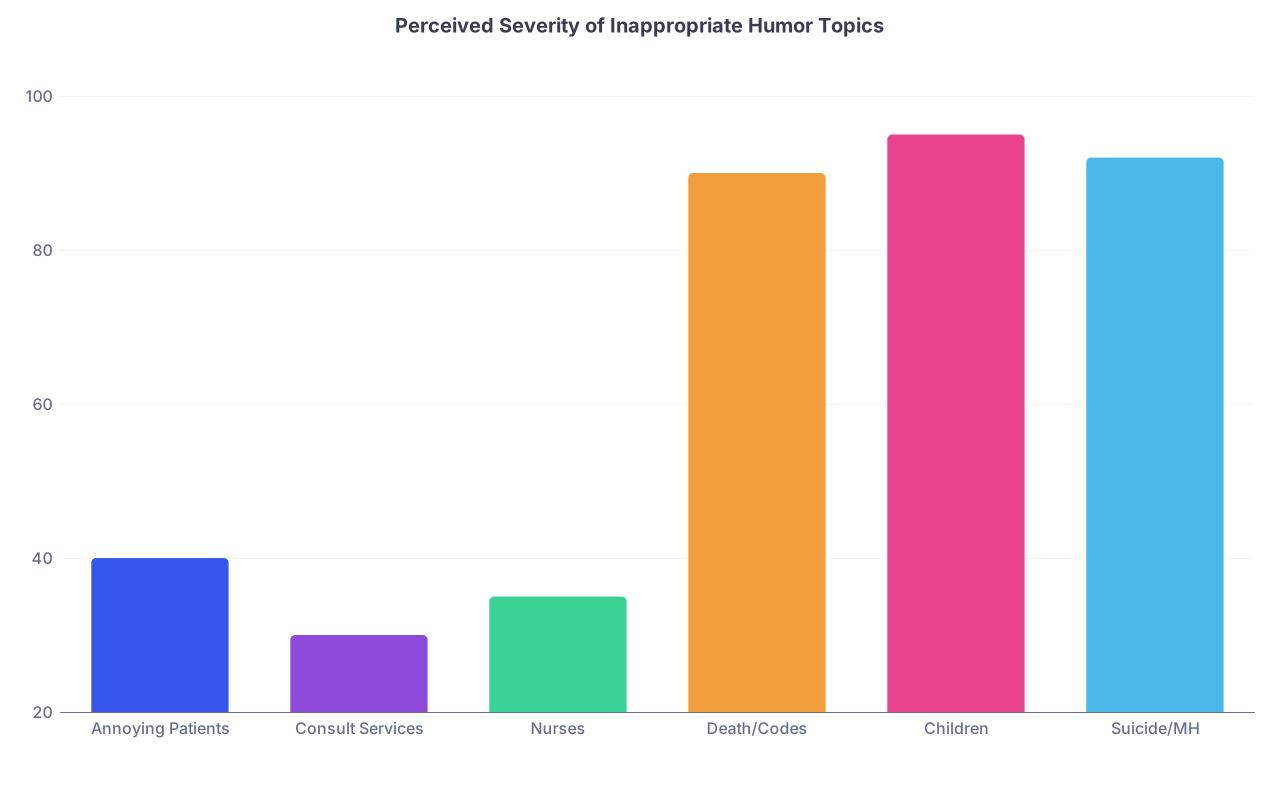
| Category | Value |
|---|---|
| Annoying Patients | 40 |
| Consult Services | 30 |
| Nurses | 35 |
| Death/Codes | 90 |
| Children | 95 |
| Suicide/MH | 92 |
Let me tell you what actually happens after a code where the patient dies.
The code team disperses, everyone’s adrenaline is high, someone says something to break the tension. An attending mutters, “Well, that went well,” with gallows irony. People chuckle, half from shock, half from exhaustion.
You, the med student, think, “This is how we cope here.”
You are wrong.
In closed-door debriefs and evaluation meetings, the same attending who made that quip will say, “Also, that student laughed pretty loudly right after the time of death. I’m not sure they get the gravity yet.”
And just like that, your “fit for the profession” becomes a discussion item.
This is one of the most strictly policed unspoken rules: you do not joke around codes, deaths, bad outcomes, or anything involving end-of-life. You may see residents do it among themselves, especially at 3 a.m. in a call room. You may even see attendings do it. That does not make it safe for you.
Absolute no-go for you as a student:
- Anything even lightly humorous about time of death, mortality, or “one less patient on the list”
- Comments about how a code improved your procedure numbers or made your night “less boring”
- Sarcastic remarks when a family is grieving—even if you think they’re not in earshot
I’ve seen a student laugh nervously (not maliciously, just awkwardly) right after a failed resuscitation while the team was still in the room. The intensivist didn’t say a word to them. Just wrote in the eval: “Concerning emotional response after patient death. Needs significant maturation.”
That student did not get a strong letter from what should have been their best ICU rotation.
If you don’t know what to do with your face and body after a bad outcome, default to silence, soft voice, neutral expression. You’re allowed to be human and shaken. You’re not allowed to be comic relief.
No-Go Zone #2: Pediatric Anything, Ever
Peds and OB are the two rotations where humor missteps get remembered for years.
Nobody, and I mean nobody, finds humor about sick children acceptable outside of the darkest, most private corners of long-term teams. Those jokes don’t leave the hallway. They don’t go to the lunch table. They absolutely don’t get shared with students.
You’re coming in for 4–6 weeks. You haven’t watched a kid slowly get better or worse over months. You haven’t sat for three family meetings in a row. You don’t get to make a single joke that touches a pediatric patient’s suffering.
No “At least this one is small so it’s easier to intubate.”
No “NICU babies look like aliens.”
No “The parents are crazier than the kid.”
This is how attendings hear it:
“Lacks empathy. Doesn’t understand longitudinal suffering. Immature.”
The brutal part? You might think you’re being obviously sarcastic. They will not care.
On peds, your humor can be self-deprecating (“Apparently I can’t use an otoscope without poking my own eye”) or purely silly in a kid-friendly way if you’re actually interacting with the child (“My stethoscope is secretly a baby dragon, can I check your heart?”).
But anything that sounds even slightly like you’re making light of the child’s condition, disability, or prognosis—off-limits.
I sat in a peds residency selection meeting where an otherwise good candidate got absolutely shredded because of a single line noted by an attending: “Made an inappropriate joke in the workroom about a child’s feeding tube.” The student thought they were being funny. The attending wrote a paragraph about “lack of emotional attunement.”
The candidate didn’t match there.
No-Go Zone #3: Mental Health, Suicide, and Substance Use
You grew up with meme culture where “I want to die lol” is just background noise. That style of humor does not translate cleanly into medicine. On the wards, mental health isn’t a meme; it’s the core diagnosis for a huge percentage of admissions and consults.
You can’t come into psych clinic, see a packed schedule, and say, “Wow, everyone’s crazy today.”
You can’t finish rounds on three suicide attempts and mutter, “Well, that’s one way to get out of finals.”
You may think it’s obvious that you’re not serious. Your attending is not evaluating your meme fluency. They’re evaluating your professional filter.
Psych attendings are especially attuned to this. They pay attention to your language. They notice when you say “crazy,” “psycho,” “nutcase,” or “failed suicide” instead of “suicide attempt.” Jokes that play off those words become evidence that you “don’t quite get it.”
Here’s the really harsh little secret: a lot of your supervisors have had their own mental health crises, or lost colleagues and relatives to suicide. They will not necessarily tell you that. They’ll just quietly decide they don’t trust your judgment or your empathy.
This doesn’t mean you need to walk around joyless. You can joke about how confusing the psych medication cross-titration chart is. You can joke about your own brain feeling “fried” after reading five consult notes in a row. But you never make a patient’s mental illness the punchline.
Same goes for substance use. The “frequent flyer” drunk in the ED that everyone groans about? That’s one of the fastest places for students to burn themselves. An attending might vent, “He’s back again.” A student saying, “We should just put his name on a bed plaque” is crossing a line they don’t see.
No-Go Zone #4: Nurses, Techs, and “The Team Below You”
You want one sentence that will instantly expose you as someone the attending shouldn’t trust?
Make a joke that punches down at nursing.
Every program director I know has a mental blacklist that starts with: “Disrespects nursing staff.”
The politics here are simple. Attendings know the nurses are the ones who will quietly tell them if a resident or student is unsafe, arrogant, or dismissive. If you crack jokes that make nurses the punchline—even if they laugh along at the moment—you’re playing with matches in a room full of oxygen.
That includes:
- Making fun of a nurse’s page as “unnecessary” in front of others
- Joking that nursing is just “doctor’s orders with extra steps”
- Sarcastically mimicking a nurse’s concern in the workroom
You might hear residents grumble or joke sideways about a particular nurse or unit. Do not assume you can join in. A resident with a two-year history on that floor has relational capital. You, as a student, have none.
Keep your humor horizontal or upward. You can joke with nurses about your own clumsiness, your handwriting, how you’re the least competent person in the room. That’s fine. It shows humility. But the minute you start mocking their work or role, you’ve made yourself a liability.
And believe me, nurses talk. If they decide you’re a problem, that absolutely trickles into “off the record” comments to attendings and chiefs.
No-Go Zone #5: Identity-Based Humor (Race, Gender, Religion, etc.)
This is the one that gets people professionally killed, even if they thought they were being “on the same side.”
I’ve watched a student try to make a “light” gender joke to a female surgical attending. He thought it was bonding, like “We all know surgery’s still a boys’ club, right?” She smiled tightly, switched him off her service the next week, and wrote: “Lacks insight into gender dynamics, made inappropriate comment in OR.”
These are landmines:
- Any joke referencing race, ethnicity, or accents—even if you share that identity
- Any joke about gender stereotypes in particular specialties
- Any joke about patients “from that neighborhood” or “that culture”
- Any humor about religious practices, dress, or beliefs
Here’s the part nobody tells you: medicine has a long, dirty history with all of these issues. The attendings you’re working with have lived through offensive “jokes” their entire careers. They’ve stopped calling them out every time because they’d never get any work done.
But they remember who keeps doing it. And they remember which students don’t.
Even if you and a co-resident share an ethnicity and joke privately about it, doing it in mixed company as a student is a bad bet. People in the room may not know your relationship. They just hear a med student making identity-based jokes and file that away under “potential professionalism problem.”
No-Go Zone #6: Chart Humor, Documentation, and EMR
This one’s quieter but just as dangerous.
The chart is not your stand-up set. It’s a legal document. Anything you put there as a joke can (and has) shown up in courtrooms.
I’ve literally seen a student type “LOL” into a sign-out note. Another wrote, “Patient joined the frequent flyer club again.” The senior scrubbed it, then brought it straight to the attending. That student was pulled aside, then pulled off the rotation.
Here’s the behind-the-scenes rule: any shred of flippant language that survives into the chart is interpreted as unprofessional at best, malicious at worst.
Do not:
- Use sarcasm in notes (“Patient claims 10/10 pain yet seen laughing with visitors”)
- Put jokes in your assessment (“Plan: convince patient to stop being stubborn”)
- Use meme abbreviations or slang in any formal documentation
You think you’re being cute. Your faculty think you’re a malpractice risk.
No-Go Zone #7: Public Spaces, Elevators, and “Private” Hallway Jokes

You know where most HIPAA violations and professionalism complaints start? Not the OR. Not the ICU. The elevator.
You would be shocked how often I’ve heard some version of this:
Student: “At least that psych patient was entertaining.”
Random stranger in elevator: quiet.
Later that day: an email from Patient Relations about “unprofessional staff conversation overheard.”
You never know who is within earshot. That person in scrubs could be a family member. That “random” visitor could be a hospital board member. That person in jeans might be your dean’s spouse.
The unspoken expectation is: public spaces are patient-neutral zones. No joking about cases, no laughing about how wild your night was, no comment that could possibly be tied back to a patient or sensitive situation.
Attending-level people have stories burned into their memory: students making jokes in the lobby, in the cafeteria line, in the parking garage shuttle. Those stories get repeated at orientation talks—not with your name, but with your role: “The student who thought it was funny…”
If you wouldn’t be comfortable with a patient’s family hearing your comment word-for-word, don’t say it in a hallway or an elevator. You’re not that funny. It’s not worth it.
Where Humor Is Safer—and How to Use It Without Self-Destructing

| Step | Description |
|---|---|
| Step 1 | Start as MS3 |
| Step 2 | Use only self deprecating humor |
| Step 3 | Add neutral observational humor |
| Step 4 | Gauge team style quietly |
| Step 5 | Very mild dark humor about your own fatigue |
| Step 6 | Still avoid no go zones |
| Step 7 | Trusted by team? |
You don’t have to be a robot. The teams that feel best to work on use humor constantly—but it’s targeted carefully, and it’s built on trust.
Here’s where humor actually helps you:
- Jokes at your own expense. “I spent 20 minutes trying to find the CT images before realizing I was on yesterday’s patient.” That shows humility and insight.
- Shared suffering about the system. “Epic just ate my note for the third time, so if I start crying in the corner that’s why.” You’re punching up at bureaucracy, not at people.
- Light observational humor that doesn’t target anyone. “I swear the elevator knows when I’m late for pre-rounds.”
Residents and attendings remember students who could lift the team’s mood without making anyone the butt of the joke. They write those students up as “great team player, good sense of humor, mature.”
So when can you slightly deepen your humor? After:
- You’ve been on a team for at least a week
- People have started teasing you a little (in a kind way)
- You’ve shown you’re competent and not a walking disaster
Even then, you keep the no-go zones sacred. Your dark humor, if it exists, is about your own brain falling apart at 2 a.m., not the patient who coded at 2 a.m.
| Target | Safety Level |
|---|---|
| Yourself | Safer |
| EMR / bureaucracy | Safer |
| Weather / coffee | Safer |
| Other students (light, kind) | Usually safe |
| Patients / families | Dangerous |
| Nurses / staff | Dangerous |
The Hidden Evaluations: What Faculty Actually Write
Let me show you how this plays out in real eval language.
Nobody writes: “Student made a messed-up joke about a dying patient.” It comes out as:
- “Concerning judgment in emotionally charged situations.”
- “Occasionally insensitive in patient-related discussions.”
- “Needs to further develop professionalism and awareness of impact of words.”
Those phrases are kiss-of-death material in MS3/MS4 narrative evals.
Program directors read between the lines. When they see “insensitive,” “questionable judgment,” or “professionalism concerns,” they know there’s a story there. Your file goes into the risk pile.
And remember: you might never be directly confronted. Attendings hate having awkward conversations with students about borderline comments. It’s easier for them to smile, say nothing, and then quietly destroy you in the eval.
You walk away thinking, “Rotation went fine, they laughed at my jokes sometimes,” and then get blindsided by a lukewarm or poisonous narrative.
So assume this: if a joke feels even slightly edgy in your head, its written translation will be “professionalism concern.”
The Future: Humor, Burnout, and a Profession That’s Cracking
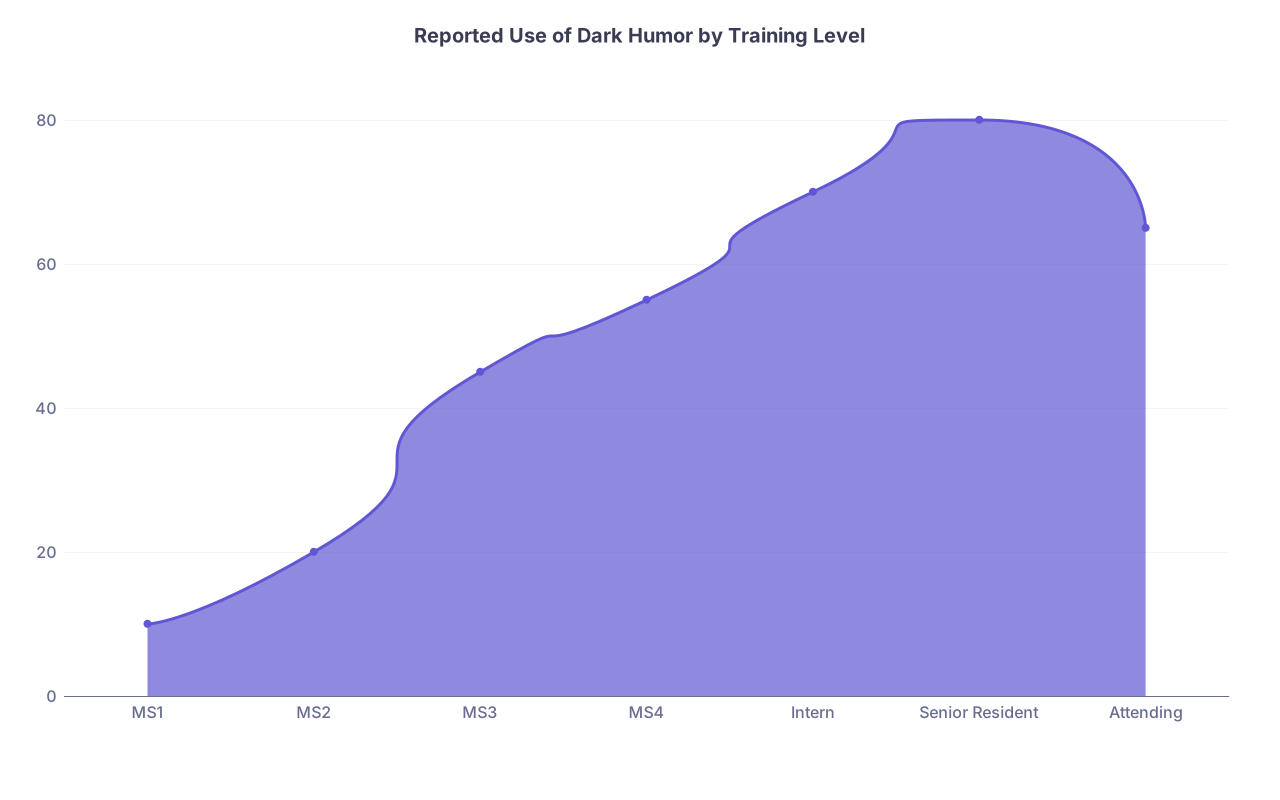
| Category | Value |
|---|---|
| MS1 | 10 |
| MS2 | 20 |
| MS3 | 45 |
| MS4 | 55 |
| Intern | 70 |
| Senior Resident | 80 |
| Attending | 65 |
Medicine is getting darker. Burnout is higher. Everyone’s coping mechanisms are getting more twisted. Dark humor is not going away; it’ll probably get worse.
But here’s the shift you need to understand: institutions are also getting more sensitive, more watched, more regulated. Patients, families, boards, and social media have eyes everywhere.
So you’re entering a system where the private humor is getting darker, but the tolerance for public missteps is shrinking. That’s the tension.
Long term, we’ll probably see more explicit teaching around “professional coping” and less of this hypocritical “we do it but you don’t” culture. But you’re training now, not ten years from now.
So play the game that exists, not the one that should.
You want to survive this profession with your humanity intact? Build a small, trusted circle away from patients where you can be honest, raw, and yes, occasionally dark. But do not confuse that with the wards, the workroom, or the chart.
On the record, in front of people who can hire or fire you, keep your humor sharp—but clean. Show that you get the gravity and you can still smile under it.
That’s the balance people are actually looking for.