
What happens to your “teaching scores” when your best teaching move is a TikTok-worthy one-liner during rounds?
You already know the folklore: “The residents everyone loves get the best evals.” And “everyone loves” usually means: funny, chill, self-deprecating. The human meme of the ward team.
Let me ruin the magic a bit.
The Myth: Humor = Better Evaluations
Ask around any academic hospital and you’ll hear some version of this:
- “Attendings love him — he’s hilarious.”
- “She gets insane evals because she keeps it light.”
- “If you want honors, just be funny and likable.”
That’s the myth: good humor magically upgrades your numbers. Too stiff? Average evals. Crack jokes? Suddenly you’re “role model educator, 5/5, would rotate again.”
There’s a grain of truth hiding in there. But it is not what most people think.
What actually shows up in the data is more boring, more uncomfortable, and more useful:
- Likeability matters a lot.
- Humor is only one of many ways to signal likeability.
- Evaluations are heavily biased by interpersonal stuff that has nothing to do with clinical ability.
- And yes, humor can backfire and tank you.
So no, “funny = better evals” is too simple. The reality is uglier and more nuanced.
What the Research Really Shows (On Likeability, Not Jokes)
Here’s the first problem: almost no one in the medical education literature is measuring “funniness” as a variable. Nobody’s doing RCTs of “dad-joke vs deadpan attending.”
But we do have a mountain of work on things that overlap with humor:
- “Teacher warmth”
- “Personability”
- “Approachability”
- “Enthusiasm”
- “Learning climate” or “psychological safety”
These are proxies. And they correlate strongly with better teaching and rotation evaluations.
Let me be blunt: if learners like you, your scores go up. Even if your teaching is mid.
There are multiple studies showing:
- Residents and attendings rated as “kind,” “supportive,” or “approachable” get higher overall teaching scores, even when objective knowledge or exam performance is similar.
- Global ratings from students and juniors are weakly correlated with actual clinical skills but strongly correlated with “professionalism” and “communication” as perceived by the learner.
- One classic meta-point in education research (not just medicine): student ratings of teachers correlate more with how much they enjoyed the course than how much they objectively learned.
Humor usually lives inside those traits. It’s often interpreted as:
- Confidence
- Warmth
- Social intelligence
- Safety (“I can ask questions without getting destroyed”)
So the real equation isn’t:
Funny ⇒ Good evals
It’s more:
Warm / likeable / safe ⇒ Good evals
Humor = one possible route to that, but not required
And yes, being awkward, cold, or intimidating will absolutely drag your scores down, even if you’re the best clinician on the floor.
Where Humor Helps (When It Actually Works For You)
Humor does some very specific heavy lifting on teams. When used well, it does things that directly influence how people evaluate you.
1. It lowers perceived hierarchy
Rounds are inherently lopsided. One person talks. Everyone else pretends to breathe normally while getting silently judged.
A resident who uses light, self-directed humor:
- “I also had no idea what to do as an MS3, so start there.”
- “My brain is at 50% battery, ask me anything while I’m still coherent.”
…signals: I’m not here to crush you. That directly increases psychological safety.
And we know from the data: psychological safety is one of the strongest predictors of learners’ satisfaction and perceived teaching quality. Not knowledge. Not number of chalk talks. Safety.
2. It makes teaching stickier
Every educator who’s actually taught at 2 a.m. knows this trick:
- You attach a weird or funny hook to a concept, and the learner remembers it.
- “Tamponade = ‘3 D’s: Distant, Decreased, Dying.’”
- “AKI consults: hydrate, hold, hope.”
Cognitive psychology backs this: emotionally salient, unusual, and humorous content is more memorable. That means when a student feels like they “learned a lot from you,” some of that is just because your jokes made the content easier to recall later.
And the evaluation often asks: “How effective was this resident as a teacher?” Perceived recall feeds directly into that answer.
3. It humanizes you in a dehumanizing system
Everyone’s tired, overpaged, and one weird code away from losing it.
A resident who occasionally uses humor to acknowledge the absurdity — not to mock patients, but to call out the system — gets framed as:
- Relatable
- “One of us”
- A buffer between juniors and chaos
That buys you a lot of goodwill. Goodwill turns into leniency. Leniency turns into: “Yeah, 5/5 overall.”
So yes — humor can help your evals. But only inside those channels: safety, recall, goodwill.
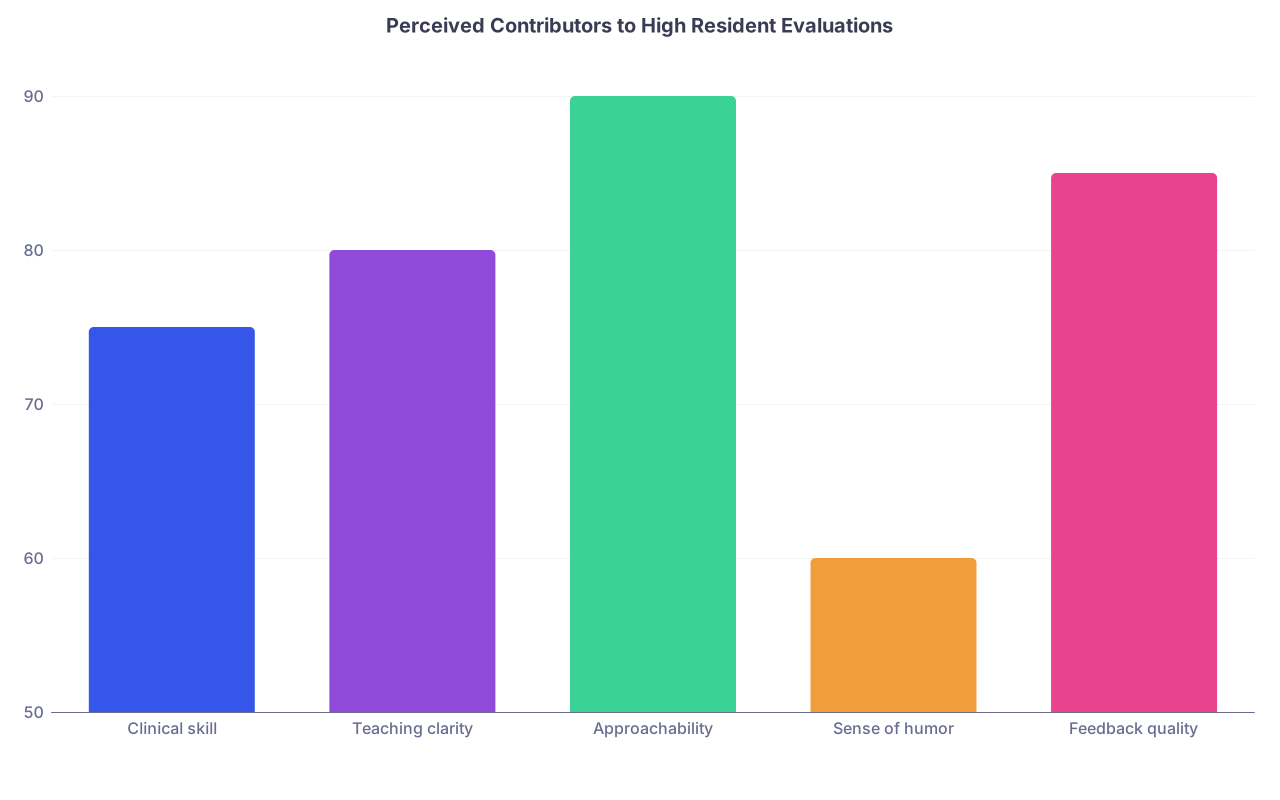
| Category | Value |
|---|---|
| Clinical skill | 75 |
| Teaching clarity | 80 |
| Approachability | 90 |
| Sense of humor | 60 |
| Feedback quality | 85 |
Where Humor Hurts (And Absolutely Tanks People)
There’s a darker side. I’ve watched residents who thought they were “the funny one” quietly get shredded in evals.
Patterns are predictable.
1. The punch-down comedian
You want a fast way to ruin your teaching reputation? Aim your jokes downward.
- Jokes about “weak” students
- Sarcastic comments about nurses
- Eye-rolling humor at consults
- Casual “roasting” during presentations
You might get a few laughs from peers. You will also get:
- “Creates an unsafe learning environment.”
- “Intimidating.”
- “Disrespectful.”
Even if one student laughs with you, they often still mark you down later. People do not like to formally reward someone who made them, or their peers, feel small.
2. The deflector
Another trap: using humor to dodge responsibility.
- A mistake happens: “Wow, guess I’m failing this block too, haha.”
- Feedback question: “Anything I can do better?” — “Besides buying everyone coffee every day.”
That reads as evasive. Supervisors and students both notice when humor is a shield against accountability. And many eval forms specifically ask about:
- “Accepts feedback”
- “Professionalism”
- “Responsibility”
Humor used to avoid serious discussion drops you right there.
3. The try-hard stand-up
Some people are naturally dry, or quiet, or just not comedic. When they force humor, it comes across as:
- Inauthentic
- Distracting
- Slightly cringe
Learners are not stupid. If they sense you’re trying more to be liked than to help them or the patient, you get coded as “performative” rather than “supportive.”
Reality: authenticity beats jokes. A calm, earnest, slightly boring resident who clearly has your back will usually score above the “intern trying to run a Netflix special on rounds.”

The Ugly Truth: Evaluations Are Biased, Full Stop
Let’s talk about the part no one likes to say out loud: resident evaluations are not objective instruments of truth. They’re an emotional snapshot filtered through bias.
The literature is very clear:
- Trainees tend to rate people higher when they’re similar to them (gender, background, communication style).
- Underrepresented residents often have to be both better and more “likable” to achieve similar impressions.
- Harsh graders are often simply people who did not “click” with the resident, regardless of actual performance.
So where does humor fit in?
Humor is a social tool for alignment. When it lands, it creates fast, superficial similarity: “You laugh at the same things I do; you must be my kind of person.”
Which means:
- If your humor style fits the dominant culture of your program, it amplifies your evaluations.
- If your humor style doesn’t match (different cultural references, different boundaries), the same attempt can get labeled “weird,” “unprofessional,” or “inappropriate.”
Same joke, different audience, different career impact.
That’s not fair. It is, however, real.
| Humor Style | Typical Evaluation Impact |
|---|---|
| Self-deprecating | Safer, often boosts likeability |
| Supportive/wholesome | Improves approachability scores |
| Sarcastic/punch-down | Harms professionalism/safety |
| Dark/edgy | Very audience-dependent, risky |
| Forced/try-hard | Often read as inauthentic |
How to Use Humor Without Letting It Use You
If you’re expecting some polished “Top 10 Tips To Be Funny On Rounds,” you’re missing the point. Humor is not the goal. It’s a tool — and a volatile one.
Here’s the more honest playbook.
1. Make “safe and respected” the baseline
If your team does not feel safe asking questions, your jokes will not save you.
Non-negotiables:
- Don’t mock learners, nurses, or other services.
- Don’t weaponize sarcasm about knowledge gaps.
- Don’t make patients the punchline, ever.
You can be funny around absurd documentation, EMR glitches, bureaucracy, pager hell. Laugh with people about the system, not at people inside it.
2. Use yourself as the primary target
Self-deprecating humor is generally the least risky:
- “If I fall asleep mid-sentence, just gently nudge me toward the coffee machine.”
- “I also used to think BNP stood for ‘Basically Not Predictive.’”
Here’s why it works:
- You lower your own status voluntarily.
- You signal vulnerability.
- You make it easier for learners to admit they don’t know something.
That directly feeds psychological safety. Which feeds good evaluations.
3. Tie humor to learning, not distraction
You want the eval line “exceptional teacher”? Make your humor functional:
- Mnemonics that are ridiculous but sticky.
- Stories that are funny but reinforce a clinical pearl.
- Light moments to reset attention before a complex teaching point.
The metric in your head should be: “Does this joke help them remember, or just pass 10 seconds?”

| Step | Description |
|---|---|
| Step 1 | Think of a joke |
| Step 2 | Do not say it |
| Step 3 | Probably skip |
| Step 4 | Go ahead |
| Step 5 | Who is the target |
| Step 6 | Supportive or mocking |
| Step 7 | Helps learning |
4. Watch the quiet ones
If your team laughs but one person stiffens, goes silent, or stops volunteering — your humor is not harmless.
Adjust. You’re not a stand-up comic chasing the loudest laugh. You’re running a micro-learning environment where one scared MS3 can undo your “everyone loves them” legend with one detailed eval.
5. Don’t use humor as personality spackle
If you’re disorganized, can’t give useful feedback, or clearly don’t know what you’re doing, all the jokes in the world won’t save your evaluations.
Residents get into trouble when they:
- Rely on humor instead of preparation.
- Try to “vibe” through a rotation they’re not clinically ready for.
- Assume being liked is enough.
Learners do actually notice when you’re clinically solid, thoughtful in your plans, and honest about your limits. Humor amplifies that. It doesn’t replace it.

The Future: Evaluations That Care Less About Your Personality (Maybe)
Let’s zoom out.
Humor is a personality trait and a social behavior. The more systems rely on global, subjective ratings, the more your personality — including humor — will skew your evaluations.
There’s a slow movement in medical education toward:
- More objective assessments (checklists, direct observation tools)
- Entrustable professional activities (EPAs)
- Multi-source feedback that separates “is this person kind” from “can this person manage a DKA safely”
As that grows, pure likeability — and therefore humor — should matter less to your official record.
But we’re not there yet. And even if we get closer, humans still write comments. Humans still advocate behind closed doors: “She was fantastic, I loved working with her.” Or: “He was…a lot.”
Those conversations are still shaped by the emotional experience of working with you. Humor will always live there.
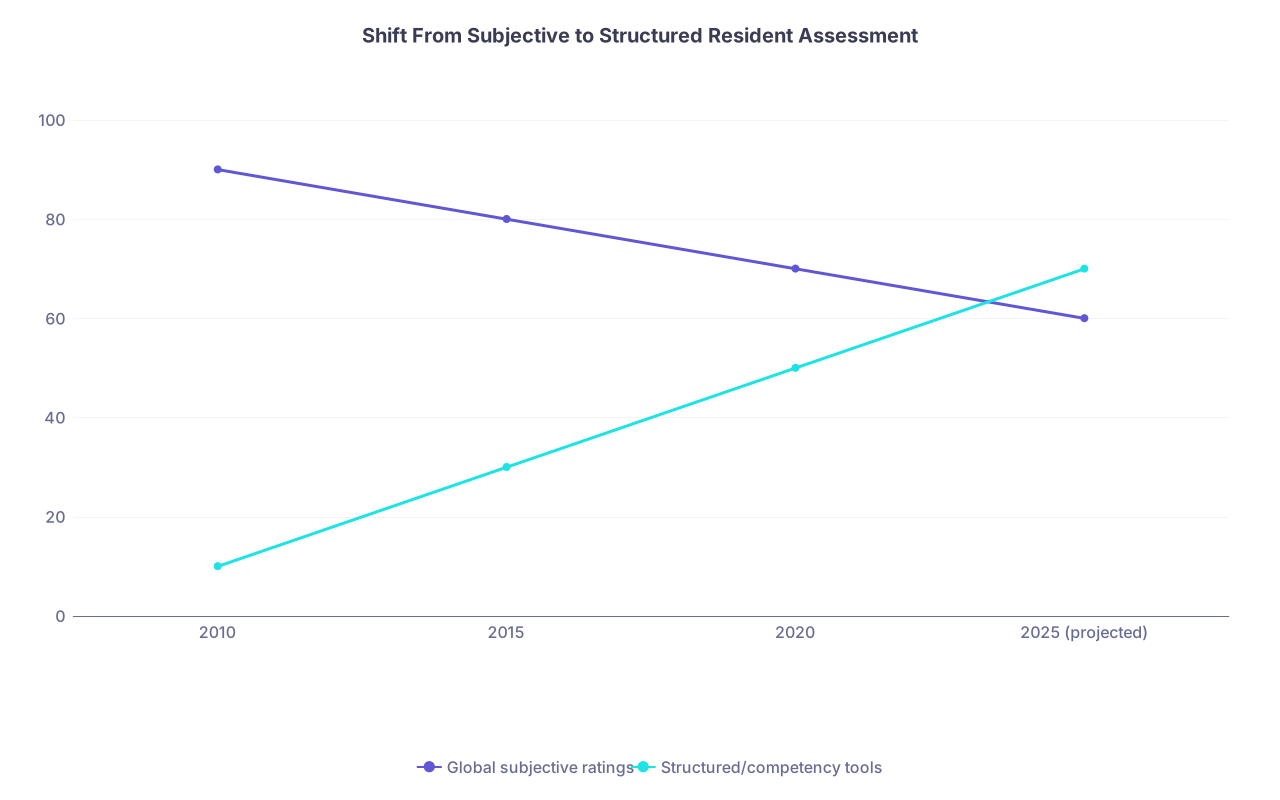
| Category | Global subjective ratings | Structured/competency tools |
|---|---|---|
| 2010 | 90 | 10 |
| 2015 | 80 | 30 |
| 2020 | 70 | 50 |
| 2025 (projected) | 60 | 70 |

Myth vs Reality: The Verdict
So, do funny residents actually get better evaluations?
Here’s the stripped-down answer:
- Being liked gets you better evaluations. That’s backed by data.
- Humor is one common route to being liked, but not a guaranteed or required one.
- The type of humor — and who it targets — matters more than the sheer number of jokes.
- Over time, competence and reliability matter more than how many times you made your team laugh, but during training, social dynamics absolutely color your evals.
If you’re naturally funny and it helps people relax, remember things, and feel safe: good. Use that. Carefully.
If you’re not, don’t fake it. Be clear, kind, organized, and honest. You’ll do just fine.