
The popular claim that “dark humor is a coping skill” is wrong – or at least dangerously oversimplified. In medicine, it’s become a shield phrase we throw around to excuse behavior we do not want to examine too closely.
Let me be blunt: dark humor can be a signal of healthy coping, maladaptive avoidance, moral injury, or outright cynicism – and the data does not support the lazy idea that “it’s just how we cope” as some inherently protective strategy. Sometimes it tracks with more distress, not less.
You want evidence, not folklore. So let’s pull the myth apart.
What People Think Dark Humor Does – And What It Actually Does
The cultural script in medicine goes like this: you see something horrific, you make a dark joke, everyone laughs, tension drops. Therefore, the humor “helped you cope.” Case closed.
Except coping is not “I felt better for 20 seconds.” Coping, when psychologists measure it, is about long‑term adjustment: less burnout, less depression, fewer PTSD symptoms, preserved empathy, sustained functioning.
Here’s what research actually shows across healthcare and related high‑exposure professions:
- Humor in general can be associated with better psychological adjustment.
- But “humor” is not one thing. Styles matter. Dark/sarcastic/hostile humor often track differently from affiliative or self‑enhancing humor.
- In a lot of studies, the darker, more aggressive humor styles correlate with higher distress, not lower.
We even have naming for this. Martin et al.’s humor styles framework breaks humor into four types: affiliative, self‑enhancing, aggressive, and self‑defeating. The first two are usually adaptive. The last two often are not.
Dark medical humor usually isn’t the “we’re all in this together” affiliative type; it frequently shades into aggressive (at or about patients, families, colleagues, or oneself) and self‑defeating (“I guess I’m a terrible human but whatever”) styles.
That distinction matters.
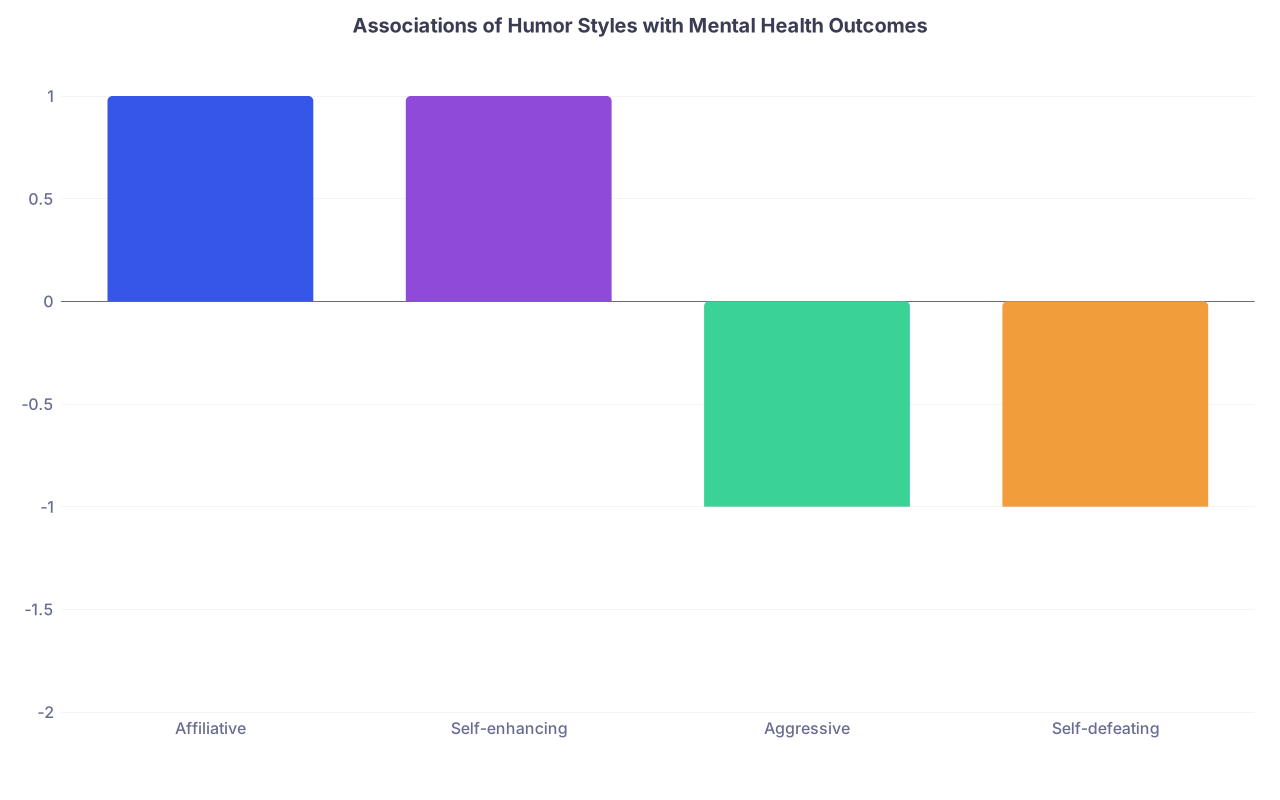
| Category | Value |
|---|---|
| Affiliative | 1 |
| Self-enhancing | 1 |
| Aggressive | -1 |
| Self-defeating | -1 |
The numbers above aren’t effect sizes; they’re shorthand: positive association with well‑being for affiliative and self‑enhancing; negative for aggressive and self‑defeating. That pattern shows up across multiple large samples.
Yet in the hospital, we toss all of this into one bucket called “coping.” That’s not science. That’s culture rationalizing itself.
What the Data in Healthcare Actually Shows
Let’s look at concrete findings, not vibes.
Studies in physicians, nurses, paramedics, and students have looked at humor and emotional outcomes. A few patterns keep showing up:
– Emergency and prehospital teams report heavy use of dark humor. – Dark humor is often tied to higher exposure to death, trauma, and moral distress. – People report that it helps them get through the shift. – But when you correlate humor style with actual measures of burnout, PTSD, depression, or empathy, the picture is mixed at best.
For example, in EMS and emergency medicine samples, heavy use of gallows humor tends to cluster with higher trauma load and higher emotional exhaustion. Not because the jokes cause trauma, obviously, but because the people most impacted are reaching for darker humor more often.
You’ll hear versions of this in real life:
- The new intern hears a dark joke and looks horrified.
- The fourth‑year resident says, “You’ll laugh like this too after your third code blue.”
- The attending shrugs and calls it “a coping mechanism.”
The attending is half right. It’s an attempt at coping. That’s not the same as an effective or healthy coping style.

One more uncomfortable finding: depersonalization – that “everyone’s just a body, not a person” feeling that’s central to burnout – often correlates with the edgier side of medical humor.
When you start making jokes that name the patient by diagnosis instead of person, talk about “the train wreck in 12,” or laugh about “bagging the frequent flyer again,” your brain is not just dumping stress. It’s rewiring who counts as fully human.
That’s not neutral.
Short‑Term Relief vs Long‑Term Cost
There’s a classic trap in mental health: mistaking what feels good immediately for what helps long‑term.
Scrolling your phone in bed feels good. Sleep gets worse. Avoiding a difficult conversation feels good. The relationship rots. Drinking to “take the edge off” works. Until it doesn’t.
Dark humor falls squarely in this category.
Yes, in the short term it can:
- Drop physiological arousal (tension, anxiety) in the moment.
- Create quick social bonding: “We’re the only ones who get this.”
- Provide a tiny sense of control when everything else feels uncontrollable.
But we have to ask at what cost.
When researchers look past immediate self‑report and examine broader patterns, you often see:
- Higher burnout scores in people who heavily rely on aggressive or self‑defeating humor.
- More negative attitudes toward patients and families.
- Reduced emotional engagement, framed as “thick skin” but looking suspiciously like numbing.
The key misconception: people assume “if I didn’t have this humor, I’d be even worse.” That might be true for some. But it could just as easily be that the habit of cutting everything with a dark joke is keeping you from engaging with the stuff that would actually help: debriefing, reflection, boundaries, therapy, systemic advocacy.
Dark humor can become emotional duct tape. Slap it over every crack so you do not have to see how deep the fracture runs.
When Dark Humor Is Probably Helping
Let me not pretend it’s all bad. The data on humor as a broad category is actually pretty favorable.
Affiliative and self‑enhancing humor – laughing with, not at; finding absurdity without contempt; using humor to reframe your own stress – are consistently linked to higher resilience and better mental health metrics.
Sometimes dark humor blends elements of that:
- The team that survived a disastrous on‑call night together and later jokes about themselves (“remember when I tried to hang cefepime on the coffee machine”) more than about patients.
- A palliative care team laughing at the absurdity of hospital bureaucracy and EMR pop‑ups while still being laser‑respectful with families.
- A conversation in the residents’ room where the target of the joke is the system – impossible staffing, nonsense metrics – not the suffering person in the bed.
In those cases, the darkness is context and color, not the soul of the joke. The actual psychological function is connection, perspective‑taking, and a kind of shared “we’re not crazy; this is” validation.
There’s also some evidence that being able to tolerate and even laugh at taboo content in a safe group context can act as exposure – making horrible realities a bit more speakable, a little less unspeakable and isolating. That’s not nothing.
The problem is that we rarely distinguish these uses from the nastier forms. We throw all of it under “coping.” And then pretend they’re equally healthy.
They are not.
| Humor Style | Typical Target | Likely Impact on Coping |
|---|---|---|
| Affiliative | Shared experience | Often adaptive, builds connection |
| Self-enhancing | One's own hardship | Often adaptive, reframes stress |
| Aggressive | Patients/colleagues | Often maladaptive, fuels cynicism |
| Self-defeating | Own worth/competence | Often maladaptive, linked to distress |
The Ethical Line: “Coping” vs Contempt
Let’s talk about the thing most people dance around: ethics.
Staff‑only spaces (break rooms, sign‑out rooms, resident lounges) have always had some degree of dark humor. I’ve heard nurses crack jokes immediately after a failed code. I’ve heard surgeons say things you absolutely could not put in a patient’s chart. I’ve heard residents cope with a pedi trauma by leaning on brutal sarcasm for ten minutes because if they didn’t, they’d cry for an hour.
I understand why that happens. I’m not shocked by it.
But there is a line. And pretending there isn’t, under the banner of “coping,” is cowardly.
Red flags that your “coping humor” has crossed into something corrosive:
- You are comfortable making the same jokes in front of junior trainees who obviously aren’t okay with it, and you frame their discomfort as weakness.
- The punchline routinely relies on stereotypes (weight, language, disability, addiction, housing status) of your patients.
- You notice yourself feeling less inclined to take a patient’s suffering seriously after joking about them.
- The jokes continue long after the acute stress of the case has passed; they become part of how you talk about that patient category in general.
- You would be horrified if someone recorded and played it to the patient’s family – not because of context, but because on some level you know it’s cruelty, not care.
At that point, calling it “a coping mechanism” is like calling bullying “social feedback” or an alcohol problem “stress management.” It’s a euphemism for something you don’t want to examine.
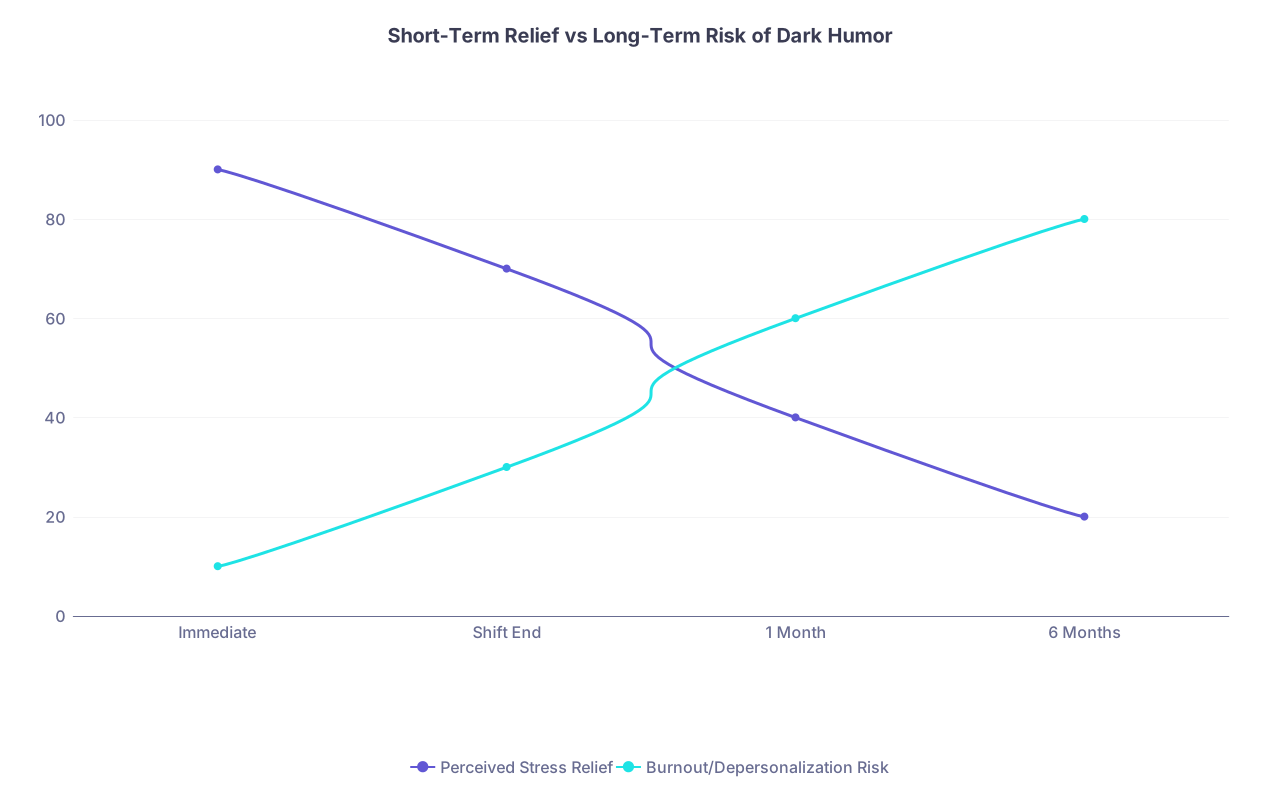
| Category | Perceived Stress Relief | Burnout/Depersonalization Risk |
|---|---|---|
| Immediate | 90 | 10 |
| Shift End | 70 | 30 |
| 1 Month | 40 | 60 |
| 6 Months | 20 | 80 |
Those numbers are conceptual, but the pattern mirrors what we often see clinically: the thing that feels fantastic up front quietly bites you later.
What Actually Looks Like Healthy Coping
People ask, “So what, should we all just stop joking? Become robots? Cry in the hall every time something awful happens?”
No. But if the only tool you’re proud of is dark humor, that’s not sophistication, it’s poverty.
Healthier patterns – again, based on actual data from burnout and resilience research in clinicians – look more like this:
- Humor that builds belonging, not contempt.
- Spaces for real debriefing after critical events, where the point isn’t to “lighten the mood” but to metabolize what happened.
- Being able to tolerate not immediately joking about something horrible. Letting the horror land. Naming it as such.
- Access to mental health support that’s not performative wellness wallpaper.
- Some individual strategies (exercise, relationships, non-medical identity) that actually correlate with lower burnout in repeated surveys.
Dark humor can sit in this mix. It just shouldn’t be the centerpiece or the unexamined default.
And if you’re honest with yourself, you often know the difference between:
“I’m laughing with my team about how absurdly broken this system is,”
vs.
“I’m making fun of this patient because it’s easier than facing how powerless and angry I feel.”
Those are not the same coping skill.

The Future: We Need to Stop Hiding Behind the Joke
As medicine leans harder into “wellness” talk, there’s a real temptation to either sanitize everything (“no dark humor ever”) or to shrug and enshrine the current culture (“this is just how we survive”).
Both are lazy.
The more honest, evidence‑aligned path is messier:
- Accept that dark humor is common and sometimes genuinely relieving.
- Admit that not all of it is healthy or ethically acceptable.
- Stop labeling every expression of gallows humor as “coping” and start being specific about function and impact.
- Build actual support structures so the joke isn’t the only place the emotion goes.
If you want one practical rule of thumb for the future culture of medicine, here’s mine:
Use humor to punch up (at systems, power, absurd rules) or sideways (at your own shared misery), not down (at patients, families, trainees with less power). When in doubt, assume your patient is a full person even when they’re not in the room.
And if you notice your jokes getting darker, meaner, and more frequent over time, don’t pat yourself on the back for “great coping.” Consider that your distress might actually be getting worse.
Because that’s what the data really suggests.
Key points:
- “Dark humor is a coping skill” is an oversimplification; some humor styles are associated with more distress and depersonalization, not less.
- Short‑term relief from dark jokes doesn’t prove long‑term healthy coping – especially when the humor targets patients and blunts empathy.
- The future of medicine needs less hiding behind “it’s just how we cope” and more honest distinction between adaptive humor, ethical lines, and real support.