
The joke is not “just a joke” if your stomach drops when you hear it.
If you’re on a team where the attending keeps crossing the line with “humor,” you’re not being oversensitive. You’re being put in a bad professional situation. And you need scripts, not vague advice about “advocating for yourself.”
This is exactly where words freeze, power dynamics explode in your head, and you go home replaying the moment at 2 a.m. So let’s kill the theory and get into the exact phrases you can use.
First, get clear on the problem you’re actually in
Not all bad jokes are the same beast. You respond differently depending on what you’re dealing with.
Common scenarios I keep seeing:
The “equal-opportunity offender” attending
Think: “I make fun of everyone, relax.”
Jokes about gender, race, patients, obesity, mental health—whatever is nearby. They’ll say: “Come on, this is surgery. If you can’t take a joke…”The “playful” undermining
Public digs at your competence:
“Well, that’s what happens when you let a med student think.”
“Good thing I checked, or we’d all be sued by now.”
Everyone chuckles. You feel small.Humor that targets a vulnerable patient group
Jokes about psych patients, substance use, non-English speakers, uninsured patients, trans patients.
Often said “off the record” in workrooms and call rooms, but very much on the record for your conscience.Sexual or gender-based “jokes”
“You know ortho is just for big strong guys, right?”
“You should smile more, it helps with patient satisfaction scores.”
Anything about your appearance, dating, body, or love life. Even if “technically” a joke.You’re not the target, but someone else is
You overhear something said about a nurse, cleaner, tech, another trainee, or a patient. You’re stuck between: “I don’t want to create a scene” and “I can’t believe I said nothing.”
Each of these has different risks: your evals, letters, team dynamics, and your own emotional safety. So your response has to fit both the content and the context.
Before you react: three things to decide in 10 seconds
No, you don’t have an hour to reflect. You’ve got about 10 seconds while someone is still smirking. In those 10 seconds, silently ask:
What’s my primary goal right now?
- Protect myself?
- Protect someone else (patient, colleague, student)?
- Signal this is not okay and plant a flag for later?
You can’t optimize for all three at once. Pick the priority.
What’s my power in this room—today and long-term?
- Are you a med student on a 4-week rotation depending on them for a grade and letter?
- A PGY-3 who will be working with this attending again and again?
- A fellow who actually has some status?
This affects tone more than content.
Is it safer to respond live, or to address this later?
Live responses are most powerful. They’re also the riskiest.
Delayed responses are safer and more controlled. Less satisfying in the moment, but often smarter.
What I’m going to give you next: specific scripts for both in-the-moment and after-the-fact for each type of situation.
Scripts for in-the-moment responses (low to high intensity)
Think of these as tiers. You can dial up or down depending on the attending, the situation, and how safe you feel.
1. The “micro-pause” response
This is for when you’re shocked, not ready to fight, but you want to make it weird to continue.
Use a neutral, slightly puzzled tone. Minimal words.
- “Huh.”
- “Wait, what?”
- “I’m not sure how to respond to that.”
- “Oof.”
- “Yikes.”
Why this works:
You’re not delivering a TED Talk on professionalism. You’re introducing friction. You’re showing: “I noticed, and I’m not on board.” Often, that alone shifts the vibe, especially if others are silently uncomfortable too.
You can also use a curious follow-up:
- “Can you say more about what you mean by that?”
- “I’m not following—what’s the joke there?”
For a lot of insecure “funny” attendings, being forced to explain kills the joke instantly.
2. The “name it and nudge it” response
This is where you name what’s happening but keep it light, almost deadpan. Works well when you want to set a boundary without full confrontation.
Examples:
For a joke about gender, race, or identity:
- “That’s… pretty loaded.”
- “That one lands a little differently for me.”
- “I don’t think that one’s going to age well in 2026.”
For a joke belittling you in front of the team:
- “I know we’re joking, but I do want to be sure I’m actually learning here.”
- “Ouch. I get that’s humor, but I’d appreciate feedback straight, not as a punchline.”
- “I get dark humor, but that one’s hard to hear thinking about them as a person.”
- “I know we’re blowing off steam, but talking about them like that makes it harder for me to do my best.”
Tone: calm, slightly dry. You’re not apologizing for having a reaction.
3. The “values anchoring” response
Attending says something clearly off about a patient group, another team, or a colleague. You anchor back to shared professional values. This sounds “safe” and institutional. That’s the point.
Examples:
- “Honestly, jokes like that make it harder for me to keep the empathy piece strong when I’m tired. I’m trying really hard not to become cynical.”
- “We hear so much about psychological safety and respect in healthcare—I’m trying to practice that in how we talk about patients, too.”
- “We see such vulnerable people here, I worry that kind of humor can spill over into how we treat them.”
You’re not calling them a bad person. You’re saying: this joke undermines something we both supposedly care about.
4. The “direct boundary” response (when you’re the target)
Use this when you’re the one being joked about and you’re done being polite.
For comments about your appearance, dating, gender, or identity:
- “I’m not comfortable being the subject of that kind of joke at work.”
- “Comments about my appearance are not okay for me in this setting.”
- “I’d rather keep humor away from my gender/appearance. Can we stick to the medicine?”
For undermining jokes about competence:
- “I know you’re joking, but when feedback about my work comes as a joke, I’m not sure what to actually fix.”
- “If there’s a concern about my performance, I’d rather hear it directly than as a joke in front of everyone.”
Notice the structure:
“I’m not comfortable / I would rather X / This is not okay for me.”
You are describing your line, not judging their entire character.
5. The “call it for the room” response (when someone else is hit)
You’re not the target. A nurse, PA, med student, or patient group is. Power is messy here, but silence is complicity. You can still say something calibrated.
Soft version:
- “Hey, I’m not sure how that landed for others, but that felt pretty sharp.”
- “I think that might have come across harsher than you meant, especially given the power dynamic.”
Stronger version:
- “We’re all under stress, but that kind of joke at their expense doesn’t sit right with me.”
- “That sounded personal. I’d feel awful if someone said that about me in front of the team.”
If they double down—“Relax, it’s just a joke”—you can calmly say:
- “I hear you’re joking. I still think it crosses a line in a professional setting.”
And then drop it. You’ve said your piece. Everyone heard it.
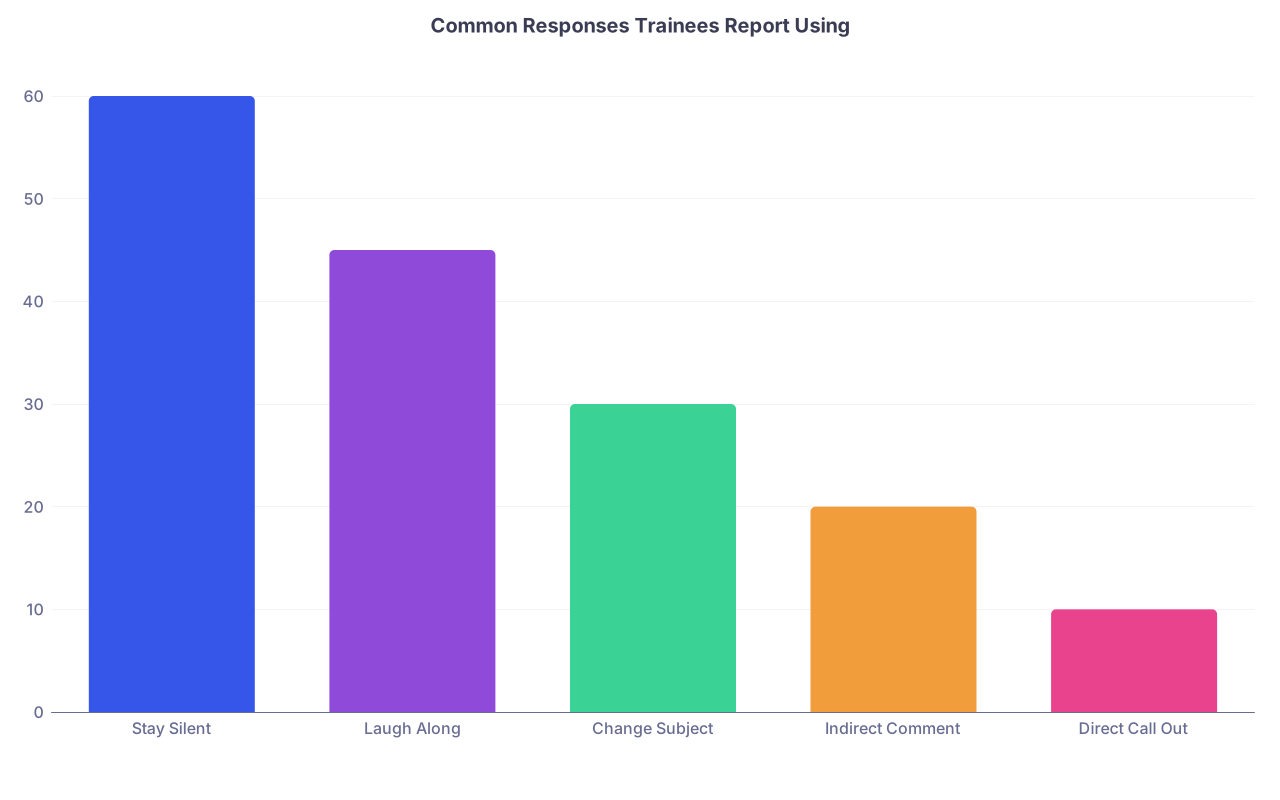
| Category | Value |
|---|---|
| Stay Silent | 60 |
| Laugh Along | 45 |
| Change Subject | 30 |
| Indirect Comment | 20 |
| Direct Call Out | 10 |
Scripts when you decide to address it later
Sometimes the smartest move in a toxic moment is: say very little, remember everything, and circle back later when the power imbalance is less explosive.
Here’s how to do that without sounding accusatory or unhinged.
1. The one-on-one debrief
Pick a quieter moment. Post-rounds, after clinic, or at the end of the week. Knock on the door or catch them walking.
Open with a neutral framing:
- “Do you have a minute? I wanted to circle back to something from earlier this week.”
Then be concrete:
- “On rounds Tuesday, when we were in front of the team and you said, ‘That’s what happens when we let the med student think,’ I laughed in the moment but I’ve been thinking about it.”
Now give your impact, not a cross-examination:
- “It actually made me hesitant to ask questions after that, because I wasn’t sure if I’d be turned into the joke again.”
- “As a woman in this field, jokes about appearance and ‘smiling more’ land differently for me. It made me uncomfortable.”
Close with what you want next:
- “Going forward, I’d really appreciate feedback about my work given directly, not in a joking way in front of others.”
- “It would help me a lot if humor stayed away from gender or appearance. I do better when I know we’re keeping that off-limits.”
If they apologize? Accept it simply:
- “Thanks, I appreciate you hearing that.”
If they get defensive?
- “I understand you didn’t intend harm. I just wanted you to know the effect so we can work better together.”
You’re not here to win a debate. You’re signaling, documenting (in your own mind at least), and protecting your future self from feeling gaslit.
2. Email follow-up (for your protection and clarity)
If the interaction was really bad—or you’re worried about retaliation—you may want a written record. Not a six-page manifesto. A calm, factual note.
Something like:
Dr. Smith,
I wanted to briefly follow up on a moment from rounds today. During the discussion of [patient initials or room], there was a joke made about [very general description, no PHI]. I laughed at the time but have been thinking about it since.
I felt uncomfortable because [brief impact – e.g., “it involved my gender,” “it referenced a vulnerable patient group,” “it was about my competence in front of the team”]. I value learning from you and want to maintain a professional environment where I and others feel respected.
I appreciate you taking a moment to hear this.
Best,
[Name, role]
This does 3 things:
- It documents that you perceived a boundary-crossing moment.
- It shows you approached it professionally and directly.
- It gives them a very easy chance to correct course.
If this ever escalates, your tone in this email matters a lot. Calm, factual, measured.

Looping in allies without immediately “reporting”
You don’t have to jump straight from “this felt bad” to “I filed a formal report.” There’s a middle path: calibrated conversation with someone you trust.
Good people to consider:
- Chief resident
- Program director (if they’re actually approachable)
- A trusted attending on a different service
- GME office / ombudsperson
- Senior resident who knows the politics
You can frame it as: asking for advice, not lodging a lawsuit.
Example:
- “Can I run a situation by you? I’m not sure if I’m overreacting, but it’s been bothering me.”
- “I’m trying to figure out the best way to handle repeated jokes about X from Dr. Y. I’d value your take on what’s reasonable here.”
When you tell the story, stick to:
- Specific comments and when they happened
- Who was in the room
- How it affected you / the team / the patient environment
- What (if anything) you’ve already tried
Then ask directly:
- “If you were me, what would you do next?”
- “Is this something that has a chance of changing if I speak to them? Or is this more of a systemic issue you’ve seen before?”
If they minimize it—“Oh, that’s just how Dr. X is”—that tells you something about your environment. You then decide: Is this a hill to die on now, or do I focus on surviving this rotation and documenting?
When it’s clearly over the line: harassment, discrimination, or abuse
Some “jokes” are not gray-area humor. They’re textbook sexual harassment, racism, or targeted humiliation. You know it when you feel that cold, adrenaline hit.
Examples:
- Comments about your body or sexual life
- “Jokes” about trading favors for grades, letters, or opportunities
- Racial slurs or mocking accents
- Threats disguised as humor: “Better smile if you want a good eval”
Here’s my take: you do not owe this person a perfectly phrased “teaching moment.” Your first job is to protect yourself and others.
Immediate response options (if you can manage any words):
- “That’s not appropriate.”
- “That crosses a line.”
- “I’m not going to respond to that.”
And then stop. Do not argue. Do not get pulled into “You can’t take a joke?” territory.
Afterward, this moves into documentation and reporting:
- Write down exactly what was said, where, and who was present. Same day, while your memory is sharp.
- Save any written communications or group messages where similar things happened.
- Decide your next step: trusted faculty, chief resident, program director, GME, Title IX, HR, or union if you have one.
If you’re unsure what’s reportable at your institution, anonymous or confidential resources (ombuds, Title IX consult line) can often tell you.
| Situation Type | First Contact Option |
|---|---|
| Awkward, one-off bad joke | One-on-one with attending |
| Repeated unprofessional humor | Chief resident or PD |
| Targeted humiliation of trainee | PD or GME office |
| Sexist/racist “jokes” | PD, GME, or Title IX |
| Sexual comments or quid pro quo | Title IX / HR immediately |

| Step | Description |
|---|---|
| Step 1 | Hear inappropriate joke |
| Step 2 | Say little, document later |
| Step 3 | Micro-pause or light comment |
| Step 4 | Name impact or set boundary |
| Step 5 | State not appropriate, exit |
| Step 6 | Debrief with ally |
| Step 7 | Document and consider reporting |
| Step 8 | Decide on 1 -1 talk or escalation |
| Step 9 | Am I safe to respond now |
| Step 10 | Severity |
How to respond without tanking your evals (the politics piece)
You’re not paranoid to worry about retaliation. It happens. I’ve watched residents suddenly go from “excellent” to “needs improvement” after they pushed back.
A few strategies to reduce risk:
Keep your tone steady, not heated.
You want anyone who hears the story secondhand to think: “They were measured, not emotional.”Anchor to patient care and team function.
- “It makes it harder for me to ask questions and learn.”
- “It impacts how I relate to this patient group.”
- “It undercuts trust on the team.”
These are institutional values. Harder to argue with.
Do not do this alone if you don’t have to.
If others on the team are also uncomfortable, you can approach together, or at least all document.Understand your program’s culture.
Some programs want trainees to call this out and will back you. Others will circle the wagons around attendings. Knowing which one you’re in shapes how loudly you speak.Protect your long game.
If you’re a 4th-year med student desperate for an away-letter from one toxic star attending, you might decide: “I’ll document, I’ll get support, but I’m not going nuclear this month.”
That’s not being cowardly. That’s strategy. Just don’t gaslight yourself into thinking the behavior is fine.

Practicing the scripts so they’re actually usable
If you wait for the next awful joke to try this language for the first time, your brain will blank. Practice now. Low stakes.
Here’s a quick drill you can literally do tonight:
- Pick 2-3 scripts that feel like you. Don’t use my exact words if they sound fake in your mouth.
- Stand in front of a mirror or walk around your apartment and say them out loud:
- “I’m not comfortable being the subject of that kind of joke at work.”
- “That one lands differently for me.”
- “I know we’re joking, but comments like that make it harder for me to speak up on rounds.”
- Say each one five times until your tongue stops tripping.
You’re building a reflex. When your amygdala goes off in the real moment, muscle memory helps.
Also consider one “default line” you’ll use when your brain fully freezes:
- “I’m going to step out for a second.”
- “I need a minute.”
Sometimes physically removing yourself from the situation is all you can manage. That’s still a response. It still sends a signal.
If nothing changes: what’s your play then?
You spoke up. You tried a one-on-one. Maybe you emailed. The jokes continue.
That’s data. It tells you:
- This attending is not going to change because of you.
- The institution either can’t or won’t rein them in, at least right now.
At that point, you shift from “fix this person” to “protect myself and others.”
That might mean:
- Limiting one-on-one time with them when you can
- Documenting carefully after every bad incident
- Steering more vulnerable students away from their team
- Choosing rotation and mentor pathways that minimize their influence on your future
- Looking for institutions (for fellowship, job) where this behavior is not brushed off
You are not a failure because you couldn’t reform a 30-year attending with three kids in college and a god complex. Your job is not to be their moral rehab. Your job is to get through training with your integrity—and career—intact.
Bottom line
Three things I want you to walk away with:
- You’re not “too sensitive” for being bothered by harmful humor. That discomfort is a sign your professional values are still alive. Good.
- Having actual phrases ready—micro-pauses, boundary statements, values-based lines—gives you options besides silent resentment or career-risking confrontation.
- If someone’s humor repeatedly crosses into harassment or humiliation, this is no longer a “joke” problem. It’s a professionalism and safety problem—and you’re allowed to treat it like one.