
The tension before pre-rounds is real, and most people are using humor wrong.
They either crack jokes that land like a lead balloon, or they clamp down and go stone-faced “professional” and let the cortisol do laps around their bloodstream. Both extremes are bad. You’re not a stand-up comic, and you’re not a robot. You’re a human in a pressure cooker.
Let’s talk about how to use light humor in that 6:00–7:30 a.m. danger zone without minimizing how hard this actually is—for you or for your patients.
What You’re Up Against Between 5:30 and Rounds
Picture this:
You’re a PGY-1 on medicine. You pre-round on six patients in 45 minutes. The night float left one cryptic note: “FYI, 302 had a ‘moment’ around 3 am, see nursing note.” Your intern friend just whispered “We’re so cooked” under their breath. The attending is known for saying things like, “I don’t believe in the word ‘busy’.”
This is the ecosystem you’re dropping humor into.
Pre-round tension comes from a few repeat offenders:
- Fear of being exposed as unprepared or incompetent
- Information overload (labs, vitals, consult recs, new imaging, orders)
- Anticipation of being pimped, corrected, or blindsided by “surprises”
- Exhaustion + caffeine + no real food = emotional volatility
- The hidden scoreboard in everyone’s head (who’s “on top of it,” who’s not)
You feel all of this. So does the med student, the senior, the night nurse finishing a brutal shift, and yes, even the supposedly unflappable attending.
Humor in this setting is like a medication with a narrow therapeutic window. Too little and everyone stays miserable. Too much or the wrong kind, and you look insensitive, unprofessional, or detached.
The goal: lower the emotional temperature by 5–10 degrees. Not erase stress. Not “keep vibes up.” Just make the room slightly more survivable.
The Core Rule: Punch Up, Not Down, and Never at the Patient
If you remember nothing else, remember this: your humor should never punch down and never trivialize suffering.
That means:
- No jokes about patients, even “nice” ones.
Saying, “Mr. X really tried to die last night, huh?” is not dark humor; it’s lazy and gross. - No jokes about how “silly” it is that people are upset, anxious, or in pain.
- No “jokes” that are actually passive aggression at nurses, consultants, or other staff.
The safest, most useful targets for light humor before rounds:
- Yourself
- The absurdity of the system
- Universal experiences everyone in the room shares (sleep, coffee, pager chaos)
- Minor, non-dangerous inconveniences (printer jams, EMR quirks, pager sounds)
If your joke requires everyone to ignore real harm, real fear, or real suffering, it is the wrong joke at the wrong time.
What Light Humor Actually Looks Like at 6:45 a.m.
Let’s get specific. You’re not on Netflix; you’re standing in a cramped workroom staring at Epic and a half-dead highlighter.
Here’s what “light humor” looks like in real life.
Safe, quick, tension-lowering lines
You open the chart of your first patient and see 50+ overnight labs:
- “Okay, looks like our friend in 304 got the deluxe lab package.”
- “This CBC clearly woke up more refreshed than I did.”
Severe weather outside, everyone dragged themselves in:
- “Shoutout to us for surviving The Great Parking Lot Ice Rink of 2026.”
Endless admission list on the board:
- “I see our unit has adopted a strict ‘no bed left behind’ policy.”
These are not hilarious. That’s the point. You’re not trying to kill. You’re trying to signal: “We all see this is ridiculous. You’re not alone in thinking this is a lot.”
Micro-humor that doesn’t slow you down
The best humor before rounds is fast. Half a sentence, one facial expression, 1–2 seconds max.
Examples:
- Eye contact + tiny eyebrow raise when yet another STAT lab pings at 6:59.
- Quiet: “I love when the computer waits until exactly 6:59 to remember it can freeze.”
- Glancing at the list: “Okay, I will be speed-talking this presentation.”
You don’t derail prep. You just give a pressure valve release.
Reading the Room So You Don’t Make It Worse
Humor is not brave if it makes everyone around you more tense. It’s just self-centered.
You need to scan two things: the room mood and each person’s bandwidth.
Signs you should keep it extra light or skip humor
- Attending is already at the workstation, hyper-focused, asking rapid-fire questions.
- Someone is clearly flustered and trying to finish data gathering with five minutes left.
- A serious clinical event just happened (rapid response, death, massive bleed, code).
- The med student looks like they’re about 10 seconds from crying.
In those settings, your “joke” is not a gift; it’s another demand on their energy.
So what do you do instead? You pivot to supportive, still-human comments:
- “Hey, if you want, I can help skim vitals while you finish the HPI.”
- “Rounds are going to be rough but you’re not the only one who feels behind.”
- “Let’s split the list—no one needs to be a hero right now.”
If someone is drowning, they don’t need your punchline. They need your competence and your presence.
When humor actually helps
- Team is mostly ready, waiting for attending, everyone is just sitting there simmering.
- You’re walking between patients and there’s 30–60 seconds of dead space.
- The worst crises of the morning are already addressed; now it’s anticipatory anxiety.
- The senior or attending uses a light comment; you can match tone, gently.
In those spots, a 3–5 word quip can reset everyone’s shoulders down half an inch.
Patient-Facing vs Team-Facing Humor: Different Rules
People screw this up constantly. They talk to patients like they talk to co-residents. Do not do that.
With patients before rounds
Patients can be scared, in pain, sleep-deprived, or just sick of people waking them up. Humor there has to be softer, slower, and optional.
Acceptable light patient-facing humor:
You walk in at 6:10 a.m.:
- “Good morning, I’m sorry we keep meeting at terrible hours.”
- Glancing at the blood pressure cuff: “This thing wakes you up more than coffee, doesn’t it?”
Patient comments, “Do any of you ever sleep?”:
- “We’re working on it. Coffee is winning the battle right now.”
You never joke:
- About their diagnosis, prognosis, or how “dramatic” the night was
- About pain, disability, body size, or mental health
- About “almost coding” or “almost going to the ICU”
Bottom line: humor at the bedside is about showing you see their humanity, not distracting yourself from their condition.
With the team, away from patients
Completely different arena. You have more leeway, but the same core rule stands: do not minimize patient suffering.
Example of bad team humor:
- “302 tried really hard to die last night but we weren’t having it.”
Better:
- “302 had a rough night—nurse and night float did a lot of heavy lifting.”
- If you must lighten: “I think the ICU team has us on speed dial now.”
Notice the focus shifts from “LOL near-death” to “This was serious, but we survived and worked as a team.”
Using Humor to Acknowledge Stress, Not Erase It
The amateur move is to use humor as denial: “Haha, we’re fine, everything’s fine, medicine is silly.” It feels good for 10 seconds but leaves everyone more alone afterward.
What works better: humor that openly admits, “Yeah, this is a mess,” without pretending it doesn’t hurt.
Examples that land well:
- “If I look calm right now, it’s just because my anxiety is very organized.”
- “Okay, real talk, this list is a beast. We’ll get through it one bite at a time.”
- “Today has strong ‘we should all be paid more’ energy.”
None of these pretend everything is okay. They let people laugh and still feel seen.
Avoid lines like:
- “Hey, at least no one died!” (Sometimes that’s not even true.)
- “Could be worse, we could be surgery.”
- “It’s just residency, it’ll be over soon.”
Those sound like you’re minimizing how brutal this morning actually feels.
Micro-Scripts You Can Steal and Adapt
You’re tired. You don’t need to invent material from scratch. Steal these starting points and make them sound like you.
When you’re clearly overwhelmed but want to keep morale
- “I’m operating on 40% brain power and 120% effort.”
- “If I say anything that doesn’t make sense on rounds, that was my evil twin.”
- “I promise I checked that lab, I just can’t remember what decade it was.”
When the tech is being dumb
- “Epic has entered its contemplative phase.”
- “Loading… just like my brain.”
- “The computer and I are both buffering today.”
When everyone’s just waiting for the attending
- “This feels like waiting for boards results, but with more pager noise.”
- “Anyone else practicing their ‘I totally knew that’ face?”
When the med student is terrified
After they stumble through a pre-round presentation:
- “Hey, you got through the hard part. We can clean up details together.”
- “You’re already doing better than I did on my third month of med school.”
- “Rounds are a team sport. No one expects you to solo this.”
Light humor plus validation is remarkably stabilizing.
What Not to Joke About (Even If Seniors Do)
You will hear bad jokes. From residents. From attendings. From people you consider role models.
Hard no-go zones for humor in pre-rounds:
- Deaths and codes from the same shift
- Self-harm, overdose, or suicide attempts
- Domestic violence, sexual assault, child abuse
- “Frequent flyers” and people with addiction or homelessness
- Patient appearance, weight, language skills, or mental illness
Even if the bedside is clear and it’s “just the team,” these topics do not magically become funny backstage. They just expose how normalized desensitization has become.
If someone else goes there, you don’t need to be the comedian who adds on. You can let it die in silence, or redirect:
- “Yeah, honestly that was pretty rough. Night team handled a lot.”
- Then move the attention back to the medicine or the plan.
You’re not the morality police. You just quietly refuse to add fuel.
Using Humor as a Leadership Tool (Even as a Junior)
Leadership is not about PGY title. It’s about who sets the emotional tone. Sometimes that’s the senior; sometimes it’s the intern everyone actually trusts.
Light humor can signal: “I see how bad this is, but I’m not bailing. I’m here with you.”
Tactical ways to use it:
- At the whiteboard before rounds: “Alright, friends, welcome to another episode of ‘How Many Problems Can One Patient Have.’” Then immediately: “Okay, let’s divide up tasks.”
- To redirect an escalating panic:
“Okay, one crisis at a time. Let’s not preload tomorrow’s anxiety while we’re still in today.” - To praise the team:
“You all survived this morning. Starbucks should be sending you handwritten thank-you notes.”
The trick is you always follow the humor with something concrete: a plan, a redistribution of work, a clear next step. Joke, then action. That’s what makes it leadership and not avoidance.
When You Just Don’t Have It in You
Some days, humor feels fake. You’re too tired, too upset, or too burned out. Forcing jokes then doesn’t make you “resilient,” it makes you brittle.
On those days, your move is:
- Neutral competence
- Low-key kindness
- Silence that isn’t cold, just focused
If someone else cracks a small joke and you can manage half a smile or a nod, that’s enough participation. You don’t have to produce. You can just not be hostile.
You’re allowed to have “no-joke” mornings. Use them to pay attention: who uses humor well, who uses it badly, and what actually makes you feel a bit better vs more alone.
Quick Table: Good vs Bad Pre-Rounds Humor Targets
| Target / Topic | Usually Safe? | Notes |
|---|---|---|
| Yourself | Yes | Self-deprecation in small doses |
| EMR / pager / tech | Yes | Avoid blaming specific IT staff |
| Shared exhaustion | Yes | Don’t glorify burnout |
| Patient suffering / trauma | No | Off-limits, even off the floor |
| Nurses / staff as a group | No | Easy to slip into disrespect |
| System absurdities | Yes | Make sure it’s clear you care anyway |
| Specific bad outcome | No | Process it, don’t joke about it |
A Simple Pre-Rounds Humor “Checklist”
When you’re about to say something vaguely funny, run it through this 5-second mental filter:

| Step | Description |
|---|---|
| Step 1 | Think of joke |
| Step 2 | Do not say it |
| Step 3 | Say it softly and briefly |
| Step 4 | Skip or reframe |
| Step 5 | Say it briefly and move on |
| Step 6 | At patient bedside |
| Step 7 | About patient or suffering |
| Step 8 | Punching down on patient or staff |
| Step 9 | Acknowledges stress not erases it |
If it passes: short, kind, not punching down, acknowledges reality—you’re good.
If you hesitate for more than a second, that’s your answer. Save it for group text, or better, don’t.
A Glance at the Future: Humor in a Burned-Out System
As medicine gets more algorithmic—AI notes, decision support, relentless metrics—human moments will matter more, not less. The system will not get kinder on its own. Schedules won’t magically soften.
Humor is one of the last organic, human tools you have to say: “I’m still a person. You’re still a person. This is hard. Let’s not pretend it isn’t.”
We’ll see more institutional “wellness” programs, more resilience workshops, more posters about work-life balance taped to walls of units short two nurses. Some will help. Many will not.
Your real buffer will be micro-interactions like:
- The senior who shrugs and says, “Yep, this is awful, but I’ve got your back.”
- The intern who cracks a tiny, perfect one-liner that makes the whole team exhale.
- The attending who can be deadly serious about patient care and still say, “Okay, time for caffeine rounds after real rounds.”
Is humor the cure for burnout? No. Anyone saying that is selling something.
But done right, it’s one of the few low-cost, high-impact ways to make mornings survivable.
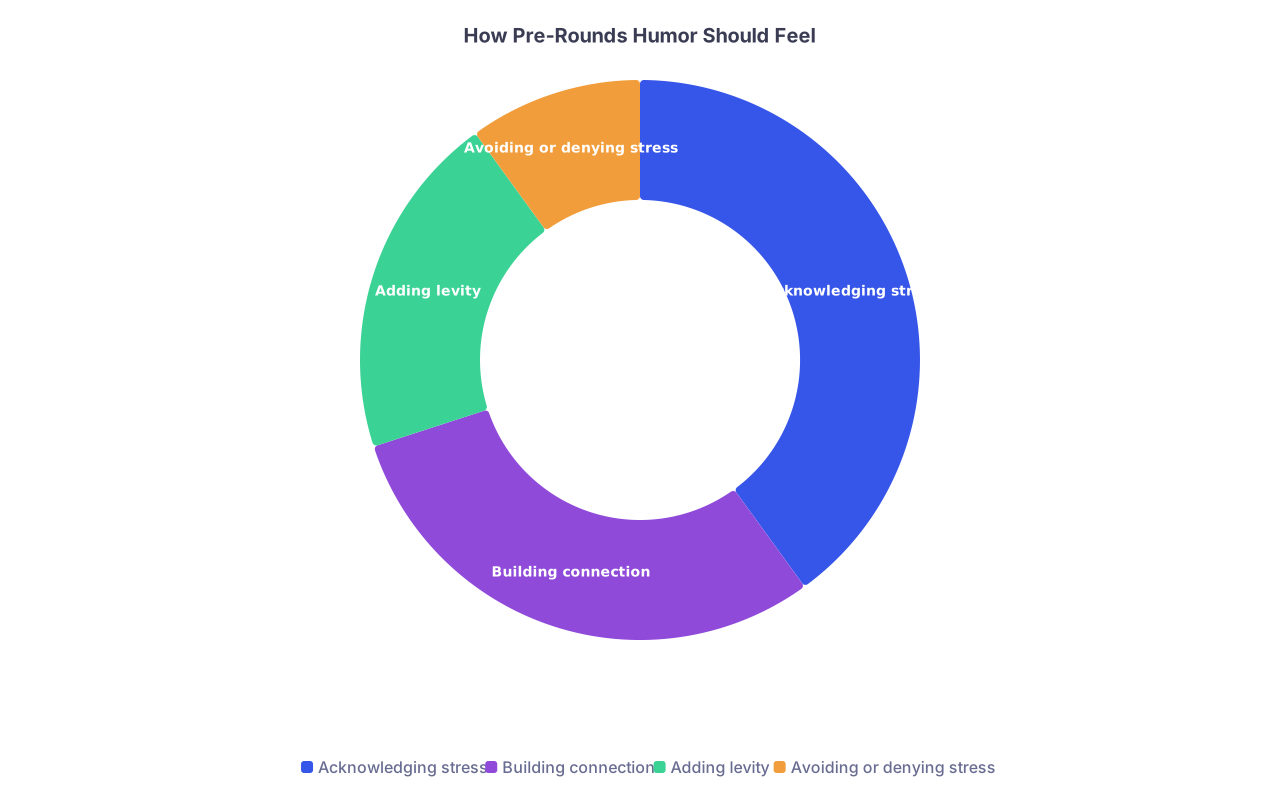
| Category | Value |
|---|---|
| Acknowledging stress | 40 |
| Building connection | 30 |
| Adding levity | 20 |
| Avoiding or denying stress | 10 |
Bottom Line
Keep it simple:
- Use light, quick humor to acknowledge stress—not erase it—and never punch down or joke about suffering.
- Read the room: patient-facing humor stays soft and human; team-facing humor can be a bit sharper but must still respect patients and staff.
- Joke, then act: a small quip followed by real help or a clear plan is how you become the person people want on their team at 6:30 a.m.