
The worst moments in medicine are not always codes or bad outcomes. Sometimes it’s realizing you just laughed at a joke that absolutely crossed a professional line.
You joined in. You saw one person’s face drop. And now your stomach is in your shoes.
Good. That sick feeling is your professionalism alarm working. Now let’s fix it.
1. First, Get Oriented: How Bad Was This?
Not every awkward joke is a career-destroying event. But some can seriously damage trust, especially with patients, nurses, or junior staff. Before you overreact or underreact, you need a quick internal triage.
Ask yourself, fast and honestly:
- Was the joke about a protected characteristic? (race, gender, sexual orientation, religion, disability, age, weight, etc.)
- Was a specific person present and obviously the butt of the joke?
- Was a patient involved—either directly (they heard it) or indirectly (you joked about their case inappropriately)?
- Did you add to the joke (a tag-on comment), or did you just laugh or smile?
- Who heard it: just peers, or nurses, techs, patients, families, attendings, leadership?
You’re basically sorting into three rough categories:
| Level | Description | Typical Response Needed |
|---|---|---|
| Mild | Off-color but not targeted; only close peers present | Simple, brief repair |
| Moderate | Targeted at a group/person; others clearly uncomfortable | Direct apology + behavior reset |
| Severe | Discriminatory, about a patient, or in front of patient/family/leadership | Immediate repair + documentation/mentor help |
If you have to ask “Was that discriminatory?” it probably landed that way for someone. Err on the side of repair.
2. The Core Rule: Separate Yourself From The Comment
Your priority is simple: make it clear that your laugh or comment does not represent your actual values or how you treat people as a clinician.
There are three levers you can pull:
- What you say immediately
- What you say later, in private
- How you act over the next days and weeks
Use all three if the situation is anywhere near moderate or severe.
3. What To Do In The Moment (Or As Soon As You Realize)
Let’s walk through specific situations. I’ll give you language you can use verbatim if you want.
Scenario A: You Just Laughed, Didn’t Add Anything
Example: You’re in the workroom. Someone makes a joke about a patient’s weight or social situation. A few people laugh. You chuckle, then see the nurse at the computer stiffen.
What to do within 5–10 seconds:
- Stop smiling. Neutral face.
- Give a short, corrective statement that signals distance.
You can say, calmly, not performatively righteous:
- “Yeah… that’s actually not cool.”
- “Honestly, that feels over the line.”
- “I shouldn’t have laughed at that.”
If it’s too tense to say anything to the group, turn to the person who looked hurt as soon as there’s a tiny opening:
- “Hey, for the record, I shouldn’t have laughed at that. I’m sorry.”
Tiny line. Big impact.
Scenario B: You Added To The Joke
This is worse, but still fixable if you’re proactive.
Example: Attending makes a snide remark about a specialty (“psych patients are just…”) and you add, “Yeah, or like that guy we saw last night,” and everyone laughs. Then you realize the psych resident is at the computer behind you.
You need a two-step repair:
Immediate break from the joke
- “Actually, I don’t mean that. That came out wrong.”
- “I shouldn’t have said that. Sorry.”
Say it plainly. No nervous giggling. You’re not auditioning; you’re retracting.
Follow-up with the person who might be hurt
Later that day or as soon as you can:
- “Hey, earlier when we were talking about that patient and I made that comment—I realized that was out of line. I’m sorry I said it. That’s not how I want to talk about patients.”
Short. Direct. No excuses.
Scenario C: Patient or Family Was Within Earshot
Here’s where it gets serious.
Example: You’re at the nurses’ station, make a dark joke about “frequent fliers,” and then spot the patient’s daughter in the waiting area, 5 feet away, clearly listening.
You can’t just “move on.” You need to walk into the fire.
Step 1: Approach promptly (ideally within minutes)
- “Hi, I’m Dr. __. A few minutes ago, you may have heard me make a comment at the desk. It was unprofessional and I’m sorry.”
Step 2: Don’t over-explain or defend
Avoid this garbage: “We’re under a lot of stress, and sometimes we cope with humor…” No. That makes it about you.
Better:
- “That’s not how we want you or your family to feel talked about or cared for. I apologize.”
Step 3: Offer space
- “If you’d like to talk with someone else about this, I can help you reach the charge nurse or patient relations.”
Does this feel terrifying? Yes. But this is exactly the kind of thing that, if not corrected, shows up in complaints, chart notes, and your reputation.
4. Private Apologies: Who, When, and How
If someone clearly looked hurt, uncomfortable, or shut down after the joke, you owe them a direct, private repair. That might be:
- A nurse who was charting nearby
- A junior resident or med student
- A colleague who’s part of the group that was the target of the joke
How soon?
Same shift if at all possible. Within 24 hours at the latest. The longer you wait, the more it feels like you’re hoping it’ll just blow over.
What to say (simple template)
You don’t need a TED Talk. You need four beats:
- Name the event
- Own your part
- Validate impact (without telling them how they felt)
- Commit to better
Example:
“Hey, can I grab 30 seconds?
Earlier in the workroom, when that joke about [topic] happened, I laughed/added to it. I’ve been thinking about it, and I realize that was out of line. I’m sorry I did that. I don’t want to be someone who makes or supports those kinds of comments, especially at work.”
Then stop talking. Let them respond or shrug or say “it’s fine.” You’re not fishing for forgiveness. You’re showing alignment with professionalism.
If they brush it off with “oh it’s nothing, people say worse,” do not use that as permission to repeat it. Their coping mechanism is not your guide.
5. When The Power Dynamics Are Messy (Attending, PD, Senior Resident)
This is where most people freeze.
Scenario: Your attending cracks a clearly sexist joke. Everyone laughs. You give a reflexive laugh, too. The only woman in the room goes silent.
You feel gross, but you’re also not about to lecture an attending mid-round.
Here’s how you handle it.
Step 1: Minimal in-the-moment participation
If you can catch yourself:
- Don’t add to the joke.
- Let the laugh die quickly.
- Body language: slight frown, look back at your notes, move on clinically.
Step 2: Private repair with the affected person
This matters more than “calling out” the attending 99% of the time.
Later:
- “Hey, earlier when Dr. X made that comment and we all kind of laughed… I laughed too and I really wish I hadn’t. I’m sorry for my part in that. That’s not how I feel and I’m working on not going along with that stuff.”
You’ve drawn a line between yourself and the behavior. She now knows where you stand, regardless of what you said in the moment.
Step 3: Deciding whether to address the higher-up
Case-by-case. Factors:
- Is this a pattern vs a one-off stupid attempt at humor?
- Is there psychological safety at your institution? (You know this already.)
- Are you in a role where speaking up will do more good than harm?
If you do speak to the attending later, keep it non-accusatory and brief:
- “Dr. X, earlier there was that joke about [topic]. I laughed, but I’ve been thinking about it, and I’m not comfortable with that kind of comment. It didn’t sit right, especially with [person] in the room.”
Some will be defensive. Some will actually adjust. But you’ve documented, to them and to yourself, that you’re not on that train.
6. If The Joke Crossed Policy Lines (Discriminatory / Harassment Territory)
You know the line I’m talking about. Slurs. Targeted mocking of disability. Overt sexual comments about a colleague. Things your institutional training explicitly calls harassment or discrimination.
If you joined in—even with just a laugh—you need to treat this as a professionalism event, not just “oops, bad humor.”
For these, you should:
Document for yourself
Write down: date, time, who was present, what was said, exactly what you did. Not for drama. For clarity if it comes up later.Talk with a trusted mentor or chief
Someone you believe actually gives a damn about humans: chief resident, faculty mentor, program ombudsperson.Script:
- “I’m uncomfortable with something that happened yesterday. There was a joke about [X], I laughed/added to it, and I realized it was wrong. I want to own my part and also figure out what I should do next.”
Consider using formal channels
Especially if the target was a patient or vulnerable staff member, or it’s part of a pattern.
You’re not throwing yourself under the bus by doing this; you’re actually building a record that you recognized the problem and attempted repair.
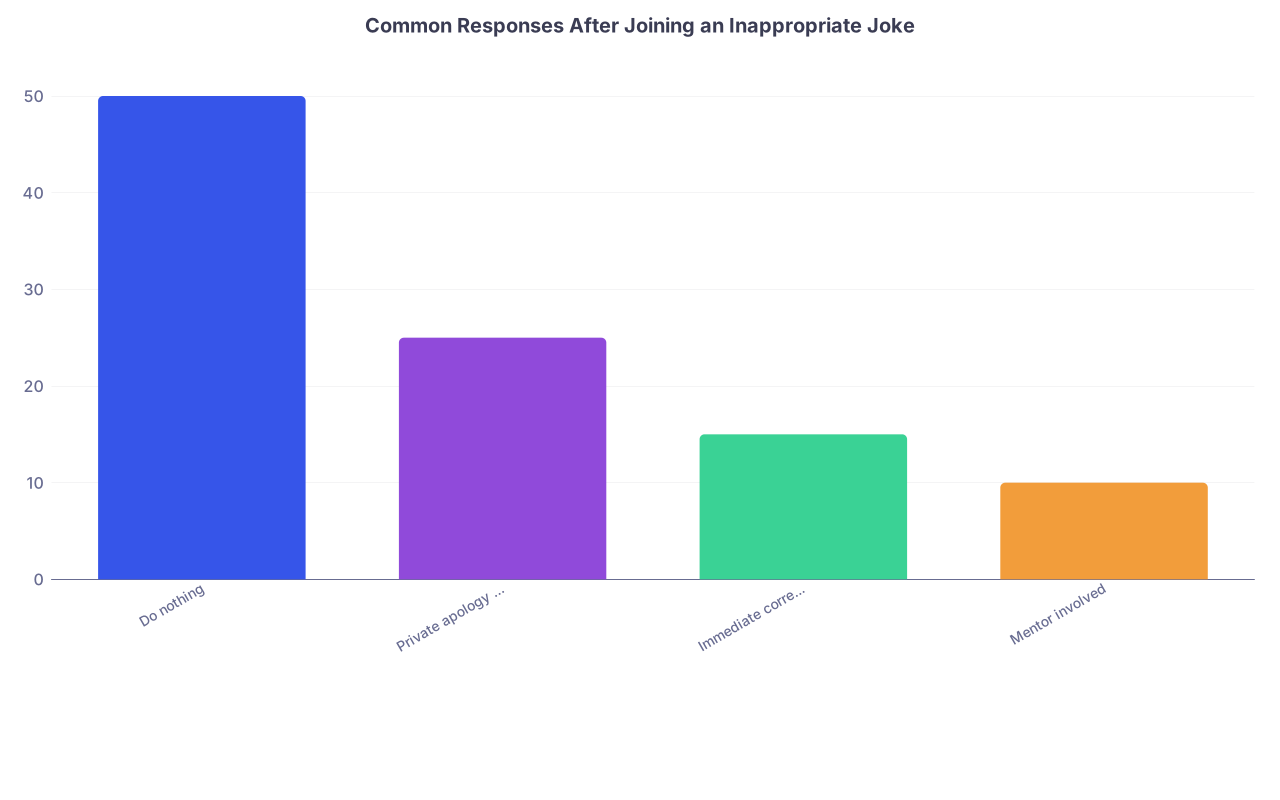
| Category | Value |
|---|---|
| Do nothing | 50 |
| Private apology only | 25 |
| Immediate correction | 15 |
| Mentor involved | 10 |
7. Fixing Your Own Reflexes So This Doesn’t Keep Happening
The real problem isn’t one bad laugh. It’s the reflex to align with the loudest voice in the room instead of your own values.
You can re-train that reflex.
Micro-skill 1: Neutral exit lines
Preload yourself with a couple of “escape phrases” you can use whenever a joke turns:
- “Anyway…” + immediately shift back to clinical topic.
- “Back to the labs—what did the troponin show?”
- “I’m gonna go check on the patient.”
You’re signaling: I’m not riding this train; I’m going back to work.
Micro-skill 2: Default face
In questionable environments—certain call rooms, some ORs, some locker rooms—keep a neutral baseline. You don’t have to perform laughter to be socially accepted. Quiet, competent, neutral is safer and frankly more professional.
Micro-skill 3: One-liner boundary setters
Have one line you can deploy without drama:
- “Dark is fine, but not at patients’ expense.”
- “I’m not into jokes about that.”
- “I’m tapping out of this one.”
You say it, then you move on. You’re not doing a TED Talk on equity in the workroom.
8. How This Actually Plays Out For Your Reputation
Here’s what people really remember.
They don’t remember that you laughed once. Everyone has nervous laughter moments.
They do remember:
- Who consistently piles on when the jokes get mean
- Who never once apologizes or self-corrects
- Who treats patients one way in the room and another way at the desk
- Who privately says, “Hey, that wasn’t okay and I’m sorry I went along with it”
I’ve seen residents go from “questionable sense of humor” to “one of the most respectful people on the team” in a year—purely because they started repairing quickly and changing their default response.
You don’t need to become humorless. You need to be deliberate. Dark humor about situations and systems is different from dark humor at the expense of patients, colleagues, or groups.

9. Special Case: Group Chats, Text Threads, and Social Media
Same principles, different medium—and with a paper trail.
Scenario: You drop a spicy meme in the team group chat about a patient “type,” someone reacts with just a single “…” emoji, and the chat goes dead.
You need to:
Follow up in the same space you messed up
- “That meme was not appropriate for work chat. My bad, I’m deleting it.”
Then actually delete it if the platform allows.
If any specific person might feel targeted, message them privately
- “Hey, that meme I sent was out of line. I’ve taken it down. Sorry I put that in the chat.”
Do not repost or joke about the incident later
Treat it like a bad medication error. You learn, you adjust, you don’t make it a bit.
And for social media: if it involves a patient scenario, stop. Just stop. Too many people have torched their careers for “jokes” involving de-identified-but-actually-identifiable cases.
10. If You Can’t Stop Thinking About It
If your brain keeps replaying the moment—especially if a patient was involved—that’s not overreacting. That’s your conscience trying to close the loop.
Do three things:
Write it out (privately, no patient identifiers)
What happened, what you did, what you wish you’d done.Translate that into one specific practice change
For example: “I will not participate in jokes about patient demographics. If one starts, I will at least go silent and redirect to clinical content.”Run it by someone you trust
“This happened, here’s what I did to repair, here’s what I’m planning to do differently. Anything I’m missing?”
Often that’s enough to let your brain file it as “lesson learned” instead of “unsolved guilt.”
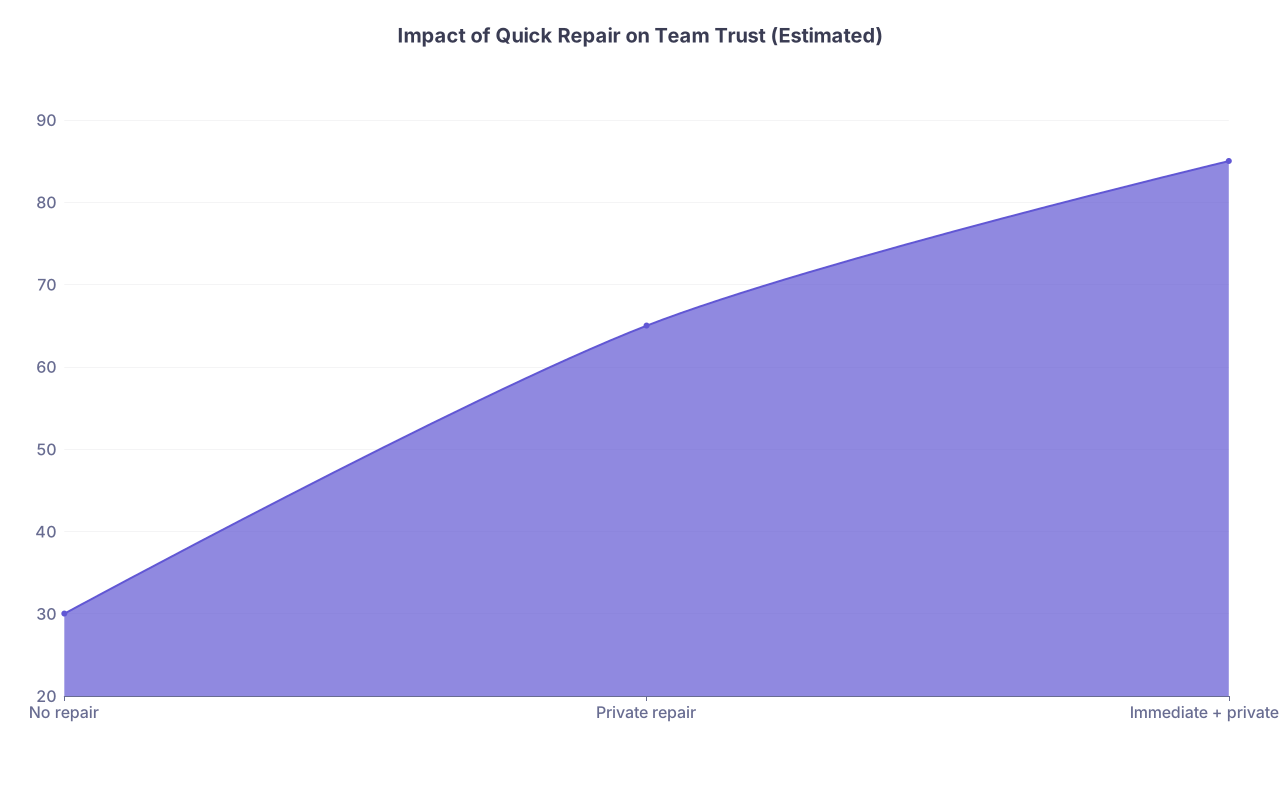
| Category | Value |
|---|---|
| No repair | 30 |
| Private repair | 65 |
| Immediate + private repair | 85 |

FAQ (Exactly 3 Questions)
1. What if the person I apologize to says, “It’s fine, don’t worry about it”?
You still did the right thing. The goal of the apology isn’t to extract a specific reaction; it’s to align your behavior with your values and make clear where you stand. Their “it’s fine” may be politeness, discomfort, or genuine lack of concern. You don’t need to push. Just respond with something like, “I appreciate you saying that. I’ll still be more careful moving forward,” and then actually follow through.
2. Can one bad joke really affect my evaluations or career?
Yes, depending on content and context. A single cruel or discriminatory comment, especially involving a patient, can absolutely show up in 360 evaluations, patient complaints, or informal back-channel discussions about your professionalism. The flip side is also true: a visible apology and sustained pattern of respectful behavior can rehabilitate an early misstep. People in medicine care about patterns more than isolated events—your job is to make sure this stays an isolated event that you visibly learned from.
3. What if I’m in a culture where everyone makes these jokes and no one seems bothered?
That culture is more fragile than it looks. Many people in those spaces are quietly uncomfortable but do not feel safe speaking up. You don’t have to become the office morality police. Start small: stop contributing, use neutral exits, and offer private support or apologies when lines are crossed. Over time, other people notice who is safe, who is not, and who is moving the tone in a better direction. You may not change the room overnight, but you can absolutely decide who you are in that room.
Open your mental replay of that moment right now and write a 2-sentence script you wish you’d said—one line for in the moment, one line for a private apology. Then save it somewhere you’ll see before your next shift and be ready to actually use it.