
The belief that “if you work in medicine, you have to tolerate dark humor” is wrong.
You do not have to be okay with jokes that make your stomach drop, even if “everyone else is laughing,” even if “that’s just how this specialty copes.” You’re allowed to draw a line. And you can draw it without blowing up your team or being labeled “too sensitive,” if you’re strategic.
Let’s walk through what to do when a colleague uses dark humor and you’re not okay with it—step by step, in real scenarios you might actually live through.
First, Get Clear on What Just Happened
Before you react, you need to name the situation in your own head. That’s not touchy‑feely; it’s tactical. Your response depends on what category this lands in.
Common patterns I’ve seen on wards and in the ED:
Coping-through-chaos joke
Example: After a brutal trauma code that went nowhere, an attending mutters, “Well, that went great,” and half-smiles. The team chuckles awkwardly. You’re not offended, just unsettled.Dehumanizing or mocking patients
Example: ICU sign-out: “Bed 7 is cirrhosis guy. Frequent flyer. His liver’s given up more often than he has.” Laughter. You feel your jaw clench.Punching down on colleagues or trainees
Example: In the OR, someone jokes, “If you keep tying knots like that, we’ll have another lawsuit on our hands. At least the lawyers will get rich.” Room laughs. You feel small.Disguised bias
Example: “Of course he left AMA, he’s from [insert neighborhood]. Must’ve heard the cops were coming.” People smirk. You feel disgusted.Trauma-triggering “joke”
Example: A flippant comment about self-harm, suicide, or sexual assault that hits way too close to home for you personally.
You don’t have to do philosophy about what “counts” as dark humor. But you do need to ask yourself two things:
- Did this feel like them trying (badly) to cope?
- Or did it feel like them taking pleasure in someone else’s suffering or identity?
Your answer determines your move. So pause—literally a beat or two—and decide: “This crossed my line.” That’s enough.
Decide Your Goal Before You Act
You can’t have everything at once. You’re not going to fully fix the culture, protect your peace, preserve the relationship, and change their worldview in one clever sentence.
So pick a primary goal for this incident:
- Protect your own psychological safety
- Set a clear boundary
- Give subtle feedback and test the waters
- Document a pattern for later escalation
- Make it very clear that a line was crossed (even at some relational cost)
Once you know your priority, you can pick a response that matches. Most people get into trouble because they react purely from emotion or purely from fear. You need to blend both with intention.
In-the-Moment Responses: What to Say Right Then
Let’s go through actual scripts you can use in the moment, based on how direct you want to be.
Option 1: The Light Deflection (for low stakes or power imbalances)
This is for when you’re a med student/intern and the jokester is a beloved attending. You’re uncomfortable but not ready to plant a flag.
Tools:
- Silence (yes, it’s a tool)
- Neutral face, no smile
- Mild redirect
Examples:
They joke about “cirrhosis guy.” You stay quiet, don’t smile, and then say to the team:
“What’s his MELD again? Any chance for transplant eval or are we firmly palliative here?”
Translation: “I’m not playing, and I care about this as a human case.”Someone cracks a joke about a suicidal patient:
“Yeah… that one feels heavy. Anyway, what’s the follow-up plan with psych?”
You’re signaling: I’m not laughing, and I’m steering us back to seriousness. This alone, repeated consistently, changes how people use humor around you.
Option 2: The Small Boundary Statement
Use when you want to signal “not okay” but keep it low flamethrower.
Short, factual, no lecture.
- “I’m not really into jokes about patients like that.”
- “That one’s a bit too dark for me.”
- “I know we all cope differently; that one doesn’t sit well with me.”
- “Can we skip the jokes on this one? It’s a little close to home for me.”
Say it calmly, then move on. The power is in the mismatch: their “haha” vs your flat, grounded boundary.
Option 3: The Direct Call-Out (for bias, cruelty, or repeat offenders)
When it’s about race, gender, disability, sexuality, or straight-up cruelty, you’re justified in being clear. You do not have to soften bigotry into “a difference of coping styles.”
Examples:
- “That sounds more like making fun of him than coping with the case. I’m not okay with that.”
- “I know dark humor is a thing, but comments like that are pretty dehumanizing.”
- “That stereotype is not funny to me.”
- “Jokes that link that neighborhood with crime feel off. Can we not go there?”
Notice what I’m not adding: long explanations, debates, or apologies. The more you talk, the more room there is for them to wriggle out. Short and clean works better.
Power Dynamics: What If It’s Your Attending or Program Director?
This is where everyone freezes. You’re not wrong to be cautious. Your goal here usually splits:
- Stay safe (grades, letters, contracts)
- Still not betray your values completely
You have three main paths:
Path A: Minimalist, Protect-Yourself Approach
You use mainly Options 1 and 2 above.
You:
- Withhold laughter
- Redirect conversation
- Use mild boundary language once or twice
- Document internally (dates, phrases) if this is a pattern
You’re not a martyr. You don’t have to burn your eval to make a point in week 3 of your core rotation.
Path B: Private Feedback After the Fact
Sometimes the best move is not to correct them in front of everyone.
Example script, after clinic, in their office or hallway:
“Hey Dr. Khan, can I mention something quickly from this morning? When you said about the patient with cirrhosis, ‘his liver’s given up more often than he has,’ the team laughed, but it stuck with me. I know people use humor to cope, but it came across as making fun of him more than the situation. It made me uncomfortable. I wanted to flag it because I respect working with you and I think it could land badly with others too.”
Key elements:
- Specific reference to what was said
- Assume positive intent but state negative impact
- You’re speaking from your experience, not as the moral police
Will every attending love this? No. But I’ve watched more than a few blink, exhale, and say some version of, “Fair point. I didn’t think of it that way.”
Path C: Formal Escalation (When It’s Repeated or Serious)
If:
- The jokes are discriminatory
- You’ve seen patterns over time
- Patients or trainees are being clearly harmed
- You’re not in a position to confront safely
Then you move to documentation and escalation.
Start a factual log: date, time, who was present, rough quote, context.
Then consider routes:
- Trusted chief resident
- Program director you trust (not always the same person)
- GME office or HR
- Anonymous reporting if your institution has it
You do not have to open with, “I want to file a complaint.” You can start with, “I need advice about a behavior I’m seeing that’s making me uncomfortable.”
When the Joke Hits a Personal Nerve
This is a different category. It’s not just “I disagree ethically,” it’s “That just punched me in the chest.”
Common examples:
- Suicide jokes when you’ve struggled yourself
- Sexual assault humor when you’re a survivor
- Jokes about obesity, substance use, or immigration status that map directly onto your own life or family
Your nervous system is going to react first: flush, heart racing, maybe tears. That makes it harder to respond smoothly. So your first “intervention” is on yourself.
Step 1: Stabilize, even 5%
- Slow inhale through your nose, long exhale through your mouth
- Ground your feet; feel the floor
- If needed, ask for a quick break: “Excuse me one second, I need to step out.”
Step 2: Decide whether you want them to know it’s personal
- If no: use a generic boundary: “That kind of joke doesn’t work for me.”
- If yes (and you feel safe):
“That topic’s really personal for me. I’d appreciate if we could not joke about it.”
Step 3: Take care of yourself later
Do not gaslight yourself into thinking you’re weak for being affected. You’re a human, not a procedure robot.
Give yourself something after the shift:
- Debrief with a friend outside your program
- Write down what was said and how it hit you
- If this touches past trauma, this is the sort of thing to actually bring up with a therapist; it’s textbook material
Cultural Norm vs. Actual Requirement
There’s a con you’ll hear constantly: “It’s just part of the culture. You’ll get used to it.”
Here’s the truth: dark humor is common in medicine. It’s not required. Plenty of excellent clinicians don’t use it or keep it strictly among peers they know are aligned.
Let me show you how this really plays out across teams:
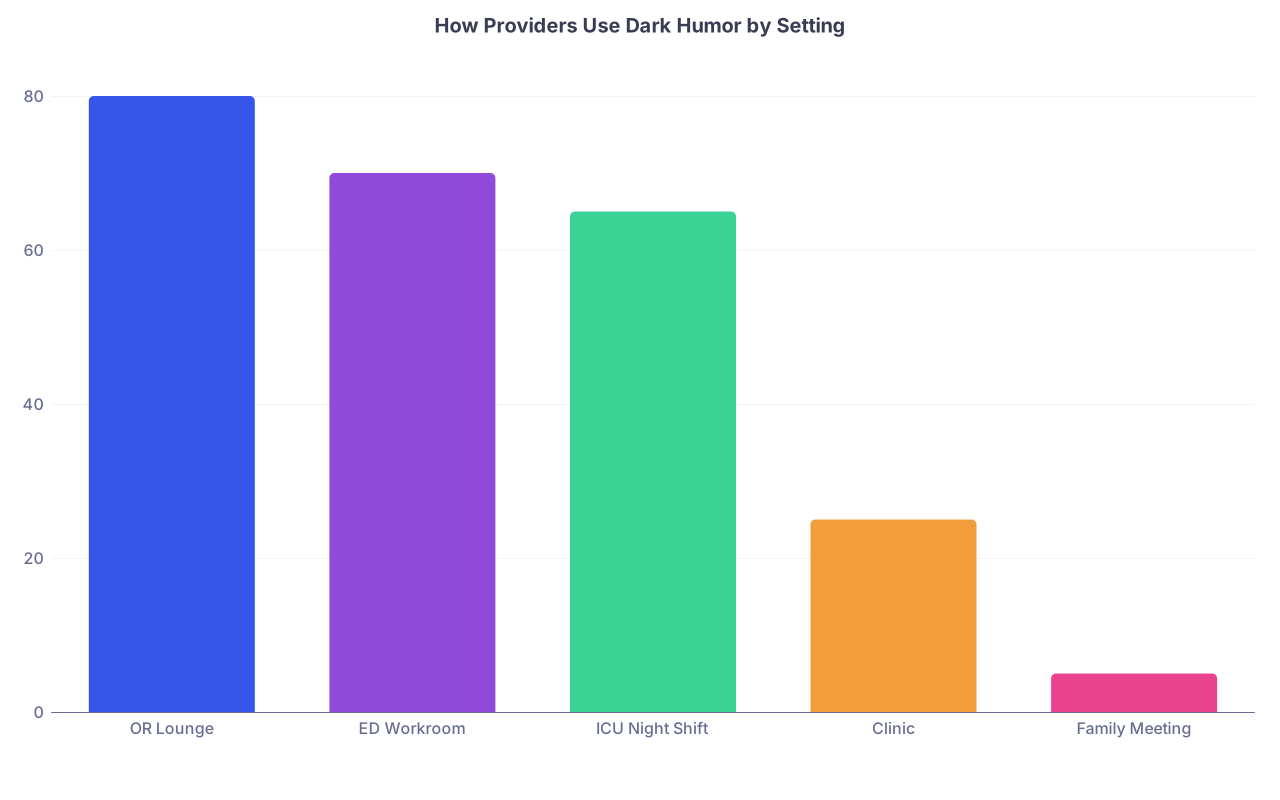
| Category | Value |
|---|---|
| OR Lounge | 80 |
| ED Workroom | 70 |
| ICU Night Shift | 65 |
| Clinic | 25 |
| Family Meeting | 5 |
Interpreting that:
- Yes, it’s everywhere backstage (OR, ED)
- But notice: when families and patients are present, it drops like a rock
Why? Because “coping” suddenly becomes indefensible if the audience changes. That tells you something. They can control it. They just choose not to in certain “safe” spaces.
You’re allowed to be one of the people who says, “If I wouldn’t say it within earshot of the patient’s spouse, I don’t want to hear it at all.”
Handling It as a Bystander (When You’re Not the Target but You’re Still Not Okay)
Sometimes the joke isn’t about you or a group you belong to. It’s about a patient, a marginalized group, or a junior colleague. You still feel gross.
You’ve basically got three tools:
Withdraw your participation
Stop laughing. Sound minor? It’s not. Social reinforcement is oxygen for this stuff.Name it lightly in the moment
“Oof, I’m not sure that one landed.”
“That’s a little harsh.”
“Brutal joke.” (Tone makes it clear you are not praising them.)Ally feedback later
“Hey, earlier when you joked about the Spanish-speaking family, it could definitely be heard as stereotyping. I don’t think that’s how you meant it, but that’s how it can land.”
You can decide how much political capital you want to spend based on your role. A senior resident has more leeway than a rotating student. Use that reality, don’t ignore it.
When They Double Down or Mock Your Sensitivity
Let’s say you speak up and they respond with:
- “Relax, it’s just a joke.”
- “Wow, tough crowd.”
- “You must be fun at parties.”
- Eye roll, side comment, “gen Z can’t take anything.”
This is the moment that usually scares people into never speaking up again. Do not take the bait into a full argument in the middle of sign-out.
You have two main moves.
Move 1: Calm Reassertion
- “I get that you meant it as a joke. I’m just letting you know how it landed with me.”
- “Sure. I’m just saying I’m not comfortable with that kind of humor.”
- “You asked why it got quiet—that’s why.”
Then stop talking. Let the silence sit with them.
Move 2: Strategic Retreat, Document, Escalate Later
If the person’s clearly not receptive, there’s no prize for getting into a debate in front of the team.
- Make a mental note of allies in the room who looked uncomfortable
- Jot down the incident later
- Talk to someone you trust: “Here’s what happened, here’s how I responded, and here’s how they reacted. How have others handled this with them?”
You’re playing the long game here, not trying to win one argument.
Using the System Without Getting Crushed by It
Most hospitals and training programs will tell you they want to know about unprofessional behavior. Some mean it. Some mostly want plausible deniability.
Either way, you should know your options.
| Approach | Best For | Risk Level |
|---|---|---|
| In-the-moment comment | One-off or mild incidents | Low |
| Private follow-up | Single colleague, some trust | Low–Medium |
| Talk to chief/senior | Recurring issue on a team | Medium |
| Program/GME report | Patterns, serious bias | Medium–High |
| HR or formal complaint | Harassment, discrimination | High |
You don’t have to jump to the bottom of the list right away. But if you never move beyond internal eye-rolling, the culture doesn’t change, and you just get more bitter.
Pick your battles, yes. But pick some.
Protecting Your Own Humor Without Becoming Them
One more angle: you might use dark humor yourself in ways that feel aligned. And then you bump into the stuff that crosses your line and think, “Am I a hypocrite?”
Not necessarily. There’s a massive difference between:
- Making a grim joke about the system
- vs. mocking the patient, their body, their culture, their neighborhood
You can absolutely keep:
- Jokes about insurance denials (“Blue Shield: now offering hospice at 35 years old”)
- Jokes about absurd documentation requirements
- “We’re one EMR click away from a class action burnout suit” type humor
And you can absolutely cut:
- Nicknames like “train wreck,” “whale,” “drug seeker,” “frequent flyer”
- Jokes blaming patients for their illnesses
- “At least the transplant list got shorter today” after a patient death
One type punches up or sideways. The other punches down. Your gut knows the difference.
What This Looks Like Over Time
If you consistently:
- Don’t laugh at jokes that cross your line
- Make one or two simple “that doesn’t land for me” comments per week
- Have a private conversation or two with people you trust
- Escalate patterns that are clearly harmful or discriminatory
Then three things slowly happen:
People categorize you (silently) as “someone who doesn’t do that kind of humor.” They self-edit around you. That’s a win, not social exile.
You feel less complicit. Less “I sat there and smiled while they trashed that patient.” That matters for your long-term moral injury.
You become a small gravitational pull toward a different culture. Not in a movie-hero way. In a slow, subtle, “maybe we don’t say that out loud anymore” way.
You are not going to eradicate dark humor from medicine. It’s too baked into how people cope with constant exposure to death, suffering, and failure.
But you can shape the version of it you’re willing to share space with.

| Step | Description |
|---|---|
| Step 1 | Hear dark humor |
| Step 2 | Silence or light deflect |
| Step 3 | Document and seek advice |
| Step 4 | Small boundary comment |
| Step 5 | Direct call out or private talk |
| Step 6 | Escalate if pattern continues |
| Step 7 | Power dynamics |
| Step 8 | Severity |
| Step 9 | Severity |
Today, do one concrete thing:
Think of the last time a dark joke at work made you uncomfortable. Write down exactly what was said and then write one sentence you wish you had said in that moment. Just one. That’s your script for next time.