
The med student who won’t stop performing is not “just funny.” They’re a patient safety risk with good timing.
Let’s talk about how to handle them.
You know exactly who I mean. The student doing bits on rounds. Turning every patient encounter into improv night. Whisper-joking during sign-out. Dropping TikTok punchlines in family meetings. Everyone laughs politely; no one actually likes it.
You’re stuck in the room with them. You’re their senior, their resident, their co-student, sometimes even their attending-lite as a fellow. And you’re thinking: “I’m not their parent, I just want to get through this call shift alive. How do I shut this down without becoming The Humorless Monster?”
Here’s how.
Step 1: Diagnose what kind of “performer” you’re dealing with
Not all clowning is the same problem. You handle them differently depending on the flavor of chaos they bring.
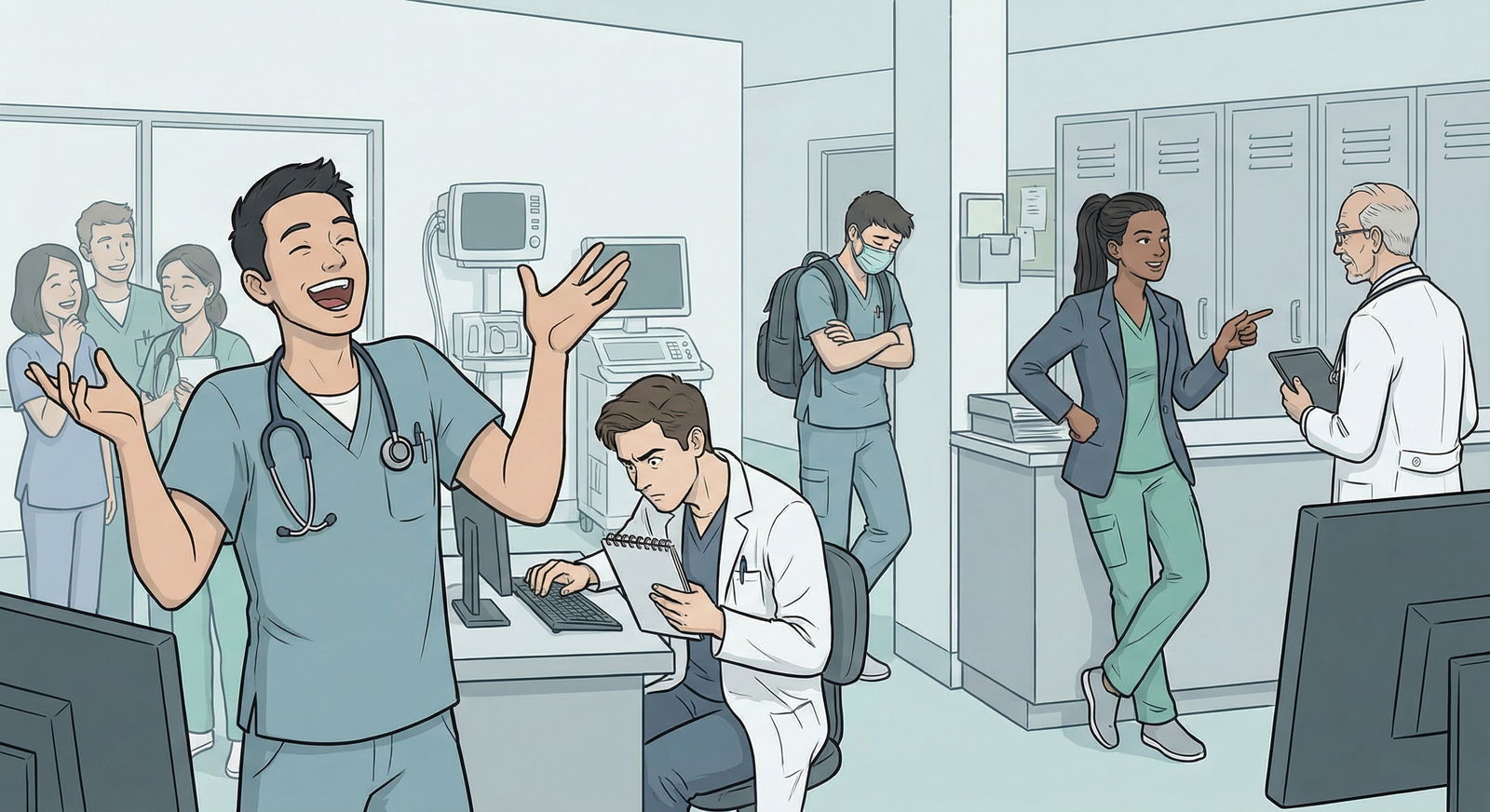
Most “I perform for laughs” med students fall into one of these:
The Nervous Stand-Up
- Uses jokes as anxiety armor.
- Laughs at their own jokes, eyes flick to the attending after every punchline.
- Talks more when things get serious (bad prognosis, procedures, codes).
- Usually redirectable if you give them a clear lane.
The Attention Vacuum
- Needs to be the center. Of every room. All the time.
- Will talk over nurses, other students, sometimes even attendings.
- Loves “roasting” others (you, other students, occasionally patients).
- Harder to redirect. You’ll need boundaries, not hints.
The Meme Doctor
- Lives in TikTok audio and Reddit jokes.
- References niche med memes on rounds, in sign-out, on consult calls.
- Thinks they’re just being “relatable.” Doesn’t realize half the team is cringing.
- Often immature rather than malicious. They respond to specific feedback.
The Class Clown Turned Liability
- Was probably beloved in undergrad. Landed a personality-based secondary essay.
- Doesn’t realize medicine is not improv club.
- Will say wild things in front of patients and think it’s charming.
- This is where you start worrying about evals and professionalism reports.
Figure out which type they are. It will shape whether you lead with empathy, directness, escalation, or all three.
Step 2: Decide your role and responsibility
Your response depends on who you are in the hierarchy.
| Your Role | How Direct You Can Be | Primary Tool |
|---|---|---|
| Co-Med Student | Low–Medium | Peer nudge |
| Intern | Medium | Expectation-setting |
| Senior Resident | High | Feedback + eval |
| Fellow | High | Boundary + escalation |
| Attending | Very High | Formal feedback |
If you’re a co-student, your goal is: keep patients safe, protect your learning, and maybe gently nudge them.
If you’re the resident or fellow: your goal is: protect the team, model professionalism, and document patterns. You are not obligated to save their ego.
Step 3: Set the tone early—preferably before the fifth bad joke
The worst version of this is: you tolerate it for 2 weeks, then explode at 3 a.m. on night float.
Do this instead.
If you’re the resident/fellow: pre-brief at the start of the rotation
Day 1, when you’re laying out expectations, include humor explicitly:
“I want this team to feel human. It’s okay to laugh, to joke, to decompress. But here’s the line:
— No jokes in front of patients or families that shift focus away from them.
— No side comments during sign-out, procedures, or bad news.
— If I say ‘let’s focus,’ that’s the cue to shut down side chatter.
Cool? Any questions?”
Short. Neutral. You’re not targeting anyone yet, you’re defining the culture.
If you’re a co-student: micro-boundaries
You don’t need a monologue. You need tiny, sharp nudges:
On rounds, when they start an unrelated joke:
“Hey, can we talk about this later? I’m trying to follow the plan.”In front of a patient:
“Let’s focus on [patient’s name] right now.”
You’re not their supervisor. You are allowed to not participate.
Step 4: In the moment—how to shut down the “show” without a scene
Here’s where most people screw up. They either:
- Laugh along, silently resent, do nothing
or - Blow up when they’re sleep-deprived and cornered
You want a third path: clean, direct interruption.
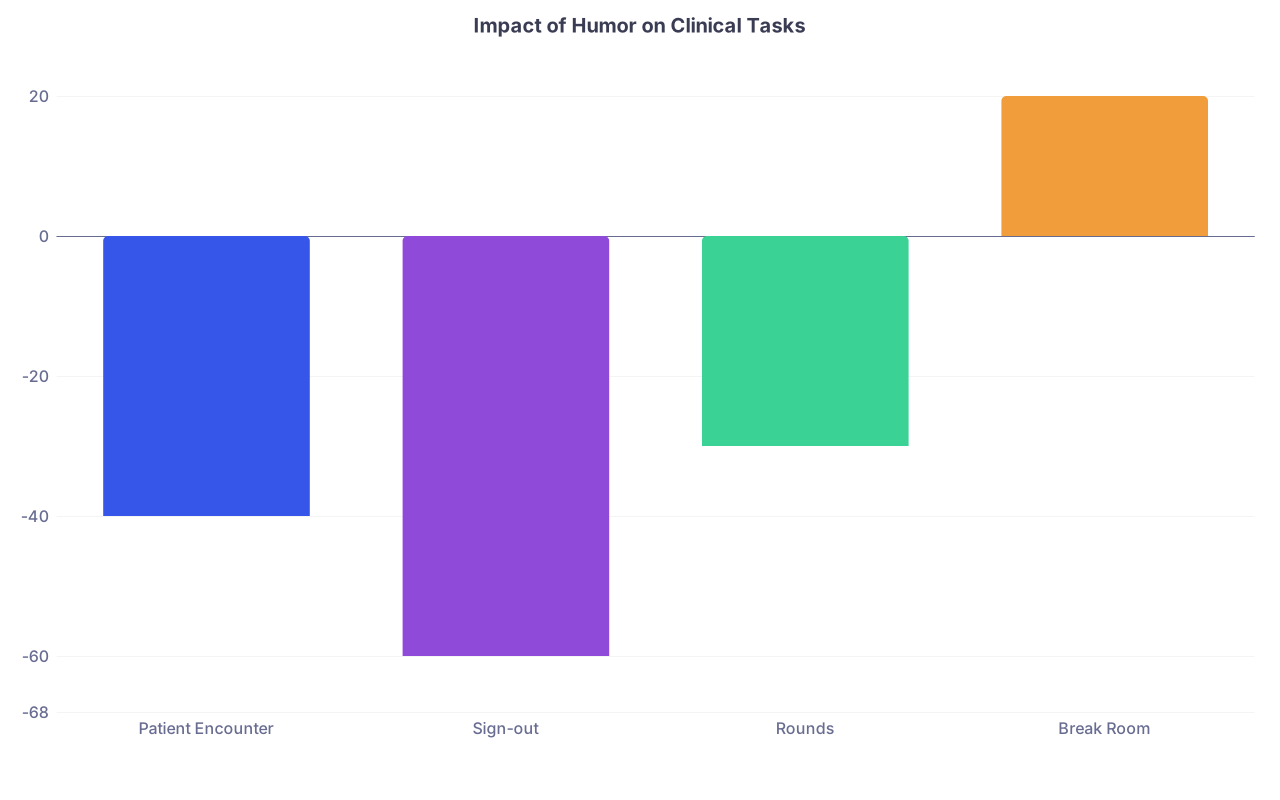
| Category | Value |
|---|---|
| Patient Encounter | -40 |
| Sign-out | -60 |
| Rounds | -30 |
| Break Room | 20 |
(Interpretation: humor during patient care tasks hurts; in the break room, it helps.)
During rounds
Scenario: You’re presenting to the attending, the performing student keeps whispering jokes, riffing on the attending’s questions, or adding commentary that isn’t helpful.
Use a calm, work-focused phrase:
Resident version:
- “Let’s keep interruptions to clarifying questions.”
- “Hold comments for after rounds—I want to get through all the patients.”
If they keep going:
- “I’m serious. No side comments during presentations. We’re losing track of the plan.”
No raised voice. No sarcasm. Just an explicit rule.
In a patient room
This is where I have zero patience.
If the student cracks jokes that make the visit about them or trivialize the situation:
Right then and there, you can say:
- “Let’s keep things serious for a moment.”
- “This is a tough topic; we’re going to stay focused on [patient’s name] right now.”
If it’s egregious (e.g., joking about weight, substance use, suicide, trauma), you shut it down sharply and move on. Later, you debrief privately (we’ll get to that).
In sign-out or critical tasks
If they’re talking over sign-out with “funny” commentary:
- “Pause the jokes. We need to hear this cleanly.”
- “No side chatter during sign-out. It’s too easy to miss things.”
If they push back with “I’m just kidding,” you do not get baited into defending your sense of humor.
You repeat:
- “This is not about jokes. It’s about safety. No side chatter.”
Period.
Step 5: The private conversation you’re avoiding (but need)
If you’re their senior, you owe them at least one honest, private conversation before you just nuke them on evals.

| Step | Description |
|---|---|
| Step 1 | Notice repeated performing |
| Step 2 | Micro-correct in real time |
| Step 3 | Plan private feedback |
| Step 4 | Describe specific behaviors |
| Step 5 | Explain impact on patients and team |
| Step 6 | Set clear expectations |
| Step 7 | Reinforce positively |
| Step 8 | Escalate and document |
| Step 9 | Is it minor? |
| Step 10 | Behavior improves? |
Do it somewhere neutral. Not in front of nurses. Not in front of other students.
Template you can use almost verbatim:
“I want to talk about something that’s affecting the team.
I’ve noticed during rounds and in patient rooms, you make a lot of jokes and side comments. For example, yesterday in Ms. Lopez’s room, when we were talking about her new cancer diagnosis, you joked about ‘all-inclusive hospital stays.’
I get that you’re probably trying to ease tension or be likable. But here’s the impact: it shifts focus away from the patient, it makes it harder for us to track the plan, and it can come across as unprofessional.
Going forward, I need you to:
- Keep jokes and banter out of patient rooms unless it’s clearly aligned with the patient’s tone.
- Stay quiet during others’ presentations except for clinical questions.
- Save humor for the workroom when tasks are done and no one’s actively running patient care.
Can you do that?”
Then shut up. Let them respond. Common reactions and what to do:
“I was just trying to lighten the mood.”
Response:“I understand the intent. I’m giving you feedback on the impact. In medicine, impact wins over intent every time.”
“No one else has ever complained.”
Response:“Someone is now. I’m responsible for this team. This is your feedback for this rotation.”
They get obviously embarrassed or tearful.
Response:“I’m not saying you’re a bad person or that you can’t ever be funny. I’m saying on this team, in this setting, we need a different balance.”
They say “okay” but keep doing it.
Then we move to escalation.
Step 6: Document and escalate when they don’t stop
If you’ve:
- Set expectations at the start
- Corrected in the moment
- Had a clear private conversation
…and they still keep doing the bit?
You escalate. This isn’t you being mean. This is you doing your job.
How to document (residents/fellows/attendings)
Keep it simple and factual:
- Date
- Context
- Exact or near-exact wording
- Impact
Example notes (keep them in a secure, appropriate place—your own passworded doc, or institutional feedback form, not the group chat):
- “7/5 – AM rounds – repeatedly added nonclinical jokes during senior’s presentation after being asked twice to hold comments.”
- “7/8 – In patient room with new CHF diagnosis – joked ‘at least you get out of work for a while,’ patient visibly upset, I redirected conversation.”
- “7/10 – Private feedback given: outlined concerns about professionalism, asked to restrict humor during patient care and sign-out. Student verbalized understanding.”
When it’s eval time, this becomes:
“Student frequently engaged in performative humor at inappropriate times (during patient encounters, sign-out, and presentations) despite direct feedback. This impaired team focus and risked undermining patient trust.”
Not “they have a good sense of humor but sometimes go too far.” That’s how patterns persist.
Who to escalate to
- Clerkship director or site director if behavior continues or seriously affects patient care.
- Program leadership (APD/PD) if you’re dealing with a sub-I or an acting intern headed toward residency.
- Attending, if you’re a resident and haven’t looped them in yet.
You do not need 10 incidents. A handful of clear, unambiguous episodes plus prior feedback is enough.
Step 7: Protect yourself as a co-student
If you’re not the one holding the pen on evaluations, this part matters.
Your risks as a co-student:
- Being guilt-by-association “the silly pair”
- Losing learning time to their performance
- Being used as their audience and then resented for not laughing
Here’s what you can do.
Quietly separate your behavior
On rounds, you:
- Stand slightly apart, look at the chart, not at the comedian.
- Ask your own clinical questions.
- Volunteer to present, to follow up, to call consults.
Make it visually obvious: you’re here to work, not to perform.
Short, boundary-setting lines
With them directly, low-drama:
- “Hey, I’m going to focus during rounds; can we save the bits for after?”
- “I get nervous when there’s joking in front of patients; I’d rather keep it more serious.”
If they tease you—“You’re no fun,” “Lighten up”—you do not defend your personality.
You say:
- “I’m here to learn and not get in trouble. That’s all.”
If they say something really off with a patient
You don’t need a speech. One line can create distance:
To the patient, gently:
- “I’m sorry about that; we’re taking your situation seriously.”
Then after, you tell the resident:
- “FYI, during Ms. X’s encounter, [student] made a joke about [topic]. It felt off to me and the patient looked uncomfortable.”
You’re not snitching. You’re flagging a real issue.
Step 8: The nuance—when humor is actually useful
I’m not anti-humor. I’m anti-self-serving humor in the wrong setting.
There are ways to redirect a performing student without crushing their entire personality.
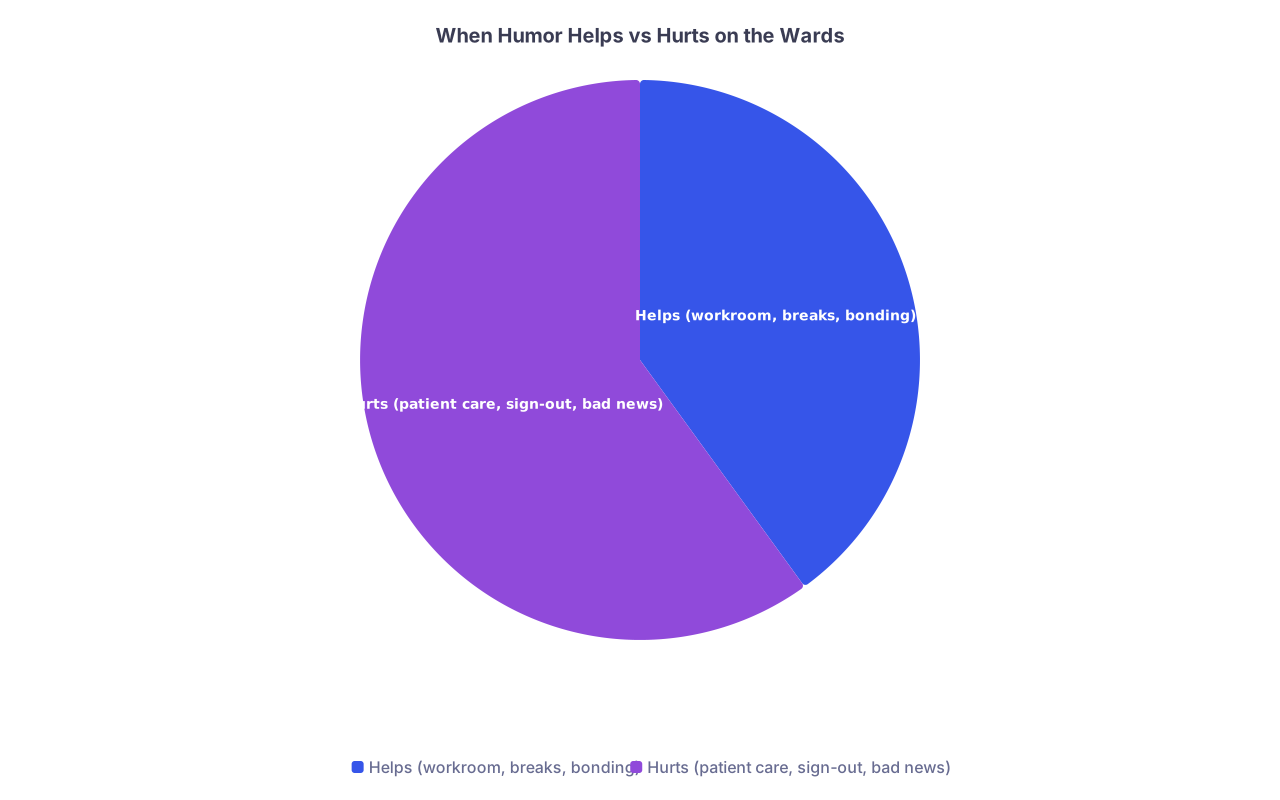
| Category | Value |
|---|---|
| Helps (workroom, breaks, bonding) | 40 |
| Hurts (patient care, sign-out, bad news) | 60 |
If you notice they’re genuinely good at connecting with people (when they’re not overdoing it):
Resident script:
“You clearly have a gift for putting people at ease. That’s going to make you a better doctor. The skill to learn now is timing. Use that same warmth and humor to respond to them instead of performing at them. Let them set the tone; follow, don’t lead.”
Practical reframe for them:
- If patient or family laughs first: you can match it, gently.
- If patient is crying, scared, confused: your job is to hold space, not fill silence.
- If it’s sign-out or serious rounds: humor is off.
Sometimes they just haven’t seen it modeled. You can call it out when they do it right:
- “Hey, the way you joked with Mr. K after he joked first—that was perfect. That’s what appropriate use of humor looks like.”
Positive feedback on the right use of humor helps extinguish the wrong use faster than constant criticism.
Step 9: Scripts for common ugly scenarios
Let me give you concrete lines. You’ll thank me at 2 a.m.
Scenario: They make a joking comment about a patient’s weight in the room
Immediate response (resident/fellow/attending):
“We don’t joke about weight or appearance here. This is a medical issue and we take it seriously.”
Then smoothly pivot back to patient care. Later, private conversation. Document.
Scenario: They keep interrupting your presentations with jokes
During rounds:
“Please hold comments unless they’re about the plan. I’m losing my train of thought.”
If repeated:
“We’ve talked about this. No more side comments during presentations.”
Scenario: They complain you’re “too serious” to other students
If it comes back to you and you actually care:
“Yeah, I’m serious when it comes to patient care. You can absolutely be funny—just not at the expense of the work.”
If you don’t care: ignore it. You’re not on a popularity rotation.
Scenario: They’re fine in front of attendings but wild when unsupervised
This is classic. Many students know when to “turn it on” and when they think no one important is watching.
You treat unsupervised behavior as real data.
Tell your attending or clerkship director:
“Just FYI, [student] is much more performative and unprofessional when it’s just the team without attendings present. For example, during cross-cover last night they [specific behavior]. We’ve given feedback; behavior’s ongoing.”
Translated: this is not just mild joking. This is a pattern.
Step 10: Remember what you’re actually responsible for
You’re not responsible for:
- Healing their childhood need for attention
- Making sure they “feel seen”
- Preserving their self-image as “the funny one”
You are responsible—if you’re above them in the hierarchy—for:
- Patient safety and trust
- Team learning environment
- Accurately reflecting professionalism on their evals
- Modeling boundaries for quieter students who think this is normal
And if you’re beside them in the hierarchy, you’re allowed to:
- Opt out of being their audience
- Ask for a more serious environment
- Protect your own reputation and learning
Open your notes app and write three phrases you’re willing to say out loud this week—one to redirect in the moment, one for a private conversation, and one to protect yourself as a co-student. Then, the next time the “show” starts, use one of them instead of just forcing a smile.