
Last week on nights, an intern told a joke about “earning ICU punch cards” where every code blue was one stamp closer to a free coffee. Everyone laughed. Hard. Except one person, who kind of half-smiled, stared at the floor, and then avoided the workroom for the rest of the shift.
That person could’ve been me. Honestly, it might be you next year.
The fear you don’t want to say out loud
Let me just say it straight: I’m scared I’m going to end up in a program where everyone copes with dark humor, and I…don’t. Or at least, not in the same way.
Not the cute “haha we’re all so tired” jokes. I mean the “if my patient codes one more time I’m unplugging them to charge my phone” level. The “another septic grandpa, better call the transplant team for my soul” stuff. The comments that make your stomach twist a little but everyone else thinks are comedy gold.
The nightmare loop in my head goes like this:
- I match into a program where everyone is fluent in aggressive, bleak humor.
- I don’t laugh, or I look uncomfortable.
- They think I’m uptight. Or weak. Or judging them.
- I get labeled “doesn’t fit the culture.”
- I get frozen out socially.
- Then that bleeds into evals. And maybe fellowship letters. And then my whole career gets quietly screwed because I couldn’t pretend to laugh about dead patients at 3 a.m.
That sounds dramatic when you write it out, but I know I’m not the only one thinking it.
So here’s what I want to untangle:
- Is dark humor really everywhere?
- Do you have to play along to belong?
- Can not fitting that culture actually hurt you?
- What can you realistically do if you end up in a place that feels too dark for you?
Why dark humor is so loud in medicine
Let’s be honest: medicine is a horror show a lot of the time.
Codes that don’t work. Kids with cancers they shouldn’t have. Families screaming in the hallway. People dying alone. All while you’re sleep-deprived, hungry, and being graded.
Dark humor is one of the main defense mechanisms people use to not fall apart.
I’ve heard:
- “He didn’t code, he rage-quit.”
- “Trauma pager is basically a DoorDash for corpses.”
- “At least the patient can’t complain anymore.”
On day one, that stuff can sound monstrous. By month three, it almost starts to blend in. And that’s what scares me the most—that you either adapt or go numb or both.
Here’s the uncomfortable truth: dark humor is not going away. It’s wired into how a lot of clinicians survive this job. If you expect a residency with zero dark humor, you’re going to be disappointed.
But there are very different flavors of dark humor, and that matters.
| Type | Rough Example |
|---|---|
| Self-directed | "If I miss one more lab, just page psych." |
| Situation-focused | "Of course the code happens at 6:59." |
| System-directed | "Perfect, 4 admissions and no beds." |
| Patient-depersonalizing | "Bed 12 is circling the drain." |
| Family-mocking | "Classic crazy daughter syndrome again." |
The top three are survivable. Sometimes even relatable. The bottom two? That’s where I start feeling sick. That’s usually what people mean when they say, “The humor here is dark.”
So no, you’re not overreacting if those last two categories bother you.
The quiet panic: “If I don’t laugh, will they think I’m judging them?”
Yeah. This is the core terror, right?
You’re not just worried about not being funny. You’re worried that your face will betray you. Slight frown. Awkward silence. Not laughing with the group. And then someone later says, “You know, she’s…kind of sensitive.”
I’ve seen this play out:
- Intern doesn’t laugh at the “haha this guy’s CT is a dumpster fire” joke.
- Senior clocks the reaction.
- Later: “Good worker, but a little too serious. Needs to thicken skin.”
And that ends up in some version of feedback or reputation.
So what do you do if you genuinely don’t find it funny and don’t want to fake it?
Three things I’ve seen work:
Default to neutral — not performative.
You don’t have to laugh. A small tight smile, quick redirect to task, or even just eye contact with the one person who also looks uneasy. You’re not the comedy police. You’re allowed to just…not engage.Use self-deprecating pivots.
Example: Someone jokes, “Wow, ICU bingo, we got every organ failure today.”
You: “I’m just trying not to be the one who completes someone’s bingo card.”
You acknowledged the vibe, moved it to yourself, and away from mocking the patient.Save your opinions for 1-on-1, not the whole group.
Calling someone out in front of everyone — “That’s not funny” — almost never ends well as an intern. But saying quietly later to someone you trust, “That joke about the patient’s body really shook me, is this normal here?” can actually lead to surprising honesty.
You’re not required to clap when you don’t like the show.
Will not “fitting” hurt me professionally?
Here’s the thing I keep turning over at 2 a.m.: they all say they care about empathy, professionalism, patient-centered care. But in the workroom, it feels like you get bonus points for being brutal and sarcastic.
So which one actually matters for evals and careers?
This might sound cynical, but I think it’s true:
What matters on paper:
Showing up, doing the work, being reliable, not being a jerk to staff or patients, communicating clearly, responding to pages, not blowing up under pressure.What matters socially (and leaks into “fit”):
Whether you’re easy to be around when everyone’s exhausted. That can include humor style, but it’s not only that.
If you’re respectful, helpful, and not constantly radiating moral judgment, most people genuinely don’t care that you’re not the darkest person in the room.
Where people get in trouble is when “I don’t like this humor” turns into:
- Visibly glaring every time someone jokes.
- Sighing, eye-rolling, or walking out dramatically.
- Passive-aggressive comments like, “Wow, we’re really joking about this?”
That’s when they don’t label you as “sensitive,” they label you as “difficult.” And that absolutely can show up in evals.
So the line I try to hold is:
- I don’t have to join in.
- I don’t have to laugh.
- But I also don’t have to broadcast contempt.
You can disagree silently and still protect yourself.
Reading the room vs. betraying yourself
Part of what freaks me out is this idea that I’ll either:
- Become numb and start making the same jokes I hate now.
or - Refuse to adapt at all and be miserable and isolated.
Real life is usually messier and more in-between.
You’ll probably end up with:
- Some attendings who never do dark humor. Just straight, serious, kind humans. (They exist. Clinical saints. Treasure them.)
- Some residents who go too far and make your skin crawl.
- Some people who do quick, blunt jokes that are dark but not mean-spirited, and you might eventually find yourself half-laughing in spite of yourself.
You’re allowed to evolve. You’re allowed to find some of the gallows humor funny and still draw a line.
A trick I use: gut-check where the joke is pointed.
At the system?
“Of course the EMR crashed during sign-out.” That’s fine. Honestly healthy.At my own suffering?
“My Hgb is 7 and it’s only day 2 of nights.” Again, fine.At a patient’s dignity or identity?
“He’s basically a vegetable, anyway.” That’s where I internally tap out.
You don’t have to announce these boundaries out loud. You just use them to guide when you engage and when you go quiet.
What if the humor really is toxic?
Let’s not sugarcoat this: some programs cross from “coping” into “cruel."
I’m talking:
- Consistent mocking of specific patient populations (obesity, addiction, mental health, non-English speakers).
- “Jokes” that are basically bullying: “Of course the psych patient is manipulative, they all are.”
- Laughing in front of patients or families in a cruel way.
That’s not just “different humor.” That’s ethics and professionalism. And if that’s the main culture — not just one person, but the default — you’re not overreacting to be deeply uncomfortable.
Signals you’re not alone in feeling weird about it:
- Nurses exchange glances when a certain fellow starts talking.
- Med students shut down and go silent.
- One or two residents stay out of the workroom a lot.
- Everyone stops joking when a specific attending walks in, because they won’t tolerate it.
If you end up in a truly toxic environment, your goal shifts from “how do I fit in?” to “how do I survive this without losing myself?”
That looks like:
- Finding your micro-tribe: one co-intern, a nurse, a senior, a pharmacist, anyone who vibes closer to how you think. You don’t need the whole program. Two people can feel like oxygen.
- Using spaces you control to reset: home, therapy, group chats with friends at other programs who get it.
- Documenting clear unprofessionalism (not for vendetta, but in case you need patterns later).
- Quietly seeking mentors outside your immediate team: PD, APD, wellness faculty, even across departments.
You’re not trapped forever. Residency is long, but not permanent.
Can you spot this culture before you match?
This is the part that makes me crazy: how are you supposed to figure this out on virtual interview day when everyone is pretending to be on their best behavior?
You can’t know everything, but you can probe.
Try asking residents:
- “What kind of humor is common in the workroom? Do people cope with jokes, venting, silence—what’s the vibe?”
- “If someone isn’t into dark humor, would they feel out of place here?”
- “Do you feel like people are generally respectful when talking about patients when they’re not in the room?”
And listen less to the words, more to the hesitation. If they pause. If they laugh-nervous and say, “We joke a lot, but it’s all in good fun, you know?” and move on quickly—that’s a sign.
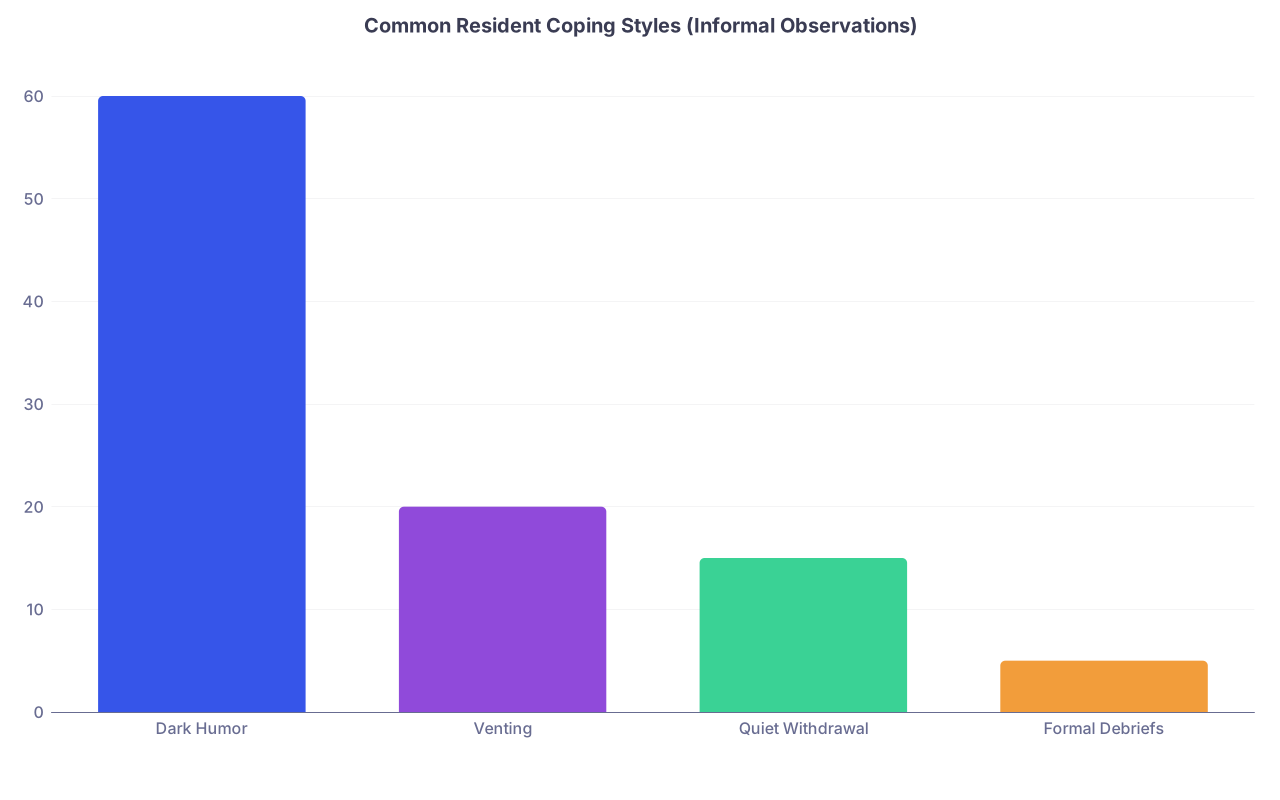
| Category | Value |
|---|---|
| Dark Humor | 60 |
| Venting | 20 |
| Quiet Withdrawal | 15 |
| Formal Debriefs | 5 |
Programs love to talk about “we’re like a family.” Ask, “Okay, and in this ‘family,’ when the days are really hard, what does that look like in the workroom?” Let them show you whether “family” means supportive or sarcastic and brutal.
No method is perfect. But you can often sense if the dominant energy is:
- Exhausted but kind
vs. - Exhausted and mean
Trust that sense.
How to exist in a dark-humor-heavy program without breaking
If I do end up somewhere where the jokes are darker than I’d like, I’m trying to prep a playbook now so I don’t just freeze.
Stuff I’m actually planning to do:
Decide my red lines beforehand.
For me: no laughing at patient bodies, trauma histories, or deaths. No “jokes” that mock families during active grief. If it happens, I just stay quiet, look at the monitor, check orders. I don’t reward it with attention.Curate my people aggressively.
You don’t need everyone. If I find one attending and one co-intern whose default is more humane and less cynical, I’m going to cling to them. Eat lunch with them. Decompress with them. Build my own micro-culture inside the bigger one.Protect my own humor lane.
I’m not humorless. I just don’t want to be cruel. So I can still participate with:- self-targeted jokes (“If I don’t sit down soon my joints will also need ortho consult”)
- system jokes (“Amazing how admin discovered ‘no cap on admissions’ but not ‘no cap on salary’”)
This lets me be part of the group without selling my soul.
Have one person I can be fully honest with.
Maybe that’s a therapist, maybe a mentor outside my program, maybe a friend across the country. Someone who can say, “No, you’re not crazy. That was messed up,” when the whole room laughs and you want to cry.Remember: professionalism still wins big-picture.
The same attendings who drop dark one-liners in the workroom will often also write, “Incredibly empathetic, always speaks respectfully about patients,” and that matters way more for your future than whether you laughed at the ICU bingo joke.

| Step | Description |
|---|---|
| Step 1 | Hear Dark Humor |
| Step 2 | Stay Neutral or Light Joke |
| Step 3 | Go Quiet and Focus on Work |
| Step 4 | Process Later with Trusted Person |
| Step 5 | Maintain Rapport |
| Step 6 | Adjust Boundaries |
| Step 7 | Crosses Your Line |
You’re not broken for not finding it funny
This is the part I keep needing someone to say to me, so I’m going to say it to you too:
You’re not naive. You’re not weak. You’re not “too sensitive” because you don’t want to laugh about human beings at their worst moments.
The part of you that flinches at certain jokes? That’s the same part that will sit with a terrified patient at midnight. That will catch the small discrepancy in the chart because you actually see the person behind the numbers.
The system will try to sand that off. Dark humor is part of that sanding. Some of it’s protective. Some of it’s corrosive. You’re allowed to protect the part of you that doesn’t want to rust.
The goal isn’t to become immune. It’s to become durable without going numb.

Tiny script bank: what you can actually say
If you’re like me, you freeze when things get awkward. So here are some phrases that don’t start fights but still protect your sanity:
When a joke goes too far:
“Man, this place really gets to everyone, huh?”
(Names the stress, not the joke.)To pivot away:
“Okay, I’m going to go check on bed 12.”
(You remove yourself without lecturing.)To gently re-humanize:
Someone: “Bed 4 is circling the drain.”
You: “Yeah, he’s had a rough run.”
(You use “he,” not “bed.” Tiny, but real.)In 1-on-1 with someone you trust:
“Sometimes the jokes make me feel worse, not better. Am I the only one?”
(Opens the door. I promise you’re not the only one.)
You don’t have to be the ethics committee. Just quietly choosing different words matters.
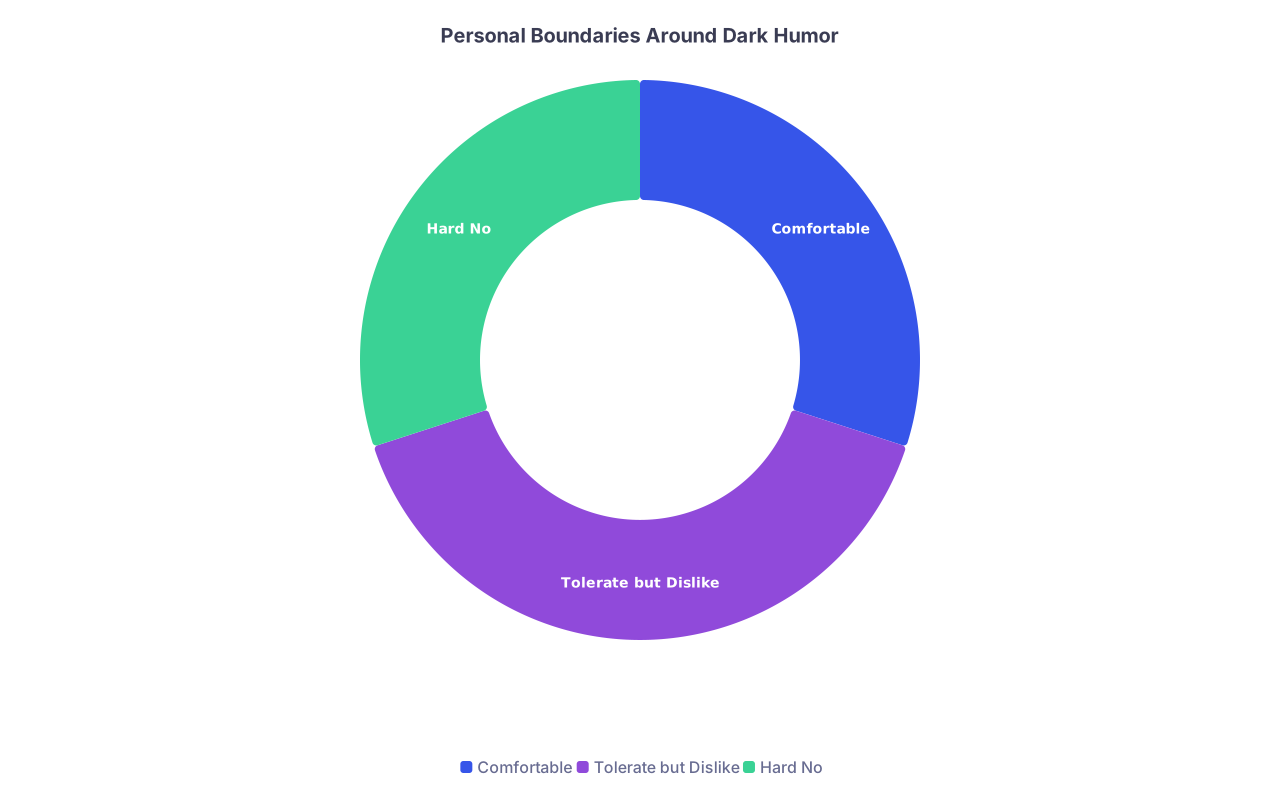
| Category | Value |
|---|---|
| Comfortable | 30 |
| Tolerate but Dislike | 40 |
| Hard No | 30 |
FAQ (exactly what I’m still spiraling about)
1. Will programs think I’m “not a good fit” if I don’t lean into dark humor on interview day?
Unlikely, as long as you’re warm and engaged in other ways. Interview-day humor is usually pretty tame compared to what you’ll see at 3 a.m. If you smile, show interest, ask good questions, and don’t give off “I’m silently judging all of you” vibes, no one is docking you points for not making edgy jokes. They care much more that you seem like someone they can work with at 2 a.m. when everything’s on fire.
2. Should I fake laughing so I don’t look weird?
I wouldn’t build a personality on fake laughing. A small polite smile in the moment is fine if you’re caught off guard. But long-term, constant fake laughter feels awful and people can eventually tell something’s off. Better to stay mostly neutral, occasionally smile if something’s genuinely funny, and redirect with work-related comments or gentler humor. You don’t have to be the loudest laugh in the room to avoid being an outcast.
3. What if an attending makes a really disturbing joke—am I supposed to report it?
It depends how bad it is and how safe you feel. If it’s a one-off, gross comment that doesn’t target a protected group, many residents just…don’t engage and vent about it later. If it’s ongoing, discriminatory, or clearly unprofessional (racist, sexist, mocking disability, etc.), then yes, that’s exactly what things like anonymous reporting, GME office, or trusted faculty are for. You don’t have to decide alone—talk to a senior or chief you trust first, get their read, and then decide if and how to escalate.
4. Can I actually find a program with less dark humor, or is this just everywhere?
Dark humor exists almost everywhere, but the volume and tone vary a lot. Peds, psych, and some IM programs tend to skew toward gentler or more self-directed humor. Trauma, EM, surgery often lean darker and more sarcastic, though there are exceptions in every direction. Your best bet is to ask residents directly about culture, watch how they talk about patients during pre-interview chat, and pay attention to your own gut. You probably won’t find a completely “pure” environment, but you can find places where the dominant energy is more humane than hostile.
Open your notes app and write down three humor boundaries for yourself: one thing you’re okay with, one thing you’ll tolerate, and one thing that’s a hard line. That’s your starting compass. You don’t have to fix the whole culture—but you do need to know where you stand.