
You’re Standing There, They’re All Laughing, and Your Brain Just… Blue Screens
It’s 10:37 a.m. You’re on rounds. The team has somehow shifted from sepsis management to a running joke about a pager going off during someone’s proposal, and everyone is laughing — attendings, residents, even the pharmacist who never laughs.
You?
You’re standing there with that polite half-smile, pretending you got the joke while your brain is frantically thinking:
“Wait, what was the setup? Did I miss the reference? Should I laugh harder? If I laugh now is it delayed and weird? Oh God, I’ve missed the window. Now I’m just silently staring. I look creepy. I seem cold. They think I’m a robot. They’re definitely going to write on my eval that I’m ‘socially awkward and not a team player.’ Perfect.”
You say nothing.
You chuckle once, way too late.
You stare at your shoes.
And then for the rest of the day, you obsess:
I froze when the team was joking. Do I seem cold? Awkward? Unlikable? Did I just tank my rotation because I didn’t laugh at a nephrology meme?
Let’s talk about that. Because I have been exactly there, clutching my folded list, watching a room laugh and wondering if my whole career just died over one missed punchline.
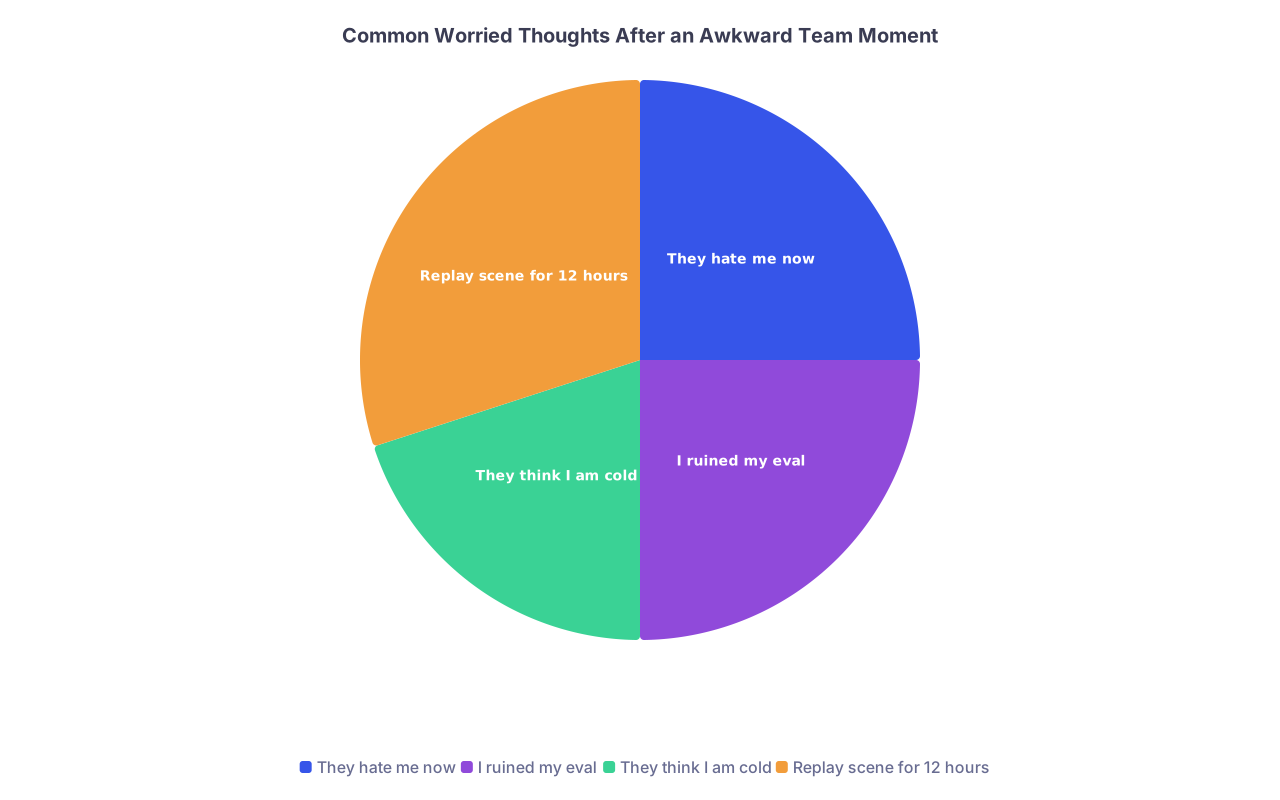
| Category | Value |
|---|---|
| They hate me now | 25 |
| I ruined my eval | 25 |
| They think I am cold | 20 |
| Replay scene for 12 hours | 30 |
What You Think Happened vs What They Actually Saw
Here’s the messed-up part: your internal experience and their external perception are almost never aligned.
Inside your head, it feels like this huge, glaring social failure. You experienced:
- A lag in processing the joke
- Panic about how to respond
- Physical freezing
- Then rumination afterward on loop
Outside, to them, it probably looked like… you were just quiet. Or distracted. Or tired.
I’m not saying this to be fluffy and comforting. I’m saying this because I’ve literally watched it happen from the other side. I’ve been the anxious MS3 in the corner, and I’ve been the resident looking at a student thinking, “They’re a little quiet, but fine,” while that student later tells me they thought they “completely embarrassed” themselves at sign-out.
Most teams are not sitting there psychoanalyzing your micro-laugh latency. People are thinking about:
- The patient with crashing blood pressure
- Their notes they haven’t written
- The text they got from their partner about daycare calling
- Whether they’re going to eat lunch before 4 p.m.
If anything, what they maybe noticed was: “Oh yeah, that student is kind of reserved.” Full stop. Not “cold,” not “hates us,” not “emotionally defective.”
You’re narrating a catastrophe they never watched.

Why You Freeze When People Joke (Especially in Medicine)
Let me say the quiet part out loud: a lot of us in medicine are not naturally smooth social operators.
We’re high on analysis, low on improv. You give us a differential? We’re great. Unexpected banter in a high-stress environment with people who evaluate us? Our brains crash.
A few reasons this “freeze” keeps happening:
Power dynamics
These aren’t just friends hanging out. They’re attendings and residents who literally control your grade, your letter, maybe your specialty shot. So your brain does the math:
“If I say something dumb, I might tank my future.”
Result: you say nothing.Split attention
While they’re laughing, half your mind is on: “Don’t miss the labs. Don’t forget to follow up that CT. What if they pimp me right now?” Jokes are background noise when you’re in survival mode.Perfectionism
You don’t want to say the “wrong” thing. So your brain demands the perfect comment. But jokes are fast. Humor doesn’t wait for perfection. Silence wins by default.Latency
Some of us just process social stuff a few seconds slower, especially when anxious. By the time we really understand the joke, the moment’s gone. So we just… stand there.
None of this screams “cold” or “unfriendly.” It screams “anxious, overloaded brain with way too much riding on this rotation.”
I’m not excusing actual rudeness or indifference. But “I froze and didn’t join in the joking” is not that.
What This Actually Does to Your Evaluation (Blunt Answer)
You’re probably terrified about this part, so let’s be direct.
Does freezing during jokes automatically mean:
“Poor team player, would not work with again” on your eval?
No.
Could it feed into a broader pattern if you’re also disengaged with patients, uninterested on rounds, and never speak or ask questions? Yes, then it can be one small part of a bigger story.
But one (or several) awkward joke moments by themselves? That’s not an eval-killer.
Here’s what attendings and residents actually care about 100x more than whether you laughed:
| Category | How Much It Matters |
|---|---|
| Reliability | Extremely high |
| Work ethic | Extremely high |
| Kindness to patients | Very high |
| Initiative | Very high |
| Clinical growth | Very high |
| Social smoothness | Medium to low |
If you:
- Show up on time
- Know your patients cold
- Follow up on tasks reliably
- Are kind to nurses and staff
- Try to learn and improve
Then “a bit quiet socially” usually shows up as a one-liner at most: “On the quieter side but pleasant.” That’s it. That’s what you’re losing sleep over.
The only time this really becomes an issue is if you cross over from “reserved” into “seems disinterested/aloof.” That’s fixable, by the way, without turning into the rotation clown.

| Step | Description |
|---|---|
| Step 1 | Team makes joke |
| Step 2 | You freeze and half smile |
| Step 3 | Your brain - I ruined everything |
| Step 4 | Team brain - Student is quiet |
| Step 5 | Ruminate all day |
| Step 6 | Move on with rounds |
How to Seem Less “Cold” Without Turning Into the Team Comedian
You don’t have to be the funniest person on the team. You really don’t. You just have to give off “engaged human who’s glad to be here” instead of “AI tablet with a stethoscope.”
If humor isn’t your reflex, use small, low-risk behaviors instead.
1. The “Supportive Laugh + Micro-Comment” Move
If you kind of get the joke but not enough to contribute, this is enough:
- Small genuine smile or light laugh
- One short echo comment, like:
- “That sounds brutal.”
- “I can’t even imagine.”
- “That’s so on brand for nights.”
You’re signaling: I’m here, I’m listening, I’m not made of stone. You’re not trying to out-funny anyone.
2. The “I’m With You” Nonverbals
If words feel risky, use your face and body:
- Turn slightly toward the group
- Uncross your arms
- Nod when others laugh
- Smile when people tell stories
You’d be shocked how many residents interpret that as: “They’re nice, just a bit quiet.” Most people do not need you to perform.
3. Low-Stakes Small Talk Before or After
Your eval isn’t written based on who laughed hardest at the colonoscopy story. It’s built over weeks of small, human interactions. A few options that don’t require you to be charming:
- On the way to the next patient: “Long day for you guys?”
- At the computer: “Do you prefer days or nights?”
- After rounds: “Any tips for getting better at presentations on this service?”
These show you’re not cold. You’re just reserved. Huge difference.
4. Patient-Facing Warmth Still Counts as “Team Player”
A lot of residents and attendings judge your “interpersonal” skills heavily based on how you are with patients and families.
If you’re warm at the bedside, explain things kindly, pull the blanket up, grab the patient some water — that’s “not cold.” Even if you’re awkward in the workroom.
So if you’re going to spend emotional energy anywhere, spend it there.
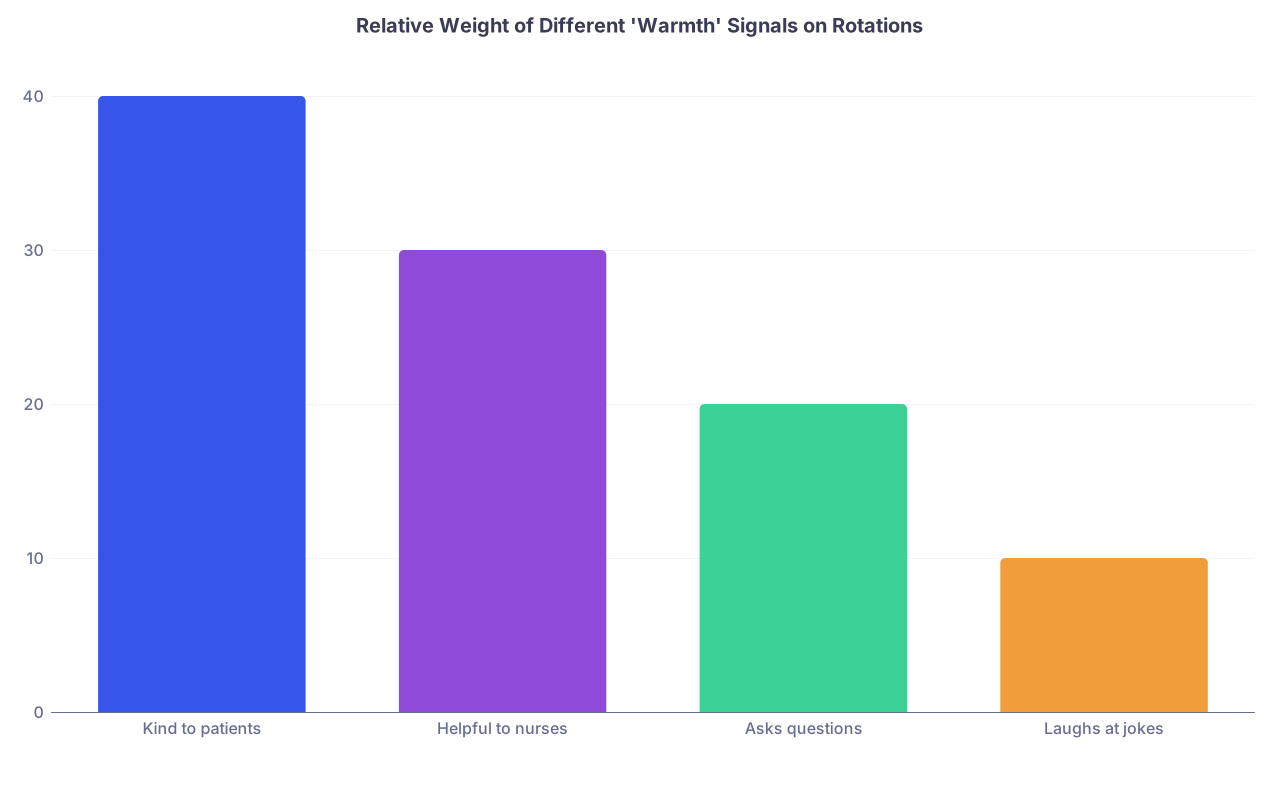
| Category | Value |
|---|---|
| Kind to patients | 40 |
| Helpful to nurses | 30 |
| Asks questions | 20 |
| Laughs at jokes | 10 |
The Dark Thought: “What If They Really Do Think I’m Awkward?”
Okay, let’s stare at the scary version for a second: maybe someone on your team does think you’re awkward. Or quiet. Or “hard to read.”
So what.
Truly. Some of the best residents and attendings I’ve ever met were deeply awkward as students and interns. Medicine is full of socially weird, brilliant, deeply caring people who don’t know what to do with their hands during group jokes. You’re not disqualified.
If someone wrote: “A bit awkward socially but hardworking and cares about patients” on an eval? Programs will still absolutely take you. That reads as: “A real human who is trying.”
You know what’s actually a problem?
- “Dismissive with nurses.”
- “Late and unreliable.”
- “Doesn’t follow through.”
- “Talks badly about other team members.”
Not: “Didn’t laugh when we made a joke about the EMR going down.”
If you’re worried it’s becoming a pattern, you can literally ask for feedback in a controlled way:
“Hey, I know I’m on the quieter side, and I want to make sure I’m not coming across as disinterested. Anything I should be doing differently on the team side of things?”
Most residents will say something like, “No, you’re doing fine — you can always ask more questions, but you’re definitely not coming off as rude.” And even if they do say, “Yeah, you are quiet — speaking up a bit more would help,” that’s not condemnation. That’s solvable.

The Medical Humor Part: You Are Not the Only Frozen One
Let me tell you what nobody admits on rounds: everyone has stories of socially malfunctioning in front of the team.
I’ve seen:
- An intern laugh way too hard at a mediocre joke from an attending and then not know how to stop, so they just kept laughing until the room went quiet.
- A student try to join in and accidentally make a joke about something that turned out to be the attending’s research area. Silence. Nuclear silence.
- A resident respond to a joke with a detailed pathophys explanation because they thought it was a teaching question.
You know what everyone did?
Moved on.
Half the room forgot 10 minutes later because someone’s pager went off.
You freezing is not some unique, horrifying flaw. It’s just your version of “I’m uncomfortable and my brain lagged.” If medicine had closed-circuit video of everyone’s social misfires, nobody would ever make it past intern year.
The future of medicine isn’t going to be: “Only extroverted, flawlessly socially calibrated people allowed.” If anything, as the system gets more chaotic and burned out, there’s more room for the quiet, steady, non-performative types who just do the work and care about people.
Your awkward half-smile in a joke you didn’t understand is not the thing that’s going to decide your fate. It just feels that way right now, because your brain is telling you the stakes are always life-or-death.
What You Can Actually Do Next Time (Without Faking a Personality)
Here’s a simple, script-level way to handle the next “team is joking and I’ve frozen” moment:
- Let yourself just smile. Not perform. Just a small smile. That’s enough in the moment.
- If you think of something minor and safe to say, toss it in: “That sounds rough,” “Classic ER,” “I’ve definitely done that with my pager.” If your brain is blank, skip this. Really. Silence is better than forced weirdness.
- Later, find a tiny moment to be human outside the joke context — compliment someone’s teaching, ask a question about workflow, or say “thanks for letting me follow along today.” That does more for how they see you than your performance during jokes.
And if it’s already happened and you’re sitting here replaying it for the 50th time: the moment is over. It exists now only inside your head. The team has moved on. You’re the only one still stuck there.
You don’t need to become The Funniest Person on Service. You just need to be:
- Not actively rude
- Minimally responsive
- Clearly engaged in the work and the patients
That’s enough. Really.
FAQ (Exactly the Stuff You’re Spiraling About)
1. Can one awkward moment during team jokes tank my rotation eval?
No. One moment? Absolutely not. Evals come from patterns over weeks: your work, reliability, and attitude. “Didn’t laugh at our story about a code brown” isn’t going on the form. If the rest of your behavior is solid, this becomes invisible background noise.
2. Do attendings and residents actually notice if I don’t laugh?
Sometimes they notice you’re “quiet” or “serious,” but they’re not cataloging each missed laugh. Most of the time they’re only half paying attention to the joking anyway. You’re giving this one moment way more attention than anyone else did.
3. Will programs think I’m not a ‘team player’ if I’m introverted and awkward?
They’ll think you’re not a team player if you’re dismissive, unreliable, or hard to work with. Being introverted but kind, responsive, and respectful is fine. Lots of excellent residents are awkward, quiet, and deeply valued.
4. Should I force myself to joke more, even if it feels fake?
No. Forced humor usually backfires and makes you feel worse. Aim for “present and warm-ish,” not “hilarious.” A small smile, nods, brief supportive comments — that’s enough. Save your energy for actually learning and caring for patients.
5. How do I fix it if I think I came off as cold already?
You don’t need a grand apology. Just start adding small human touches going forward: a “good morning,” a “thanks for teaching today,” a quick question about how they approach something. Over a few days, that will completely overwrite one awkward moment.
6. What’s one simple thing I can do tomorrow to seem less cold without faking a personality?
Pick one person on your team — a resident, nurse, whoever — and say one genuine sentence to them that isn’t purely task-based. Something like, “Thanks for walking me through that,” or “That was really helpful,” or “I appreciated how you explained that to the patient.” That alone shifts you from “closed off” to “quiet but engaged.”
Open up your brain’s highlight reel of awkward moments, pick the most recent “I froze when they were joking” scene, and do this:
Ask yourself, “If I watched this like a video of a stranger, would I think they were horrible and cold, or just a quiet student on a busy team?”
If the honest answer is “just quiet,” let yourself treat it that way. Then tomorrow, say one sentence to one person that has nothing to do with labs or imaging. That’s your next step.