
One awkward joke is almost never what ruins your letter of recommendation.
That’s the truth people don’t say out loud, while the rest of us lie awake at 2 a.m. replaying a stupid comment from week two of the rotation and quietly spiraling.
I’m going to talk to you like someone who has spent way too much time catastrophizing about this exact thing—and has also seen how attendings actually write letters. Because the story in your head (“I ruined everything with one joke”) and the story in theirs (“Decent student, worked hard, had one weird moment”) are not the same story.
Let’s walk straight into the anxiety.
The Awkward Joke Scenario (aka: The Rotating Shame Reel)
You know the script.
You’re on rounds. You’re tired. Everyone’s kind of joking around, and for one tiny second you forget you’re technically at work in a hierarchy that still runs on vibes and unwritten rules. Something pops into your head. You say it.
And as soon as it leaves your mouth, you know.
Too casual.
Not as funny out loud as it was in your brain.
Wrong audience. Wrong moment.
The attending barely reacts. Maybe gives you a half-smile. Maybe a flat look. Maybe changes the subject.
And then your brain:
“Well. That’s it. No LOR. Or worse, a bad LOR. I’ve torched my career for a mid-level joke about GI bleeds.”
Here’s what I’ve actually seen happen in real life:
- Student makes an awkward joke about “at least the patient isn’t crashing… yet”
- Attending blinks, moves on
- End of rotation eval: “Pleasant to work with, shows initiative, needs to build confidence when presenting”
- LOR: perfectly solid, maybe even strong
- Student: still thinking about The Joke a year later
You’re obsessing about a moment the attending probably doesn’t even remember by the end of the week.
That doesn’t mean “you can say anything and it’s fine.” No. But the bar for “actually ruins a letter” is a lot higher and uglier than “I told a dumb joke.”
What Actually Matters in a Letter (vs What Your Anxiety Thinks Matters)
This is the part nobody wants to believe: your letter is not built on one moment. It’s built on the entire pattern of how you showed up.
Here’s what attendings really anchor on when they write LORs:
- Did you consistently show up on time?
- Did you care about your patients?
- Did you improve during the rotation?
- Did you make their life easier or harder?
- Did you seem teachable, decent, safe?
Everything else is background noise.
To put some shape to this, imagine this really simple mental split:
| Category | Impact on LOR |
|---|---|
| Reliability (showing up, following through) | Very High |
| Clinical performance & growth | Very High |
| Professionalism with patients/staff | Very High |
| How easy you were to work with | High |
| A single awkward comment/joke | Low to negligible |
| Your internal 3 a.m. shame spiral | Zero |
You’re giving that joke a “Very High” weight in your personal panic model. The attending has it filed under “Minor social weirdness” if they remember it at all.
Most attendings teach students every month, every year, forever. You’re not the first awkward human they’ve met. If the rest of your behavior was good—kind, responsible, teachable—their dominant impression of you is that. Not one off-key attempt at being funny.
When Can a Joke Actually Hurt You?
Ok, now the part your anxiety is bracing for: yes, sometimes words do come back to bite people.
Let me be very blunt: the jokes that poison letters are almost never just “awkward.” They’re:
- Mean
- Dismissive of patients
- Offensive (sexist, racist, ableist, etc.)
- Inappropriate about a vulnerable situation
- Or repeated patterns of poor judgment
If your “awkward joke” was something like, “Well, at least they’re old, so they’ve had a good run,” in front of the team and the patient’s family—yeah, that’s a problem. That doesn’t just make people think “weird”; it makes them question whether you should be trusted with real responsibility.
But 90% of the jokes students panic over are not like that. They’re more:
- “Guess I’m the weakest link on this team” said in a weird tone
- A bad pun about bowel movements that didn’t land
- Something too casual like “this note is a disaster” said a little too loud at the workstation
- Trying to be sarcastic with an attending who clearly doesn’t do sarcasm
Cringe? Yes. Character indictment? No.
Here’s the rule I’ve seen play out:
One awkward joke in the context of otherwise solid professionalism almost never sinks you. One bad joke in the context of already questionable professionalism, chronic lateness, eye-rolling, disengagement? That’s where it becomes “yet another data point” in a negative letter.
So you have to look honestly at the whole rotation, not just the one moment your brain has latched onto.
Do Attendings Really Remember This Stuff?
Short answer: rarely the way you think they do.
Most attendings aren’t walking around with an internal burn book titled “Student Jokes That Offended Me.” They’re thinking: “Who was that student who always followed up on the labs?” or “Who was the one who disappeared whenever work showed up?”
Here’s the not-so-glamorous reality: a lot of letters are written like this:
- They pull up your evals and any notes they made.
- They think for 3 minutes about your overall vibe.
- They write about your work ethic, growth, attitude, and specific patient-care examples.
If you stood out, they’ll mention specific moments. Usually:
- The extra time you stayed with a scared patient
- The time you took ownership of a follow-up call
- How much your presentations improved from week 1 to week 4
“Made a slightly weird GI joke on rounds” doesn’t make the highlight reel unless it was egregious.
To give your anxiety something visual to chew on:
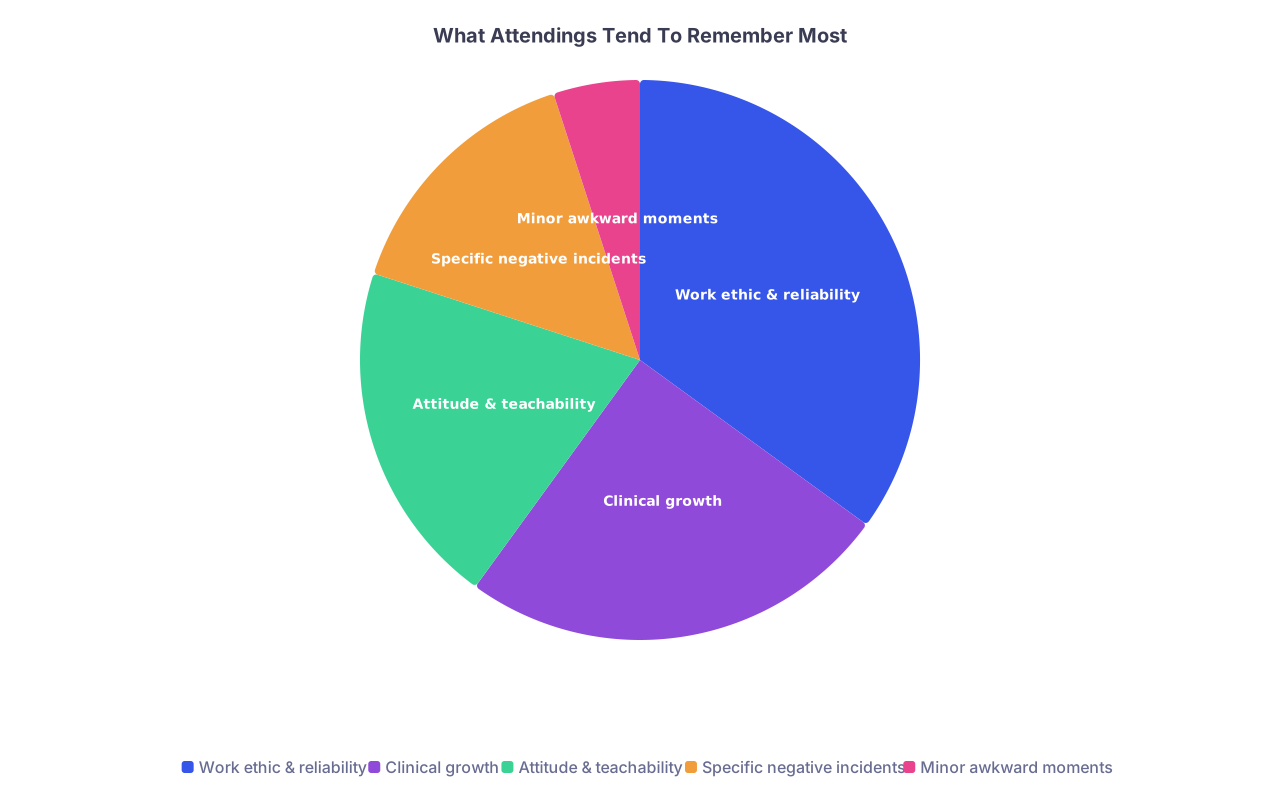
| Category | Value |
|---|---|
| Work ethic & reliability | 35 |
| Clinical growth | 25 |
| Attitude & teachability | 20 |
| Specific negative incidents | 15 |
| Minor awkward moments | 5 |
That last sliver—“Minor awkward moments”—is where your joke lives. It’s tiny.
What You Should Do After the Joke (If You’re Still On The Rotation)
If this happened last week and you’re still working with the attending, you actually have more control than you think.
Here’s the play, and it’s surprisingly simple:
Over-correct in professionalism, not in weirdness.
Don’t suddenly become robotic and silent to “prove” you’re serious. Just be on time, prepared, and engaged. Show you’re not chronically inappropriate; you just had one clumsy moment.Let your work speak louder than your cringe.
Volunteer to follow up on a task. Read on your patients. Ask a thoughtful question. You’re making new data points in their brain that say: “This person is mature and conscientious.”If the joke was actually kind of bad—apologize once. Briefly.
Something like:
“Dr. X, I realized that joke I made earlier could have come across the wrong way. I’m sorry about that—wasn’t my intention.”
Then stop. No over-explaining. No 10-minute monologue. Just a quick, adult correction.
Most attendings will mentally file you as: “Student with insight who can self-correct.” That’s actually positive.
Here’s a rough “flowchart” of what usually happens in real life:

| Step | Description |
|---|---|
| Step 1 | Awkward Joke Happens |
| Step 2 | Attending moves on |
| Step 3 | Professionalism concern |
| Step 4 | LOR solid, joke irrelevant |
| Step 5 | Neutral or weak LOR |
| Step 6 | Attending cautious but forgiving |
| Step 7 | Negative LOR or no LOR |
| Step 8 | Is it offensive or harmful? |
| Step 9 | Overall performance strong? |
| Step 10 | Pattern of behavior? |
Your brain thinks every joke jumps straight from A to J. It doesn’t.
What If The Joke Already Happened Months Ago?
This is the worst flavor of anxiety: it’s done, the rotation’s over, and now you’re spiraling imagining them typing:
“Student is unprofessional, told me a terrible joke, do not rank.”
Let me be blunt because the soothing answer is actually the true one here:
If they agreed to write you a letter, they’ve already decided you’re basically ok.
People who are truly bothered by you—like, “this student is not safe or professional”—do one of two things:
- They do not agree to write you a letter
- They write a lukewarm or negative letter and usually you can feel that the rotation didn’t go well
If you ended the rotation with:
- Decent evals
- No major “we need to talk about your professionalism” meeting
- A direct yes when you asked for a letter
Then the odds that they are centering that one awkward joke in the LOR are extremely low.
I’ve seen attendings dictating letters while half-looking at prior evals, saying things like:
“Yeah, she was a good student—engaged, took feedback, nice to patients,” and that’s it. The catastrophic narrative lives exclusively in the student’s head.
If you still can’t let it go, ask yourself:
- Did I ever get pulled aside specifically about that joke?
- Did I notice their behavior toward me shift for the rest of the rotation?
- Did they seem reluctant or hesitant when I asked for a letter?
If the answer is no across the board, this is your anxiety, not reality.
Medical Culture, Humor, and Why Everything Feels So High-Stakes
Part of why this freaks you out so much is the culture you’re swimming in.
You spend all day around dark humor, gallows humor, sarcasm, and the kind of jokes that only people who work around suffering understand. But the rules about who can say what, when, and to whom are invisible and constantly shifting.
Residents can say certain things to each other. Attendings can say certain things in closed rooms. You, as the student at the bottom of the food chain, are still trying to figure out where the line is. So you’re going to cross it once in a while. It’s basically guaranteed.
And yes, medicine is still hierarchical and weird. One attending’s “lighthearted” is another attending’s “borderline disrespectful.” That mismatch is exhausting. I get why your brain is convinced that one misstep is fatal.
But attendings also know students are… students. Not fully formed professionals with perfect social calibration. The reasonable ones (and most are reasonable, even if grumpy) expect a bit of awkwardness.
On the “future of medicine” front, there actually is a slow cultural shift happening. More emphasis on psychological safety, more acknowledgement that shame-based teaching is garbage, more awareness that people make mistakes—including social ones—and don’t need to be crushed for them.
You’re living in the messy in-between: still in an old-school structure, but in a generation that’s way more tuned into nuance, boundaries, and context. That clash makes any misstep feel like a career-ending event.
A Quick Reality Check: What Actually Tanks Letters
If you want to be appropriately worried about something, worry about the things that consistently show up in weak or negative letters. It’s almost never “told one awkward joke.”
It’s things like:
- Chronic lateness
- Not following up on tasks or labs
- Being dismissive or impatient with patients or nurses
- Blaming others when caught in a mistake
- Showing no growth over the rotation
- An actual professionalism or conduct incident
To hammer this home, look at this:
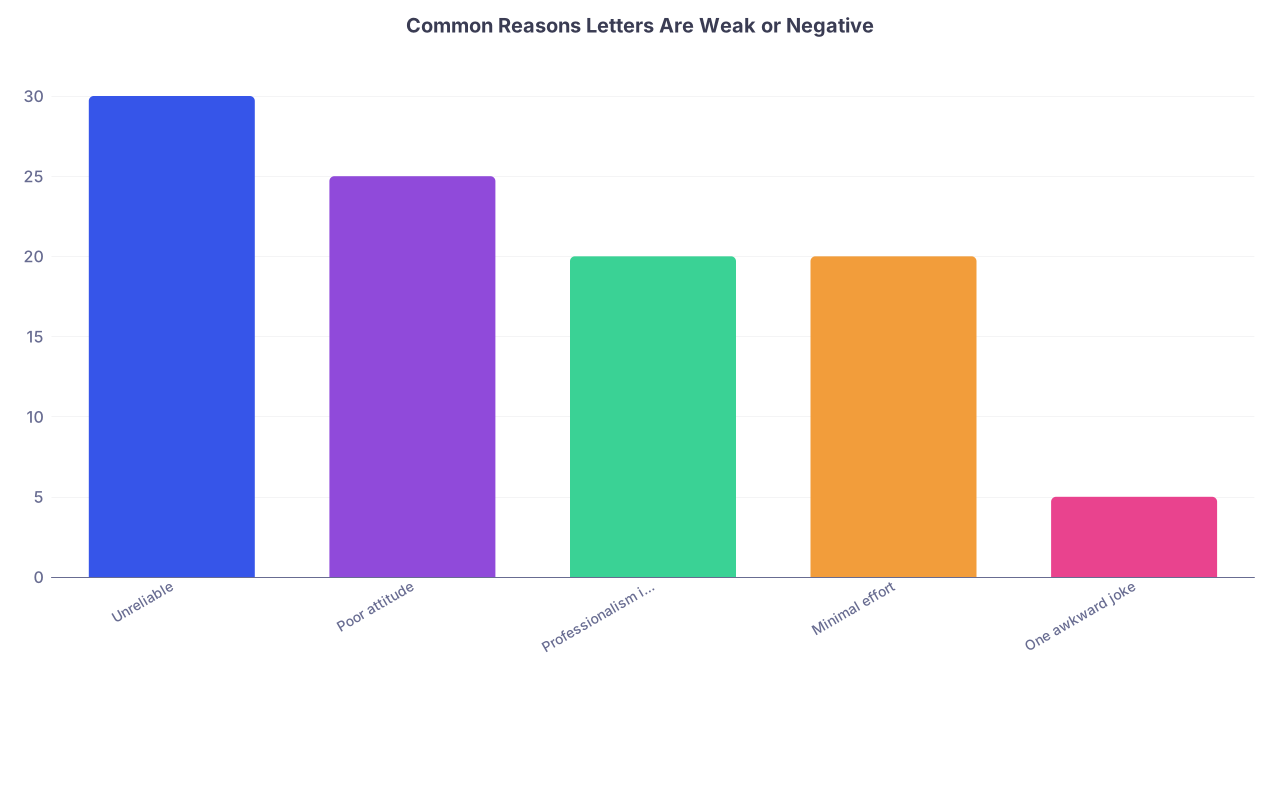
| Category | Value |
|---|---|
| Unreliable | 30 |
| Poor attitude | 25 |
| Professionalism issues | 20 |
| Minimal effort | 20 |
| One awkward joke | 5 |
Your brain is catastrophizing about the 5% category and ignoring the rest.
If that’s not you—if you showed up, tried hard, were kind, and just had one weird moment—your letter is probably fine. Boringly fine. Or even… good.
How to Actually Move On (Instead of Replaying It Forever)
The hardest part isn’t understanding logically that one awkward joke won’t ruin your LOR. You probably already know that on some level. The hard part is getting your nervous system to stop acting like you committed a felony on rounds.
Try this:
Give yourself one final replay. Sit down and walk through the scene in your head intentionally. What you said. How they reacted. What happened after. Then ask:
- Did anyone correct me in the moment?
- Did the tone of the day change?
- Did they treat me differently the rest of the week?
- Did any eval or feedback mention “professionalism concerns”?
If the answer is no, label the scene accurately: “Mild social miscalibration, low external impact, high internal shame.”
Then decide: “I’m allowed to feel embarrassed, but I’m not going to keep treating this like a career-ending event.”
And then focus on the actual work in front of you. Next rotation. Next patient. Next interaction. That’s where your letters are really written—in thousands of small, boring, competent moments.
FAQs
1. Could an attending secretly hate me for a joke and still agree to write a letter?
If they truly felt you were unprofessional or unsafe, the more common response is a soft “no” to the letter: “I don’t think I know you well enough,” or “I’m not the best person to write for you.” A yes usually means they think you’re at least fine, if not good. Passive-aggressively saying yes just to tank you in writing is rare and frankly a huge ethical breach.
2. Should I bring up the awkward joke when I ask for the LOR?
Usually, no. Don’t drag a minor, forgotten moment back into the spotlight. If it was genuinely problematic and you already apologized, let it go. When you ask for the letter, focus on: “I really enjoyed working with you and learned a lot; would you feel comfortable writing me a strong letter of recommendation?” That “strong” word gives them a graceful out if they actually had concerns.
3. Can I ask to see what they wrote in the letter?
In the US, most systems assume you’ve waived your right to see letters. That’s standard and programs expect it. Technically, in some cases you could request it later through records, but doing that just to check on a joke isn’t worth the mental gymnastics. If you asked for a “strong” letter and they said yes, trust that.
4. What if another trainee laughed but the attending didn’t—does that make it worse?
No. It just means different people have different humor thresholds. Residents are usually more relaxed; attendings a bit more guarded. The mixed response doesn’t magically transform the joke into a professionalism incident. It was just a joke that didn’t fully land with everyone.
5. Could this one joke keep me from matching?
Not by itself. Matching is a massive composite of your scores, clinical performance, interview vibe, personal statement, and letters. Even a mediocre letter usually doesn’t single-handedly kill your chances; it just doesn’t help as much as a great one. One slightly awkward moment baked into an otherwise positive letter is background static, not a bomb.
6. How can I avoid this kind of panic in future rotations?
You probably can’t avoid all panic—welcome to medicine—but you can shift it. Stick to humor that’s self-deprecating, light, and never at the expense of patients, nurses, or colleagues. Read the room before joking with attendings. If you mess up, apologize once and then double down on being reliable and kind. And when your brain starts the “I ruined my life” spiral, remind yourself: letters are written about patterns, not one-liners.
Key points: One awkward, non-malicious joke almost never ruins a letter of recommendation. Attendings write about your overall professionalism and work, not your most cringe moment. If they agreed to write you a strong letter and there were no professionalism interventions, your anxiety is almost certainly louder than reality.