
The most painful part of bedside presentations is not being wrong. It is the ten seconds of dead air after you stop talking and nobody knows what to do with the silence.
You can fix that. And you can turn those moments into laughs without looking unprofessional, annoying, or like you are auditioning for open-mic night.
This is a practical playbook for doing exactly that.
Step 1: Know What “Awkward Silence” Really Is
Awkward silence on rounds is not mysterious. It usually falls into a few predictable categories. Once you can label it, you can handle it.

Common silence triggers:
The “I do not know” pause
- You get asked: “Why did you choose cefepime over ceftriaxone?”
- Brain: blue screen of death.
- Team: staring.
- Patient: looking between faces like a tennis match.
The “no one wants to answer” attending question
- Attending throws out: “So what are causes of an anion gap metabolic acidosis?”
- Everyone looks at the floor, the ceiling, the monitor, their shoes.
- You could hear an EKG machine beeping three rooms away.
The “I just finished my presentation and nobody says anything” vacuum
- You nail your 1-liner, HPI, and plan.
- You stop talking.
- The attending is thinking. Nurse walks in. Patient is staring.
- Silence stretches past the comfort threshold.
The “patient just said something heavy and the team freezes”
- Patient: “I am really scared I am going to die.”
- You and the team: collectively frozen for a second too long.
If you do nothing, the silence becomes awkward. If you have rehearsed moves, the same silence can become a pressure release valve—with a quick, respectful laugh that makes everyone feel more human.
Step 2: Set Your Personal Boundaries First
You are not there to be the team clown. You are there to be competent and safe.
Humor at the bedside is only acceptable if it follows three non‑negotiables:
Never punch down
- You never joke about the patient, their symptoms, their body, their social situation, their culture, or their intelligence. Ever.
- You joke about:
- Yourself
- The shared training experience
- The absurdity of the system
- The generic weirdness of medicine (ICD‑10 codes, pager sounds, EMR quirks)
Never joke instead of empathizing
- If a patient is scared, crying, or clearly distressed, your first move is validation and presence, not jokes.
- Humor can come later, gently, with them, not at their expense.
Match the attending’s temperature
- Some attendings actively use humor; some run military rounds.
- If your attending is extremely formal, do not try to do a Netflix special during their presentation.
- You can still diffuse your own awkwardness with very light, self-directed humor that no one will object to.
You work inside those guardrails. Not outside.
Step 3: Build a “Humor Toolkit” You Can Deploy Quickly
You do not need to be naturally funny. You need a small, rehearsed set of moves that are:
- Short
- Safe
- Repeatable
- Easy to adapt
Think of it as having canned responses—except they do not sound canned because you insert them naturally.
A. Self-deprecating one‑liners for “I forgot / I do not know”
When you blank on rounds, the worst look is panic and flailing. The best look is calm honesty, with a sprinkle of self-awareness.
Here is the protocol:
- Admit the gap.
- Lighten the moment with a quick, safe line.
- Commit to the follow‑up.
Examples:
- “I am blanking on that right now—my prefrontal cortex clocked out early today. I will look it up after rounds and report back.”
- “I do not know off the top of my head. This is where my ‘med student brain’ buffer runs out. I will read about it and send a short summary.”
- “That was on page 3 of my study notes, which my brain apparently left at home. I will look this up and update the team.”
Notice the pattern:
- Start with “I do not know / I am blanking.”
- Very brief humor, aimed at your own brain, not the patient or team.
- Clear commitment: “I will read / I will follow up.”
You look honest, human, and still serious about learning.
B. “Team-inclusive” comments for the dead room
When the attending asks the team a question and nobody answers, you can soften the silence without undermining learning.
Safe options:
- “This feels like the part where one of us should volunteer as tribute.”
Then actually attempt an answer. - “We are all doing the med student calculus of ‘how wrong am I allowed to be’ right now. I can take a swing.”
Then try. - “I will start us off with the part I do know, and someone can rescue me if I crash.”
These:
- Acknowledge the social tension.
- Produce a small, shared laugh.
- Move the group toward answering, not away from it.
C. Micro‑humor for the “finished presentation” void
You finish your presentation. Nobody speaks. Attending is thinking. You can reduce your own discomfort without hijacking the moment.
Use light, optional one‑liners only if the attending has a generally relaxed style and the patient seems comfortable:
- After a long pause:
“That was the official end of my transmission.”
Then stay quiet. - Very softly, with a small smile:
“And that concludes the ‘talking very fast at 8 a.m.’ portion of my day.”
If the attending is a serious type or the case is heavy, skip the jokes here. Let the silence stand. Not every silence must be filled.
Step 4: Scripts for Specific Awkward Moments
Let us get concrete. Here are awkward bedside scenarios and exactly how you can turn them.
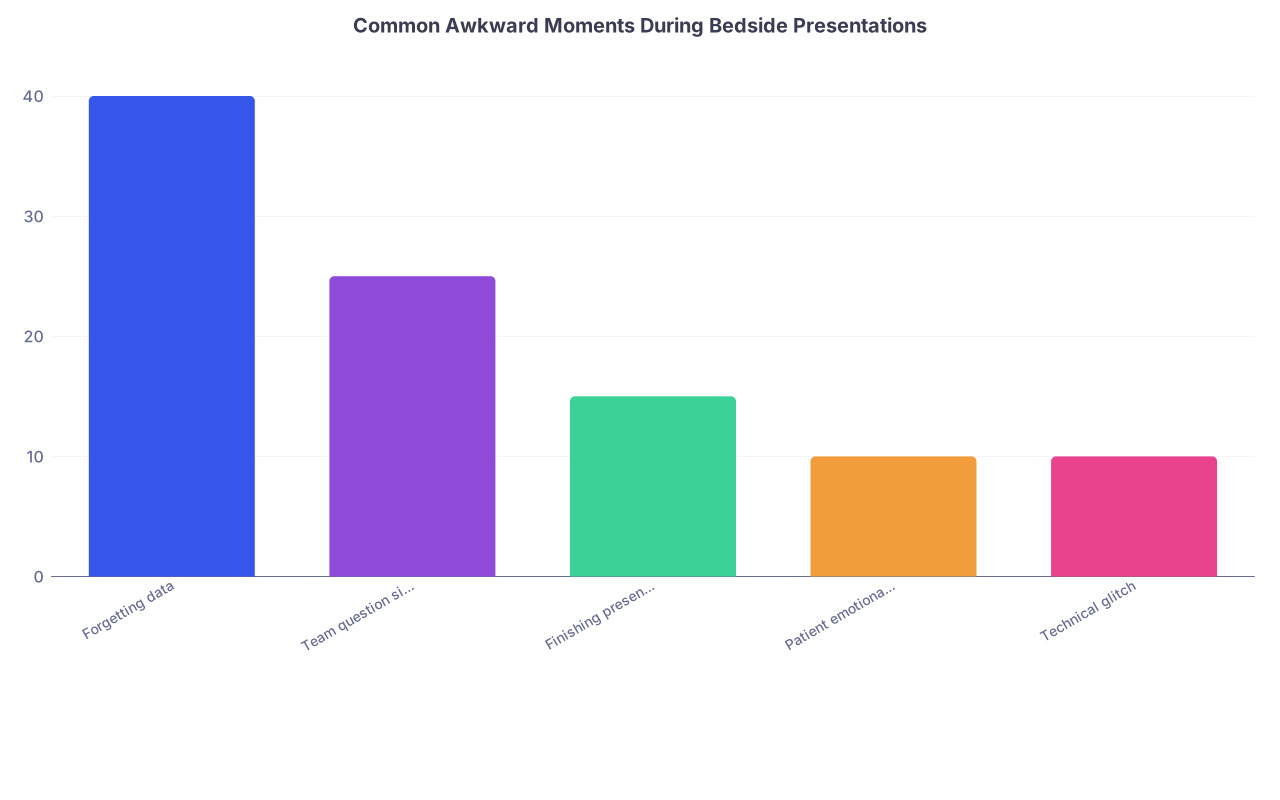
| Category | Value |
|---|---|
| Forgetting data | 40 |
| Team question silence | 25 |
| Finishing presentation | 15 |
| Patient emotional moment | 10 |
| Technical glitch | 10 |
Scenario 1: You forget a key piece of data
Attending: “What was the creatinine this morning?”
You (brain empty): 3 seconds of silence.
Instead of panicking:
- Acknowledge quickly.
- Light self-deprecation.
- Concrete plan.
Example:
- “I did not write that one down, which was a mistake. That is on me. I can check it in the chart as soon as we step out, and we can adjust the plan if needed.”
- If the attending prompts clearly that you can check now: “Let me pull it up. My note-taking skills are apparently still PGY‑0.”
You are not trying to be hilarious. You are saying: “I see the error, I own it, I am not melting down, I will fix it.” The tiny bit of humor keeps the tension from spiking.
Scenario 2: Attending asks a question directly in front of the patient, and you do not know
Attending: “Can you explain why we chose low-dose heparin over a DOAC in this patient?”
You: silence, patient watching.
You cannot pretend. The patient is right there.
Try:
- “I do not want to guess. I am not fully confident on that yet. I would like to read more about it—my current understanding is that with their kidney function and surgical status, we lean toward heparin, but I cannot give you a clean guideline citation right now.”
- Then, optional micro-humor if the vibe allows:
“This is one of those ‘I just realized I do not know what I thought I knew’ moments for me.”
The patient sees you as careful, not clueless. The team sees you as teachable, not fragile.
Scenario 3: Patient says something very heavy and the team freezes
Patient: “Doctor, I am scared I am going to die.”
The worst thing you can do here is reach for humor first. Do this instead:
- Lead with empathy.
- Pause.
- If appropriate later, use warmth, not jokes.
Script:
- “Thank you for saying that out loud. It makes sense to be scared with everything going on.”
- Pause. Let them respond. Let the attending step in if they want.
- Later, after the plan is explained and there is some relief, maybe:
“Our job is to worry about the numbers and the scans. Your job is to tell us when you are scared so we do not miss the human part. You are doing your job very well.”
That line can sometimes draw a small, relieved smile. That is the only kind of “laugh” you want in that context.
Scenario 4: Technical glitch during your presentation
You are presenting from the EMR on a computer in the room. It freezes.
The whole team watches you click uselessly. You can feel the seconds piling up.
Options:
- “Epic has decided it also needs a coffee.”
Then step away from the screen and continue with your written note or memory. - “This is the EMR version of dramatic suspense. I will switch to analog mode and use my note.”
You:
- Acknowledge the absurdity.
- Stop fighting the frozen machine in front of everyone.
- Move on.
Scenario 5: You mispronounce a medication or medical term in front of the patient
You: “We started you on cefepime—sorry, ceFEH-pime—however we want to say it today.”
Team chuckles. Patient looks slightly confused.
Clean fix:
- Smile lightly: “I promise I know what the drug does, even if I trip over the name occasionally. It is a strong antibiotic to treat your infection.”
- If the team laughs more: let it die quickly. Do not turn into a bit about pronunciations.
The laughter diffuses your embarrassment, but you immediately anchor back to patient care and clarity.
Step 5: Use Humor to Protect the Patient, Not Just Yourself
Some of the best bedside humor is not really about you. It is about making the environment less terrifying for the patient.
| Category | Safe to Joke About? | Examples |
|---|---|---|
| Yourself | Yes | Forgetfulness, med student nerves |
| Training experience | Yes | Rounding rituals, pager noises |
| Hospital systems | Yes (lightly) | EMR quirks, finding a working printer |
| General medicine | Yes | Long drug names, ICD codes |
| Patient’s illness | No | Symptoms, prognosis |
| Patient’s body | No | Weight, appearance, physical limits |
| Culture/identity | No | Religion, race, language |
Examples that help patients:
- During physical exam explanations:
“We are going to listen to your lungs again—do not worry, it is not a pop quiz, you do not have to do anything fancy. Just breathe how you normally do.” - When a patient apologizes for “taking up your time”:
“This is literally my job. If I get too efficient, they will just give me more patients, so you are doing me a favor by letting me talk with you.”
These lines often get quiet laughs and visibly relax patients. The team benefits too. The awkwardness melts.
Step 6: Calibrating to Your Attending and Team Culture
This is where people go wrong. They learn a couple of jokes and try them on the wrong attending.
You need a quick mental checklist before you deploy anything beyond very mild self-deprecation.
The 10‑second assessment
In the first 1–2 patients of rounds each day, silently gather data:
- Does the attending ever smile or laugh with patients?
- Do senior residents add light comments or keep things strictly medical?
- Are patients responding positively or shutting down?
If:
- The attending is deadpan, residents are tense, and patients look anxious → you stick to:
- Brief self-directed lines when you mess up
- No jokes about the process or the system
- The attending uses gentle humor, residents smile, patients are chatty → you have more room:
- Short comments about the absurdity of medicine
- Warm lines that include the patient in the team’s humanity
One rule: never be funnier than your attending. If they are at “smiles and one joke per room,” you stay below that. It shows respect and situational awareness.
Step 7: Practice Off‑Stage So You Do Not Fumble On‑Stage
You cannot improvise well while anxious. So you script and rehearse.

| Step | Description |
|---|---|
| Step 1 | Notice awkward moments |
| Step 2 | Write 2-3 safe lines |
| Step 3 | Practice out loud |
| Step 4 | Test with trusted peers |
| Step 5 | Use on low-stakes rounds |
| Step 6 | Refine based on reactions |
Concrete practice steps:
List your three most common panic moments on rounds.
Example:- Forgetting a lab value
- Being asked “why this drug” and not knowing
- Finishing a presentation and getting silence
For each, write 2–3 short lines that:
- Admit reality
- Add a tiny bit of self-aware humor
- Commit to a follow-up or action
Say them out loud in your room.
You will hear which ones sound natural and which sound forced.Test with classmates or co-residents on mock cases.
Ask: “Does this sound like I am trying too hard?” If yes, cut it down.Start with low stakes: hallway presentations, non-critical patients, non-intense attendings. You do not test out new material on the ICU attending who eats interns for breakfast.
Over time, you will build a small internal library of phrases that feel like you, not like you are reciting a script.
Step 8: Handling When a Joke Lands Badly
It will happen. You will say something you think is harmless and it will land flat. Or worse, someone will misinterpret it.
The fix is straightforward. Do not spiral. Do not overexplain.
If it just falls flat (no one laughs, no one looks offended):
- Let it die. Move on. Keep your face neutral.
- You learned something: that line does not work with this crowd. Retire it for this rotation.
If someone looks uncomfortable or it might have been insensitive:
- Say, calmly:
“Sorry—that was not the right time for that comment.”
Then pivot back to the medicine or patient.
If you accidentally tread into something that might hurt the patient:
- Immediately:
“I am sorry. That came out wrong. What I meant is…” and rephrase in plain, respectful language. - Then later, debrief with your senior or attending: “I think I misstepped when I said X. I am working on doing better with that.”
Owning it quickly is how you keep one misfire from becoming your whole identity on the team.
Step 9: Use Humor to Make Learning Stick
One of the underrated uses of humor on rounds is making educational points memorable.
Think of small teaching hooks you can attach to jokes that do not involve the patient at all.
Examples:
- After a long anion gap discussion in front of the patient, as you step out:
“Today’s episode of ‘Things We Blame Lactate For’ was brought to you by this morning’s labs.”
Then actually summarize the teaching point: “So from now on, in anyone this sick, I will be systematically checking for the ‘MUDPILES’ causes.” - After incorrectly guessing the cause of hyponatremia and being corrected:
“Mental note: before I blame SIADH, I should make sure the patient is not just on five diuretics and a gallon of free water.”
You are tying a minor laugh to a specific learning point. You will remember it much longer. So will your peers.
Step 10: Recognize When Silence Should Stay Silent
There is a final skill that separates the mature clinician from the eager entertainer:
Knowing when not to fix the silence.
Some silences in medicine are supposed to be uncomfortable. They are part of taking care of humans:
- After a new cancer diagnosis is explained.
- When a patient is deciding about surgery.
- When a family asks, “What does this mean for her life?”
If you feel an urge to “lighten” those moments, resist it. Let the silence work. Let people think. Let emotions surface.
Your “bedside humor” toolkit is for:
- Your own mistakes and nerves.
- Group tension over benign things.
- Technical and social weirdness.
- Mild patient anxiety where warmth helps.
It is not for shielding yourself from the humanity of hard moments. If you use it as armor, you will come off detached or flippant. Patients notice. So do attendings.
The Short Version
- Awkward silences on rounds are predictable. Plan specific, short, self-aware lines for your common panic moments instead of winging it.
- Aim humor at yourself and the shared training experience, never at the patient or their illness, and always let empathy win when things are heavy.
- Calibrate to your attending and the room, practice off-stage, and know when to leave the silence alone. The goal is not to be funny; the goal is to keep everyone—especially the patient—feeling human.